
The peptide field guide
Exenatide
The retained exenatide record distinguishes immediate-release and extended-release product formulations.
A shared ingredient does not establish the same product, clinical outcome or current supply.
Explore this compoundConceptual editorial illustration; not a measured molecular structure, product photograph or treatment result.
02 / At a glance
At a glance
Key facts
- Also known as
- Byetta, Bydureon, Exendin-4, AC2993
- Type
- Weight Management
- Evidence level
- FDA-approved for type 2 diabetes: now listed as discontinued.
- US regulatory status
- FDA-approved as Byetta® (2005) and Bydureon® (2012) for type 2 diabetes; every US exenatide product is now listed as discontinued
- Updated
Identity
The retained exenatide record distinguishes immediate-release and extended-release product formulations.
Research context
Catalogue formulation comparison only; no trial outcome or measured release profile is shown.
Evidence limits
A shared ingredient does not establish the same product, clinical outcome or current supply.
Read the technical profile and study-use reference
Quick answer
Evidence: StrongFirst-in-class GLP-1 RA (Byetta BID / Bydureon weekly). Synthetic exendin-4 from Heloderma. Modest weight loss. A freeze-dried powder is not Bydureon microspheres.
- FDA label dose
- FDA label (Byetta): dose and schedule set by the prescriber and the label
Research summary, not medical advice.
At a glance
Kymata peptide profile · Nov 6, 2026- Common vials
- 0.25 mg / 2 mg
- Molecular weight
- 4186.6 g/mol
- CAS
- 141732-76-5
- FDA label dose
- FDA label (Byetta): dose and schedule set by the prescriber and the label
- Half-life
- ~2.4 hours (IR); ~2 weeks release (ER)
03 / Identity and origin
Identity and origin
Also called Byetta, Bydureon, Exendin-4, AC2993. GLP-1 receptor agonist: immediate-release and extended-release formulations.
Read the sequence and compound record
Compound card
- Sequence
- Exendin-4, 39-aa (53% homology to human GLP-1)
- Class
- GLP-1 receptor agonist: immediate-release and extended-release formulations
- Formula
- C184H282N50O60S
- Molecular weight
- 4186.6 g/mol
- CAS
- 141732-76-5
- Described by
- Alkermes / AstraZeneca (exendin-4 discovery: John Eng, 1992), 2005
- Bioavailability
- ~100% (SC)
04 / How it may work
How it may work
GLP-1 receptor agonist: immediate-release and extended-release formulations
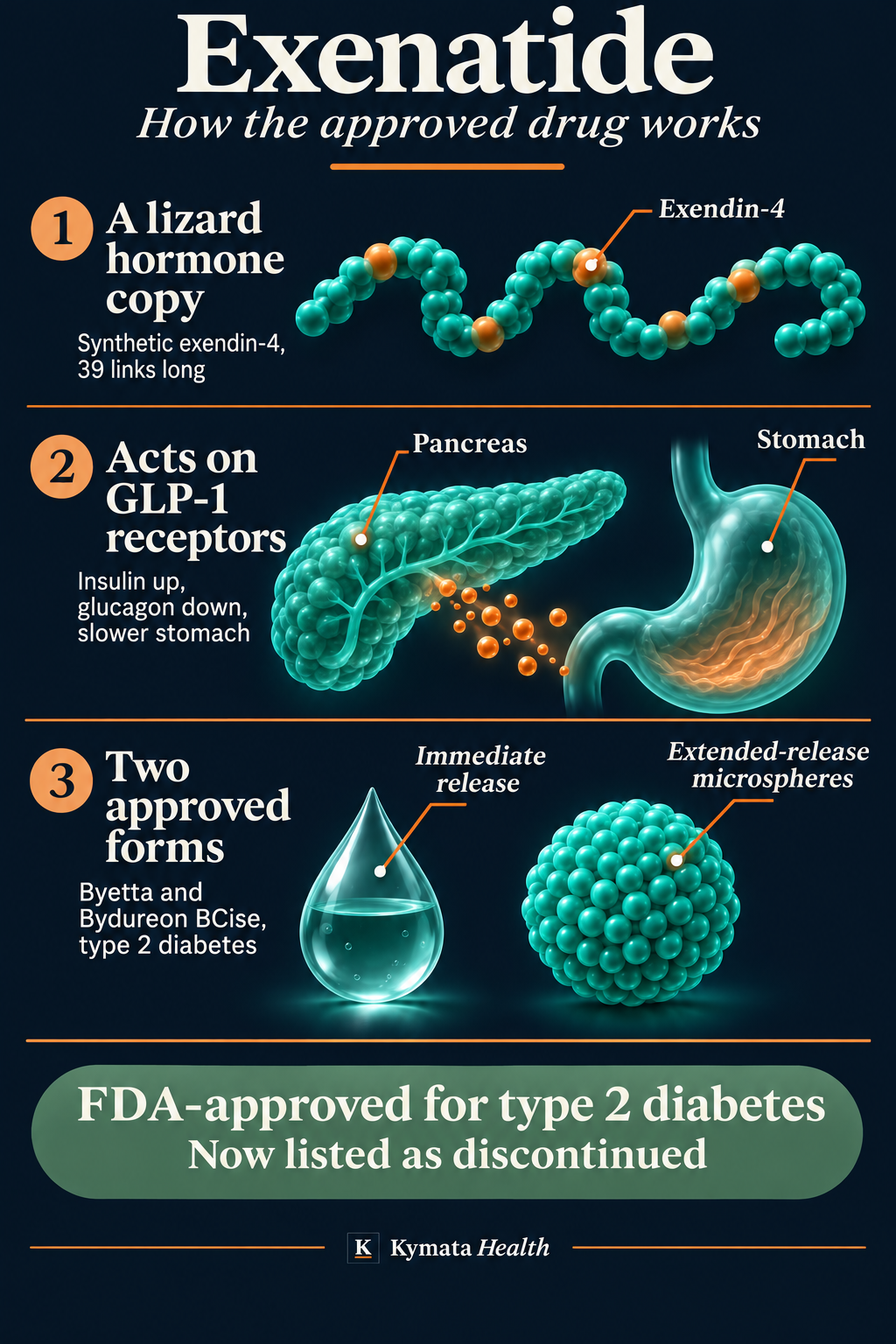
The guide shows exenatide as synthetic exendin-4, a 39-amino-acid copy of a hormone first found in Gila monster venom, which activates GLP-1 receptors. The labels describe glucose-dependent insulin release, lower glucagon and slower stomach emptying. It was approved as Byetta, an immediate-release solution, and Bydureon BCise, an extended-release microsphere form, both for type 2 diabetes; their warnings differ, and every US exenatide product is now listed as discontinued. The drawing is a schematic, not a measured molecular structure, a product photograph or a treatment result. Illustration review: 22 November 2026, against this page’s own mechanism, evidence and regulatory records.
No complete letter-by-letter sequence is supplied in the retained fields reviewed for this illustration; no sequence model is shown.
Illustration notes and source record
Read the source record on this page. Laboratory, topical and injected studies are separate evidence; this illustration does not establish an indication or a treatment outcome.

How it works
SourcedExenatide is a synthetic exendin-4 analog that activates GLP-1 receptors. Byetta is an immediate-release solution; Bydureon BCise contains exenatide in extended-release microspheres. Their labels describe glucose-dependent insulin secretion, reduced glucagon secretion and slowed gastric emptying. Formulation-specific contraindications matter; a blanket MTC/MEN2 class statement misrepresents the Byetta label. Separate trials and different weight-outcome units do not establish a head-to-head weight-loss comparison with semaglutide.
Source: AC2993 Phase 3
05 / Evidence and limits
Evidence and limits
Use-case scores
0–100–10 against the evidence we have, not a gym ranking. Hidden domains do not apply here.
- Metabolic / weight7.5/10Approval evidence concerns labeled type 2 diabetes products. The score does not establish research-powder equivalence or a head-to-head weight-loss ranking.
Limits of current evidence
3 limits- Byetta prescribing information (revised September 2025), section 4: severe hypersensitivity to exenatide or excipients, and exenatide-induced immune-mediated thrombocytopenia.
- Bydureon BCise prescribing information (revised May 2025), sections 4 and 5.1: those restrictions plus a personal or family history of medullary thyroid carcinoma (MTC), or multiple endocrine neoplasia syndrome type 2 (MEN2) in the patient. Its boxed warning concerns thyroid C-cell tumors in rats; human relevance is unknown.
- A published label does not establish current stock or availability. Immediate-release pens, extended-release microspheres and research powders are not interchangeable products.
Trial FinderRecruiting now: 6 open registrations for exenatide
What it is studied for
- Type 2 Diabetes: High
- Weight Management: Moderate
Verdict
Byetta is immediate-release exenatide; Bydureon BCise is an extended-release microsphere formulation. Their contraindications are not identical: the MTC/MEN2 restriction appears in the BCise label, not the Byetta label. Neither label describes a research-chemical powder.
06 / Product forms and access
Product forms and access
Regulatory & legal status
- FDA status (US)
- ApprovedFDA-approved as Byetta® (2005) and Bydureon® (2012) for type 2 diabetes; every US exenatide product is now listed as discontinued
- WADA status (2026)
- Not ListedNot currently on the WADA 2026 Prohibited List. Policies may change. Verify before competition.
- Classification
- Prescription Drug
07 / Tools and practical checks
Tools and practical checks
Dose it
2 mg + 0.65 mL BAC water → 3.08 mg/mL · 1 unit (U-100) = 30.8 mcg.
Reconstitution math
U-100 syringe| Vial | Water | Concentration |
|---|---|---|
| Approved product formulations | Not selected by this page | Product-specific label |
08 / Published study use
Published study use
What the label states, for the patients it is approved for, and the source. Not a dose for you.
What the FDA label says
FDA label- Byetta (type 2 diabetes): 5 mcg under the skin twice a day, within 60 minutes before the morning and evening meals; 10 mcg twice a day after 1 month based on response. Byetta label, DailyMed (opens in new tab)
The label’s dosing, for the patients it is approved for; the prescriber sets the dose.
Administration
- Route / form
- Labeled formulations are subcutaneous products; administration instructions belong to the product label and prescriber.
Timeline
1 stage- Formulation-specific evidence
Immediate-release and extended-release products have separate clinical-study sections. A shared molecule does not make their release profiles or warnings identical.
Who it is for
2 uses| Category | Fit | What exists |
|---|---|---|
| Type 2 Diabetes | High | Labeled products have type 2 diabetes indications; formulation-specific contraindications and warnings still apply. |
| Weight Management | Moderate | Separate studies and different weight-outcome units do not establish a head-to-head comparison; the labels reviewed here describe type 2 diabetes indications. |
09 / Safety and interactions
Safety and interactions
What the record says
Byetta and Bydureon BCise have distinct labels. Both list serious hypersensitivity and exenatide-induced immune-mediated thrombocytopenia as contraindications; BCise additionally lists a personal or family history of MTC, or MEN2 in the patient; it also carries a boxed thyroid C-cell tumor warning (Byetta label, September 2025; BCise label, May 2025). Both labels also warn about pancreatitis and other risks. Absence of the thyroid contraindication in Byetta is not evidence of individual safety. Product selection and risk assessment require a prescriber.
10 / Comparisons and goal guides
Comparisons and goal guides
There is no separate comparison record on this page. Similar names do not establish that products or their evidence are interchangeable.
11 / Common questions
Common questions
Common questions
3 answersDo Byetta and Bydureon BCise have the same MTC/MEN2 contraindication?
No. The Byetta label revised September 2025 lists severe hypersensitivity and exenatide-induced immune-mediated thrombocytopenia. The BCise label revised May 2025 additionally lists a personal or family history of MTC, or MEN2 in the patient; it also carries a boxed thyroid warning. This distinction is not a personal safety clearance.
What is the difference between Byetta and Bydureon BCise?
Byetta is an immediate-release solution; Bydureon BCise is an extended-release microsphere suspension. A research powder is not an equivalent product, and the existence of prescribing information does not confirm current stock.
Is Exenatide FDA-approved?
Yes. FDA-approved as Byetta® (2005) and Bydureon® (2012) for type 2 diabetes; every US exenatide product is now listed as discontinued.
12 / Sources and references
Sources and references
2 sources cited on this page.
Sources
2 sources- 1“Bydureon BCise (exenatide extended release): prescribing information, revised May 2025.”AstraZeneca DailyMed (2025). Prescribing information
- 2“Byetta (exenatide) injection: prescribing information.”AstraZeneca DailyMed (2025). Prescribing information
14 / Prescription options
Prescription options
Prescription options: compare licensed telehealth providers
Some peptide therapies are available only by prescription after a consult with a licensed clinician.
Compare telehealth →15 / Peptide library
Peptide library
Keep reading: Peptide research library
Peptide research library: every pagePeptide libraryBrowse all topics
- DulaglutidePrevious in this topic · Once-weekly GLP-1 receptor agonist fused to an IgG4 Fc fragment (Trulicity), approved for glycemic control in type 2 diabetes in adults and children 10 and older and to reduce…
- LixisenatideNext in this topic · Once-daily short-acting GLP-1 RA (Adlyxin / Lyxumia); stand-alone Adlyxin was withdrawn from US sale in 2023, and in the US it is sold with insulin glargine as Soliqua.
- MazdutideMazdutide (IBI362) is Innovent’s GLP-1/glucagon dual agonist, approved in China for obesity and type 2 diabetes but not by the FDA.
- Peptides by goalEvidence and US status for the compounds named for each goal and combination.
- OrforglipronLilly oral small-molecule GLP-1 receptor agonist (LY3502970), FDA-approved as Foundayo tablets in April 2026 for weight reduction and long-term maintenance in adults with…
Regulatory and sport classification
- FDA-approved