
The peptide field guide
Adipotide
An experimental two-part peptidomimetic that homes in on the blood vessels feeding white fat.
Monkey study only. No human study. Not FDA-approved.
Explore this compoundConceptual editorial illustration; not a measured molecular structure, product photograph or treatment result.
02 / At a glance
At a glance
Key facts
- Also known as
- Prohibitin-TP01, Prohibitin targeting peptide 1, CKGGRAKDC-GG-D(KLAKLAK)2, Prohibitin-targeting peptide
- Sequence
- CKGGRAKDC-GG-D(KLAKLAK)₂
- Evidence level
- Cell and animal research: human benefit remains unproven.
- US regulatory status
- Not FDA-approved
- Updated
Identity
An experimental two-part peptidomimetic that homes in on the blood vessels feeding white fat.
Research context
Its homing part (CKGGRAKDC) binds prohibitin on vessels supplying white fat and its D(KLAKLAK)2 part disrupts mitochondrial membranes; in obese rhesus monkeys it caused weight loss and better insulin sensitivity, with changes in kidney tubule function (Barnhart 2011).
Evidence limits
Monkey study only. No human study. Not FDA-approved.
Read the technical profile and study-use reference
Quick answer
Evidence: LowAdipotide reduced body weight in obese rhesus monkeys and caused kidney injury in primate studies. A phase 1 trial in men with metastatic prostate cancer and obesity enrolled four and stopped. The trial registry reports no human weight-loss or safety results.
- In published studies
- No human dose established by the terminated phase 1 trial
Research summary, not medical advice.
At a glance
Kymata peptide profile · Nov 22, 2026- In published studies
- No human dose established by the terminated phase 1 trial
- Half-life
- No human half-life established
- Common vials
- Research vial; no sourced vial preset in this calculator
03 / Identity and origin
Identity and origin
Also called Prohibitin-TP01, Prohibitin targeting peptide 1, CKGGRAKDC-GG-D(KLAKLAK)2, Prohibitin-targeting peptide. Investigational peptidomimetic targeting blood vessels in white fat.
Read the sequence and compound record
Compound card
- Sequence
- CKGGRAKDC-GG-D(KLAKLAK)₂
- Class
- Investigational peptidomimetic targeting blood vessels in white fat
- Described by
- Kolonin and colleagues, 2004
- Bioavailability
- Human bioavailability was not reported in the trial registry.
04 / How it may work
How it may work
Investigational peptidomimetic targeting blood vessels in white fat
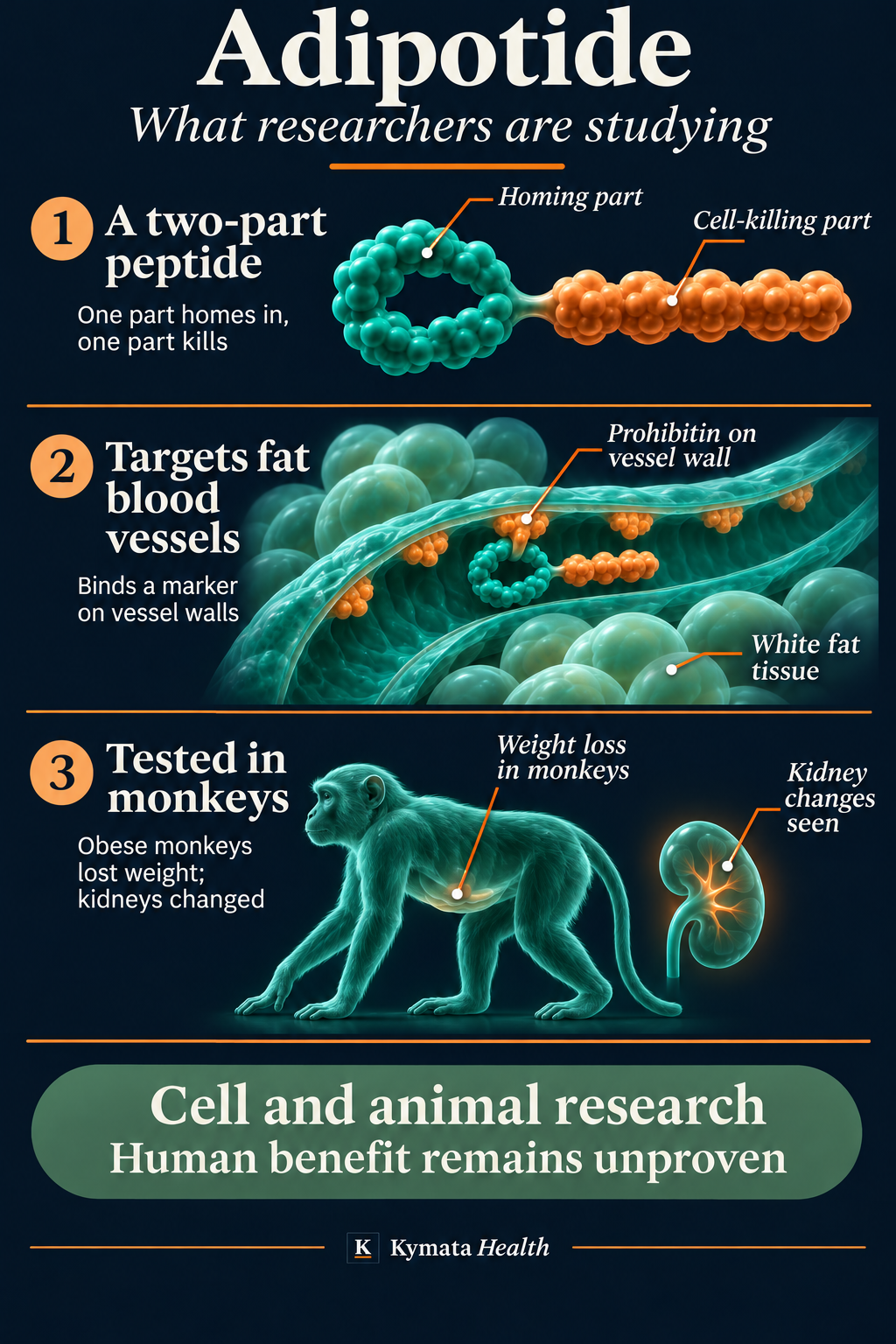
An experimental two-part peptidomimetic that homes in on the blood vessels feeding white fat. Its homing part (CKGGRAKDC) binds prohibitin on vessels supplying white fat and its D(KLAKLAK)2 part disrupts mitochondrial membranes; in obese rhesus monkeys it caused weight loss and better insulin sensitivity, with changes in kidney tubule function (Barnhart 2011). Monkey study only. No human study. Not FDA-approved. The drawing is a schematic, not a measured molecular structure, a product photograph or a treatment result. Illustration review: 19 November 2026, against this page’s own mechanism, evidence and regulatory records.
A sequence model is not provided for this record. Read the identity and evidence notes; an illustration does not verify a molecular structure.
Illustration notes and source record
Read the source record on this page. Laboratory, topical and injected studies are separate evidence; this illustration does not establish an indication or a treatment outcome.

How it works
SourcedAdipotide links two peptides with a pair of glycine residues. In the original mouse experiment, the first sequence, CKGGRAKDC, bound to a protein called prohibitin on blood vessels in white fat. The second sequence was designed to trigger cell death. A later monkey study measured weight and fat mass. The treated animals also ate fewer chow biscuits, which limits what their weight change alone can tell us about the mechanism.
Source: PMID: 15133506, PMID: 22072637, ClinicalTrials.gov: NCT01262664
Background & History
Kolonin and colleagues tested targeted destruction of white-fat blood vessels in mice. Barnhart and colleagues then examined weight change, eating behavior and kidney effects in primates.
05 / Evidence and limits
Evidence and limits
Barnhart and colleagues reported primate experiments. The separate open-label phase 1 trial in men with metastatic prostate cancer and obesity enrolled four.
Human evidence
Barnhart and colleagues reported primate experiments. The separate open-label phase 1 trial in men with metastatic prostate cancer and obesity enrolled four.- In the four-week experiment, 10 obese rhesus monkeys received adipotide and five received saline. The treated animals lost 7.4% to 14.7% of starting weight. Changes in controls ranged from a 3.5% loss to a 1.0% gain.
- Figure 6 shows that creatinine, a blood marker of kidney function, rose during treatment and declined during recovery. In a separate safety study in lean rhesus monkeys, some still had small areas of kidney tubule damage after recovery (figure 7).
- ClinicalTrials.gov lists Prohibitin-TP01 (NCT01262664) as terminated at the investigator’s request. Arrowhead reported that the first patient received the drug. The registry has no posted results for weight change, kidney effects or a maximum tolerated dose.
Limits of current evidence
2 limits- The monkey study measured each animal’s weight against its own baseline and included a separate saline group.
- Human enrollment and the trial’s planned endpoints do not establish the size of a weight change, the frequency of kidney injury or a safe human dose.
What it is studied for
- Body weight and fat mass in obese rhesus monkeys
- Kidney function during exposure and kidney tissue after recovery in primate studies
- A phase 1 study of tolerability and biological activity in men with metastatic prostate cancer and obesity
Verdict
Ten obese rhesus monkeys given adipotide lost 7.4% to 14.7% of their starting weight over four weeks. Kidney changes occurred in primate experiments. The human trial stopped after four men enrolled and posted no outcomes.
06 / Product forms and access
Product forms and access
Regulatory & legal status
- FDA status (US)
- InvestigationalThe phase 1 study of Prohibitin-TP01 was terminated. No FDA-approved adipotide product was identified.
- WADA status (2026)
- Not ListedThe 2026 WADA List does not name adipotide. Section S0 covers pharmacological substances without approval for human therapeutic use from any regulator when another section does not cover them. Verify before competition.
- US compounding
- Not eligible / not available
07 / Tools and practical checks
Tools and practical checks
No separate record is provided here. Read the linked evidence and limitations for this compound.
08 / Published study use
Published study use
What published studies gave, in whom, and the source. Not a dose for you.
What studies used
Primate experiments and a terminated human trial- A randomized study in 15 obese rhesus monkeys compared four weeks of adipotide with saline. The paper reports weight loss in the treated animals and kidney effects across its primate experiments. Barnhart et al., primate study, PMID 22072637 (opens in new tab)
- The phase 1 Prohibitin-TP01 trial (ClinicalTrials.gov NCT01262664) enrolled four men and was terminated at the investigator’s request. The registry gives the planned regimen but has no posted results for tolerability, weight change or a maximum tolerated dose.
A record of what researchers gave, in whom; not a dose for you.
Administration
- Route / form
- The phase 1 protocol specified subcutaneous administration. The registry does not report how many participants completed treatment.
09 / Safety and interactions
Safety and interactions
What the record says
The primate study found kidney tubule injury related to exposure. Several measurements improved after treatment stopped, although small areas of damage remained in some animals. The human registry gives no kidney outcomes or adverse-event counts. It does not give a toxicity reason for stopping the trial.
Interactions & Contraindications
The phase 1 trial registry reports no human drug-interaction outcomes.
10 / Comparisons and goal guides
Comparisons and goal guides
There is no separate comparison record on this page. Similar names do not establish that products or their evidence are interchangeable.
11 / Common questions
Common questions
Common questions
5 answersHas adipotide (Prohibitin-TP01) been tested in humans?
Yes. A phase 1 trial of Prohibitin-TP01 enrolled four men with metastatic prostate cancer and obesity. Arrowhead reported dosing the first participant in 2012. The trial was terminated at the investigator’s request, and ClinicalTrials.gov has no posted results.
Did people in the trial lose 10% of their weight?
The registry defines a 10% reduction in body weight or BMI as a planned measure of biological activity. It gives no participant weight changes. That figure cannot be reported as a human result.
How much weight did the monkeys lose?
Over four weeks, the 10 treated obese rhesus monkeys lost 7.4% to 14.7% of their starting weight. The five controls ranged from a 3.5% loss to a 1.0% gain. Those are individual changes in monkeys.
What is known about kidney injury and a human dose?
The researchers observed dose-related injury to kidney tubules in primates. Some changes persisted after recovery. The human trial registry lists a proposed regimen but reports no outcome establishing human tolerability, a safe dose or a plasma half-life.
Is Adipotide FDA-approved?
No. The phase 1 study of Prohibitin-TP01 was terminated. No FDA-approved adipotide product was identified.
12 / Sources and references
Sources and references
6 papers cited on this page.
Sources
6 papers- 1“A peptidomimetic targeting white fat causes weight loss and improved insulin resistance in obese monkeys.”Barnhart KF et al. Science Translational Medicine (2011). PMID: 22072637 DOI: 10.1126/scitranslmed.3002621
- 2“Reversal of obesity by targeted ablation of adipose tissue.”Kolonin MG et al. Nature Medicine (2004). PMID: 15133506 DOI: 10.1038/nm1048
- 3“Barnhart 2011, full text with figures 2, 6 and 7 (PMC3666164).”Barnhart KF et al. PubMed Central (2011).
- 4“NCT01262664: phase 1 Prohibitin-TP01 in men with metastatic prostate cancer and obesity (4 enrolled, terminated, no results posted).”MD Anderson Cancer Center ClinicalTrials.gov (2010).
- 5“Arrowhead announces dosing of first patient in anti-obesity trial (July 11, 2012; Adipotide formerly Prohibitin-TP01).”Arrowhead Pharmaceuticals Company press release (2012).
- 6“World Anti-Doping Code: 2026 Prohibited List (adipotide is not named; section S0 covers non-approved substances).”World Anti-Doping Agency WADA (2026).
14 / Prescription options
Prescription options
Prescription options: compare licensed telehealth providers
Some peptide therapies are available only by prescription after a consult with a licensed clinician.
Compare telehealth →15 / Peptide library
Peptide library
Keep reading: Peptide research library
Peptide research library: every pagePeptide libraryBrowse all topics
- EpithalaminPrevious in this topic · Epithalamin is a polypeptide extract of animal pineal glands from the Khavinson group, the natural predecessor of synthetic Epitalon; Russian studies, including long-term…
- DulaglutideNext in this topic · Once-weekly GLP-1 receptor agonist fused to an IgG4 Fc fragment (Trulicity), approved for glycemic control in type 2 diabetes in adults and children 10 and older and to reduce…
- ExenatideFirst-in-class GLP-1 RA (Byetta BID / Bydureon weekly).
- LixisenatideOnce-daily short-acting GLP-1 RA (Adlyxin / Lyxumia); stand-alone Adlyxin was withdrawn from US sale in 2023, and in the US it is sold with insulin glargine as Soliqua.
- MazdutideMazdutide (IBI362) is Innovent’s GLP-1/glucagon dual agonist, approved in China for obesity and type 2 diabetes but not by the FDA.
Regulatory and sport classification
- Not FDA-approved