
The peptide field guide
Prostamax
A synthetic four-amino-acid Khavinson prostate cytogen (Lys-Glu-Asp-Pro, KEDP); not Prostatilen, which is a prostate tissue extract.
Rat study only. Not FDA-approved.
Explore this compoundConceptual editorial illustration; not a measured molecular structure, product photograph or treatment result.
We earn a commission if you buy through some links on this page. You pay the same price. See how we make money.
02 / At a glance
At a glance
Key facts
- Also known as
- KEDP, Lys-Glu-Asp-Pro, prostate tetrapeptide, Простамакс
- Sequence
- KEDP
- Evidence level
- Cell and animal research: human benefit remains unproven.
- US regulatory status
- Not FDA-approved, research chemical
- Updated
Identity
A synthetic four-amino-acid Khavinson prostate cytogen (Lys-Glu-Asp-Pro, KEDP); not Prostatilen, which is a prostate tissue extract.
Research context
In a rat model of prostate enlargement, one prostate lobe was smaller in rats that received KEDP along with the drug used to induce enlargement (Borovskaya 2014); the inventors also describe patient case series in a patent.
Evidence limits
Rat study only. Not FDA-approved.
Read the technical profile and study-use reference
Quick answer
Evidence: LowProstamax has the reported residue sequence KEDP. The sequence identifies the order of amino acids. The package label identifies the formulation and its intended use.
- Class and target
- Cytogen (synthetic short peptide) · Prostate · sequence KEDP
- In published studies
- No established human dose for the laboratory preparation
Research summary, not medical advice.
At a glance
Kymata peptide profile · Nov 21, 2026- Documented forms
- Research vial
- Molecular weight
- 487.5 g/mol
- In published studies
- No established human dose for the laboratory preparation
- Half-life
- Not established in humans
- CAS
- 473578-47-1 (PubChem depositor synonym)
03 / Identity and origin
Identity and origin
Also called KEDP, Lys-Glu-Asp-Pro, prostate tetrapeptide, Простамакс. Khavinson cytogen (KEDP).
Read the sequence and compound record
Compound card
1 cell = 1 amino acid- Sequence
- KEDP
- Class
- Khavinson cytogen (KEDP)
- Formula
- C20H33N5O9
- Molecular weight
- 487.5 g/mol
- CAS
- 473578-47-1 (PubChem depositor synonym)
- PubChem CID
- 9848296
- Described by
- Khavinson cytogen series
04 / How it may work
How it may work
Khavinson cytogen (KEDP)
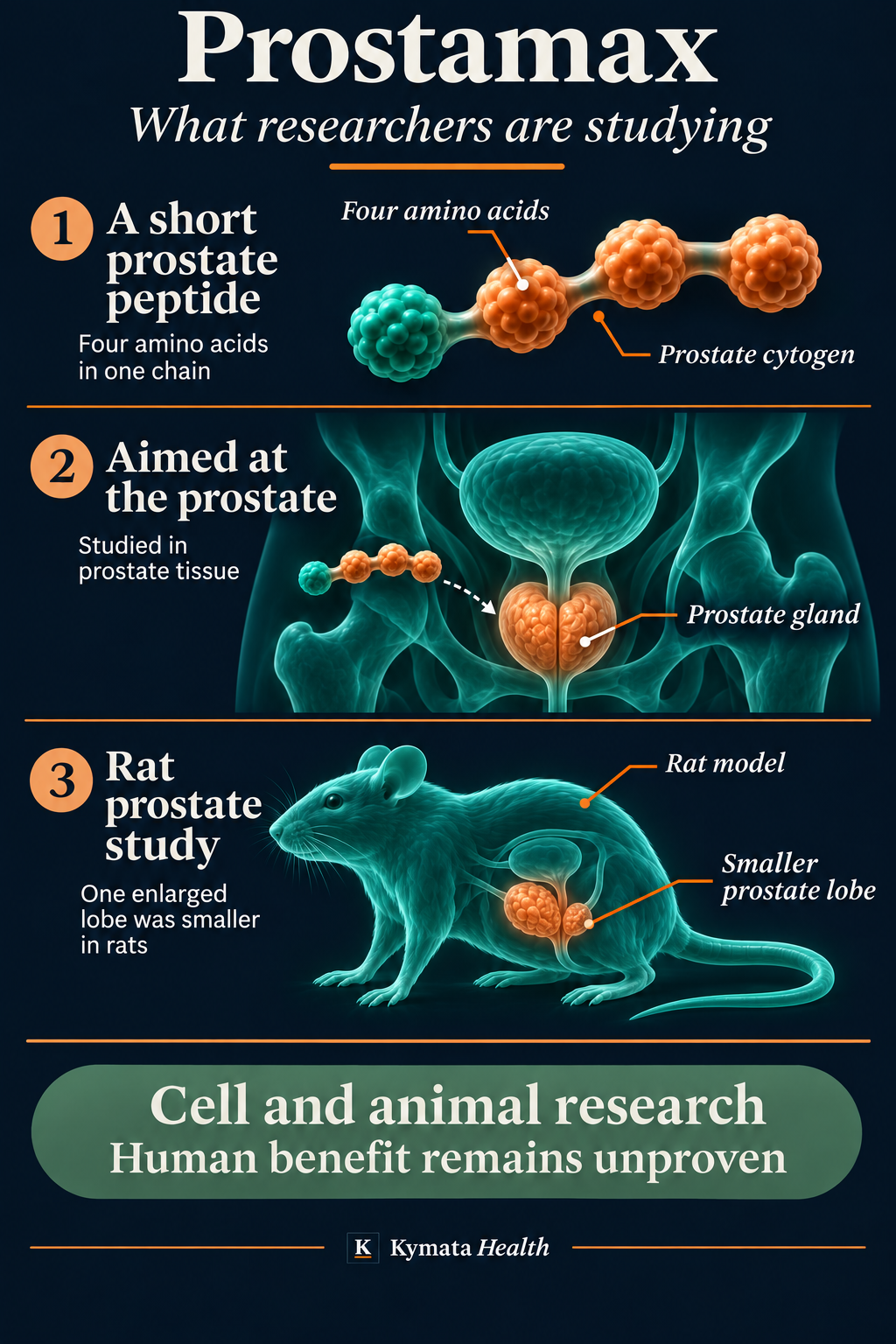
A synthetic four-amino-acid Khavinson prostate cytogen (Lys-Glu-Asp-Pro, KEDP); not Prostatilen, which is a prostate tissue extract. In a rat model of prostate enlargement, one prostate lobe was smaller in rats that received KEDP along with the drug used to induce enlargement (Borovskaya 2014); the inventors also describe patient case series in a patent. Rat study only. Not FDA-approved. The drawing is a schematic, not a measured molecular structure, a product photograph or a treatment result. Illustration review: 19 November 2026, against this page’s own mechanism, evidence and regulatory records.
A sequence model is not provided for this record. Read the identity and evidence notes; an illustration does not verify a molecular structure.
Illustration notes and source record
What did researchers measure when they tested Prostamax for prostate enlargement?
A four-amino-acid peptide. Prostamax is a synthetic peptide called KEDP. Libidon contains a mixture extracted from the prostate. A laboratory supplier lists KEDP as a freeze-dried powder for research use.
What changed in rats. Researchers gave rats a drug that causes prostate enlargement. After 60 days, one lobe of the prostate was 40% smaller by volume in rats also given KEDP than in rats given the drug alone. The study measured tissue size, leaving the effect on urinary symptoms in people unanswered.
A thin layer of cells lines the glands inside the prostate.
Earlier contextual illustration
Read the source record on this page. Laboratory, topical and injected studies are separate evidence; this illustration does not establish an indication or a treatment outcome.

How it works
Borovskaya and colleagues (2014, DOI 10.4236/mri.2014.33013) reported in 40 male Wistar rats with sulpiride-induced prostate enlargement that 60 days of intramuscular KEDP left the lateral prostate lobe 24% lighter and 40% smaller in volume than in sulpiride-only rats, while saw palmetto extract did not. Borovskaya and colleagues (2013, DOI 10.4236/mri.2013.23007) induced chronic aseptic prostatitis in male rats and compared 15 days of intramuscular Prostamax or Samprost with saw palmetto extract given by stomach tube, finding no significant differences in prostate weight or volume versus controls and describing changes only in tissue morphometry. Zakutskii and colleagues (2006, PMID 17152728) reported that synthetic Prostamax (KEDP), along with cardiogen, bronchogen and pancragen, stimulated growth of matching organ explants, including prostate explants, from 3-week-old and 18-month-old rats in organotypic culture. In cultured human lymphocytes, Dzhokhadze and colleagues (2012, PMID 23221144) and Meskhi and colleagues (2004, PMID 15612551) reported chromatin changes. Libidon and Prostatilen are separately prepared prostate tissue extracts.
Prostamax product forms
Form labels checked Nov 7, 2026Prostamax has the reported residue sequence KEDP. The sequence identifies the order of amino acids. The package label identifies the formulation and its intended use.
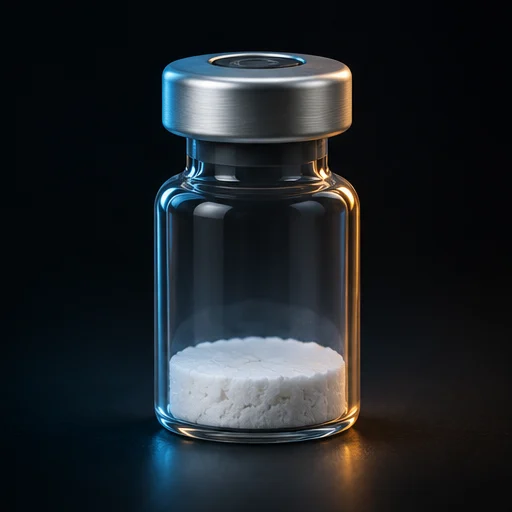
Research vial
The supplier identifies this material for laboratory research. A freeze-dried powder and a purity figure do not establish sterility or a route for human injection. Capsule instructions do not apply.
Laboratory product specificationIllustrations show the type of packaging. Check the name, contents and route on the actual pack. See product names and availability ↓
Inside the study
Researchers gave KEDP to rats with drug-induced prostate enlargement and found a lighter, smaller lateral prostate lobe than in untreated rats. The experiment did not measure urinary symptoms in people.
Borovskaya and colleagues, rat prostate study ↗05 / Evidence and limits
Evidence and limits
Patent case series · control results not reported
Human evidence
Patent case series · control results not reported- In example 6 of patent EP1353939B1, the inventors reported that intramuscular KEDP raised mean urine flow from 17.3 to 23.5 mL/s in 35 men aged 23-45 with chronic prostatitis, while the 14 men on conventional treatment were named as controls but their results were not tabulated.
- In example 7 of patent EP1353939B1, mean urine flow rose from 11.3 to 17.5 mL/s in 19 men aged 51-67 with stage I-II prostate adenoma given intramuscular KEDP, with 17 conventionally treated controls whose results were not reported.
- The 2011 institute report on oral Libidon repeats the patent’s KEDP mean urine-flow values (17.3 to 23.5 and 11.3 to 17.5 mL/s) and its symptom percentages for differently described groups (ages 38-49 and 51-65), so neither document independently confirms a benefit.
Limits of current evidence
4 limits- The patent’s control groups were named but their results were not tabulated, and no randomization or blinding is described.
- The 2011 oral Libidon report repeats the patent’s mean urine-flow values and symptom percentages for differently described groups, so neither document independently confirms a benefit.
- Rat and cell studies (prostate-lobe size, explant growth, chromatin changes) are not urinary outcomes in people, and a 2013 rat prostatitis study found no weight or volume difference.
- A laboratory product label does not establish suitability for human use.
What it is studied for
- Reference page for Prostamax. Concentration arithmetic is not a treatment protocol.
Verdict
Prostamax is the synthetic four-amino-acid peptide KEDP (Lys-Glu-Asp-Pro). A supplier lists it as a freeze-dried laboratory powder. A patent reports urine-flow changes after experimental KEDP injections; the same figures later appear in an oral Libidon report, so the human benefit is unconfirmed.
06 / Product forms and access
Product forms and access
Regulatory & legal status
- FDA status (US)
- Research OnlyKEDP tetrapeptide. Distinct from Prostatilen (bovine prostate extract). Not a US BPH drug
- WADA status (2026)
- Not ListedNot currently on the WADA 2026 Prohibited List. Policies may change. Verify before competition.
- US compounding
- Not eligible / not available
Cytogen (synthetic short peptide) · Prostate
Identity
Canonical 41- Class
- Cytogen (synthetic short peptide)
- Organ
- Prostate
- Target
- Prostate
- System
- Reproductive
- Sequence
- KEDP · Lys-Glu-Asp-Pro
In these Khavinson catalog sets
1 setManufacturer-style organ combinations, not FDA protocols. Every name links to its own page.
The Khavinson school
Prostamax is filed here as cytogen (synthetic short peptide), targeting the prostate. Khavinson's St. Petersburg group moved from organ extracts (Cytamins) to capsule complexes (Cytomaxes) to synthetic short peptides (Cytogens); most of the evidence comes from that one group, with little independent Western replication.
Read the full background, the proposed epigenetic mechanism, the literature limits, and how we count the canonical 41 on the Khavinson bioregulators index.
History of this molecule
One extra residue turns a vessel tripeptide into a prostate tetrapeptide in this naming system. That is the whole warning label. CIS urology used Prostatilen as a drug product; KEDP is the defined motif people buy as research powder.
Not tadalafil. Not finasteride. PSA still matters.
A defined sequence is not an FDA indication. Prostate cytogens sit in a Russian experimental-gerontology literature with limited Western replication. “Oral bioavailability because PEPT1” is real peptide-transport biology; it is not proof this SKU treats the organ disease. A purity chromatogram alone cannot identify a peptide sequence or establish that a preparation is sterile.
Full 41-map: Khavinson bioregulators index · Khavinson catalog sets
07 / Tools and practical checks
Tools and practical checks
No separate record is provided here. Read the linked evidence and limitations for this compound.
08 / Published study use
Published study use
What published studies gave, in whom, and the source. Not a dose for you.
What studies used
Patent case series; no established human dose- Patent EP1353939B1 (examples 6 and 7) describes intramuscular KEDP in 35 men with chronic prostatitis and 19 men with prostate adenoma, with mean urine flow rising from 17.3 to 23.5 and from 11.3 to 17.5 mL/s; control-group results were not tabulated, and a later oral Libidon report repeats the same means.
- Rats with drug-induced prostate enlargement (Borovskaya 2014, DOI 10.4236/mri.2014.33013): 60 days of intramuscular KEDP left the lateral prostate lobe 24% lighter and 40% smaller than in untreated enlarged-prostate rats.
- Rats with induced chronic prostatitis (Borovskaya 2013, DOI 10.4236/mri.2013.23007): 15 days of intramuscular Prostamax or Samprost, compared with saw palmetto extract by stomach tube, left prostate weight and volume no different from controls.
- A published study exposed human cells to the peptide in the laboratory. It does not establish a dose for people. Meskhi 2004, PMID 15612551 (opens in new tab)
- Rat prostate explants in culture grew with KEDP. No animal or person was given the peptide. Zakutskii 2006, PMID 17152728 (opens in new tab)
- The doses quoted online come from animal work and vendor or forum sources.
A record of what researchers gave, in whom; not a dose for you.
Administration
- Route / form
- Research vial. The supplier identifies this material for laboratory research. A freeze-dried powder and a purity figure do not establish sterility or a route for human injection. Capsule instructions do not apply.
- Timing
- The laboratory vial has no human administration schedule.
- Empty stomach?
- Not applicable: The vial is labeled for laboratory research.
09 / Safety and interactions
Safety and interactions
What the record says
Research tetrapeptide. Not finasteride, not tamsulosin, not a substitute for urologic care. Distinct from the bovine extract.
10 / Comparisons and goal guides
Comparisons and goal guides
Prostamax vs. Prostatilen
4 attributesCanonical comparison: Prostamax vs Prostatilen · Prostatilen evidence profile
| Attribute | Prostamax | Prostatilen |
|---|---|---|
| Molecule | KEDP tetrapeptide | Bovine prostate polypeptide extract |
| Class | Synthetic cytogen | Pharmaceutical tissue extract (not a Cytomax) |
| US status | Research SKU | Registered as a drug in Russia; not FDA-approved |
| Human data | Patent case series of injected KEDP; the same figures reappear in an oral Libidon report | Uncontrolled Russian series and a 2022 open-label comparison of two rectal versions (PMID 36318852) |
11 / Common questions
Common questions
Common questions
10 answersWhich forms of Prostamax are documented, and which instructions apply to each?
Research vial. The supplier identifies this material for laboratory research. A freeze-dried powder and a purity figure do not establish sterility or a route for human injection. Capsule instructions do not apply.
Prostamax vs Libidon vs Prostatilen?
Prostamax = KEDP cytogen. Libidon = oral prostate extract A-16. Prostatilen = pharma extract.
Vs Vesugen?
Vesugen is KED (vessels). Prostamax is KEDP (prostate). Vilon is KE. One residue makes a different molecule.
BPH drug?
Not in the US. No FDA-approved KEDP product was identified.
Sequence?
Lys-Glu-Asp-Pro (KEDP). PubChem CID 9848296 lists C20H33N5O9 and 487.5 g/mol.
Do the patent and Libidon figures confirm each other?
No. The 2011 Libidon report repeats the patent’s KEDP mean urine-flow values and symptom percentages for differently described groups, so the two documents are not independent.
Is Prostamax the same as Prostatilen?
No. Prostamax = KEDP tetrapeptide. Prostatilen = prostate tissue extract. Samprost, the comparator in a 2013 rat study, is also a prostate extract.
What human data exist for Prostamax?
Only case series in patent EP1353939B1: intramuscular KEDP in 35 men with chronic prostatitis and 19 men with prostate adenoma, with mean urine flow rising from 17.3 to 23.5 and from 11.3 to 17.5 mL/s and no tabulated control results. A 2011 oral Libidon report prints the same means, so the figures do not confirm a benefit for either product.
Is Prostamax Forte the same thing?
No. Fortex’s Prostamax Forte label lists saw palmetto fruit extract, pumpkin seed oil, nettle leaf extract, zinc and selenium and does not list KEDP.
Is Prostamax FDA-approved?
No. KEDP tetrapeptide. Distinct from Prostatilen (bovine prostate extract). Not a US BPH drug.
12 / Sources and references
Sources and references
7 papers cited on this page.
Sources
7 papers- 1“The tissue-specific effect of synthetic peptide bioregulators in organotypic tissue culture of young and old rats.”Zakutskii AN et al. Advances in Gerontology (2006). PMID: 17152728
- 2“Deheterochromatinization of the chromatin in old age induced by oligopeptide bioregulator (Lys-Glu-Asp-Pro).”Dzhokhadze TA et al. Georgian Medical News (2012). PMID: 23221144
- 3“The influence of the peptide bioregulator prostamax on heterochromatin of human lymphocytes in situ.”Meskhi T et al. Biofizika (2004). PMID: 15612551
- 4“Experimental Study of Efficiency of Tertapeptide Lysil-Glutamyl-Aspartyl-Proline Using the Model of Benign Prostatic Hyperplasia.”Borovskaya TG et al. Modern Research in Inflammation (2014). DOI: 10.4236/mri.2014.33013
- 5“Comparative study of KEDP (Prostamax), Samprost and saw palmetto extract in a rat model of chronic aseptic prostatitis.”Borovskaya TG et al. Modern Research in Inflammation (2013). DOI: 10.4236/mri.2013.23007
- 6“Tetrapeptide regulating prostate functions and its compositions and uses (examples 6-7).”Vladimir Khavinson and colleagues European patent EP1353939B1 (priority 2001) (2004).
- 7“Prostatilen treatment of prostatic adenoma (Prostatilen, not KEDP).”Al'-Shukri SKh et al. Urologiia (2006). PMID: 17315707
14 / Prescription options
Prescription options
Oral tissue-peptide capsules sold by Vita-Stream, house line first: a different product from the Prostamax studied above.
Capsule comparison
Paid links · we earn a commissionOral capsuleAffiliate links: we earn a commission if you buy, at no extra cost to you.
- Browse Prostalon (paid link, opens in new tab)
Prostalon is Vita-Stream's US-made prostate peptide capsule (Vita Peptides' own house line), a different product from Prostamax. No trial has tested it.
- Per capsule
- 15 mg active natural peptides
Label wording as Vita-Stream's product page states it, read 19 October 2026. Follow the label on the bottle you buy.
- In Khavinson’s lab work, synthetic short peptides modeled on a tissue’s peptide extract stimulated the growth of cultured rat explants of that same tissue. Khavinson 2001, PMID 11713572 (opens in new tab)
- His group proposes that such peptides act on gene expression in the cells they reach; most of that work is in cells and animals. Khavinson 2021 review, PMID 34834147 (opens in new tab)
These statements have not been evaluated by the FDA. These products are not intended to diagnose, treat, cure, or prevent any disease.
Use code KymataLabs at checkout
15 / Peptide library
Peptide library
← Back to Peptide LibraryKhavinson catalog sets
Keep reading: Peptide research library
Peptide research library: every pagePeptide libraryBrowse all topics
- N-Acetyl Epitalon AmidatePrevious in this topic · The published telomere experiments tested parent Epitalon in cultured human cells.
- AdalankNext in this topic · Adalank is a supplier name for N-acetyl Selank amidate (Ac-TKPRPGP-NH2), a modified Selank.
- PTD-DBMProtein-transduction-domain + Dishevelled-binding motif peptide that competes with CXXC5 for Dvl, intended to lift a brake on Wnt/β-catenin in hair-follicle models.
- B7-33B7-33 is a 27-amino-acid peptide modeled on one chain of human relaxin-2.
- Humanin-HNGS14G substitution on humanin (HNG): an analog with stronger activity than the mitochondrial 24-aa peptide we already list.
Regulatory and sport classification
- Not FDA-approved, research chemical