
The peptide field guide
N-Acetyl Epitalon Amidate
N-acetyl epitalon amidate (NAEA, Ac-AEDG-NH2) is the epitalon tetrapeptide with an N-acetyl cap and a C-terminal amide; it is not epithalamin, the pineal extract.
Research peptide. No published human study of this form. Not FDA-approved.
Explore this compoundConceptual editorial illustration; not a measured molecular structure, product photograph or treatment result.
02 / At a glance
At a glance
Key facts
- Also known as
- NAEA, Ac-AEDG-NH2, Ac-Epitalon-NH2, N-Acetyl Epithalon Amidate, Ac-Ala-Glu-Asp-Gly-NH2, acetylated amidated epitalon
- Sequence
- Ac-Ala-Glu-Asp-Gly-NH₂
- Evidence level
- Research peptide: little published research.
- US regulatory status
- Not FDA-approved
- Updated
Identity
N-acetyl epitalon amidate (NAEA, Ac-AEDG-NH2) is the epitalon tetrapeptide with an N-acetyl cap and a C-terminal amide; it is not epithalamin, the pineal extract.
Research context
Parent epitalon is the pineal tetrapeptide from Khavinson’s Russian research; the caps are meant to slow breakdown by exopeptidases, but no study has measured that for this analog in people.
Evidence limits
Research peptide. No published human study of this form. Not FDA-approved.
Read the technical profile and study-use reference
Quick answer
Evidence: LowThe published telomere experiments tested parent Epitalon in cultured human cells. N-Acetyl Epitalon Amidate (Ac-AEDG-NH₂) has a chemical modification at each end. We found no human study measuring its effects or half-life.
- Class and target
- Stability analog (not a Khavinson original) · Pineal (parent AEDG) · sequence Ac-AEDG-NH₂
- In published studies
- No human dose established for this modified peptide
Research summary, not medical advice.
At a glance
Kymata peptide profile · Nov 22, 2026- In published studies
- No human dose established for this modified peptide
- Half-life
- No human half-life established for Ac-AEDG-NH₂
- Common vials
- Research vial; no sourced vial preset in this calculator
- Molecular weight
- 431.40 g/mol (calculated from the sequence)
03 / Identity and origin
Identity and origin
Also called NAEA, Ac-AEDG-NH2, Ac-Epitalon-NH2, N-Acetyl Epithalon Amidate, Ac-Ala-Glu-Asp-Gly-NH2, acetylated amidated epitalon. Epitalon tetrapeptide with an N-terminal acetyl group and a C-terminal amide.
Read the sequence and compound record
Compound card
- Sequence
- Ac-Ala-Glu-Asp-Gly-NH₂
- Class
- Epitalon tetrapeptide with an N-terminal acetyl group and a C-terminal amide
- Formula
- C16H25N5O9 (calculated for the neutral peptide)
- Molecular weight
- 431.40 g/mol (calculated from the sequence)
- Bioavailability
- No human absorption study of the doubly modified form was identified.
04 / How it may work
How it may work
Epitalon tetrapeptide with an N-terminal acetyl group and a C-terminal amide
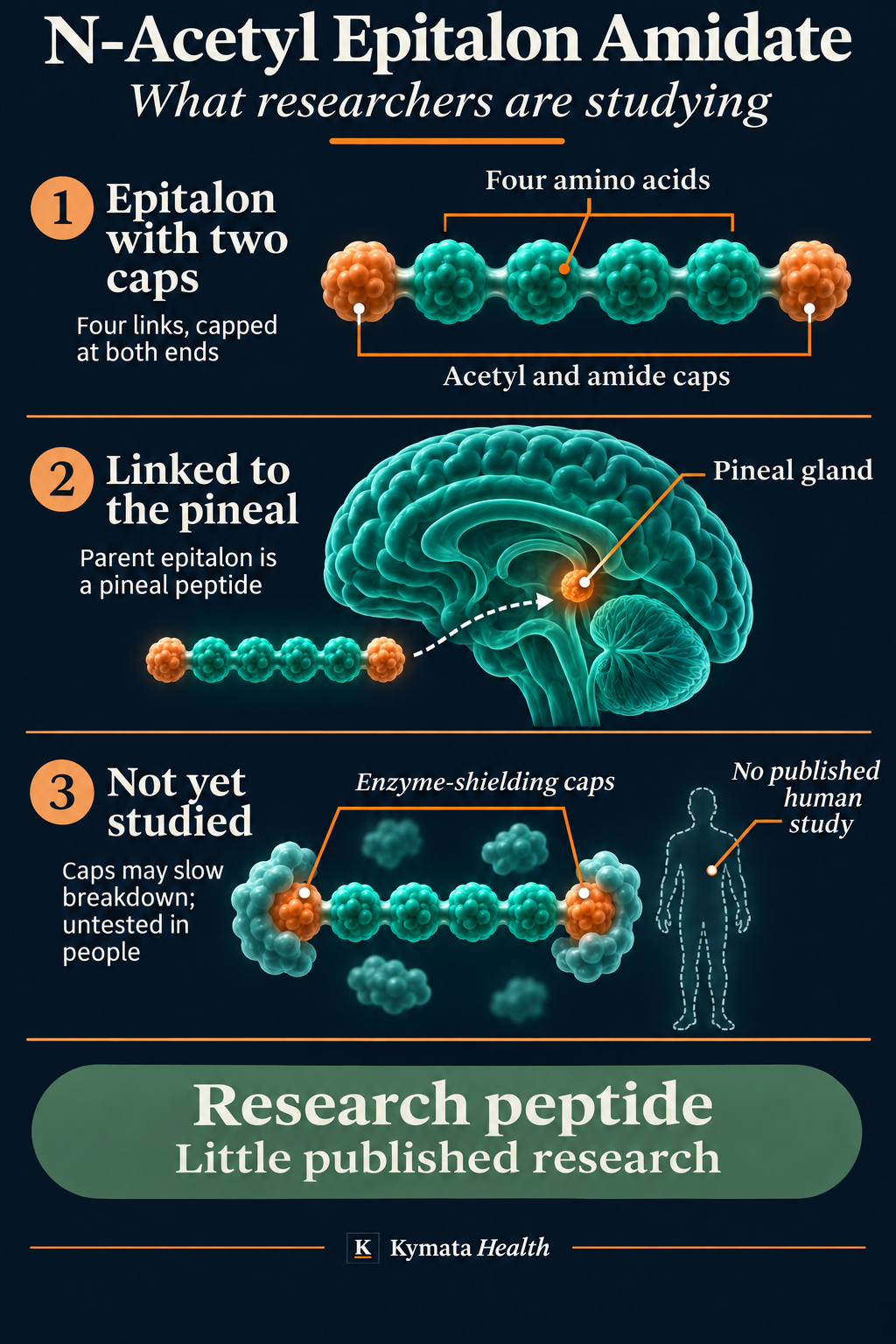
N-acetyl epitalon amidate (NAEA, Ac-AEDG-NH2) is the epitalon tetrapeptide with an N-acetyl cap and a C-terminal amide; it is not epithalamin, the pineal extract. Parent epitalon is the pineal tetrapeptide from Khavinson’s Russian research; the caps are meant to slow breakdown by exopeptidases, but no study has measured that for this analog in people. Research peptide. No published human study of this form. Not FDA-approved. The drawing is a schematic, not a measured molecular structure, a product photograph or a treatment result. Illustration review: 19 November 2026, against this page’s own mechanism, evidence and regulatory records.
A sequence model is not provided for this record. Read the identity and evidence notes; an illustration does not verify a molecular structure.
Illustration notes and source record
Read the source record on this page. Laboratory, topical and injected studies are separate evidence; this illustration does not establish an indication or a treatment outcome.

How it works
SourcedParent Epitalon has four amino acids in the order alanine, glutamic acid, aspartic acid and glycine (AEDG). The name N-Acetyl Epitalon Amidate specifies two changes. An acetyl group caps the amino end, and the carboxyl group at the glycine end becomes an amide. Those changes identify the proposed molecule. They do not establish how it acts on telomerase or how long it persists in human blood.
Source: Parent Epitalon cell studies: PMID: 12937682 and PMID: 15455129. Separate Epithalamin extract study: PMID: 22451889.
05 / Evidence and limits
Evidence and limits
The search found studies on related preparations. None of the identified human studies administered Ac-AEDG-NH₂.
Human evidence
The search found studies on related preparations. None of the identified human studies administered Ac-AEDG-NH₂.- In a 2003 experiment, researchers added parent Epitalon to human fetal fibroblasts in culture. They reported telomerase activity and longer telomeres. No person received the peptide in that experiment.
- In the follow-up cell experiment, untreated lung fibroblasts stopped dividing at passage 34. Cells exposed to the parent peptide reached passage 44 and continued dividing. These are laboratory culture measurements.
- In a separate study of older coronary patients, 39 received the pineal extract Epithalamin alongside usual care and 40 received usual care alone. The extract study cannot establish a longevity effect for the synthetic amidate.
Limits of current evidence
2 limits- Changing both ends of the peptide can change its properties. Its stability in people, absorption, potency and effects on telomeres have not been established.
- A culture passage counts cells being transferred to fresh growth conditions. It does not measure how long a person lives.
What it is studied for
- No treatment indication was established in the clinical literature for this exact form.
Verdict
A cell experiment on parent Epitalon and a human study of pineal extract answer questions about those preparations. We found no human study of the doubly modified peptide.
06 / Product forms and access
Product forms and access
Regulatory & legal status
- FDA status (US)
- Not approvedNo FDA-approved product was identified for the N-acetylated, C-amidated form.
- WADA status (2026)
- Not ListedThe 2026 WADA List does not name this modified peptide. Section S0 covers pharmacological substances without approval for human therapeutic use from any regulatory health authority when another section does not cover them. Verify before competition.
- Classification
- Research Chemical
- US compounding
- HHS identifies Epitalon acetate with an unmodified peptide chain in its October 2026 503A policy. The policy does not name Ac-AEDG-NH₂.
Stability analog (not a Khavinson original) · Pineal (parent AEDG)
Identity
Adjacent (not padded into the 41)- Class
- Stability analog (not a Khavinson original)
- Organ
- Pineal (parent AEDG)
- Target
- Pineal gland
- System
- Endocrine
- Sequence
- Ac-AEDG-NH₂
The Khavinson school
N-Acetyl Epitalon Amidate is filed here as stability analog (not a khavinson original), targeting the pineal (parent aedg). Khavinson's St. Petersburg group moved from organ extracts (Cytamins) to capsule complexes (Cytomaxes) to synthetic short peptides (Cytogens); most of the evidence comes from that one group, with little independent Western replication.
Read the full background, the proposed epigenetic mechanism, the literature limits, and how we count the canonical 41 on the Khavinson bioregulators index.
History of this molecule
Epitalon is the synthetic tetrapeptide AEDG, originally studied alongside a research program on pineal extracts. Adding an acetyl group at one end and an amide at the other produces a distinct chemical structure.
No human study established longer exposure, a clinical benefit or a dose for the doubly modified compound. A vendor designation cannot establish the composition of an individual sample.
Full 41-map: Khavinson bioregulators index · Khavinson catalog sets
07 / Tools and practical checks
Tools and practical checks
No separate record is provided here. Read the linked evidence and limitations for this compound.
08 / Published study use
Published study use
What published studies gave, in whom, and the source. Not a dose for you.
What studies used
No human study identified for Ac-AEDG-NH₂- We found no published or registered human study giving N-Acetyl Epitalon Amidate. There is no established human dose, administration route or half-life for this form.
- A study added the parent peptide Ala-Glu-Asp-Gly to cultured human fetal fibroblasts and measured cell division. Khavinson et al., parent peptide in cells, PMID 15455129 (opens in new tab)
- In a separate follow-up of older coronary patients, the added intervention was Epithalamin, a pineal extract. Korkushko et al., pineal extract, PMID 22451889 (opens in new tab)
- For epitalon itself, a 2026 review found no dose-finding human study. Jain 2026, PMID 42884164 (opens in new tab)
A record of what researchers gave, in whom; not a dose for you.
Administration
- Route / form
- Stability analog of AEDG, sold as a lyophilized research vial. Not Endoluten capsules, not Epithalamin ampoules, not a Cytomed Epitalon blister, and not a sublingual tablet.
09 / Safety and interactions
Safety and interactions
What the record says
We found no clinical study that characterized adverse effects, interactions or duration of exposure in people receiving Ac-AEDG-NH₂. Studies on a different peptide or extract do not supply those measurements.
Interactions & Contraindications
Human interaction studies of Ac-AEDG-NH₂ were not identified.
10 / Comparisons and goal guides
Comparisons and goal guides
N-Acetyl Epitalon Amidate vs. Epitalon
3 attributesCanonical comparison: N-Acetyl Epitalon Amidate vs Epitalon · Epitalon evidence profile
| Attribute | N-Acetyl Epitalon Amidate | Epitalon |
|---|---|---|
| Molecule | Ac-AEDG-NH₂, with both ends modified | H-AEDG-OH, with both ends free |
| Telomere experiments | No experiment using this exact form was identified | Researchers measured telomerase and telomere length in cultured human fetal fibroblasts |
| Human dosing | No study identified for the modified form | Cell-culture results cannot set a human dose |
11 / Common questions
Common questions
Common questions
6 answersHow does Ac-AEDG-NH₂ differ from N-acetyl Epitalon?
The N-acetyl-only molecule has a free carboxyl end (Ac-AEDG-OH). Ac-AEDG-NH₂ carries an additional amide at that end. Epitalon amide alone has a free amino end (H-AEDG-NH₂).
Does adding both end groups make it last longer in people?
No human half-life or direct comparison with parent Epitalon was identified for the doubly modified form.
Does the US Epitalon acetate policy include this amidate?
HHS describes a salt containing the parent peptide with both ends free and acetate as a separate component. N-Acetyl Epitalon Amidate has covalent modifications at both ends and is not named in that policy.
Did the telomere experiments test N-Acetyl Epitalon Amidate?
They tested parent Ala-Glu-Asp-Gly in cultured human fetal fibroblasts. Neither the telomerase experiment nor its cell-division follow-up tested Ac-AEDG-NH₂ or measured human lifespan.
Is the human Epithalamin follow-up evidence for the amidate?
The 15-year follow-up studied Epithalamin, a pineal peptide extract. The people in that report did not receive the chemically defined Ac-AEDG-NH₂.
Is N-Acetyl Epitalon Amidate FDA-approved?
No. No FDA-approved product was identified for the N-acetylated, C-amidated form.
12 / Sources and references
Sources and references
3 papers cited on this page.
Sources
3 papers- 1“Epithalon peptide induces telomerase activity and telomere elongation in human somatic cells.”Khavinson VKh, Bondarev IE, Butyugov AA Bulletin of Experimental Biology and Medicine (2003). PMID: 12937682 DOI: 10.1023/A:1025493705728
- 2“Peptide promotes overcoming of the division limit in human somatic cell.”Khavinson VKh et al. Bulletin of Experimental Biology and Medicine (2004). PMID: 15455129 DOI: 10.1023/B:BEBM.0000038164.49947.8c
- 3“Peptide geroprotector from the pituitary gland inhibits rapid aging of elderly people: results of 15-year follow-up.”Korkushko OV et al. Bulletin of Experimental Biology and Medicine (2011). PMID: 22451889 DOI: 10.1007/s10517-011-1332-x
14 / Prescription options
Prescription options
Prescription options: compare licensed telehealth providers
Some peptide therapies are available only by prescription after a consult with a licensed clinician.
Compare telehealth →15 / Peptide library
Peptide library
← Back to Peptide LibraryKhavinson catalog sets
Keep reading: Peptide research library
Peptide research library: every pagePeptide libraryBrowse all topics
- Follistatin 315Previous in this topic · Follistatin-315 (FS315) is the main form of follistatin found in human blood.
- ProstamaxNext in this topic · Synthetic tetrapeptide Lys-Glu-Asp-Pro (KEDP), the Khavinson prostate-line peptide sold as Prostamax.
- AdalankAdalank is a supplier name for N-acetyl Selank amidate (Ac-TKPRPGP-NH2), a modified Selank.
- PTD-DBMProtein-transduction-domain + Dishevelled-binding motif peptide that competes with CXXC5 for Dvl, intended to lift a brake on Wnt/β-catenin in hair-follicle models.
- B7-33B7-33 is a 27-amino-acid peptide modeled on one chain of human relaxin-2.
Regulatory and sport classification
- Not FDA-approved