
The peptide field guide
5-Amino-1MQ
5-Amino-1MQ is a small-molecule inhibitor of NNMT, not a peptide.
The retained sources do not establish human weight-loss or anti-aging benefit, a human dose or a treatment timeline.
Explore this compoundConceptual laboratory material study, not actual study equipment, compound colour, NNMT structure, inhibition measurement or treatment result.
02 / At a glance
At a glance
Key facts
- Also known as
- 5-Amino-1-methylquinolinium, NNMT inhibitor
- Type
- Mitochondrial
- Evidence level
- Cell and animal research: human benefit remains unproven.
- US regulatory status
- Not FDA-approved, research chemical
- Updated
Identity
5-Amino-1MQ is a small-molecule inhibitor of NNMT, not a peptide.
Research context
A 28-day experiment in diet-induced obese mice, recorded as Babula 2024 PMID 39161060.
Evidence limits
The retained sources do not establish human weight-loss or anti-aging benefit, a human dose or a treatment timeline.
Read the technical profile and study-use reference
Quick answer
Evidence: LowSmall-molecule NNMT inhibitor, not a peptide. Two studies in mice with diet-induced obesity measured changes in body weight. Human weight-loss effects, safety and dosing have not been established.
- In published studies
- No established human dose in the reviewed studies
Research summary, not medical advice.
At a glance
Kymata peptide profile · Nov 22, 2026- Common vials
- N/A (oral)
- In published studies
- No established human dose in the reviewed studies
- Half-life
- Not established in humans
- Molecular weight
- 159.21 g/mol (cation); 286.11 g/mol (iodide salt)
- CAS
- 42464-96-0 (iodide salt)
03 / Identity and origin
Identity and origin
Also called 5-Amino-1-methylquinolinium, NNMT inhibitor. Small-molecule NNMT inhibitor (not a peptide).
Read the sequence and compound record
Compound card
- Class
- Small-molecule NNMT inhibitor (not a peptide)
- Formula
- C10H11N2+ (cation); C10H11IN2 (iodide salt)
- Molecular weight
- 159.21 g/mol (cation); 286.11 g/mol (iodide salt)
- CAS
- 42464-96-0 (iodide salt)
- PubChem CID
- 66522933
- Described by
- Research teams at the University of Texas Medical Branch and the University of Texas at San Antonio (PMID 28548833, 29155147), 2017 (quinolinium NNMT inhibitor series, PMID 28548833)
- Bioavailability
- Not established in humans. Oral bioavailability was 38.4% in rats (PMID 34304009) and 3.5% in mice (PMID 39161060).
04 / How it may work
How it may work
Small-molecule NNMT inhibitor (not a peptide)
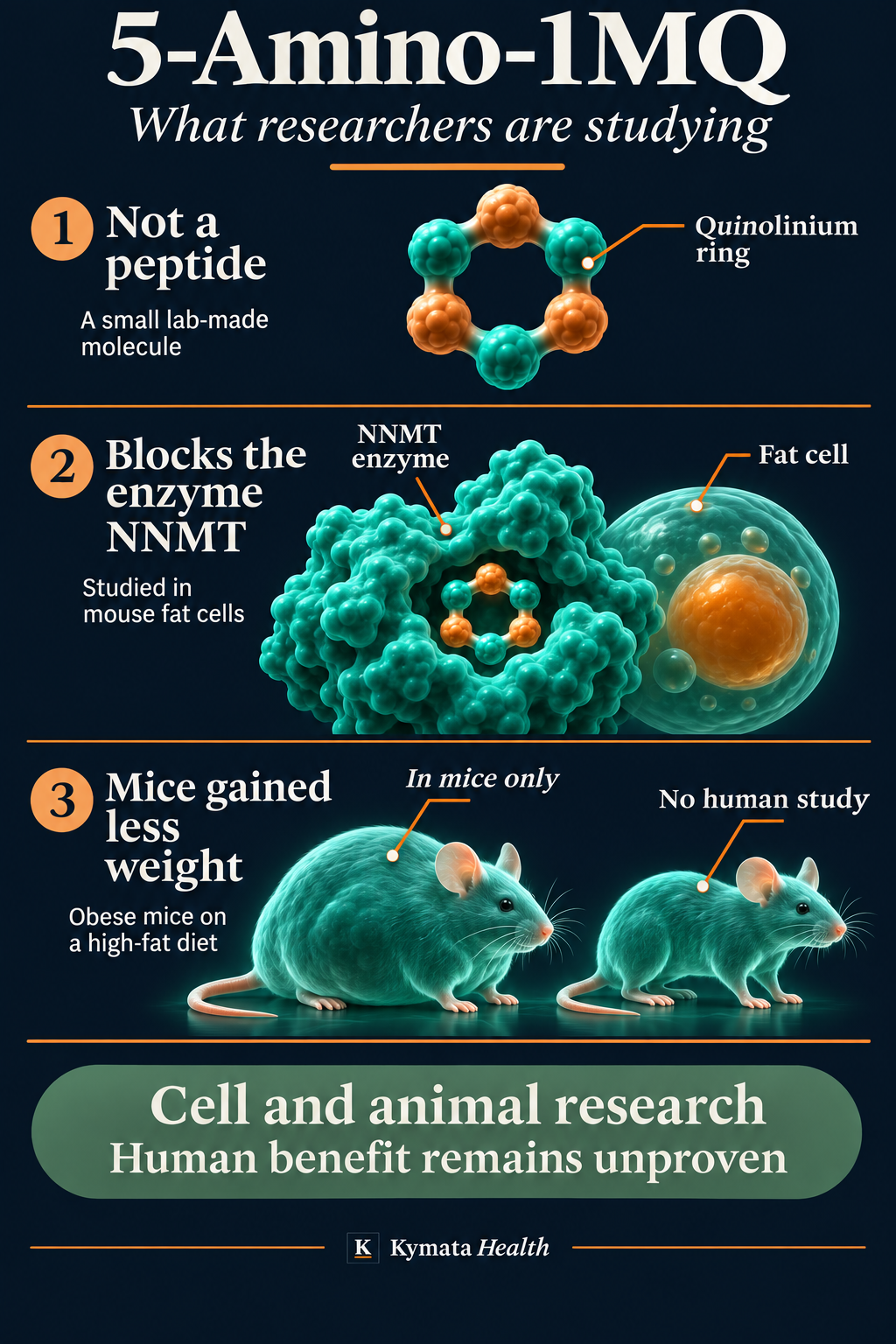
The guide shows 5-Amino-1MQ as a small quinolinium molecule, not a peptide, that blocks the enzyme NNMT and was studied in mouse fat cells. In mice with diet-induced obesity, treated mice gained less weight than controls (Neelakantan 2018; Babula 2024). No human study is registered. The drawing is a schematic, not a measured molecular structure, a product photograph or a treatment result. Illustration review: 22 November 2026, against this page’s own mechanism, evidence and regulatory records.
This is a small molecule. No peptide residue model is inferred.
Illustration notes and source record
Read the source record on this page. Laboratory, topical and injected studies are separate evidence; this illustration does not establish an indication or a treatment outcome.

How it works
SourcedNicotinamide N-methyltransferase (NNMT) converts nicotinamide to 1-methylnicotinamide using a methyl group from S-adenosylmethionine (SAM). Neelakantan and colleagues (2017, PMID 28548833), at the University of Texas Medical Branch and the University of Texas at San Antonio, screened quinolinium and related scaffolds in enzyme and docking experiments and found quinoliniums inhibited NNMT at low micromolar concentrations; no animals or people were tested.
In cultured mouse fat cells, the authors report that 5-Amino-1MQ lowered 1-methylnicotinamide and increased cellular NAD+ and SAM (Neelakantan 2018, PMID 29155147). In an 11-day study in male mice with diet-induced obesity (Neelakantan 2018, PMID 29155147; n = 9 per group), mice given 5-Amino-1MQ by three daily subcutaneous injections lost an average of 2.0 g from baseline while saline controls gained 0.6 g, with no difference in food intake. In a randomized study in male mice with diet-induced obesity (Babula 2024, PMID 39161060; n = 8 per group), mice on the higher daily subcutaneous exposure gained 0.9 g over about four weeks versus 5.2 g on the lower exposure and 5.4 g on saline, with no effect on food intake and improved liver measures. None of these studies measured weight or metabolic rate in people.
Source: PMID: 29155147, PMID: 39161060
Background & History
5-Amino-1MQ (5-Amino-1-methylquinolinium) is a small-molecule inhibitor of nicotinamide N-methyltransferase (NNMT), not a peptide. Neelakantan and colleagues at the University of Texas Medical Branch and the University of Texas at San Antonio published a medicinal-chemistry study of quinolinium NNMT inhibitors in 2017 (PMID 28548833). Their mouse and fat-cell study appeared online in Biochemical Pharmacology in November 2017 and in the January 2018 issue (PMID 29155147).
05 / Evidence and limits
Evidence and limits
Limits of current evidence
3 limits- In the 2024 mouse study (Babula, PMID 39161060; n = 8 per group), the higher-exposure group gained 0.9 g over about four weeks, while the lower-exposure group gained 5.2 g, about as much as saline (5.4 g).
- Rats and mice showed different oral exposure (38.4% oral bioavailability in rats, PMID 34304009; 3.5% in mice, PMID 39161060). Those results do not establish a human half-life or an oral schedule.
- ClinicalTrials.gov lists no registered study of 5-Amino-1MQ, and the published studies we reviewed tested cells, mice and rats only.
What it is studied for
- NNMT activity measured in enzyme and cell experiments
- Body-weight changes measured in mice with diet-induced obesity
Verdict
5-Amino-1MQ is a quinolinium small molecule, not a peptide. Two mouse studies measured changes in body weight under different conditions (PMID 29155147, 39161060); no human study has established a weight-loss benefit, a safe exposure or a dose.
06 / Product forms and access
Product forms and access
Regulatory & legal status
- FDA status (US)
- Research Only
- WADA status (2026)
- Not ListedNot named on the WADA 2026 Prohibited List. Section S0 bans at all times any pharmacological substance not covered elsewhere on the List and without current human therapeutic approval from any regulator. Verify before competition.
- US compounding
- Not eligible for 503B: in a January 20, 2026 warning letter to GenoGenix LLC, FDA said the iodide salt is not on the 503B bulks list or the drug shortage list
07 / Tools and practical checks
Tools and practical checks
No separate record is provided here. Read the linked evidence and limitations for this compound.
08 / Published study use
Published study use
What published studies gave, in whom, and the source. Not a dose for you.
What studies used
No human study- We found no published human study, and ClinicalTrials.gov lists no registered study.
- Male mice with diet-induced obesity, repeated subcutaneous injections for 11 days, nine per group: lost 2.0 g vs a 0.6 g gain on saline. Neelakantan 2018, PMID 29155147 (opens in new tab)
- Male mice with diet-induced obesity, daily subcutaneous injections for about four weeks, eight per group: gained 0.9 g on the higher exposure vs 5.2 g lower and 5.4 g saline. Babula 2024, PMID 39161060 (opens in new tab)
- The doses quoted online come from animal work and vendor or forum sources.
A record of what researchers gave, in whom; not a dose for you.
Administration
- Route / form
- Not established in humans. The two mouse body-weight studies used subcutaneous injections.
Who it is for
2 uses| Category | Fit | What exists |
|---|---|---|
| Human weight loss | Not established | The two mouse studies measured weight change under different conditions (PMID 29155147, 39161060). ClinicalTrials.gov lists no registered study of 5-Amino-1MQ, and the published studies we reviewed tested cells, mice and rats only. |
| NAD+ measurements | Cell studies only | The authors report increased NAD+ in cultured mouse fat cells after NNMT inhibition (PMID 29155147). That does not show the compound raises NAD+ in people. |
09 / Safety and interactions
Safety and interactions
What the record says
No human safety data exist: ClinicalTrials.gov lists no registered study of 5-Amino-1MQ, and the published studies we reviewed tested cells, mice and rats only. In an off-target screen, Babula 2024 reported 67.4% inhibition of MAO-A (PMID 39161060); human interactions have not been studied. In a January 20, 2026 warning letter to GenoGenix LLC, FDA said drug products compounded with 5-amino-1-methylquinolinium iodide were not eligible for section 503B exemptions because the substance is not on the 503B bulks list or the drug shortage list. The WADA 2026 Prohibited List section S0 bans at all times any pharmacological substance not covered elsewhere on the List and without current human therapeutic approval from any regulator, and 5-Amino-1MQ is not named in it.
Interactions & Contraindications
The reviewed rodent studies did not determine drug interactions, a human monitoring schedule or a suitable dose for people. In an off-target screen, Babula 2024 reported 67.4% inhibition of MAO-A (PMID 39161060).
10 / Comparisons and goal guides
Comparisons and goal guides
Appears in goal guides
1 guideGoal guides give the evidence and status for each compound, with no doses. A mention here is not a treatment plan.
11 / Common questions
Common questions
Common questions
4 answersHas 5-Amino-1MQ produced weight loss in people?
No human study has tested it. In an 11-day mouse study, treated mice lost an average of 2.0 g while saline controls gained 0.6 g (PMID 29155147). In a later mouse study, all three groups gained weight, and the higher-exposure group gained least (PMID 39161060).
Does 5-Amino-1MQ have a known human half-life?
No. In a rat pharmacokinetic study (Awosemo 2021, PMID 34304009), 5-Amino-1MQ had mean terminal half-lives of 3.8 hours after intravenous and 6.9 hours after oral dosing, with an oral bioavailability of 38.4%. A mouse study reported a terminal half-life of 14.8 hours after oral dosing and an oral bioavailability of 3.5% (PMID 39161060). Species and route both matter.
How does 5-Amino-1MQ differ from NMN for NAD+?
NMN and NR are precursors that raise NAD+ in human studies. 5-Amino-1MQ blocks NNMT, the enzyme that uses up a precursor, and has been studied only in cells, mice and rats (PMID 29155147, 39161060). No study has tested them together, and we give no stacking advice.
Is 5-Amino-1MQ FDA-approved?
No. Not FDA-approved, research chemical.
12 / Sources and references
Sources and references
8 papers cited on this page.
Sources
8 papers- 1“Structure-Activity Relationship for Small Molecule Inhibitors of Nicotinamide N-Methyltransferase.”Neelakantan H, Wang HY, Vance V, et al. Journal of Medicinal Chemistry (2017). PMID: 28548833 DOI: 10.1021/acs.jmedchem.7b00389
- 2“Selective and membrane-permeable small molecule inhibitors of nicotinamide N-methyltransferase reverse high fat diet-induced obesity in mice.”Neelakantan H, Vance V, Wetzel MD, et al. Biochemical Pharmacology (2018). PMID: 29155147 DOI: 10.1016/j.bcp.2017.11.007
- 3“Development & validation of LC-MS/MS assay for 5-amino-1-methyl quinolinium in rat plasma: Application to pharmacokinetic and oral bioavailability studies.”Awosemo O, Neelakantan H, Watowich S, et al. Journal of Pharmaceutical and Biomedical Analysis (2021). PMID: 34304009 DOI: 10.1016/j.jpba.2021.114255
- 4“Nicotinamide N-methyltransferase inhibition mitigates obesity-related metabolic dysfunction.”Babula JJ, Bui D, Stevenson HL, Watowich SJ, Neelakantan H Diabetes, Obesity and Metabolism (2024). PMID: 39161060 DOI: 10.1111/dom.15879
- 5“Warning letter: GenoGenix LLC (MARCS-CMS 718739), including 5-amino-1-methylquinolinium iodide and section 503B.”US Food and Drug Administration FDA (2026).
- 6“World Anti-Doping Code: 2026 Prohibited List (section S0, non-approved substances).”World Anti-Doping Agency WADA (2026).
- 7“PubChem CID 950107: 5-Amino-1-methylquinolinium (cation).”National Center for Biotechnology Information PubChem (current).
- 8“PubChem CID 66522933: 5-Amino-1-methylquinolinium iodide (NNMTi).”National Center for Biotechnology Information PubChem (current).
14 / Prescription options
Prescription options
Prescription options: compare licensed telehealth providers
Some peptide therapies are available only by prescription after a consult with a licensed clinician.
Compare telehealth →15 / Peptide library
Peptide library
Keep reading: Peptide research library
Peptide research library: every pagePeptide libraryBrowse all topics
- KLOW StackPrevious in this topic · Vendor GLOW mix plus KPV.
- LiraglutideNext in this topic · Once-daily GLP-1 RA.
- CagrilintideLong-acting amylin analog, not a GLP-1.
- CagriSemaNovo's combination of cagrilintide 2.4 mg and semaglutide 2.4 mg, studied in the REDEFINE trials.
- MacimorelinFDA-approved oral AGHD diagnostic (Macrilen).
Regulatory and sport classification
- Not FDA-approved, research chemical