
The peptide field guide
Matrixyl
Matrixyl is palmitoyl pentapeptide-4 (pal-KTTKS), a fragment of type I procollagen with a fatty palmitoyl tail added to help it enter the skin; Matrixyl 3000 is a different pair of palmitoyl peptides.
Cosmetic ingredient, not a drug. One controlled skin study.
Explore this compoundConceptual editorial illustration; not a measured molecular structure, product photograph or treatment result.
02 / At a glance
At a glance
Key facts
- Also known as
- Palmitoyl pentapeptide-4, Pal-KTTKS
- Type
- Cosmetic Peptide
- Evidence level
- Cosmetic ingredient: not a drug.
- US regulatory status
- Cosmetic ingredient, not a drug
- Updated
Identity
Matrixyl is palmitoyl pentapeptide-4 (pal-KTTKS), a fragment of type I procollagen with a fatty palmitoyl tail added to help it enter the skin; Matrixyl 3000 is a different pair of palmitoyl peptides.
Research context
In fibroblast cultures it stimulated collagen and other matrix proteins; in a 12-week split-face study in 93 women aged 35 to 55, the side with the peptide moisturizer improved more on fine lines and wrinkles than the plain moisturizer side (Robinson 2005).
Evidence limits
Cosmetic ingredient, not a drug. One controlled skin study.
Read the technical profile and study-use reference
Quick answer
Evidence: LowMatrixyl (palmitoyl pentapeptide-4) is a cosmetic lipopeptide whose KTTKS sequence raised collagen production in fibroblast cultures; one 12-week split-face trial in 93 women found more improvement in fine lines on the peptide side.
- In published studies
- Trial amounts are recorded under What studies used (PMID 18492182)
Research summary, not medical advice.
At a glance
Kymata peptide profile · Oct 30, 2026- Molecular weight
- 802.1 g/mol
- CAS
- N/A
- In published studies
- Trial amounts are recorded under What studies used (PMID 18492182)
- Half-life
- No human topical half-life has been published
- Common vials
- Topical cosmetic ingredient; not a calculator product
03 / Identity and origin
Identity and origin
Also called Palmitoyl pentapeptide-4, Pal-KTTKS. Palmitoyl pentapeptide-4 (topical matrikine cosmetic).
Read the sequence and compound record
Compound card
- Class
- Palmitoyl pentapeptide-4 (topical matrikine cosmetic)
- Formula
- C39H75N7O10
- Molecular weight
- 802.1 g/mol
- CAS
- N/A
- PubChem CID
- N/A
- Described by
- Sederma (Croda)
- Bioavailability
- Applied to the skin; how much reaches the dermis in people has not been measured
04 / How it may work
How it may work
Palmitoyl pentapeptide-4 (topical matrikine cosmetic)
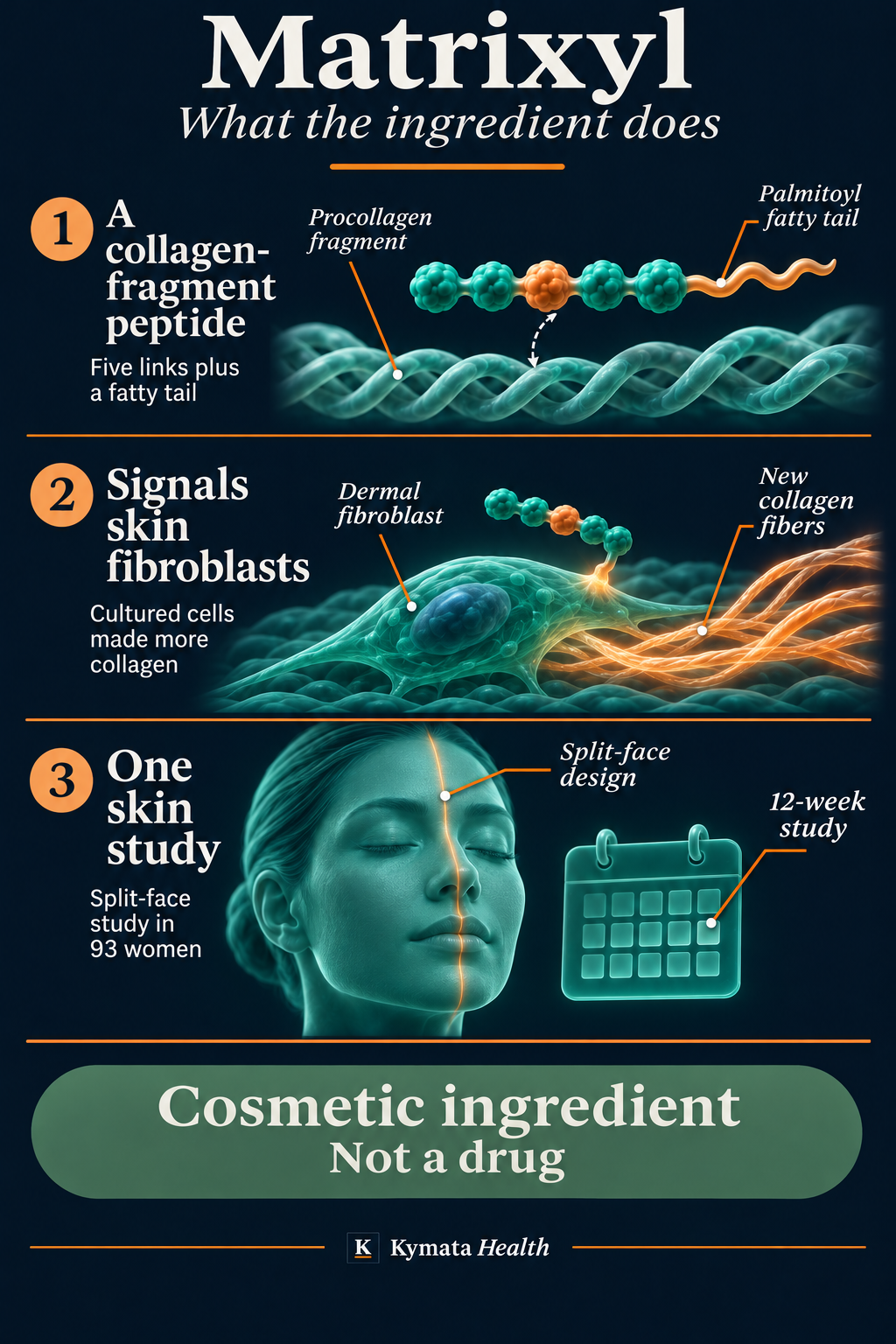
Matrixyl is palmitoyl pentapeptide-4 (pal-KTTKS), a fragment of type I procollagen with a fatty palmitoyl tail added to help it enter the skin; Matrixyl 3000 is a different pair of palmitoyl peptides. In fibroblast cultures it stimulated collagen and other matrix proteins; in a 12-week split-face study in 93 women aged 35 to 55, the side with the peptide moisturizer was compared with a plain moisturizer on the other side of the face, with skin-surface changes measured (Robinson 2005). Cosmetic ingredient, not a drug. One controlled skin study. The drawing is a schematic, not a measured molecular structure, a product photograph or a treatment result. Illustration review: 19 November 2026, against this page’s own mechanism, evidence and regulatory records.
A sequence model is not provided for this record. Read the identity and evidence notes; an illustration does not verify a molecular structure.
Illustration notes and source record
Read the source record on this page. Laboratory, topical and injected studies are separate evidence; this illustration does not establish an indication or a treatment outcome.

How it works
Original Matrixyl is palmitoyl pentapeptide-4: the five amino acids lysine, threonine, threonine, lysine and serine (KTTKS), with a palmitoyl fatty-acid chain attached. In a 1993 cell study, that five-amino-acid stretch of the type I collagen precursor was the smallest piece that still raised collagen and fibronectin production in cultured fibroblasts (Katayama 1993, PMID 8486721). The fatty-acid chain was added to help the peptide enter skin. The one controlled human trial measured visible fine lines and wrinkles, not collagen in the skin, so how much of the cell finding carries over to a person is not known.
Matrixyl 3000 is a different ingredient: palmitoyl tripeptide-1 with palmitoyl tetrapeptide-7, per its supplier. Evidence for one does not transfer to the other.
Original Matrixyl is listed as palmitoyl pentapeptide-4. Matrixyl 3000 is listed as palmitoyl tripeptide-1 together with palmitoyl tetrapeptide-7 (Croda ingredient pages). The 93-woman trial on this page tested the original ingredient, not the 3000 blend.
05 / Evidence and limits
Evidence and limits
One controlled trial of the original ingredient
Human evidence
One controlled trial of the original ingredient- People counted
- 93
- Studies listed here
- 1
- In a 12-week double-blind, placebo-controlled, split-face trial in 93 Caucasian women aged 35 to 55, the side randomly assigned the moisturizer with pal-KTTKS showed significantly greater reduction in wrinkles and fine lines than the side given the same moisturizer without it, by both image analysis and expert graders (Robinson 2005, PMID 18492182).
- The abstract reports that the difference was significant but gives no size for it, and the investigators worked for Procter & Gamble.
- No trial has tested the ingredient in men, other ages or skin types, other formulas, or for longer than 12 weeks.
Limits of current evidence
2 limits- One 12-week split-face trial in 93 women (PMID 18492182); the abstract gives no effect size.
- Matrixyl 3000 is a different pair of palmitoyl peptides. Read the INCI.
Published Trial Data
1 trials| Study | Phase | Summary | Source |
|---|---|---|---|
| Robinson 2005, split-face moisturizer trial | Cosmetic trial | In 93 women aged 35 to 55 over 12 weeks, the randomly assigned peptide side improved more on fine lines and wrinkles than the matching moisturizer side, by image analysis and expert grading; participants also reported the difference (PMID 18492182). | Source |
What it is studied for
- Fine-line cosmetics (appearance)
Verdict
Original Matrixyl is palmitoyl pentapeptide-4, a topical cosmetic. Not the GLOW injectable blend.
06 / Product forms and access
Product forms and access
Regulatory & legal status
- FDA status (US)
- Not approvedPalmitoyl pentapeptide-4, a topical cosmetic ingredient, not an FDA-approved drug. Cosmetic ingredients do not need FDA approval before sale; a product intended for a therapeutic use or to affect the body's structure or function is regulated as a drug (FDA, checked Nov 22, 2026)
- WADA status (2026)
- Not ListedNot currently on the WADA 2026 Prohibited List. Policies may change. Verify before competition.
- US compounding
- Not eligible / not available
07 / Tools and practical checks
Tools and practical checks
No separate record is provided here. Read the linked evidence and limitations for this compound.
08 / Published study use
Published study use
What published studies gave, in whom, and the source. Not a dose for you.
What studies used
One controlled skin study- 93 women aged 35 to 55: a moisturizer with 3 ppm palmitoyl pentapeptide on one side of the face against the plain moisturizer on the other, for 12 weeks. Robinson 2005, PMID 18492182 (opens in new tab)
A record of what researchers gave, in whom; not a dose for you.
Administration
- Route / form
- Route used in the trial: a moisturizer applied to the face.
Who it is for
1 use| Category | Fit | What exists |
|---|---|---|
| Fine lines and wrinkles (appearance) | Low | One 12-week split-face trial of a moisturizer with the original ingredient, sponsored by a skin-care company (PMID 18492182). |
09 / Safety and interactions
Safety and interactions
What the record says
The trial reports that the moisturizer was well tolerated over 12 weeks in 93 women. It was not designed to find uncommon reactions, and no longer-term safety data have been published.
Interactions & Contraindications
Applied to the skin. No interaction studies have been published.
10 / Comparisons and goal guides
Comparisons and goal guides
There is no separate comparison record on this page. Similar names do not establish that products or their evidence are interchangeable.
11 / Common questions
Common questions
Common questions
4 answersWhat name should I look for on the ingredient list?
Original Matrixyl is palmitoyl pentapeptide-4. Matrixyl 3000 is palmitoyl tripeptide-1 plus palmitoyl tetrapeptide-7, a different pair of peptides. The 12-week trial on this page tested palmitoyl pentapeptide-4.
What did the trial actually show?
In 93 women aged 35 to 55, each used the same moisturizer on both halves of the face, one half with the peptide added. After 12 weeks the peptide side showed significantly more improvement in fine lines and wrinkles on image analysis and expert grading (PMID 18492182). The abstract does not give the size of the difference.
Does it build collagen in the skin?
Not shown in people. The collagen finding comes from cultured fibroblasts exposed to the KTTKS sequence (PMID 8486721); the human trial measured visible lines, not collagen.
Is Matrixyl FDA-approved?
No. Palmitoyl pentapeptide-4, a topical cosmetic ingredient, not an FDA-approved drug. Cosmetic ingredients do not need FDA approval before sale; a product intended for a therapeutic use or to affect the body's structure or function is regulated as a drug (FDA, checked Nov 22, 2026).
12 / Sources and references
Sources and references
3 papers cited on this page.
Sources
3 papers- 1“Topical palmitoyl pentapeptide provides improvement in photoaged human facial skin.”Robinson LR, Fitzgerald NC, Doughty DG, et al. International Journal of Cosmetic Science (2005). PMID: 18492182 DOI: 10.1111/j.1467-2494.2005.00261.x
- 2“A pentapeptide from type I procollagen promotes extracellular matrix production.”Katayama K, Armendariz-Borunda J, Raghow R, et al. Journal of Biological Chemistry (1993). PMID: 8486721
- 3“FDA Authority Over Cosmetics: How Cosmetics Are Not FDA-Approved, but Are FDA-Regulated.”US Food and Drug Administration FDA (2026).
14 / Prescription options
Prescription options
Prescription options: compare licensed telehealth providers
Some peptide therapies are available only by prescription after a consult with a licensed clinician.
Compare telehealth →15 / Peptide library
Peptide library
Keep reading: Peptide research library
Peptide research library: every pagePeptide libraryBrowse all topics
- Snap-8Previous in this topic · Snap-8 (acetyl octapeptide-3) is a cosmetic peptide that extends the Argireline sequence by two amino acids; published studies tested it only inside multi-ingredient serums and…
- KyotorphinNext in this topic · Researchers have measured native kyotorphin (Tyr-Arg) in human spinal fluid and blood.
- TabimorelinTabimorelin (NN703) is an orally active growth hormone secretagogue that reached Phase 2 trials in adults with growth hormone deficiency before its development stopped.
- ProstatilenProstatilen (Samprost, Vitaprost) is a polypeptide extract of bovine prostate registered as a medicine in Russia; Russian clinical studies examined it in prostatitis and prostate…
- RetinalaminRetinalamin is a polypeptide extract of animal retina registered as a medicine in Russia, given by intramuscular injection or by injection next to the eye; Russian clinical…
Regulatory and sport classification
- Cosmetic ingredient, not a drug