
The peptide field guide
Tetracosactide
The first 24 amino acids of ACTH, used to test whether the adrenal glands respond.
FDA-approved as a diagnostic. Given by clinicians.
Explore this compoundConceptual editorial illustration; not a measured molecular structure, product photograph or treatment result.
02 / At a glance
At a glance
Key facts
- Also known as
- Cosyntropin, Synacthen, ACTH 1-24, Tetracosactrin
- Type
- Clinical / Pharmaceutical
- Evidence level
- FDA-approved as a diagnostic: given by clinicians.
- US regulatory status
- FDA-approved as cosyntropin (Cortrosyn® and generics), a diagnostic test of adrenal function
- Updated
Identity
The first 24 amino acids of ACTH, used to test whether the adrenal glands respond.
Research context
It stimulates the adrenal cortex to release cortisol; clinicians use it mainly in the test for adrenal insufficiency.
Evidence limits
FDA-approved as a diagnostic. Given by clinicians.
Read the technical profile and study-use reference
Quick answer
Evidence: HighTetracosactide (cosyntropin) helps clinicians investigate whether the adrenal glands can make enough cortisol. It mimics the first 24 amino acids of ACTH, the hormone that signals those glands. The meaning of the blood test depends on the laboratory’s cortisol assay and the rest of the clinical evaluation.
- FDA label dose
- FDA label (Cortrosyn): 0.25 mg vial for one diagnostic test
Research summary, not medical advice.
At a glance
Kymata peptide profile · Nov 22, 2026- Molecular weight
- 2933.5 g/mol
- CAS
- 16960-16-0
- FDA label dose
- FDA label (Cortrosyn): 0.25 mg vial for one diagnostic test
- Half-life
- Not stated in the Cortrosyn label
- Common vials
- Hospital diagnostic injection; no reconstitution in this calculator
03 / Identity and origin
Identity and origin
Also called Cosyntropin, Synacthen, ACTH 1-24, Tetracosactrin. ACTH(1-24) (cosyntropin / Synacthen diagnostic).
Read the sequence and compound record
Compound card
- Class
- ACTH(1-24) (cosyntropin / Synacthen diagnostic)
- Formula
- C136H210N40O31S
- Molecular weight
- 2933.5 g/mol
- CAS
- 16960-16-0
- Described by
- CIBA (Novartis), 1960s
- Bioavailability
- Intravenous or intramuscular injection
04 / How it may work
How it may work
ACTH(1-24) (cosyntropin / Synacthen diagnostic)
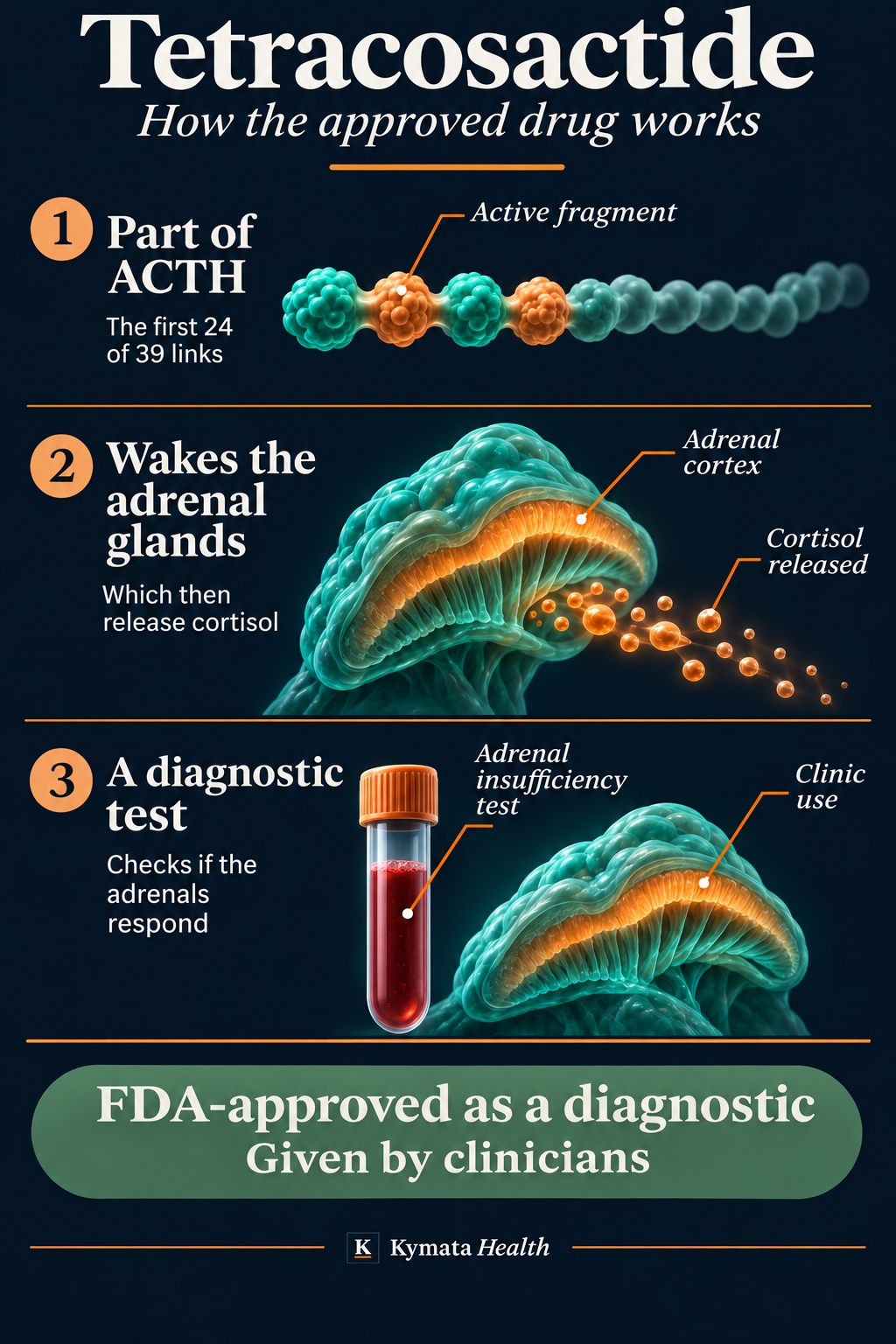
The first 24 amino acids of ACTH, used to test whether the adrenal glands respond. It stimulates the adrenal cortex to release cortisol; clinicians use it mainly in the test for adrenal insufficiency. FDA-approved as a diagnostic. Given by clinicians. The drawing is a schematic, not a measured molecular structure, a product photograph or a treatment result. Illustration review: 19 November 2026, against this page’s own mechanism, evidence and regulatory records.
A sequence model is not provided for this record. Read the identity and evidence notes; an illustration does not verify a molecular structure.
Illustration notes and source record
Read the source record on this page. Laboratory, topical and injected studies are separate evidence; this illustration does not establish an indication or a treatment outcome.

How it works
SourcedTetracosactide (also known as cosyntropin or Synacthen) is a synthetic peptide consisting of the first 24 amino acids of adrenocorticotropic hormone (ACTH). The full human ACTH has 39 amino acids, but biological activity resides entirely in the N-terminal 24 sequence.
Tetracosactide stimulates the adrenal cortex to rapidly produce cortisol and other corticosteroids. It is used clinically mainly as a diagnostic test of adrenal function (the short Synacthen or cosyntropin stimulation test). Unlike long-term corticosteroid therapy, it relies on the body's own adrenal steroidogenic pathways.
Source: Cortrosyn prescribing information (revised February 2025); Javorsky et al., PMID 33768189
Background & History
The ACTH stimulation test has been a standard test of adrenal reserve for decades. Older cortisol immunoassays helped set its historical 18 μg/dL reference. In 2021, a head-to-head study of 110 patients found that newer, more specific assays could report lower values in the same samples (PMID 33768189), and the Cortrosyn prescribing information, revised February 2025, notes that the cutoff can vary with the assay used.
05 / Evidence and limits
Evidence and limits
Diagnostic use · retrospective assay comparison
Human evidence
Diagnostic use · retrospective assay comparison- In a retrospective study of 110 patients evaluated for suspected adrenal insufficiency, the same 18 μg/dL stimulated-cortisol cutoff classified 14.5% of patients below it with the older Elecsys I assay and 29% with the more specific Elecsys II assay (Javorsky et al. 2021, PMID 33768189).
- The investigators had no independent reference test for each patient, so these percentages describe how the assays classified results, not confirmed diagnoses.
Limits of current evidence
1 limit- The 2021 assay study compared laboratory classifications. It did not independently establish which patients had adrenal insufficiency.
Trial FinderRecruiting now: 2 open registrations for tetracosactide
What it is studied for
- Screening for adrenal insufficiency, with other tests
- Interpreting a laboratory cortisol response
Verdict
Cosyntropin asks a specific diagnostic question: how much cortisol can the adrenal glands produce when stimulated? The laboratory method, time of collection and other findings help the clinician interpret the answer.
06 / Product forms and access
Product forms and access
Regulatory & legal status
- FDA status (US)
- ApprovedFDA-approved as cosyntropin (Cortrosyn® and generics), a diagnostic test of adrenal function
- WADA status (2026)
- Prohibited (S2)Competitive athletes subject to anti-doping controls should not use Tetracosactide.
- Classification
- Prescription Drug
07 / Tools and practical checks
Tools and practical checks
No separate record is provided here. Read the linked evidence and limitations for this compound.
08 / Published study use
Published study use
What the label states, for the patients it is approved for, and the source. Not a dose for you.
What the FDA label says
FDA label (diagnostic)- Cortrosyn (cosyntropin), a diagnostic test of adrenal function: approved strength 0.25 mg of lyophilized powder in a single-dose vial, given by IV or intramuscular injection, with cortisol measured at baseline and 30 and 60 minutes later. Cortrosyn label, DailyMed (opens in new tab)
The label’s dosing, for the patients it is approved for; the prescriber sets the dose.
Administration
- Route / form
- IV or IM injection
Timeline
1 stage- 30-60 minutes
Blood is drawn for cortisol. The Cortrosyn label treats a stimulated cortisol below 18 mcg/dL at 30 or 60 minutes as suggesting adrenal insufficiency, and notes that cutoffs vary by assay.
Who it is for
1 use| Category | Fit | What exists |
|---|---|---|
| Adrenal Function Testing | High | Cortrosyn label: a diagnostic agent, used with other tests, to screen adults and children for adrenal insufficiency. |
09 / Safety and interactions
Safety and interactions
What the record says
The Cortrosyn prescribing information reports hypersensitivity reactions, including anaphylaxis. Some medicines, including glucocorticoids, spironolactone and estrogen-containing drugs, can change the measured cortisol result, so the testing team reviews them before the test.
Interactions & Contraindications
The Cortrosyn label notes that glucocorticoids and spironolactone may falsely raise measured plasma cortisol, and estrogen may raise total cortisol, so other medicines can affect the test result.
10 / Comparisons and goal guides
Comparisons and goal guides
There is no separate comparison record on this page. Similar names do not establish that products or their evidence are interchangeable.
11 / Common questions
Common questions
Common questions
3 answersWhat is the Synacthen test?
A clinician injects tetracosactide (synthetic ACTH) and measures the patient's blood cortisol before and 30 and 60 minutes after. A cortisol level that stays low suggests adrenal insufficiency; other tests are needed to tell a primary (adrenal) cause from a secondary (pituitary) one.
Why does the lab matter when interpreting the cortisol result?
Different cortisol assays can report different values for the same blood sample. The Cortrosyn label says the cutoff can vary with the assay, and a 2021 comparison of 110 patients found that newer, more specific assays classified more results as low at the same historical cutoff (PMID 33768189). Your testing team can explain which reference applies to your report.
Is Tetracosactide FDA-approved?
Yes. FDA-approved as cosyntropin (Cortrosyn® and generics), a diagnostic test of adrenal function.
12 / Sources and references
Sources and references
2 sources cited on this page.
Sources
2 sources- 1“New Cutoffs for the Biochemical Diagnosis of Adrenal Insufficiency after ACTH Stimulation using Specific Cortisol Assays.”Javorsky BR et al. Journal of the Endocrine Society (2021). PMID: 33768189 DOI: 10.1210/jendso/bvab022
- 2“Cortrosyn (cosyntropin) for injection: prescribing information, revised February 2025.”Amphastar Pharmaceuticals DailyMed (2025). Prescribing information
14 / Prescription options
Prescription options
Prescription options: compare licensed telehealth providers
Some peptide therapies are available only by prescription after a consult with a licensed clinician.
Compare telehealth →15 / Peptide library
Peptide library
Keep reading: Peptide research library
Peptide research library: every pagePeptide libraryBrowse all topics
- LeuprorelinPrevious in this topic · Leuprorelin (leuprolide) is a synthetic GnRH agonist that, given continuously, suppresses testosterone and estrogen.
- VasopressinNext in this topic · Vasopressin is a hormone that narrows blood vessels and helps the kidneys retain water.
- Thymosin Beta-4Thymosin β4 is the endogenous 43-amino-acid G-actin-sequestering peptide (CAS 77591-33-4, ~4963 Da).
- GhrelinGhrelin is a 28-amino-acid stomach hormone that activates the growth hormone secretagogue receptor (GHS-R1a); infusions have been studied in small human trials of appetite, GH…
- Melanotan 1Afamelanotide (Scenesse), the approved form of melanotan I, is a synthetic alpha-MSH analog that acts at MC1R; it is FDA- and EMA-approved as an implant to increase pain-free…
Regulatory and sport classification
- WADA (S2): prohibited in sport at all times
- FDA-approved