
The peptide field guide
Octreotide
A longer-acting somatostatin analog that turns down hormone release from gland cells.
FDA-approved for specific hormone disorders. Prescription only.
Explore this compoundConceptual editorial illustration; not a measured molecular structure, product photograph or treatment result.
02 / At a glance
At a glance
Key facts
- Also known as
- Sandostatin, octreotide acetate, SMS 201-995
- Type
- Clinical / Pharmaceutical
- Evidence level
- FDA-approved for specific hormone disorders: prescription only.
- US regulatory status
- FDA-approved in 1988 as Sandostatin® for acromegaly and for symptoms of metastatic carcinoid tumors and VIP-secreting tumors; Mycapssa® capsules for acromegaly maintenance. LAR Depot is a separate clinic product
- Updated
Identity
A longer-acting somatostatin analog that turns down hormone release from gland cells.
Research context
It is prescribed for excess growth hormone (acromegaly) and for symptoms of some hormone-secreting tumors.
Evidence limits
FDA-approved for specific hormone disorders. Prescription only.
Read the technical profile and study-use reference
Quick answer
Evidence: HighSomatostatin analog, FDA-approved in 1988 (Sandostatin) for acromegaly when surgery, irradiation and bromocriptine fall short, and for the diarrhea and flushing of metastatic carcinoid tumors and VIP-secreting tumors; Mycapssa capsules cover acromegaly maintenance. US immediate-release octreotide products are ready-to-use solutions labeled in mcg/mL; Sandostatin LAR Depot is a powder mixed with its own diluent by a healthcare professional, so this calculator does not apply to it.
- FDA label dose
- FDA label (Sandostatin): dose and schedule set by the prescriber and the label
Research summary, not medical advice.
At a glance
Kymata peptide profile · Nov 21, 2026- CAS
- 83150-76-9
- FDA label dose
- FDA label (Sandostatin): dose and schedule set by the prescriber and the label
- Half-life
- Apparent elimination half-life of 1.7 to 1.9 hours after injection (Sandostatin Injection label)
- Common vials
- Ready-to-use solution; no water is added
- Molecular weight
- 1019.3 g/mol (free peptide; Sandostatin label)
03 / Identity and origin
Identity and origin
Also called Sandostatin, octreotide acetate, SMS 201-995. Somatostatin analog (Sandostatin, Sandostatin LAR Depot, Bynfezia, Mycapssa).
Read the sequence and compound record
Compound card
- Class
- Somatostatin analog (Sandostatin, Sandostatin LAR Depot, Bynfezia, Mycapssa)
- Formula
- C49H66N10O10S2 (octreotide, free peptide)
- Molecular weight
- 1019.3 g/mol (free peptide; Sandostatin label)
- CAS
- 83150-76-9
- Described by
- Novartis (Sandostatin), 1980s; US 1988
- Bioavailability
- Rapid and complete absorption after subcutaneous injection (Sandostatin Injection label)
04 / How it may work
How it may work
Somatostatin analog (Sandostatin, Sandostatin LAR Depot, Bynfezia, Mycapssa)
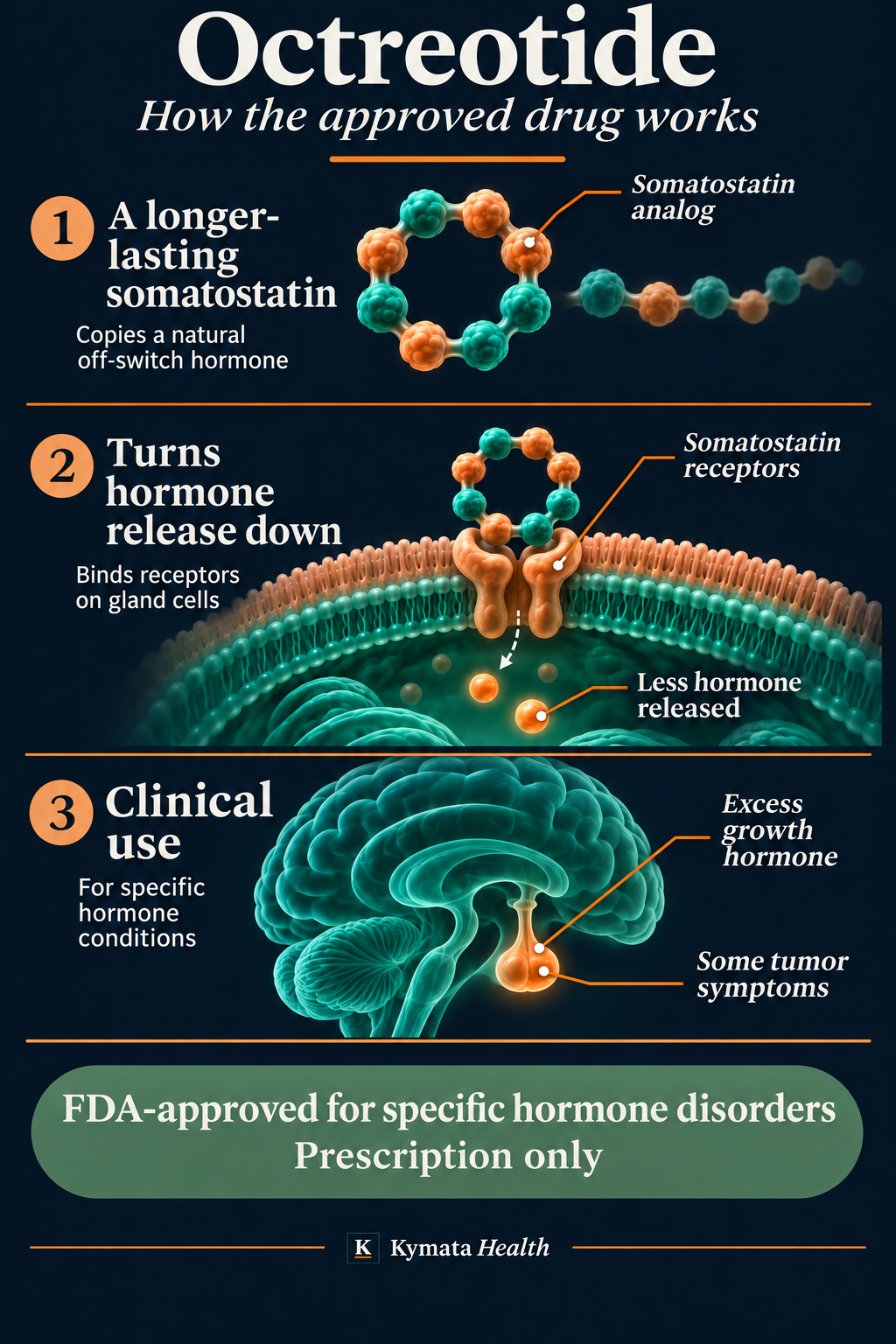
A longer-acting somatostatin analog that turns down hormone release from gland cells. It is prescribed for excess growth hormone (acromegaly) and for symptoms of some hormone-secreting tumors. FDA-approved for specific hormone disorders. Prescription only. The drawing is a schematic, not a measured molecular structure, a product photograph or a treatment result. Illustration review: 19 November 2026, against this page’s own mechanism, evidence and regulatory records.
A sequence model is not provided for this record. Read the identity and evidence notes; an illustration does not verify a molecular structure.
Illustration notes and source record
How can one medicine ease both flushing and diarrhea?
One cause for two symptoms. Some tumors release excess chemical signals, including serotonin. This can cause the sudden flushing and severe diarrhea of carcinoid syndrome. Octreotide mimics the hormone somatostatin and reduces the release of several of those signals.
What patients experienced. In a study of short-acting injections, 22 of 25 people with metastatic carcinoid tumors had relief from flushing and diarrhea. Everyone received octreotide, so the study had no untreated comparison group.
Gut hormone cells release chemical signals into the bloodstream.
Earlier contextual illustration
Read the source record on this page. Laboratory, topical and injected studies are separate evidence; this illustration does not establish an indication or a treatment outcome.

How it works
SourcedOctreotide is a somatostatin analog that acts mainly at sst2 and sst5 receptors, suppressing growth hormone, insulin, glucagon and several gut hormones. US octreotide injections are indicated to reduce GH and IGF-1 in acromegaly patients who had an inadequate response to, or cannot be treated with, surgical resection, pituitary irradiation and bromocriptine, for severe diarrhea and flushing episodes associated with metastatic carcinoid tumors, and for the profuse watery diarrhea associated with VIP-secreting tumors, while Mycapssa capsules are indicated for long-term maintenance treatment in acromegaly patients who have responded to and tolerated octreotide or lanreotide. The Sandostatin Injection label adds that its trials did not show a reduction in tumor size or rate of growth.
Approved strengths of Sandostatin Injection are 50, 100 and 500 mcg/mL octreotide in single-dose ampuls, given subcutaneously or intravenously; the label reports rapid and complete absorption after subcutaneous injection and an apparent elimination half-life of 1.7 to 1.9 hours. Approved strengths are Sandostatin LAR Depot 10, 20 and 30 mg for intragluteal intramuscular injection, indicated for patients in whom Sandostatin Injection has been shown to be effective and tolerated, and Bynfezia Pen at 2,500 mcg/mL (7,000 mcg in 2.8 mL) for subcutaneous use only. US immediate-release octreotide products are ready-to-use solutions labeled in mcg/mL; Sandostatin LAR Depot is a powder mixed with its own diluent by a healthcare professional.
Source: Sandostatin Injection, LAR Depot, Bynfezia and Mycapssa labels; PROMID (PMID 19704057); CHIASMA OPTIMAL (PMID 32882036)
Sandostatin ampuls and generic vials are already solutions with the concentration on the label. Bynfezia is a prefilled pen. Sandostatin LAR Depot is an intramuscular microsphere kit prepared by a healthcare professional, and Mycapssa is an oral delayed-release capsule. None of these needs the powder calculator.
05 / Evidence and limits
Evidence and limits
Labeled symptom and acromegaly control; tumor-growth trials outside the US label
Human evidence
Labeled symptom and acromegaly control; tumor-growth trials outside the US label- In an uncontrolled study of 25 patients with metastatic carcinoid tumors and carcinoid syndrome (Kvols 1986, PMID 2427948), self-injected subcutaneous octreotide (SMS 201-995) at 150 mcg three times daily promptly relieved flushing and diarrhea in 22, and 18 (72%) had at least a 50% fall in urinary 5-HIAA.
- In the PROMID double-blind placebo-controlled trial of 85 treatment-naive patients with well-differentiated metastatic midgut neuroendocrine tumors (Rinke 2009, PMID 19704057), octreotide LAR 30 mg monthly lengthened median time to tumor progression to 14.3 months from 6 months with placebo (hazard ratio 0.34). Tumor control is not a US-labeled indication.
- In long-term PROMID follow-up of all 85 patients (Rinke 2017, PMID 26731483), median overall survival was 84.7 months with octreotide LAR and 83.7 months with placebo (hazard ratio 0.83, not significant), and 38 of 43 placebo patients later crossed over to octreotide LAR, which may have confounded the comparison.
- In the 36-week double-blind placebo-controlled CHIASMA OPTIMAL trial of 56 patients with acromegaly previously controlled on injectable somatostatin receptor ligands (Samson 2020, PMID 32882036), 58.2% on oral octreotide capsules versus 19.4% on placebo maintained normal IGF-1 at weeks 34 and 36.
Use-case scores
0–100–10 against the evidence we have, not a gym ranking. Hidden domains do not apply here.
- Metabolic / weight3/10Labeled for second-line acromegaly control and for carcinoid and VIPoma symptoms, not for weight. Not a fat-loss peptide.
Limits of current evidence
3 limits- In the PROMID double-blind placebo-controlled trial of 85 treatment-naive patients with well-differentiated metastatic midgut neuroendocrine tumors (Rinke 2009, PMID 19704057), octreotide LAR 30 mg monthly lengthened median time to tumor progression to 14.3 months from 6 months with placebo (hazard ratio 0.34); tumor control is not a US-labeled indication, and overall survival later did not differ (PMID 26731483).
- CHIASMA OPTIMAL enrolled patients already controlled on injections; it does not support starting therapy on capsules.
- Gallbladder, heart-rhythm, glucose and thyroid effects are on the label.
Trial FinderRecruiting now: 19 open registrations for octreotide
What it is studied for
- Acromegaly (second-line): High
- Carcinoid and VIPoma symptoms: High
Verdict
Octreotide is labeled for acromegaly when surgery, irradiation and bromocriptine were inadequate or not possible, and for the diarrhea and flushing of metastatic carcinoid tumors and VIPomas; Mycapssa capsules cover acromegaly maintenance. In CHIASMA OPTIMAL (Samson 2020, PMID 32882036), 58.2% on oral octreotide versus 19.4% on placebo kept normal IGF-1. Short-acting products are already solutions, and the LAR Depot is a clinic-prepared kit.
06 / Product forms and access
Product forms and access
Regulatory & legal status
- FDA status (US)
- ApprovedFDA-approved in 1988 as Sandostatin® for acromegaly and for symptoms of metastatic carcinoid tumors and VIP-secreting tumors; Mycapssa® capsules for acromegaly maintenance. LAR Depot is a separate clinic product
- WADA status (2026)
- Not ListedNot currently on the WADA 2026 Prohibited List. Policies may change. Verify before competition.
- Classification
- Prescription Drug
- US compounding
- Available via licensed pharmacy Rx
07 / Tools and practical checks
Tools and practical checks
No separate record is provided here. Read the linked evidence and limitations for this compound.
08 / Published study use
Published study use
What the label states, for the patients it is approved for, and the source. Not a dose for you.
What the FDA label says
FDA label- Sandostatin Injection: approved strengths of 50, 100 and 500 mcg/mL octreotide in single-dose ampuls, given subcutaneously or intravenously. Sandostatin label, DailyMed (opens in new tab)
- Sandostatin LAR Depot: approved strengths of 10, 20 and 30 mg for intragluteal intramuscular injection, for patients in whom Sandostatin Injection has been shown to be effective and tolerated. Sandostatin LAR Depot label, DailyMed (opens in new tab)
- Bynfezia Pen: approved strength of 2,500 mcg/mL (7,000 mcg in 2.8 mL), for subcutaneous use only. Bynfezia label, DailyMed (opens in new tab)
- Mycapssa: approved as a 20 mg delayed-release oral capsule for long-term maintenance in acromegaly patients who have responded to and tolerated octreotide or lanreotide. Mycapssa label, DailyMed (opens in new tab)
The label’s dosing, for the patients it is approved for; the prescriber sets the dose.
Administration
- Route / form
- Sandostatin Injection: subcutaneous or intravenous. LAR Depot: intragluteal intramuscular. Bynfezia: subcutaneous only. Mycapssa: oral capsule.
Timeline
2 stages- Weeks 34 and 36
In CHIASMA OPTIMAL (Samson 2020, PMID 32882036), 58.2% on oral octreotide versus 19.4% on placebo kept normal IGF-1.
- Median 14.3 months
In PROMID (Rinke 2009, PMID 19704057), time to tumor progression with octreotide LAR versus 6 months on placebo; overall survival later did not differ (PMID 26731483).
Who it is for
2 uses| Category | Fit | What exists |
|---|---|---|
| Acromegaly (second-line) | High | Labeled when surgery, pituitary irradiation and bromocriptine were inadequate or not possible; Mycapssa only for maintenance in patients who responded to and tolerated an injectable. |
| Carcinoid and VIPoma symptoms | High | Labeled for severe diarrhea and flushing of metastatic carcinoid tumors and watery diarrhea of VIP-secreting tumors; the label says tumor shrinkage or slower growth was not shown. |
09 / Safety and interactions
Safety and interactions
What the record says
The octreotide label warns of cholelithiasis and its complications, bradycardia and conduction abnormalities, hypoglycemia or hyperglycemia, hypothyroidism from TSH suppression, and new-onset steatorrhea with malabsorption of dietary fats. Drug interactions include cyclosporine and insulin or oral glucose-lowering drugs. LAR Depot, Bynfezia and Mycapssa are separate products with their own labels.
10 / Comparisons and goal guides
Comparisons and goal guides
There is no separate comparison record on this page. Similar names do not establish that products or their evidence are interchangeable.
11 / Common questions
Common questions
Common questions
6 answersWhat is octreotide FDA-approved for?
US octreotide injections are indicated to reduce GH and IGF-1 in acromegaly patients who had an inadequate response to, or cannot be treated with, surgical resection, pituitary irradiation and bromocriptine, for severe diarrhea and flushing episodes associated with metastatic carcinoid tumors, and for the profuse watery diarrhea associated with VIP-secreting tumors. The Sandostatin Injection label adds that its trials did not show a reduction in tumor size or rate of growth.
My vial is 500 mcg/mL already.
Then the concentration is 500 mcg/mL. On a U-100 syringe, 1 unit holds 5 mcg. The powder fields do not apply.
What strengths do the LAR Depot and Bynfezia come in?
Approved strengths are Sandostatin LAR Depot 10, 20 and 30 mg for intragluteal intramuscular injection, indicated for patients in whom Sandostatin Injection has been shown to be effective and tolerated, and Bynfezia Pen at 2,500 mcg/mL (7,000 mcg in 2.8 mL) for subcutaneous use only.
What is Mycapssa?
Mycapssa is approved as a 20 mg delayed-release oral capsule for long-term maintenance treatment in acromegaly patients who have responded to and tolerated octreotide or lanreotide. In the CHIASMA OPTIMAL trial of 56 patients already controlled on injections (Samson 2020, PMID 32882036), 58.2% on the capsules versus 19.4% on placebo kept normal IGF-1 at weeks 34 and 36.
Does octreotide slow neuroendocrine tumors?
In the PROMID trial of 85 patients with metastatic midgut neuroendocrine tumors (Rinke 2009, PMID 19704057), median time to tumor progression was longer with octreotide LAR 30 mg monthly than with placebo (14.3 vs 6 months), but long-term follow-up (Rinke 2017, PMID 26731483) found no significant overall-survival difference, and most placebo patients later crossed over. Tumor control is not a US-labeled indication.
Is this tesamorelin’s opposite?
Octreotide suppresses GH and tesamorelin stimulates its release; they have unrelated labeled indications.
12 / Sources and references
Sources and references
8 sources cited on this page.
Sources
8 sources- 1“Treatment of the malignant carcinoid syndrome. Evaluation of a long-acting somatostatin analogue.”Kvols LK et al. New England Journal of Medicine (1986). PMID: 2427948 DOI: 10.1056/NEJM198609113151102
- 2“Placebo-controlled, double-blind, prospective, randomized study on the effect of octreotide LAR in the control of tumor growth in patients with metastatic neuroendocrine midgut tumors: a report from the PROMID Study Group.”Rinke A et al. Journal of Clinical Oncology (2009). PMID: 19704057 DOI: 10.1200/JCO.2009.22.8510
- 3“Placebo-Controlled, Double-Blind, Prospective, Randomized Study on the Effect of Octreotide LAR in the Control of Tumor Growth in Patients with Metastatic Neuroendocrine Midgut Tumors (PROMID): Results of Long-Term Survival.”Rinke A et al. Neuroendocrinology (2017). PMID: 26731483 DOI: 10.1159/000443612
- 4“Maintenance of Acromegaly Control in Patients Switching From Injectable Somatostatin Receptor Ligands to Oral Octreotide.”Samson SL et al. Journal of Clinical Endocrinology and Metabolism (2020). PMID: 32882036 DOI: 10.1210/clinem/dgaa526
- 5“Sandostatin (octreotide acetate) injection: prescribing information.”Novartis DailyMed (2026). Prescribing information
- 6“Sandostatin LAR Depot (octreotide acetate for injectable suspension): prescribing information.”Novartis DailyMed (2025). Prescribing information
- 7“Bynfezia Pen (octreotide acetate) injection: prescribing information.”Sun Pharmaceutical Industries DailyMed (2025). Prescribing information
- 8“Mycapssa (octreotide) delayed-release capsules: prescribing information.”Chiesi USA DailyMed (2025). Prescribing information
14 / Prescription options
Prescription options
Prescription options: compare licensed telehealth providers
Some peptide therapies are available only by prescription after a consult with a licensed clinician.
Compare telehealth →15 / Peptide library
Peptide library
Keep reading: Peptide research library
Peptide research library: every pagePeptide libraryBrowse all topics
- CetrorelixPrevious in this topic · GnRH antagonist FDA-approved (Cetrotide, 2000) for the inhibition of premature LH surges in women undergoing controlled ovarian stimulation.
- AdamaxNext in this topic · Adamax is a name used for different Semax-related peptides.
- PNC-27PNC-27 is a synthetic, 32-amino-acid peptide studied in cancer cells and mouse models of leukemia.
- Selank + SemaxA brain-imaging study gave 52 healthy participants either Selank, Semax or placebo in separate groups.
- SS-31 + MOTS-cNamed mitochondrial blend of SS-31 (elamipretide) plus MOTS-c.
Regulatory and sport classification
- FDA-approved