
The peptide field guide
Cetrorelix
A GnRH-receptor antagonist decapeptide, approved as Cetrotide for use during controlled ovarian stimulation in IVF.
FDA-approved as Cetrotide to block a premature LH surge during ovarian stimulation. Prescription only.
Explore this compoundConceptual editorial illustration; not a measured molecular structure, product photograph or treatment result.
02 / At a glance
At a glance
Key facts
- Also known as
- Cetrotide, cetrorelix acetate
- Type
- Clinical / Pharmaceutical
- Evidence level
- FDA-approved for use in IVF: prescription only.
- US regulatory status
- FDA-approved as Cetrotide® (NDA 021197) for inhibition of premature LH surge in controlled ovarian stimulation
- Updated
Identity
A GnRH-receptor antagonist decapeptide, approved as Cetrotide for use during controlled ovarian stimulation in IVF.
Research context
It blocks GnRH receptors on the pituitary, lowering LH within hours without the flare seen with GnRH agonists; its label lists anaphylaxis as a risk.
Evidence limits
FDA-approved as Cetrotide to block a premature LH surge during ovarian stimulation. Prescription only.
Read the technical profile and study-use reference
Quick answer
Evidence: HighGnRH antagonist FDA-approved (Cetrotide, 2000) for the inhibition of premature LH surges in women undergoing controlled ovarian stimulation. The kit is a single-use vial with a prefilled syringe of sterile water; the former single-dose strength is discontinued, and an AP-rated generic exists. The label reports anaphylactoid reactions with the first dose. This is a clinic kit, not a research-chem analog.
- FDA label dose
- FDA label (Cetrotide): dose and schedule set by the prescriber and the label
Research summary, not medical advice.
At a glance
Kymata peptide profile · Nov 21, 2026- Common vials
- 0.25 mg
- CAS
- 120287-85-6
- FDA label dose
- FDA label (Cetrotide): dose and schedule set by the prescriber and the label
- Half-life
- 5.0 hours after a single 0.25 mg subcutaneous dose and 20.6 hours after 14 daily doses, in groups of 12 healthy women (Cetrotide label)
- Molecular weight
- 1431.06 g/mol (cetrorelix; Cetrotide label)
03 / Identity and origin
Identity and origin
Also called Cetrotide, cetrorelix acetate. GnRH antagonist (Cetrotide kit and generic cetrorelix).
Read the sequence and compound record
Compound card
- Class
- GnRH antagonist (Cetrotide kit and generic cetrorelix)
- Formula
- Cetrorelix acetate (decapeptide antagonist)
- Molecular weight
- 1431.06 g/mol (cetrorelix; Cetrotide label)
- CAS
- 120287-85-6
- Described by
- EMD Serono (Merck KGaA); Cetrotide, NDA 021197, 1990s; US approval 2000
- Bioavailability
- About 85% mean absolute subcutaneous bioavailability (Cetrotide label)
04 / How it may work
How it may work
GnRH antagonist (Cetrotide kit and generic cetrorelix)
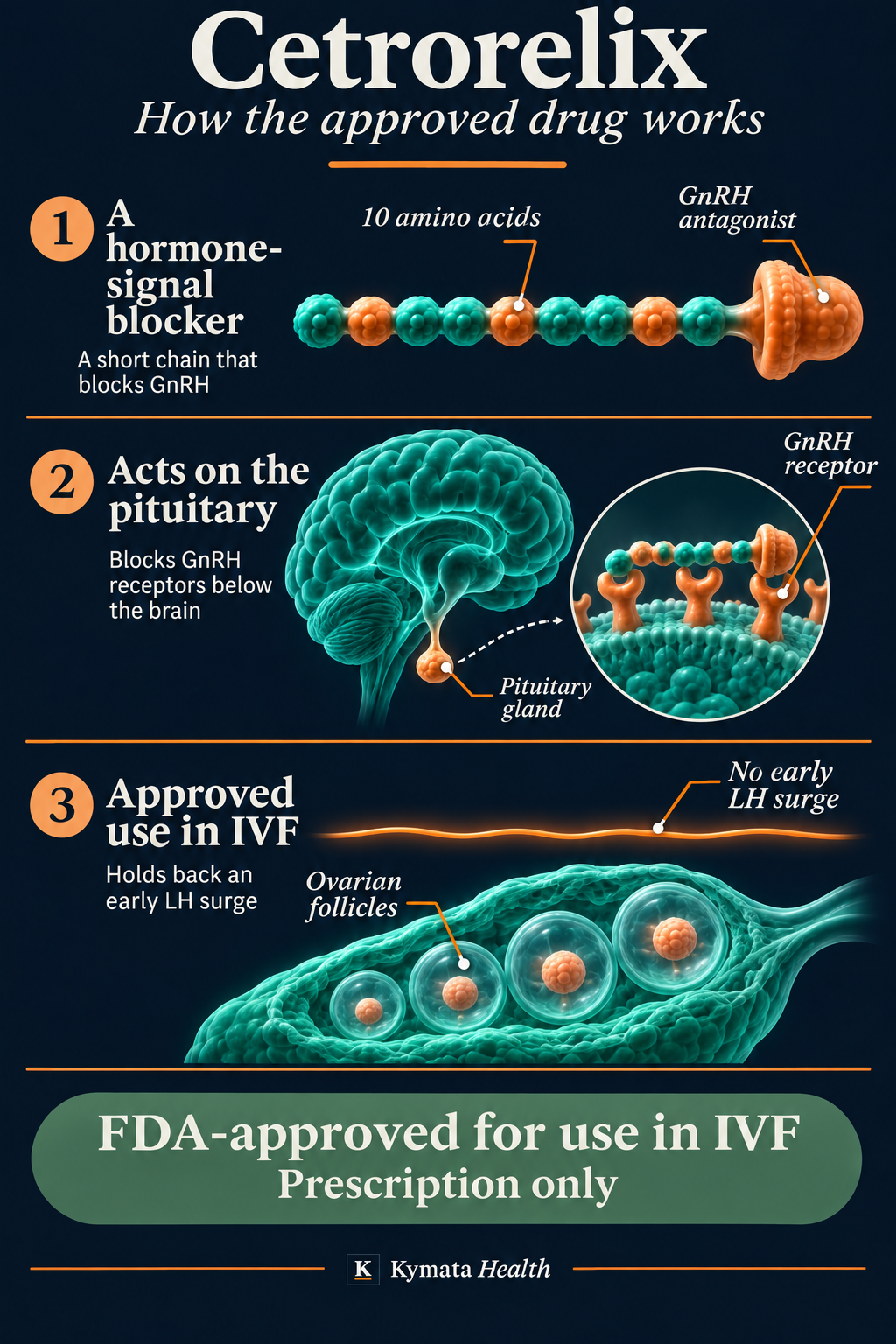
A GnRH-receptor antagonist decapeptide, approved as Cetrotide for use during controlled ovarian stimulation in IVF. It blocks GnRH receptors on the pituitary, lowering LH within hours without the flare seen with GnRH agonists; its label lists anaphylaxis as a risk. FDA-approved as Cetrotide to block a premature LH surge during ovarian stimulation. Prescription only. The drawing is a schematic, not a measured molecular structure, a product photograph or a treatment result. Illustration review: 19 November 2026, against this page’s own mechanism, evidence and regulatory records.
A sequence model is not provided for this record. Read the identity and evidence notes; an illustration does not verify a molecular structure.
Illustration notes and source record
Why delay ovulation when the goal of IVF is to collect eggs?
Keeping the eggs in place. A surge of luteinizing hormone (LH) normally triggers ovulation. During IVF, an early surge could release eggs before collection. Cetrorelix blocks the signal that tells the pituitary gland to release LH.
What the clinic can time. This gives the team time to monitor the follicles and plan the final trigger and egg collection. In two studies of daily Cetrotide, an early LH surge occurred in 1.9% and 1.0% of participants, respectively.
Clinicians track growing follicles on ultrasound. In this illustration they appear as dark circles.
Earlier contextual illustration
Read the source record on this page. Laboratory, topical and injected studies are separate evidence; this illustration does not establish an indication or a treatment outcome.

How it works
SourcedCetrorelix is a GnRH-receptor antagonist: it competes with natural GnRH at pituitary receptors. The Cetrotide label states that each 0.25 mg vial contains 0.26 to 0.27 mg cetrorelix acetate (equivalent to 0.25 mg cetrorelix) supplied with a 1.0 mL prefilled syringe of sterile water, that LH suppression begins about two hours after the 0.25 mg dose without an initial gonadotropin release, and that FSH levels are not affected at the doses used during controlled ovarian stimulation.
FDA approved Cetrotide (cetrorelix acetate for injection) in 2000 for the inhibition of premature LH surges in women undergoing controlled ovarian stimulation. The approved strength of Cetrotide is 0.25 mg cetrorelix per single-use vial, supplied with a 1.0 mL prefilled syringe of sterile water; FDA lists the former 3 mg strength as discontinued. An AP-rated generic cetrorelix acetate 0.25 mg (Xiromed, ANDA 218061) also exists, so Cetrotide is the brand rather than the only product.
Source: Cetrotide label; Albano 2000 (PMID 10686191); Olivennes 2000 (PMID 10685535)
The Cetrotide kit includes a prefilled syringe of 1.0 mL sterile water for injection, and the patient leaflet directs use of the entire prepared contents immediately. Research bulk powder is a different product; this page defaults to the Cetrotide kit.
05 / Evidence and limits
Evidence and limits
Randomized IVF trials and the label’s phase 3 studies
Human evidence
Randomized IVF trials and the label’s phase 3 studies- In a prospective randomized phase III European study of 273 women undergoing IVF or ICSI (Albano 2000, PMID 10686191), 3 of 188 women given cetrorelix (1.6%) had a rise in both LH and progesterone, and fertilization, cleavage and pregnancy rates were similar to those of the 85 women given the GnRH agonist buserelin.
- In the Phase 3 studies summarized in the Cetrotide label, an LH surge (LH at least 10 U/L with progesterone at least 1 ng/mL) after starting treatment occurred in 1.9% of 159 women on the 0.25 mg multiple-dose regimen in an active-comparator study, 1.0% of 303 in a non-comparative study, and 0% of 115 given the single 3 mg dose.
- In a multicenter randomized controlled IVF study of 154 women (Olivennes 2000, PMID 10685535), a single 3 mg cetrorelix injection prevented premature LH surges in all 115 recipients, with fewer oocytes and embryos but pregnancy rates not significantly different from 39 women given depot triptorelin; that 3 mg strength is now discontinued in the US.
- In a retrospective cohort of 173 donor IVF cycles (Mondal 2026, PMID 42897926), premature LH surge or luteinization occurred in 3.3% to 3.6% of cycles with injectable cetrorelix, oral relugolix or oral elagolix, but the study was underpowered to show equivalence and the oral groups yielded fewer mature eggs; relugolix and elagolix are not FDA-labeled for ovarian stimulation.
Use-case scores
0–100–10 against the evidence we have, not a gym ranking. Hidden domains do not apply here.
- Sexual / hormonal7/10Labeled for the inhibition of premature LH surges in controlled ovarian stimulation, with randomized IVF trials (PMID 10686191; PMID 10685535). Clinic kit. Not a testosterone protocol.
Limits of current evidence
2 limits- The label’s five clinical trials enrolled women aged 19 to 40 years (mean 32) and excluded those with polycystic ovary syndrome, low or no ovarian reserve, or stage III-IV endometriosis.
- The label’s Table 2 cohort (159 women, active comparator) is a different group from Albano 2000’s 188 cetrorelix patients; their percentages are not merged.
Trial FinderRecruiting now: 6 open registrations for cetrorelix
What it is studied for
- Controlled ovarian stimulation: High
Verdict
Cetrorelix is the GnRH antagonist in Cetrotide and an AP-rated generic, FDA-approved for the inhibition of premature LH surges in women undergoing controlled ovarian stimulation. In a randomized phase III study of 273 women (Albano 2000, PMID 10686191), 1.6% on cetrorelix had a rise in both LH and progesterone. The label reports anaphylactoid reactions with the first dose.
06 / Product forms and access
Product forms and access
Regulatory & legal status
- FDA status (US)
- ApprovedFDA-approved as Cetrotide® (NDA 021197) for inhibition of premature LH surge in controlled ovarian stimulation
- WADA status (2026)
- Not ListedNot currently on the WADA 2026 Prohibited List. Policies may change. Verify before competition.
- Classification
- Prescription Drug
- US compounding
- Not eligible / not available
07 / Tools and practical checks
Tools and practical checks
Dose it
0.25 mg + 1 mL BAC water → 0.25 mg/mL · 1 unit (U-100) = 2.5 mcg.
Reconstitution math
U-100 syringe| Vial | Water | Concentration |
|---|---|---|
| 0.25 mg lyophilized | 1 mL BAC | 0.25 mg/mL |
08 / Published study use
Published study use
What the label states, for the patients it is approved for, and the source. Not a dose for you.
What the FDA label says
FDA label- The approved strength of Cetrotide is 0.25 mg cetrorelix per single-use vial, supplied with a 1.0 mL prefilled syringe of sterile water; FDA lists the former 3 mg strength as discontinued. Cetrotide label, DailyMed (opens in new tab)
The label’s dosing, for the patients it is approved for; the prescriber sets the dose.
Administration
- Route / form
- Subcutaneous injection (Cetrotide label)
Timeline
2 stages- About 2 hours
The Cetrotide label reports LH suppression beginning about two hours after the 0.25 mg dose, without an initial gonadotropin release.
- After 14 daily doses
The label’s half-life rose from 5.0 hours after one dose to 20.6 hours, in groups of 12 healthy women.
Who it is for
1 use| Category | Fit | What exists |
|---|---|---|
| Controlled ovarian stimulation | High | FDA-labeled for the inhibition of premature LH surges in women undergoing controlled ovarian stimulation; the label’s trials enrolled women aged 19 to 40. |
09 / Safety and interactions
Safety and interactions
What the record says
The Cetrotide label reports hypersensitivity reactions, including anaphylactoid reactions with the first dose. Its contraindications are hypersensitivity to cetrorelix, extrinsic peptide hormones, mannitol or GnRH analogs, known or suspected pregnancy, lactation and severe renal impairment. It records moderate or severe ovarian hyperstimulation syndrome in 33 of 949 women (3.5%) across its clinical studies. That table counts events without regard to causality during stimulated cycles. The label says therapy is prescribed by physicians experienced in fertility treatment.
10 / Comparisons and goal guides
Comparisons and goal guides
There is no separate comparison record on this page. Similar names do not establish that products or their evidence are interchangeable.
11 / Common questions
Common questions
Common questions
7 answersWhat water comes with Cetrotide 0.25 mg?
The Cetrotide kit includes a prefilled syringe of 1.0 mL sterile water for injection, and the patient leaflet directs use of the entire prepared contents immediately.
Can the vial be split across days?
No. The Cetrotide label treats each prepared 0.25 mg vial as a single-use dose, used right after mixing.
How often did LH surges break through in the trials?
In a prospective randomized phase III European study of 273 women undergoing IVF or ICSI (Albano 2000, PMID 10686191), 3 of 188 women given cetrorelix (1.6%) had a rise in both LH and progesterone, and fertilization, cleavage and pregnancy rates were similar to those of the 85 women given buserelin. The label’s own phase 3 table reports 1.9% of 159 women in its active-comparator study.
What about the 3 mg single dose?
In a multicenter randomized controlled IVF study of 154 women (Olivennes 2000, PMID 10685535), a single 3 mg cetrorelix injection prevented premature LH surges in all 115 recipients, with fewer oocytes and embryos but pregnancy rates not significantly different from depot triptorelin. Drugs@FDA lists the 3 mg Cetrotide strength as discontinued; the 0.25 mg strength is the one marketed.
What is cetrorelix’s half-life?
The Cetrotide label reports an elimination half-life of 5.0 hours after a single 0.25 mg subcutaneous dose and 20.6 hours after 14 daily doses, in groups of 12 healthy women. In a separate pharmacokinetic study of 36 healthy women (Duijkers 1998, PMID 9806255), median terminal half-life was 5 to 10 hours after a single dose and 20 to 80 hours with daily dosing.
Is cetrorelix banned in sport?
Cetrorelix is not named on the 2026 WADA Prohibited List, and WADA’s 2026 Monitoring Program, which is not a prohibition, covers GnRH analogues only in females under 18.
Is Cetrorelix FDA-approved?
Yes. FDA-approved as Cetrotide® (NDA 021197) for inhibition of premature LH surge in controlled ovarian stimulation.
12 / Sources and references
Sources and references
5 sources cited on this page.
Sources
5 sources- 1“Ovarian stimulation with HMG: results of a prospective randomized phase III European study comparing the luteinizing hormone-releasing hormone (LHRH)-antagonist cetrorelix and the LHRH-agonist buserelin.”Albano C et al. Human Reproduction (2000). PMID: 10686191 DOI: 10.1093/humrep/15.3.526
- 2“Prospective, randomized, controlled study of in vitro fertilization-embryo transfer with a single dose of a luteinizing hormone-releasing hormone (LH-RH) antagonist (cetrorelix) or a depot formula of an LH-RH agonist (triptorelin).”Olivennes F et al. Fertility and Sterility (2000). PMID: 10685535 DOI: 10.1016/s0015-0282(99)00524-5
- 3“Single and multiple dose pharmacokinetics and pharmacodynamics of the gonadotrophin-releasing hormone antagonist Cetrorelix in healthy female volunteers.”Duijkers IJ et al. Human Reproduction (1998). PMID: 9806255 DOI: 10.1093/humrep/13.9.2392
- 4“Oral gonadotropin-releasing hormone antagonists versus injectable cetrorelix for luteinizing hormone surge prevention in donor in vitro fertilization cycles: a retrospective cohort study of efficacy, embryology, and stimulation dynamics.”Mondal R, Nandi A International Journal of Gynaecology and Obstetrics (2026). PMID: 42897926 DOI: 10.1002/ijgo.71408
- 5“Cetrotide (cetrorelix acetate for injection) prescribing information.”EMD Serono / FDA DailyMed US PI (2025). Prescribing information
14 / Prescription options
Prescription options
Prescription options: compare licensed telehealth providers
Some peptide therapies are available only by prescription after a consult with a licensed clinician.
Compare telehealth →15 / Peptide library
Peptide library
Keep reading: Peptide research library
Peptide research library: every pagePeptide libraryBrowse all topics
- AHK-CuPrevious in this topic · Copper-complexed tripeptide Ala-His-Lys, the GHK-Cu sibling used in hair and cosmetic SKUs.
- OctreotideNext in this topic · Somatostatin analog, FDA-approved in 1988 (Sandostatin) for acromegaly when surgery, irradiation and bromocriptine fall short, and for the diarrhea and flushing of metastatic…
- AdamaxAdamax is a name used for different Semax-related peptides.
- PNC-27PNC-27 is a synthetic, 32-amino-acid peptide studied in cancer cells and mouse models of leukemia.
- Selank + SemaxA brain-imaging study gave 52 healthy participants either Selank, Semax or placebo in separate groups.
Regulatory and sport classification
- FDA-approved