
The peptide field guide
AHK-Cu
Copper tripeptide-3: the amino acids Ala-His-Lys bound to copper.
Cell and cosmetic research only. Human benefit remains unproven.
Explore this compoundConceptual editorial illustration; not a measured molecular structure, product photograph or treatment result.
02 / At a glance
At a glance
Key facts
- Also known as
- Copper tripeptide-3, Ala-His-Lys-Cu, AHK copper peptide
- Type
- Cosmetic Peptide
- Evidence level
- Cell and animal research: human benefit remains unproven.
- US regulatory status
- Not FDA-approved, research chemical
- Updated
Identity
Copper tripeptide-3: the amino acids Ala-His-Lys bound to copper.
Research context
Hair and skin findings come from lab studies; there is no drug approval, and it is a different molecule from GHK-Cu.
Evidence limits
Cell and cosmetic research only. Human benefit remains unproven.
Read the technical profile and study-use reference
Quick answer
Evidence: LowCopper-complexed tripeptide Ala-His-Lys, the GHK-Cu sibling used in hair and cosmetic SKUs. Same copper-peptide class, different sequence. Evidence is mostly in vitro / cosmetic, not a drug program. Reconstitution is the same job as GHK-Cu (often stings).
- In published studies
- No human study published (lab study, PMID 17703734)
Research summary, not medical advice.
At a glance
Kymata peptide profile · Aug 31, 2026- Half-life
- Sparse published PK
- Common vials
- 10 mg / 50 mg
- CAS
- N/A
- In published studies
- No human study published (lab study, PMID 17703734)
- Molecular weight
- Tripeptide–copper complex
03 / Identity and origin
Identity and origin
Also called Copper tripeptide-3, Ala-His-Lys-Cu, AHK copper peptide. Ala-His-Lys copper tripeptide (cosmetic cousin of GHK-Cu).
Read the sequence and compound record
Compound card
- Class
- Ala-His-Lys copper tripeptide (cosmetic cousin of GHK-Cu)
- Formula
- Ala-His-Lys·Cu
- Molecular weight
- Tripeptide–copper complex
- CAS
- N/A
- Described by
- Cosmetic peptide chemistry (Pickart-adjacent copper peptides)
- Bioavailability
- Topical and SC (research/cosmetic)
04 / How it may work
How it may work
Ala-His-Lys copper tripeptide (cosmetic cousin of GHK-Cu)
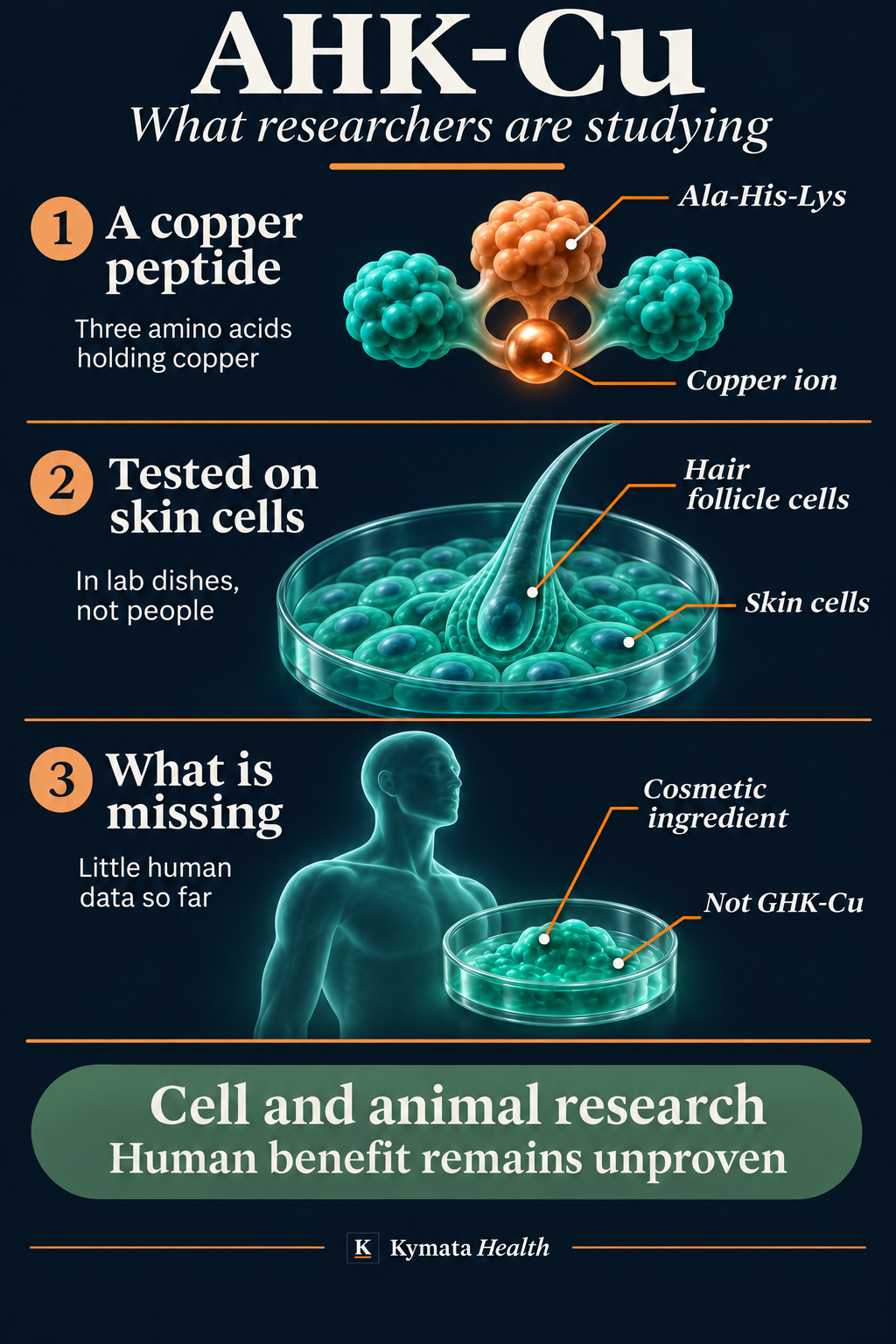
Copper tripeptide-3: the amino acids Ala-His-Lys bound to copper. Hair and skin findings come from lab studies; there is no drug approval, and it is a different molecule from GHK-Cu. Cell and cosmetic research only. Human benefit remains unproven. The drawing is a schematic, not a measured molecular structure, a product photograph or a treatment result. Illustration review: 19 November 2026, against this page’s own mechanism, evidence and regulatory records.
A sequence model is not provided for this record. Read the identity and evidence notes; an illustration does not verify a molecular structure.
Illustration notes and source record
Read the source record on this page. Laboratory, topical and injected studies are separate evidence; this illustration does not establish an indication or a treatment outcome.

How it works
SourcedAHK-Cu is Ala-His-Lys complexed with copper(II), copper tripeptide-3, vs GHK-Cu (Gly-His-Lys-Cu). Cosmetic and hair in-vitro literature exists; there is no drug approval. Injectable reconstitution is the same job as GHK-Cu and often stings.
Source: Copper-tripeptide cosmetic literature adjacent to GHK-Cu PMID: 18644225; AHK-Cu has no FDA monograph
05 / Evidence and limits
Evidence and limits
Limits of current evidence
2 limits- Do not launder GHK-Cu gene-expression counts onto AHK.
- This site will not treat androgenetic alopecia from this page.
What it is studied for
- Hair / cosmetic copper peptide: Low
Verdict
AHK-Cu is a different tripeptide from GHK-Cu. Hair-vendor marketing is not a Pickart reprint. Not minoxidil.
06 / Product forms and access
Product forms and access
Regulatory & legal status
- FDA status (US)
- Research OnlyCosmetic / research copper tripeptide. No FDA drug monograph
- WADA status (2026)
- Not ListedNot currently on the WADA 2026 Prohibited List. Policies may change. Verify before competition.
- US compounding
- Not eligible / not available
07 / Tools and practical checks
Tools and practical checks
Dose it
10 mg + 2 mL BAC water → 5 mg/mL · 1 unit (U-100) = 50 mcg.
Reconstitution math
U-100 syringe| Vial | Water | Concentration |
|---|---|---|
| 10 mg lyophilized | 2 mL BAC | 5 mg/mL |
08 / Published study use
Published study use
What published studies gave, in whom, and the source. Not a dose for you.
What studies used
Lab work only- We found no published human study of AHK-Cu.
- Human hair follicles in the lab: it lengthened follicles and spurred dermal papilla cells at very low concentrations. Pyo 2007, PMID 17703734 (opens in new tab)
- The doses quoted online come from animal work and vendor or forum sources.
A record of what researchers gave, in whom; not a dose for you.
Administration
- Route / form
- Not established: no human study.
Who it is for
1 use| Category | Fit | What exists |
|---|---|---|
| Hair / cosmetic copper peptide | Low | Sibling of GHK-Cu. Evidence is cosmetic-grade, not Phase 3. |
09 / Safety and interactions
Safety and interactions
What the record says
Copper load from repeated injection and zinc balance are the usual GHK-Cu warnings; no human injection study exists. Injection-site pain is commonly reported. Not minoxidil, not finasteride.
10 / Comparisons and goal guides
Comparisons and goal guides
AHK-Cu vs. GHK-Cu
4 attributesCanonical comparison: AHK-Cu vs GHK-Cu · GHK-Cu evidence profile
| Attribute | AHK-Cu | GHK-Cu |
|---|---|---|
| Sequence | Ala-His-Lys-Cu (copper tripeptide-3) | Gly-His-Lys-Cu (copper tripeptide-1) |
| Typical SKU | Hair / cosmetic | Skin / wound / GLOW component |
| Literature | Thinner than GHK-Cu | More published dermal copper-peptide work |
| Mixing | Same copper-peptide sting risk | Known PIP; often extra water |
11 / Common questions
Common questions
Common questions
2 answersAHK-Cu vs GHK-Cu?
Different tripeptide, same copper-peptide class. GHK-Cu has more published dermal literature. AHK-Cu is the hair-SKU sibling.
Is AHK-Cu FDA-approved?
No. Cosmetic / research copper tripeptide. No FDA drug monograph.
12 / Sources and references
Sources and references
No separate record is provided here. Read the linked evidence and limitations for this compound.
14 / Prescription options
Prescription options
Prescription options: compare licensed telehealth providers
Some peptide therapies are available only by prescription after a consult with a licensed clinician.
Compare telehealth →15 / Peptide library
Peptide library
Keep reading: Peptide research library
Peptide research library: every pagePeptide libraryBrowse all topics
- Pentadeca arginatePrevious in this topic · Arginine salt of BPC-157 (the same 15-aa gastric peptide), sold as a distinct SKU from BPC-157 acetate.
- CetrorelixNext in this topic · GnRH antagonist FDA-approved (Cetrotide, 2000) for the inhibition of premature LH surges in women undergoing controlled ovarian stimulation.
- OctreotideSomatostatin analog, FDA-approved in 1988 (Sandostatin) for acromegaly when surgery, irradiation and bromocriptine fall short, and for the diarrhea and flushing of metastatic…
- AdamaxAdamax is a name used for different Semax-related peptides.
- PNC-27PNC-27 is a synthetic, 32-amino-acid peptide studied in cancer cells and mouse models of leukemia.
Regulatory and sport classification
- Not FDA-approved, research chemical