
The peptide field guide
SHLP2
Small humanin-like peptide 2, a peptide encoded in mitochondrial DNA; related to humanin but a separate peptide, and not MOTS-c or SS-31.
Human studies measured the body’s own SHLP2 or an inherited variant; no study has given SHLP2 to people. Not FDA-approved.
Explore this compoundConceptual editorial illustration; not a measured molecular structure, product photograph or treatment result.
02 / At a glance
At a glance
Key facts
- Also known as
- Small humanin-like peptide 2, SHLP-2, MGVKFFTLSTRFFPSVQRAVPLWTNS
- Type
- Mitochondrial
- Evidence level
- Cell and animal research: human benefit remains unproven.
- US regulatory status
- No FDA-approved SHLP2 drug identified
- Updated
Identity
Small humanin-like peptide 2, a peptide encoded in mitochondrial DNA; related to humanin but a separate peptide, and not MOTS-c or SS-31.
Research context
It was characterized with other small humanin-like peptides as a mitochondria-derived peptide with cell-survival and metabolic signals (Cobb 2016); in male mice on a high-fat diet it protected against diet-induced obesity (Kim 2023).
Evidence limits
Human studies measured the body’s own SHLP2 or an inherited variant; no study has given SHLP2 to people. Not FDA-approved.
Read the technical profile and study-use reference
Quick answer
Evidence: LowSHLP2 is a 26-amino-acid peptide reported from the mitochondrial 16S ribosomal RNA region. Human studies measured circulating SHLP2 and linked its inherited K4R variant to lower odds of Parkinson’s disease. Researchers tested the effects of giving SHLP2 in cells and rodents. Not a second humanin, not MOTS-c.
- In published studies
- Human studies measured endogenous SHLP2 or an inherited variant. No human dose is established.
Research summary, not medical advice.
At a glance
Kymata peptide profile · Nov 22, 2026- CAS
- N/A
- In published studies
- Human studies measured endogenous SHLP2 or an inherited variant. No human dose is established.
- Half-life
- Human elimination half-life after administration not established
- Common vials
- Research vial; no sourced vial preset in this calculator
03 / Identity and origin
Identity and origin
Also called Small humanin-like peptide 2, SHLP-2, MGVKFFTLSTRFFPSVQRAVPLWTNS. Small humanin-like peptide 2 (mitochondrial-derived peptide).
Read the sequence and compound record
Compound card
- Sequence
- MGVKFFTLSTRFFPSVQRAVPLWTNS (26 amino acids)
- Class
- Small humanin-like peptide 2 (mitochondrial-derived peptide)
- Formula
- Small humanin-like peptide 2 (26 amino acids)
- CAS
- N/A
- Described by
- Endogenous peptide; identified and characterized by Cobb and colleagues, 2016 paper
04 / How it may work
How it may work
Small humanin-like peptide 2 (mitochondrial-derived peptide)
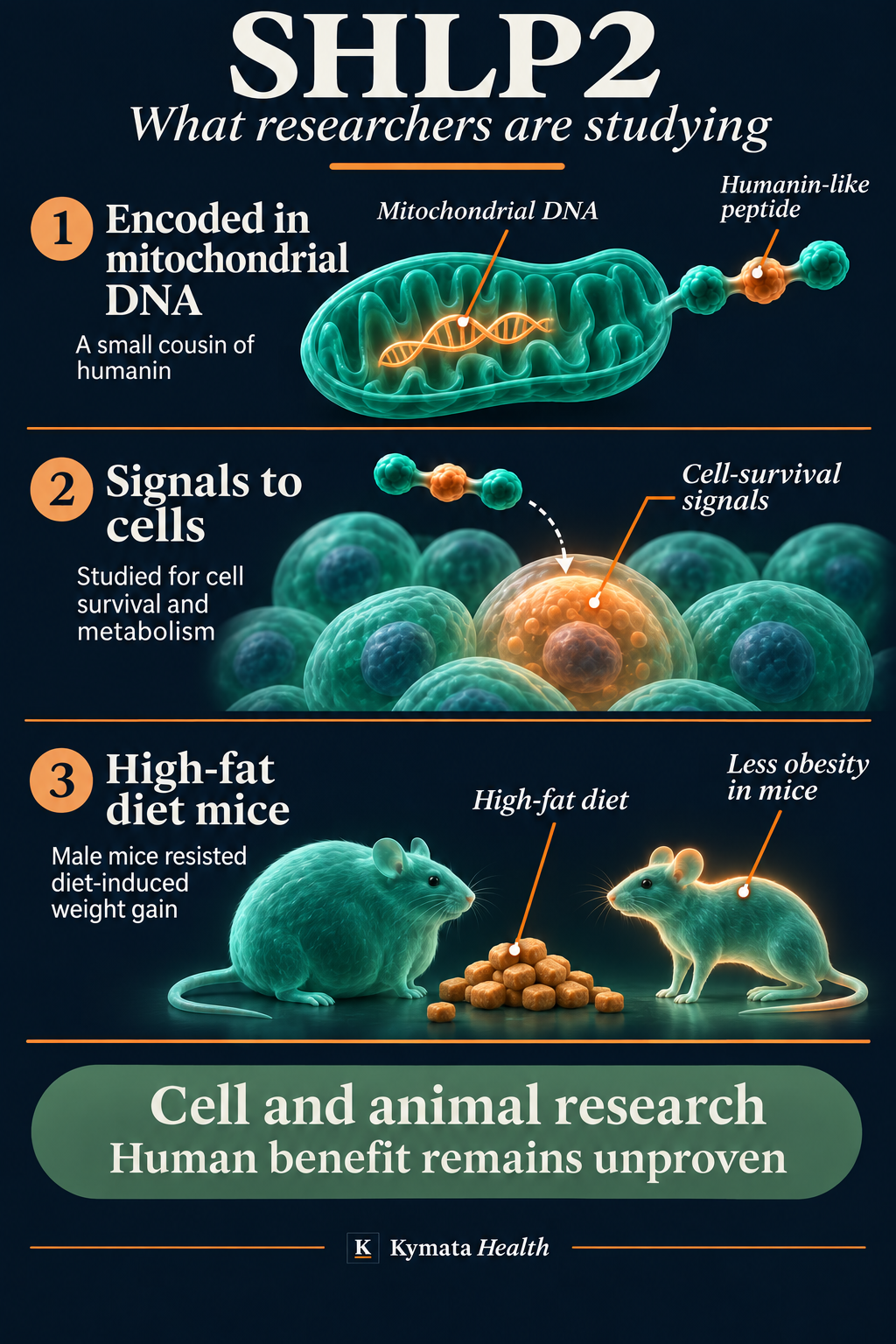
Small humanin-like peptide 2, a peptide encoded in mitochondrial DNA; related to humanin but a separate peptide, and not MOTS-c or SS-31. It was characterized with other small humanin-like peptides as a mitochondria-derived peptide with cell-survival and metabolic signals (Cobb 2016); in male mice on a high-fat diet it protected against diet-induced obesity (Kim 2023). Human studies measured the body’s own SHLP2 or an inherited variant; no study has given SHLP2 to people. Not FDA-approved. The drawing is a schematic, not a measured molecular structure, a product photograph or a treatment result. Illustration review: 19 November 2026, against this page’s own mechanism, evidence and regulatory records.
A sequence model is not provided for this record. Read the identity and evidence notes; an illustration does not verify a molecular structure.
Illustration notes and source record
Read the source record on this page. Laboratory, topical and injected studies are separate evidence; this illustration does not establish an indication or a treatment outcome.

How it works
SourcedSHLP2 is a 26-amino-acid small humanin-like peptide encoded in the mitochondrial 16S ribosomal RNA region, characterized with other SHLPs in Cobb et al. 2016 (PMID 27070352). It is not humanin (24 residues), not MOTS-c, not SS-31.
In conscious Sprague-Dawley rats under hyperinsulinemic-euglycemic clamps (Cobb 2016, PMID 27070352), SHLP2 infused into a brain ventricle raised the glucose infusion rate by roughly 50% and suppressed liver glucose production, and in the same paper plasma SHLP2 was lower in 18-month-old than in 3-month-old mice. In male mice on a high-fat diet (Kim 2023, PMID 37468558), SHLP2 signaled through the receptor CXCR7 and acted on hypothalamic POMC neurons, reducing weight gain and improving insulin sensitivity.
Kim and colleagues (2024, PMID 38167865) detected a tryptic SHLP2 fragment in differentiated human SH-SY5Y neuronal cells by targeted mass spectrometry. None of these experiments administered SHLP2 to people.
Source: Cobb et al. (PMID 27070352), Kim SK et al. (PMID 37468558), Hudson et al. (PMID 23645593) and Kim SJ et al. (PMID 38167865).
05 / Evidence and limits
Evidence and limits
Measurements of the body’s own SHLP2 or an inherited variant · no human administration study
Human evidence
Measurements of the body’s own SHLP2 or an inherited variant · no human administration study- In the human part of Kim 2023 (PMID 37468558), serum SHLP2 was lower in 6 men with obesity and 7 with diabetes than in 7 healthy men. In 125 Chinese adults without diagnosed type 2 diabetes or cardiovascular disease (Sequeira 2021, PMID 34419510), plasma SHLP2 was higher in the 26 participants with metabolic syndrome and rose with waist circumference and liver fat. These studies enrolled different groups and do not establish a diagnostic cutoff.
- In a two-stage association study of 3,074 people with Parkinson’s disease and 5,659 matched controls (Hudson 2013, PMID 23645593), the mitochondrial variant m.2158T>C was associated with reduced Parkinson’s risk in both the discovery and the replication cohort. Kim and colleagues (2024, PMID 38167865) found that this variant changes SHLP2 residue 4 from lysine to arginine (K4R). The participants inherited the variant; they did not receive a peptide.
- Among 200 men undergoing prostate biopsy at one VA hospital (Xiao 2017, PMID 29212276), lower serum SHLP2 was associated with higher prostate-cancer risk in White men, with no significant association in Black men. In a separate group of 198 men (Ramirez-Torres 2022, PMID 35789022), higher plasma SHLP2 was associated with lower risk in European American men, with no significant association in African American men. Neither study validated a screening test or treated cancer with SHLP2.
- Comparing placentas and serum from women with gestational diabetes and normoglycemic controls after cesarean delivery (Dagli 2026, PMID 42453115), researchers found lower humanin and SHLP2 levels in both serum and placenta in the gestational-diabetes group.
Limits of current evidence
3 limits- Cobb and colleagues found lower plasma SHLP2 in 18-month-old mice than in 3-month-old mice (PMID 27070352). They did not test whether giving the peptide prolongs life.
- In MPTP-treated mice, both wild-type SHLP2 and K4R restored striatal dopamine, while only K4R preserved striatal tyrosine hydroxylase (PMID 38167865).
- The K4R form degraded more slowly than wild type in transfected HEK293 cells (PMID 38167865). That is not an elimination half-life after an injection in a person.
What it is studied for
- MDP identity: Low
Verdict
Scientists have measured SHLP2 in human blood and tissue, and an inherited variant has been linked to lower Parkinson’s risk. Animal experiments show effects on insulin sensitivity and on dopamine after toxin exposure. We found no study giving SHLP2 to people.
06 / Product forms and access
Product forms and access
Regulatory & legal status
- FDA status (US)
- Research OnlyDrugs@FDA returned no approved drug under SHLP2 or humanin. Mitochondrial ORF peptide (humanin-like); no FDA program
- WADA status (2026)
- Not ListedThe WADA 2026 list does not name SHLP2. Its S0 class covers pharmacological substances without approval for human therapeutic use. Verify before competition.
- Classification
- Research Chemical
- US compounding
- Not eligible / not available
07 / Tools and practical checks
Tools and practical checks
No separate record is provided here. Read the linked evidence and limitations for this compound.
08 / Published study use
Published study use
What published studies gave, in whom, and the source. Not a dose for you.
What studies used
Human measurements and animal dosing studies- Investigators measured the body’s own SHLP2 in blood from men with obesity, men with diabetes and healthy men; the same paper gave SHLP2 to high-fat-fed male mice, which gained less weight. No person was given SHLP2. Kim 2023, PMID 37468558 (opens in new tab)
- SHLP2 was infused into a brain ventricle in rats during an insulin clamp. No human dosing or clearance result came from this experiment. Cobb 2016, PMID 27070352 (opens in new tab)
A record of what researchers gave, in whom; not a dose for you.
Administration
- Route / form
- Studies administered SHLP2 to rodents. No human route or dose was established in the records reviewed.
Who it is for
1 use| Category | Fit | What exists |
|---|---|---|
| MDP identity | Low | Sibling to humanin in the catalog sense. Different ORF peptide. |
09 / Safety and interactions
Safety and interactions
What the record says
Measurements of naturally occurring SHLP2 and its inherited variant do not establish the safety of an injected product. The reviewed studies give no human adverse-event rate for administered SHLP2. Unknown SKU identity on gray-market vials.
10 / Comparisons and goal guides
Comparisons and goal guides
SHLP2 vs. Humanin
4 attributesCanonical comparison: SHLP2 vs Humanin · Humanin evidence profile
| Attribute | SHLP2 | Humanin |
|---|---|---|
| Identity | Small humanin-like peptide 2 (26 amino acids) | Humanin (24-aa MDP) |
| Paper | Cobb et al. 2016 (PMID 27070352) | Hashimoto / MDP discovery trail |
| After interval exercise in 10 men | No change in plasma (Woodhead 2020, PMID 32271093) | Rose in plasma and muscle (same study) |
| Dose transfer | No human administration study | No human dosing study |
11 / Common questions
Common questions
Common questions
5 answersIs SHLP2 the same peptide as humanin?
No. SHLP2 has 26 amino acids and humanin has a separate 24-amino-acid sequence. In 10 young men after high-intensity interval cycling (PMID 32271093), humanin rose in plasma and muscle while SHLP2 did not change.
Did SHLP2 prevent Parkinson’s disease in people?
No study has tested that. Carriers of the inherited variant that changes SHLP2 to K4R had lower Parkinson’s risk (PMIDs 23645593, 38167865). The peptide was given only to MPTP-treated mice, where both forms restored striatal dopamine while only K4R preserved striatal tyrosine hydroxylase.
What did the SHLP2 weight study test?
Male mice on a high-fat diet gained less weight after receiving SHLP2 (PMID 37468558). The human part of the study only measured the body’s own SHLP2 in blood.
Is there a human dose or half-life for SHLP2?
No. The experiments gave SHLP2 to rats and mice. We found no human administration study that measured a dose, safety or elimination half-life.
Is SHLP2 FDA-approved?
No. Drugs@FDA returned no approved drug under SHLP2 or humanin. Mitochondrial ORF peptide (humanin-like); no FDA program.
12 / Sources and references
Sources and references
9 papers cited on this page.
Sources
9 papers- 1“Naturally occurring mitochondrial-derived peptides are age-dependent regulators of apoptosis, insulin sensitivity, and inflammatory markers.”Cobb LJ et al. Aging (Albany NY) (2016). PMID: 27070352 DOI: 10.18632/aging.100943
- 2“Mitochondria-derived peptide SHLP2 regulates energy homeostasis through the activation of hypothalamic neurons.”Kim SK et al. Nat Commun (2023). PMID: 37468558 DOI: 10.1038/s41467-023-40082-7
- 3“Plasma mitochondrial derived peptides MOTS-c and SHLP2 positively associate with android and liver fat in people without diabetes.”Sequeira IR et al. Biochim Biophys Acta Gen Subj (2021). PMID: 34419510 DOI: 10.1016/j.bbagen.2021.129991
- 4“Two-stage association study and meta-analysis of mitochondrial DNA variants in Parkinson disease.”Hudson G et al. Neurology (2013). PMID: 23645593 DOI: 10.1212/WNL.0b013e318294b434
- 5“A naturally occurring variant of SHLP2 is a protective factor in Parkinson's disease.”Kim SJ et al. Mol Psychiatry (2024). PMID: 38167865 DOI: 10.1038/s41380-023-02344-0
- 6“Low circulating levels of the mitochondrial-peptide hormone SHLP2: novel biomarker for prostate cancer risk.”Xiao J et al. Oncotarget (2017). PMID: 29212276 DOI: 10.18632/oncotarget.20134
- 7“Racial differences in circulating mitochondria-derived peptides may contribute to prostate cancer health disparities.”Ramirez-Torres A et al. Prostate (2022). PMID: 35789022 DOI: 10.1002/pros.24398
- 8“High-intensity interval exercise increases humanin, a mitochondrial encoded peptide, in the plasma and muscle of men.”Woodhead JST et al. J Appl Physiol (1985) (2020). PMID: 32271093 DOI: 10.1152/japplphysiol.00032.2020
- 9“Altered placental expression of small humanin-like peptides in gestational diabetes mellitus.”Dagli S et al. Ups J Med Sci (2026). PMID: 42453115 DOI: 10.48101/ujms.v131.14142
14 / Prescription options
Prescription options
Prescription options: compare licensed telehealth providers
Some peptide therapies are available only by prescription after a consult with a licensed clinician.
Compare telehealth →15 / Peptide library
Peptide library
Keep reading: Peptide research library
Peptide research library: every pagePeptide libraryBrowse all topics
- Orexin-APrevious in this topic · Endogenous 33-aa wake peptide (hypocretin-1).
- GPL ManNext in this topic · GPL Man is a boxed Cytomed-style geroprotector kit, not a peptide.
- GPL FemmeGPL Femme is a boxed geroprotector kit: thyroid, vessels, brain, liver, and pineal (Thyreogen, Ventfort, Cerluten, Svetinorm, Endoluten).
- PinalexPinalex is two commercial eye products: Pinalex Tab, an oral supplement with a retinal peptide complex (AA-6) plus carotenoids and vitamins, and Pinalex Eye Balm for eyelid skin.
- MariTideAmgen investigational antibody-peptide conjugate (AMG 133 / MariTide): GIP receptor antagonist plus GLP-1 receptor agonism, studied on a monthly-class schedule in obesity programs.
Regulatory and sport classification
- No FDA-approved SHLP2 drug identified