
The peptide field guide
Vesilut
Vesilut (Vesilute), the short synthetic bladder peptide on the Khavinson cytogen list, usually listed as Glu-Asp; not Chitomur and not Vesugen.
A Russian clinical report. Not yet confirmed in Western trials. Not FDA-approved.
Explore this compoundConceptual editorial illustration; not a measured molecular structure, product photograph or treatment result.
02 / At a glance
At a glance
Key facts
- Also known as
- Vesilute, VESILUT, Bladder Cytogen, Glu-Asp bladder peptide, Везилют
- Sequence
- ED
- Evidence level
- Russian clinical studies: not yet confirmed in Western trials.
- US regulatory status
- Not FDA-approved, research chemical
- Updated
Identity
Vesilut (Vesilute), the short synthetic bladder peptide on the Khavinson cytogen list, usually listed as Glu-Asp; not Chitomur and not Vesugen.
Research context
A Russian institute report compared Vesilut plus usual care with usual care alone in men with prostate conditions and reported on urinary symptoms, including nighttime bathroom trips; it did not establish how much Vesilut added.
Evidence limits
A Russian clinical report. Not yet confirmed in Western trials. Not FDA-approved.
Read the technical profile and study-use reference
Quick answer
Evidence: LowVesilut has the reported residue sequence ED. The sequence identifies the order of amino acids. The package label identifies the formulation and its intended use.
- Class and target
- Cytogen (synthetic short peptide) · Urinary bladder · sequence ED
- In published studies
- No human dosing study published
Research summary, not medical advice.
At a glance
Kymata peptide profile · Nov 21, 2026- Documented forms
- Oral capsule
- Molecular weight
- 262.22 g/mol
- CAS
- N/A
- In published studies
- No human dosing study published
- Half-life
- Not established in humans
03 / Identity and origin
Identity and origin
Also called Vesilute, VESILUT, Bladder Cytogen, Glu-Asp bladder peptide, Везилют. Khavinson cytogen (ED).
Read the sequence and compound record
Compound card
- Sequence
- ED
- Class
- Khavinson cytogen (ED)
- Formula
- C9H14N2O7 (Glu-Asp)
- Molecular weight
- 262.22 g/mol
- CAS
- N/A
- PubChem CID
- 99716
- Described by
- Vladimir Khavinson, St. Petersburg Institute of Bioregulation, 1990s
- Bioavailability
- Not measured in people; the 2008 report used swallowed capsules
04 / How it may work
How it may work
Khavinson cytogen (ED)
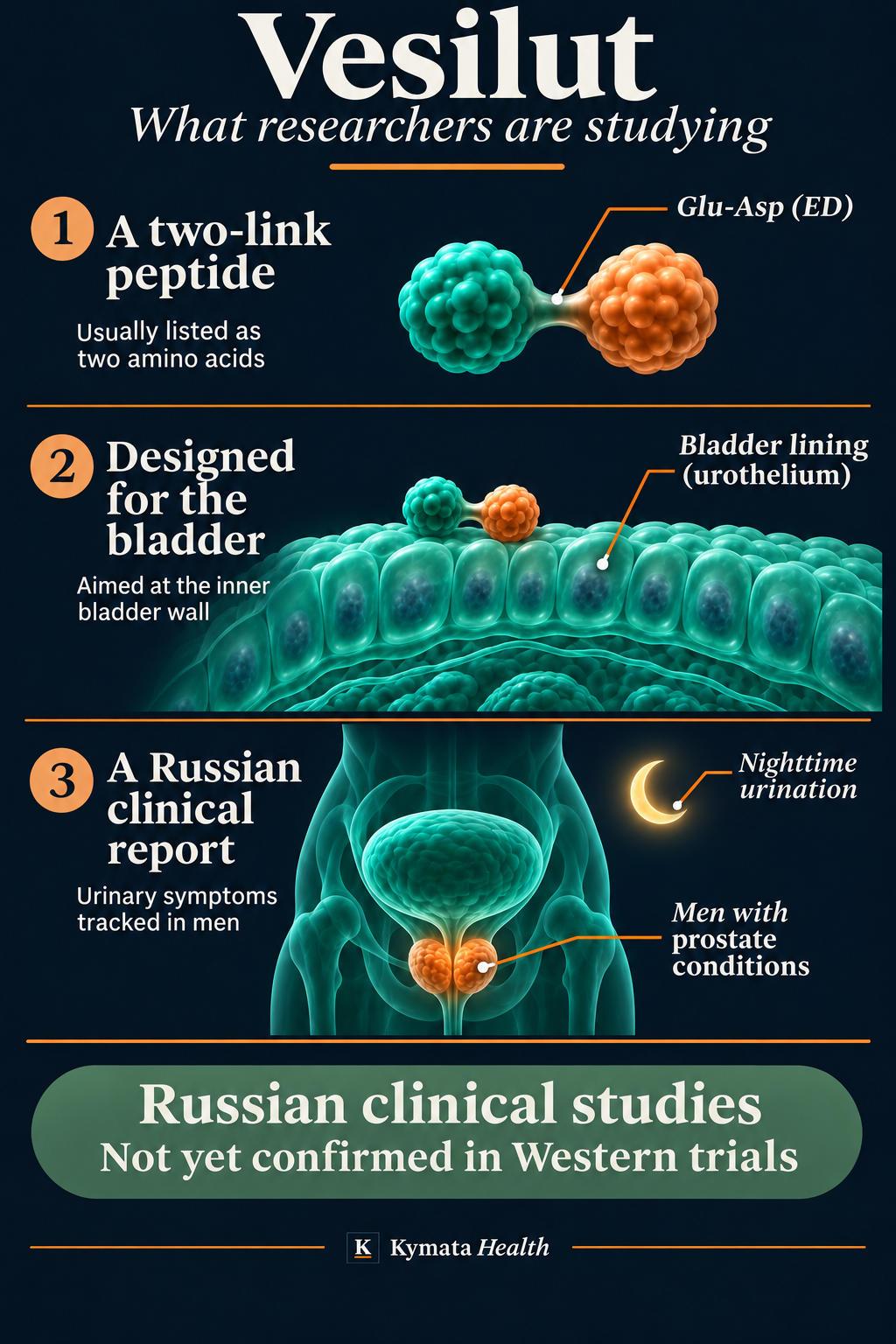
Vesilut (Vesilute), the short synthetic bladder peptide on the Khavinson cytogen list, usually listed as Glu-Asp; not Chitomur and not Vesugen. A Russian institute report compared Vesilut plus usual care with usual care alone in men with prostate conditions and reported on urinary symptoms, including nighttime bathroom trips; it did not establish how much Vesilut added. A Russian clinical report. Not yet confirmed in Western trials. Not FDA-approved. The drawing is a schematic, not a measured molecular structure, a product photograph or a treatment result. Illustration review: 19 November 2026, against this page’s own mechanism, evidence and regulatory records.
A sequence model is not provided for this record. Read the identity and evidence notes; an illustration does not verify a molecular structure.
Illustration notes and source record
Did men taking Vesilut capsules make fewer trips to the bathroom at night?
Who took the capsules. An institute studied Vesilut capsules alongside usual care in men with prostate conditions. Among the 20 men with enlarged prostates, 13 took the capsules and seven received usual care alone.
Nighttime trips to the bathroom. After treatment, the groups averaged 2.0 nighttime trips with added capsules and 2.9 with usual care alone. The report gives one starting average and no test comparing the two final numbers. The finding applies to the studied capsules.
The bladder wall contracts to push urine through its outlet.
Earlier contextual illustration
Read the source record on this page. Laboratory, topical and injected studies are separate evidence; this illustration does not establish an indication or a treatment outcome.

How it works
Vesilut (Vesilute) is listed by its developers as the dipeptide Glu-Asp (ED); its capsule label names an AKS-M complex of glutamic and aspartic acid. Khavinson and colleagues’ 2022 review of peptide transport (PMID 35887081) lists docking scores to the LAT1 carrier for named peptides, including Vesilut (ED) and Cardiogen (AEDR); it enrolled no patients and measured no absorption. It is not Chitomur (the bladder Cytomax extract), not Pielotax (kidney Cytomax) and not Vesugen (KED, vessels). No study has tested any of them together.
Vesilut product forms
Form labels checked Nov 7, 2026Vesilut has the reported residue sequence ED. The sequence identifies the order of amino acids. The package label identifies the formulation and its intended use.
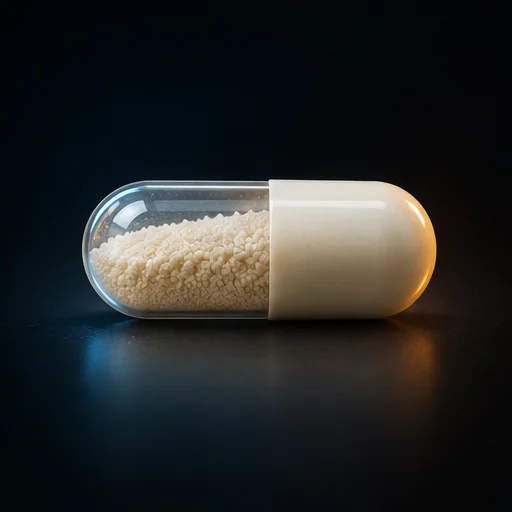
Oral capsule
The pack label states the ingredient and strength per capsule. Capsule contents are not for injection.
Vesilut capsule pack listingIllustrations show the type of packaging. Check the name, contents and route on the actual pack.
Inside the study
A manufacturer-hosted report compared oral Vesilut capsules plus usual care with usual care alone in men with prostate conditions. The researchers reported urinary symptoms, including nighttime bathroom trips. A later Chitomur report repeats every value of its prostate-adenoma table, so the comparison does not establish how much benefit the capsules added.
Institute report, Table 3 ↗05 / Evidence and limits
Evidence and limits
One small report · its table reappears in a Chitomur report
Human evidence
One small report · its table reappears in a Chitomur report- The institute’s 2008 report says it randomized 57 men aged 37-69 with chronic prostatitis (37) or prostate adenoma (20) to oral Vesilut plus usual care for 20-30 days (36) or usual care alone (21), without describing concealment or blinding.
- In the 2008 report’s Table 3 for men with prostate adenoma, nighttime voids fell from a pooled 3.7 to 2.0 with added Vesilut and 2.9 with usual care (neither marked significant), and mean urine flow rose from 13.5 to 19.4 mL/s versus 15.1 mL/s, with stars only against baseline.
- The institute’s March-November 2011 Chitomur report (animal bladder-wall extract) describes 18 treated and 10 control men aged 45-62 with BPH and 31 women with overactive bladder (22 treated, 9 control), and its Table 2 repeats every value and error term of Vesilut’s Table 3, as well as the 88.3%, 93.2%, 74.8% and 26.7% figures.
- Russian patent RU2367467C2 reports 67 older adults with frequent urination randomized to intramuscular H-Glu-Asp-OH (42) or usual care (25), with nighttime voids falling from 5.8 to 1.4 versus 5.5, and a separate example in 56 patients aged 24-45 with chronic prostatitis.
Limits of current evidence
4 limits- The institute’s March-November 2011 Chitomur report (animal bladder-wall extract) describes 18 treated and 10 control men aged 45-62 with BPH and 31 women with overactive bladder (22 treated, 9 control), and its Table 2 repeats every value and error term of Vesilut’s Table 3, as well as the 88.3%, 93.2%, 74.8% and 26.7% figures.
- The 2008 report says it randomized the men but describes no concealment or blinding, and its stars compare only against baseline.
- Russian patent RU2367467C2 used injected free Glu-Asp, a different preparation and route from the capsules.
- Vesilut (ED, bladder) and Vesugen (KED, vessels) are different peptides with similar names.
What it is studied for
- Bladder tissue (research): Low
Verdict
Vesilut is a Glu-Asp (ED) peptide product sold as oral capsules for the bladder and urinary tract. Its human record is a 2008 institute report in 57 men with prostate conditions, and a later Chitomur report repeats every value of its prostate-adenoma table, so no reliable onset or effect size exists.
06 / Product forms and access
Product forms and access
Regulatory & legal status
- FDA status (US)
- Research OnlyBladder cytogen (Vesilut). Distinct from Chitomur (extract) and Vesugen (KED vessels). Not an OAB drug
- WADA status (2026)
- Not ListedNot currently on the WADA 2026 Prohibited List. Policies may change. Verify before competition.
- US compounding
- Not eligible / not available
Cytogen (synthetic short peptide) · Urinary bladder
Identity
Canonical 41- Class
- Cytogen (synthetic short peptide)
- Organ
- Urinary bladder
- Target
- Bladder
- System
- Urinary
- Sequence
- ED · Glu-Asp (ED), as listed by the developers (PMID 35887081, Table 2); the label lists AKS-M (Glu, Asp)
In these Khavinson catalog sets
1 setManufacturer-style organ combinations, not FDA protocols. Every name links to its own page.
The Khavinson school
Vesilut is filed here as cytogen (synthetic short peptide), targeting the urinary bladder. Khavinson's St. Petersburg group moved from organ extracts (Cytamins) to capsule complexes (Cytomaxes) to synthetic short peptides (Cytogens); most of the evidence comes from that one group, with little independent Western replication.
Read the full background, the proposed epigenetic mechanism, the literature limits, and how we count the canonical 41 on the Khavinson bioregulators index.
History of this molecule
This page exists because the 41 is incomplete without it. e-peptide: “VESILUT - bladder peptide.” US catalogs skip it, then people invent a kidney cytogen that is not on the poster.
The developers list Vesilut as Glu-Asp (ED) in a 2022 review’s docking table (PMID 35887081); the capsule label names an AKS-M complex of glutamic and aspartic acid.
Chitomur is the complex. Vesugen is vessels (KED), another V-name trap.
A defined sequence is not an FDA indication. Bladder cytogens sit in a Russian experimental-gerontology literature with limited Western replication. “Oral bioavailability because PEPT1” is real peptide-transport biology; it is not proof this SKU treats the organ disease. A purity chromatogram alone cannot identify a peptide sequence or establish that a preparation is sterile. Name collision with Vesugen (vessels) is how wrong vials get shipped.
Full 41-map: Khavinson bioregulators index · Khavinson catalog sets
07 / Tools and practical checks
Tools and practical checks
No separate record is provided here. Read the linked evidence and limitations for this compound.
08 / Published study use
Published study use
What published studies gave, in whom, and the source. Not a dose for you.
What studies used
Small institute report on capsules- A 2008 institute report followed 57 men with chronic prostatitis or prostate adenoma for 20 to 30 days: 36 took oral Vesilut capsules alongside usual care and 21 received usual care alone. A 2011 Chitomur report repeats every value of its adenoma table.
- Russian patent RU2367467C2 describes 67 older adults with frequent urination randomized to intramuscular free Glu-Asp (42) or usual care (25), with nighttime voids falling from 5.8 to 1.4 versus 5.5.
- The doses quoted online come from animal work and vendor or forum sources.
A record of what researchers gave, in whom; not a dose for you.
Administration
- Route / form
- Oral capsule. The pack label states the ingredient and strength per capsule. Capsule contents are not for injection.
Who it is for
1 use| Category | Fit | What exists |
|---|---|---|
| Bladder tissue (research) | Low | Cytogen pair to Chitomur. Not mirabegron. Not a kidney peptide. |
09 / Safety and interactions
Safety and interactions
What the record says
Research peptide / Cytomed cytogen. Not FDA-approved. Sequence identity on gray-market vials is unverified without HPLC. Do not confuse with Vesugen.
10 / Comparisons and goal guides
Comparisons and goal guides
There is no separate comparison record on this page. Similar names do not establish that products or their evidence are interchangeable.
11 / Common questions
Common questions
Common questions
9 answersWhich forms of Vesilut are documented, and which instructions apply to each?
Oral capsule. The pack label states the ingredient and strength per capsule. Capsule contents are not for injection.
Vesilut vs Vesugen vs Chitomur vs Pielotax?
Vesilut = bladder cytogen (ED). Vesugen = KED vessel cytogen. Chitomur = bladder Cytomax. Pielotax = kidney Cytomax.
Why is this missing on other sites?
Western research-chem SEO copied each other’s 20-peptide lists. NPCRIZ still sells Vesilut.
Sequence?
Glu-Asp (ED), as listed by the developers (PMID 35887081). Do not assume KED (that is Vesugen).
Are the Vesilut and Chitomur results independent?
No. The 2011 Chitomur report repeats every value and error term of the 2008 Vesilut report’s adenoma table, so neither result can be attributed to one product.
OAB drug?
Not mirabegron. See urology for overactive bladder.
What did the Vesilut study find?
In the 2008 report’s Table 3 for men with prostate adenoma, nighttime voids fell from a pooled 3.7 to 2.0 with added Vesilut and 2.9 with usual care (neither marked significant), and mean urine flow rose from 13.5 to 19.4 mL/s versus 15.1 mL/s, with stars only against baseline.
Why does the Chitomur report match the Vesilut report?
The institute’s March-November 2011 Chitomur report (animal bladder-wall extract) describes 18 treated and 10 control men aged 45-62 with BPH and 31 women with overactive bladder (22 treated, 9 control), and its Table 2 repeats every value and error term of Vesilut’s Table 3, as well as the 88.3%, 93.2%, 74.8% and 26.7% figures. Identical tables under two product names cannot be counted as evidence for either one.
Is Vesilut FDA-approved?
No. Bladder cytogen (Vesilut). Distinct from Chitomur (extract) and Vesugen (KED vessels). Not an OAB drug.
12 / Sources and references
Sources and references
4 papers cited on this page.
Sources
4 papers- 1“Transport of biologically active ultrashort peptides using POT and LAT carriers (review with a docking table).”Khavinson V et al. International Journal of Molecular Sciences (2022). PMID: 35887081
- 2“Vesilut in chronic prostatitis and prostate adenoma, signed report (Russian).”St. Petersburg Institute of Bioregulation and Gerontology Institute report (2008).
- 3“Chitomur report, Mar-Nov 2011 (male table identical to the Vesilut report).”St. Petersburg Institute of Bioregulation and Gerontology Institute report (2011).
- 4“Patent RU2367467C2: Glu-Asp in urinary disorders.”Khavinson VKh and colleagues (inventors) Russian patent (2009).
14 / Prescription options
Prescription options
Prescription options: compare licensed telehealth providers
Some peptide therapies are available only by prescription after a consult with a licensed clinician.
Compare telehealth →15 / Peptide library
Peptide library
← Back to Peptide LibraryKhavinson catalog sets
Keep reading: Peptide research library
Peptide research library: every pagePeptide libraryBrowse all topics
- ChitomurPrevious in this topic · Chitomur is a Cytomax capsule bioregulator, a peptide fraction from animal bladder tissue; published work on it comes mostly from the developers' own Russian studies of bladder…
- ChonlutenNext in this topic · Chonluten (Glu-Asp-Gly) is a short synthetic peptide (cytogen) from the Khavinson group; its published studies, mostly Russian cell and animal work, examined bronchial and lung…
- CerlutenCerluten is a Cytomax capsule bioregulator, a peptide fraction from animal brain tissue; published work on it comes mostly from the developers’ own Russian reports, including a…
- EndolutenEndoluten is a Cytomax capsule bioregulator, a peptide fraction from animal pineal glands; published work on it comes mostly from the developers' own Russian studies of the…
- GlandokortGlandokort is a Cytomax capsule bioregulator, a peptide fraction from animal adrenal tissue; published work on it comes mostly from the developers' own Russian studies of adrenal…
Regulatory and sport classification
- Not FDA-approved, research chemical