Search
Conceptual render of a chromosome with its telomere caps highlighted.

Thymogen (Glu-Trp): Two Amino Acids, a Russian Drug, and One US Trial

What Thymogen (Glu-Trp) is, where it came from, what has been studied, and why big Western trials are rare. Educational only. Not medical advice.

By Kymata Health EditorialPublished 8 min read5 sourcesNo paid links in this articleEducation, not medical advice

Quick answer

Thymogen is a chain of just two amino acids, glutamic acid and tryptophan (Glu-Trp). It is registered as a drug in Russia and is not approved in the United States. The same sequence, as IM862, went through one 202-person randomized placebo-controlled US trial in a cancer setting, where it did not beat placebo (PMID 15598977). That trial says nothing about aging or other peptides.

Researched and written by Kymata Health EditorialSources cited inlineHow we checkReport an error

Evidence limit

Evidence limit: This article covers what we could verify in English-language, PubMed-indexed sources about one short peptide, Thymogen (Glu-Trp). The human data we could check come from a US cancer program, including one 202-person placebo-controlled trial. We did not review Russian-language clinical papers for this piece. Nothing here is a study of aging or general immunity, and nothing here speaks for other Khavinson peptides. None of these materials is FDA-approved.

Educational only. Not medical advice.

Key takeaways

  • Thymogen is a chain of just two amino acids: glutamic acid and tryptophan, written Glu-Trp or EW. In the Khavinson catalog it counts as a Cytogen, one of the short synthetic peptides.
  • Its roots are in thymus research in Russia. In Russia it is registered as a drug. In the United States it is not approved for anything.
  • The same two-amino-acid sequence was developed in the US under the name IM862 as a possible cancer drug. It went through one 202-person, randomized, placebo-controlled trial. In that cancer setting it did not beat placebo (PMID 15598977).
  • That trial answered a cancer question. It cannot tell us anything about aging, “immune support,” or any other peptide.
  • Big randomized trials of short natural sequences are rare, and money is one likely reason. That explains why the evidence is thin. It is not a reason to assume the peptide works, and it is not a reason to assume it doesn’t.

What Thymogen is

Take two amino acids, the building blocks of proteins. Join them. You have a dipeptide, the smallest peptide there is.

Thymogen is that. Glutamic acid plus tryptophan, Glu-Trp, or “EW” in the one-letter shorthand. It is a defined molecule: the same two pieces, in the same order, every time.

It is part of the catalog built over decades by Vladimir Khavinson and colleagues in St. Petersburg. That catalog has two main families. The Cytomaxes are extracts from animal organs, complex mixtures with no single defined sequence. The Cytogens are short synthetic peptides, usually two to four amino acids, with a defined chain. Thymogen is a Cytogen.

It helps to keep the thymus names apart, because they get tossed together in threads. Thymalin is a thymus extract. Vilon is a different dipeptide (Lys-Glu). Thymosin alpha-1 is a 28-amino-acid drug and is not part of the Khavinson catalog at all. Thymogen is none of those, and a result for one does not carry over to the others. Record 05 goes through the four side by side.

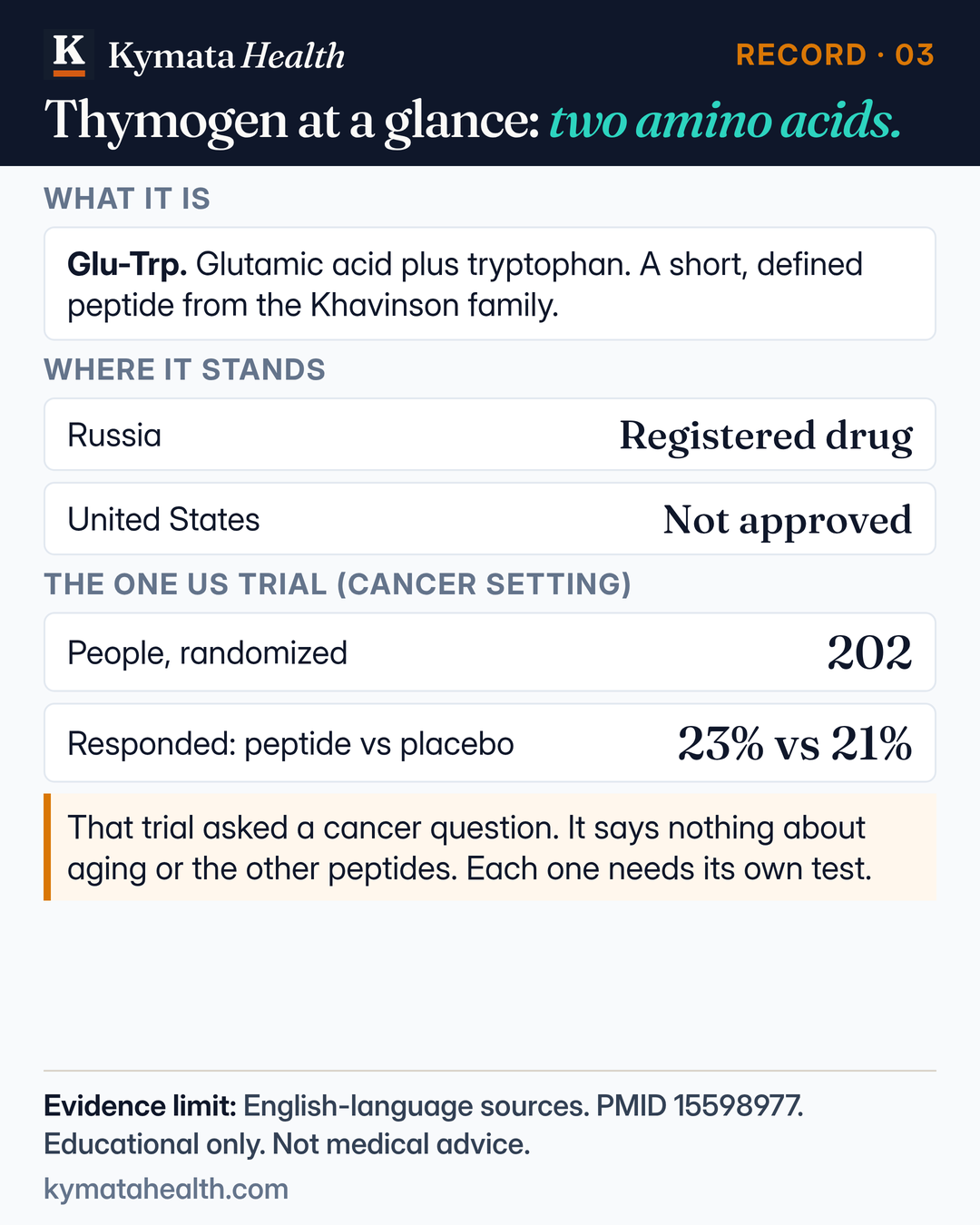
Stacked "Thymogen at a glance" graphic for phones: Glu-Trp is a short defined peptide from the Khavinson family; registered drug in Russia, not approved in the US; one 202-person randomized US trial in a cancer setting, 23% versus 21% responded, and it says nothing about aging or other peptides.
Two amino acids, one US trial in a cancer setting. It says nothing about aging or other peptides.

Where it came from

The US trial paper gives a short history. The compound was originally isolated in Russia from bovine thymus, during a search for substances that could boost immune responses. The paper describes lab and animal work showing it can block the growth of new blood vessels, and says it was later developed as a possible treatment for a cancer called Kaposi sarcoma.

In Russia, Thymogen is registered as a drug. That is a fact about Russian medicine rules: a regulator there lists it as a drug. It is not a US finding that the peptide is safe or effective, and it is not the same as a large controlled test.

What the Russian clinical literature on Thymogen reports in detail is something we did not review for this article. We would rather say that than guess.

The one US trial

Here is the part of the story that sits in English-language journals, and we will give it to you straight.

Earlier phase I and II studies had reported little toxicity and a 36% response rate in people with AIDS-related Kaposi sarcoma, a cancer. That is the usual reason a drug moves forward: an early signal that looks encouraging. It is also the usual reason a bigger, controlled trial is needed.

So the AIDS Malignancy Consortium ran one. It was randomized, double-blind, and placebo-controlled: 202 people, 104 on IM862 and 98 on placebo, for 24 weeks or until the cancer progressed. IM862 was given through the nose. (Noy, Scadden, Lee and colleagues, Journal of Clinical Oncology, 2005; PMID 15598977; ClinicalTrials.gov NCT00003879.)

What came out:

  • Tumor response: 23% on IM862 and 21% on placebo (P = .46). No complete responses in either group. Those two numbers are basically a tie.
  • Time before the cancer progressed: a median of 16 weeks on IM862 and 35 weeks on placebo (P = .012).
  • Still progression-free at 24 weeks: 42% on IM862 and 61% on placebo.
  • Serious side effects (grade 3 or 4): 16% on IM862 and 20% on placebo.

The authors concluded that, at the dose and route they used, IM862 was not better than placebo and might speed progression. They also pointed out something important. In this group of patients, modern HIV treatment (antiretroviral therapy, or HAART) can by itself shrink the tumors as the immune system recovers, and HAART alone was linked to a substantial rate of lasting tumor response. The authors argued that this may have helped make the earlier, uncontrolled response numbers look better than they were.

That last point is a good lesson on its own, and it has nothing to do with this peptide in particular. When people are also getting other treatment, a small study without a control group can make almost anything look like it works.
What that trial can and can’t tell us

It tells us one specific thing: in this cancer, at this dose and route, a two-amino-acid peptide did not beat a placebo in a randomized, double-blind trial.

It does not tell us:

  • that Thymogen has been tested for aging or for everyday immune health. It has not been tested that way in a trial of this kind.
  • that other Khavinson peptides “don’t work.” Different molecules need their own tests.
  • that the thymus extract Thymalin, or any other item in the catalog, has been disproven.

And it does not tell us the opposite either. We did not find a later Western trial that changed the result. A foreign drug registration doesn’t cancel a trial result, and a trial result doesn’t cancel a foreign registration. They answer different questions.

Tiny doors for tiny peptides: PEPT1 and PEPT2

Here’s a question people ask. If a peptide is just a short chain of amino acids, how would it get into the body at all?

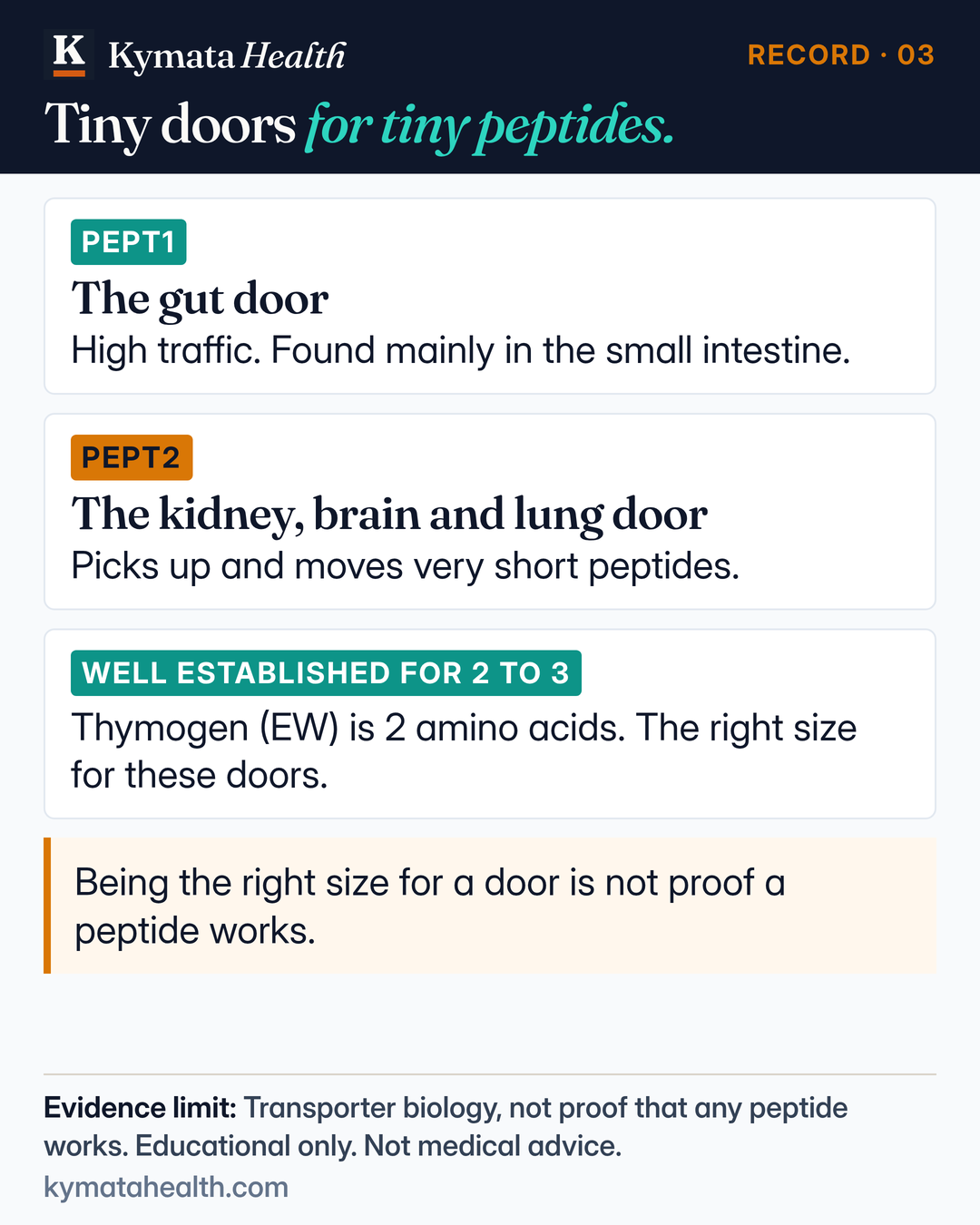
Part of the answer is that the body already has built-in doors for very short peptides. They’re proteins in cell walls called PEPT1 and PEPT2. Think of them as tiny doors that let very short peptides in (PMIDs 14977407, 23506874).

PEPT1 works mainly in the gut. PEPT2 is found mainly in the kidneys, brain and lungs (PMIDs 18668438, 36139448).

They work as a pair. PEPT1 is the high-traffic door that takes up short peptides at the gut. PEPT2 is the more sensitive door that picks them up and moves them around in the kidney and brain. That’s why they matter here: they’re the best-known reason very short chains can get into cells at all.

How does this fit Thymogen? Thymogen (EW) is two amino acids. Well established for chains of two and three amino acids, which is the right size for these doors. What isn’t established is that Thymogen itself uses them. We haven’t found a published human uptake study for it.

To be clear about what this does and doesn’t show: it’s background biology about how short peptides can travel. It doesn’t show that Thymogen reaches its target tissue, and it doesn’t show that it works.

Stacked graphic for phones: tiny doors for tiny peptides. PEPT1 works mainly in the gut and PEPT2 in the kidney, brain and lung. Thymogen: well established size range, but not shown to use the doors. Not proof that any peptide works.
PEPT1 and PEPT2 move very short peptides into cells. That is not proof that any peptide works.

Why there aren’t more big trials

If you have wondered why a peptide with this much history has so few large Western trials, there is a plain answer, and it is not a conspiracy.

A large randomized trial costs a great deal of money. Short natural sequences are hard to protect with a patent. When nobody can own the result, few companies want to pay for the trial. That is our reading of the incentives, not a quote from a paper, but it matches how drug development usually works.

So a thin record is not automatically a weak record. It is a young one, built mostly from small, early studies. What we can say fairly is that most human reports in this family are small, mostly from Russian groups, and not yet repeated by independent teams. That is early evidence. It is a reason to stay curious and careful, and a reason to ask for better tests, not a reason to say it is proven.

Educational only. Not medical advice. This article describes what published sources reported. It is not a recommendation to start, stop, or use any substance, and it is not a substitute for care from a licensed clinician.

Questions

What is Thymogen?

A two-amino-acid peptide, glutamic acid plus tryptophan (Glu-Trp), listed as a Cytogen in the Khavinson catalog.

Is it the same as IM862?

Yes, the same sequence. IM862 is the name it carried in the US cancer program.

Was it tested in a proper trial?

One did, in a cancer setting: 202 people, randomized, placebo-controlled. Response was 23% versus 21%, and time to progression was shorter on the drug (PMID 15598977).

Does that settle whether it works for anything else?

No. That trial asked a cancer question and cannot speak for other uses.

Is it approved?

It is registered as a drug in Russia. It is not FDA-approved in the United States.

Does this article recommend using it?

No. It is a record of what has been studied. It is not medical advice.

Medical disclaimer: This article is for educational and informational purposes only. It does not constitute medical advice. Consult a qualified healthcare provider before using any peptide.

Share this article

References

  1. 1Angiogenesis inhibitor IM862 is ineffective against AIDS-Kaposi’s sarcoma in a phase III trial, but demonstrates sustained, potent effect of highly active antiretroviral therapyNoy A, Scadden DT, Lee J, Dezube BJ, Aboulafia D, Tulpule A, Walmsley S, Gill P, J Clin Oncol. 2005 · PMID: 15598977 · DOI: 10.1200/JCO.2005.11.043
  2. 2Molecular and integrative physiology of intestinal peptide transportDaniel H, Annu Rev Physiol. 2004 · PMID: 14977407
  3. 3Peptide transporters and their roles in physiological processes and drug dispositionRubio-Aliaga I, Daniel H, Xenobiotica 2008 · PMID: 18668438
  4. 4Proton-coupled oligopeptide transporter family SLC15Smith DE, Clémençon B, Hediger MA, Mol Aspects Med. 2013 · PMID: 23506874
  5. 5Biology of Peptide Transporter 2 in MammalsWang C, Chu C, Ji X, et al., Cells 2022 · PMID: 36139448

Educational only. Not medical advice.

We earn a commission on some links. That never changes a rank. How we make money: kymatahealth.com/affiliate-disclosure.