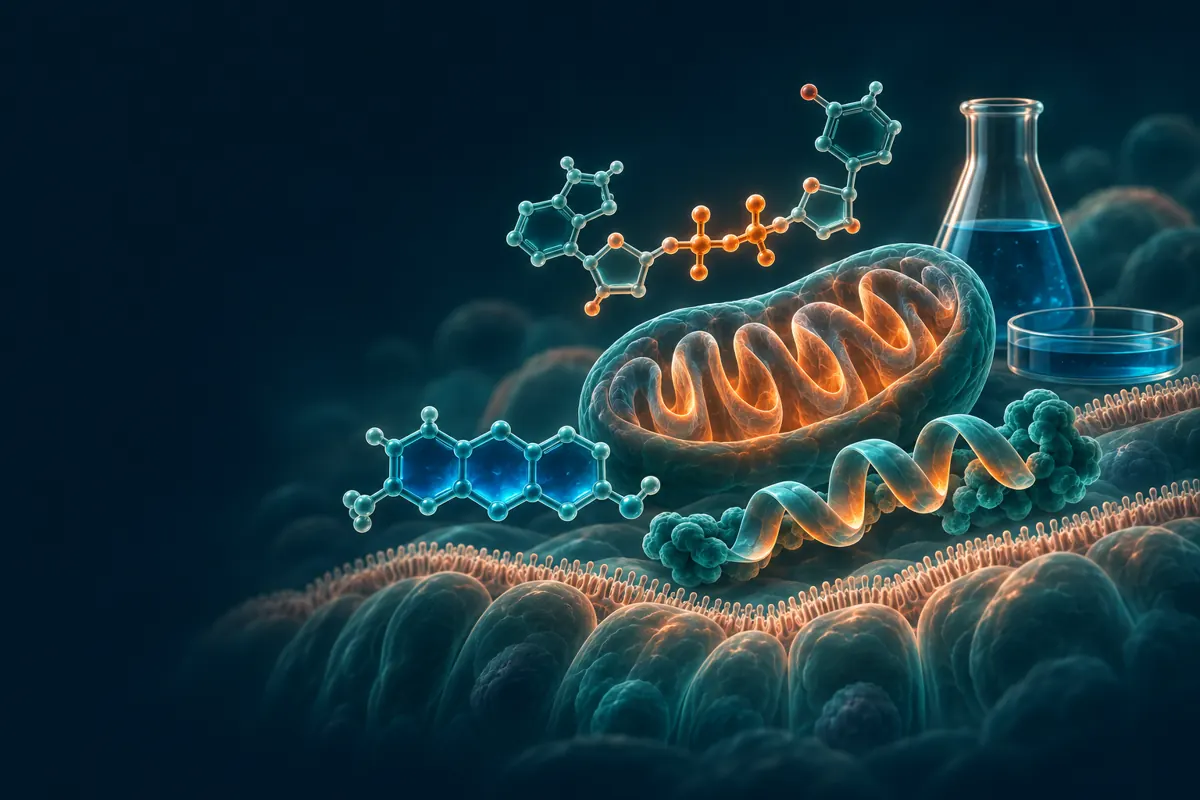
Methylene Blue: The 130-Year-Old Mitochondrial Drug
Methylene blue (methylthioninium chloride) was synthesized in 1876 and has been used medically for over a century (for malaria, methemoglobinemia, urinary tract infections, and as a surgical dye). It is on the WHO's List of Essential Medicines. And in the last decade, it has been repurposed as a mitochondrial enhancer with remarkable bioenergetic properties.
The mechanism is elegant. Methylene blue functions as an alternative electron carrier in the mitochondrial electron transport chain (ETC). Normally, electrons flow from Complex I → ubiquinone → Complex III → cytochrome c → Complex IV → oxygen. If Complex I or III is damaged or inefficient (as occurs with aging), electrons leak, producing superoxide radicals. Methylene blue can accept electrons from NADH at Complex I and donate them directly to cytochrome c, effectively bypassing damaged portions of the ETC.
In cell and animal studies, this electron-shuttle function is proposed to let methylene blue: (1) support ATP production even when ETC complexes are partially dysfunctional, (2) reduces electron leak and ROS production by providing an alternative path, (3) cycles between its oxidized form (blue) and reduced form (colorless) continuously: it is a renewable catalyst, not a one-time antioxidant. Cell and animal work suggests low concentrations behave differently from high ones; no human trial has tested an oral dose for mitochondrial enhancement. Its FDA-approved use is methemoglobinemia: the ProvayBlue label sets an IV dose, given in hospital care.
NAD+ Precursors: Fueling the Cellular Engine
NAD+ (nicotinamide adenine dinucleotide) is the essential cofactor for mitochondrial energy production and for sirtuins, the "longevity enzymes" that regulate DNA repair, gene expression, and cellular stress response. NAD+ levels decline approximately 50% between ages 40 and 60. This decline is now considered a hallmark of aging.
NAD+ precursor supplementation aims to restore youthful NAD+ levels. The three main precursors: (1) NMN (nicotinamide mononucleotide): the immediate precursor to NAD+, converted by the enzyme NMNAT. In one trial, 80 healthy middle-aged adults took 300, 600 or 900 mg of NMN by mouth once a day for 60 days, and blood NAD+ rose (PMID 36482258); in postmenopausal women with prediabetes, NMN for 10 weeks raised muscle insulin sensitivity (PMID 33888596). (2) NR (nicotinamide riboside): converted to NMN and then to NAD+ via a two-step pathway. The CHROMADEX study and others have confirmed dose-dependent NAD+ elevation. (3) Niacin (nicotinic acid/B3): the original NAD precursor, effective but dose-limited by flushing. Each precursor has different tissue distribution, bioavailability, and side effect profiles.
The peptide connection: NAD+ is the fuel. Mitochondria are the engine. If the engine is structurally damaged (cardiolipin oxidation, ETC disassembly), adding more fuel alone is insufficient. This is why the combination of NAD+ precursors with mitochondrial-targeted peptides (SS-31, MOTS-c) represents a mechanistically complementary approach.
The “Mitochondrial Stack” Sold Online
The "mitochondrial stack" sold online combines three mechanistically distinct interventions: (1) SS-31 (elamipretide): structural repair of the inner mitochondrial membrane, stabilizing ETC supercomplex organization. (2) NAD+ precursor (NMN or NR): substrate restoration for the ETC and sirtuin enzymes. (3) Methylene blue: alternative electron carrier that bypasses damaged ETC components and provides a renewable antioxidant shuttle.
The pitch is that each component addresses a different bottleneck. No study has tested any combination, so any synergy is theoretical, and we give no combined protocol. SS-31 is FDA-approved only for Barth syndrome (Forzinity); methylene blue’s FDA label is for methemoglobinemia.
Other supplements sold alongside: CoQ10 and PQQ (dietary supplements, each with its own product label) and MOTS-c, which has no human dosing study (PMID 25738459). No study has tested any combination.
What Studies Used, and Monitoring
Methylene blue: no human trial has tested an oral dose for mitochondrial enhancement; the FDA label sets an IV dose for methemoglobinemia, given in hospital care (ProvayBlue label). Pharmaceutical-grade methylene blue (USP grade, >98% purity) differs from industrial grade, which can contain heavy metals. It turns urine blue-green. FDA has warned of serotonin syndrome when methylene blue is given to people taking serotonergic drugs such as SSRIs, SNRIs and MAOIs, because methylene blue inhibits MAO-A (FDA Drug Safety Communication, 2011).
NAD+ precursors: in an NMN trial, 300 to 900 mg by mouth once a day for 60 days raised blood NAD+ (PMID 36482258). NMN and NR are sold as supplements with their own product labels.
Monitoring: no lab panel has been validated for judging these compounds. Standard metabolic panels track overall health; organic acids and lactate/pyruvate testing are specialist tests for diagnosed mitochondrial disease. Use the Kymata Health reconstitution calculator for vial math only.
Questions
Is methylene blue a peptide?
No. Methylene blue is a synthetic compound (phenothiazine dye), not a peptide. It comes up in peptide stacking discussions because it can carry electrons in the mitochondrial ETC; no study has tested it with SS-31 or NAD+ precursors.
Can I combine methylene blue with NAD+ IV?
No study has tested the combination. Methylene blue’s FDA label sets an IV dose for methemoglobinemia, given in hospital care, and IV NAD+ has only small studies with notable side effects (PMID 41704678).
Medical disclaimer: This article is for educational and informational purposes only. It does not constitute medical advice. Consult a qualified healthcare provider before using any peptide.