Search
Conceptual render of a chromosome with its telomere caps highlighted.

The 41 Khavinson Bioregulators: What Was Actually Tested, and How Strong That Evidence Is

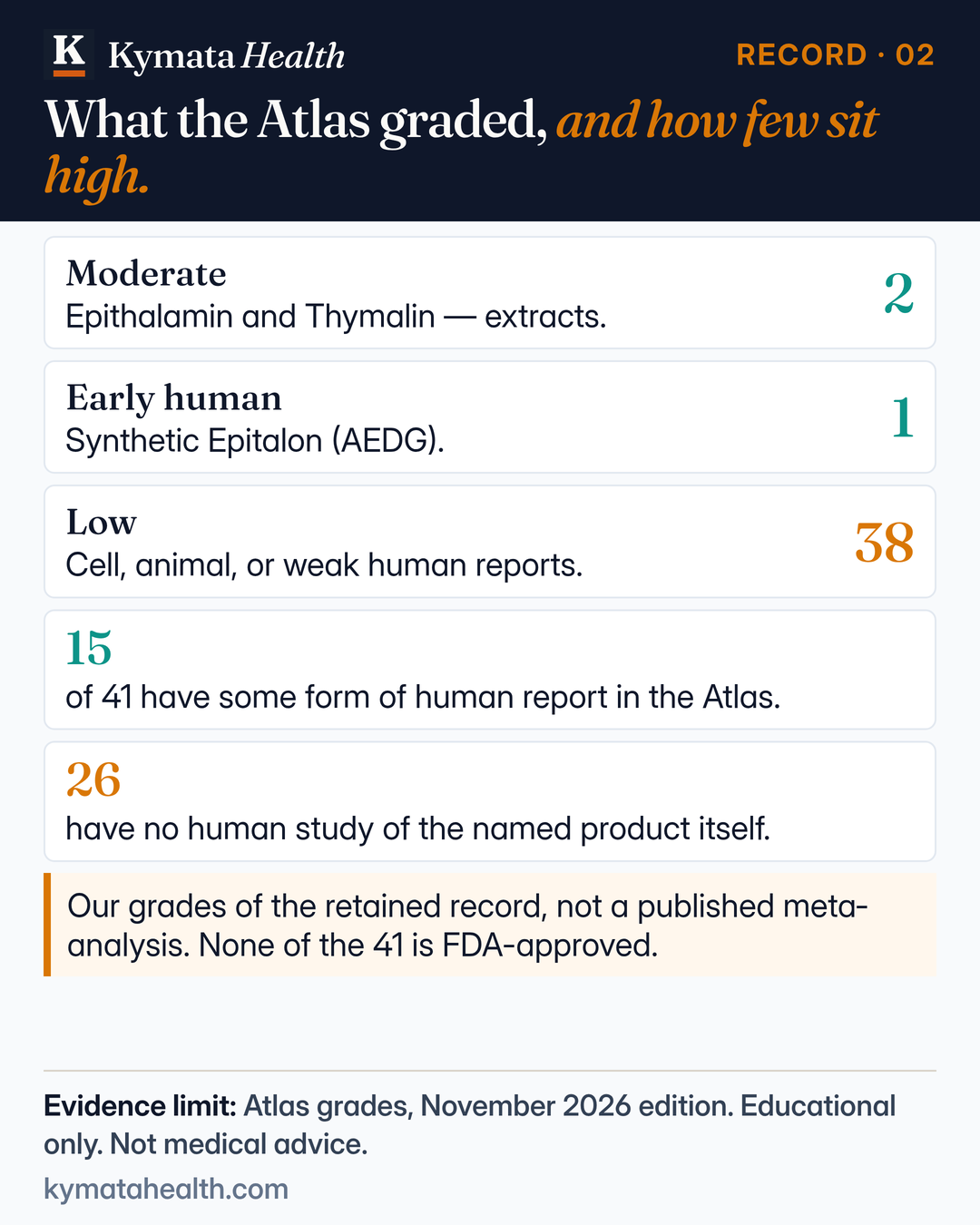
The Atlas maps 41 items in three classes. Tiers: 2 Moderate, 1 Early human, 38 Low. Evidence does not transfer across classes. Not medical advice.

By Kymata Health EditorialPublished 9 min read6 sourcesNo paid links in this articleEducation, not medical advice

Quick answer

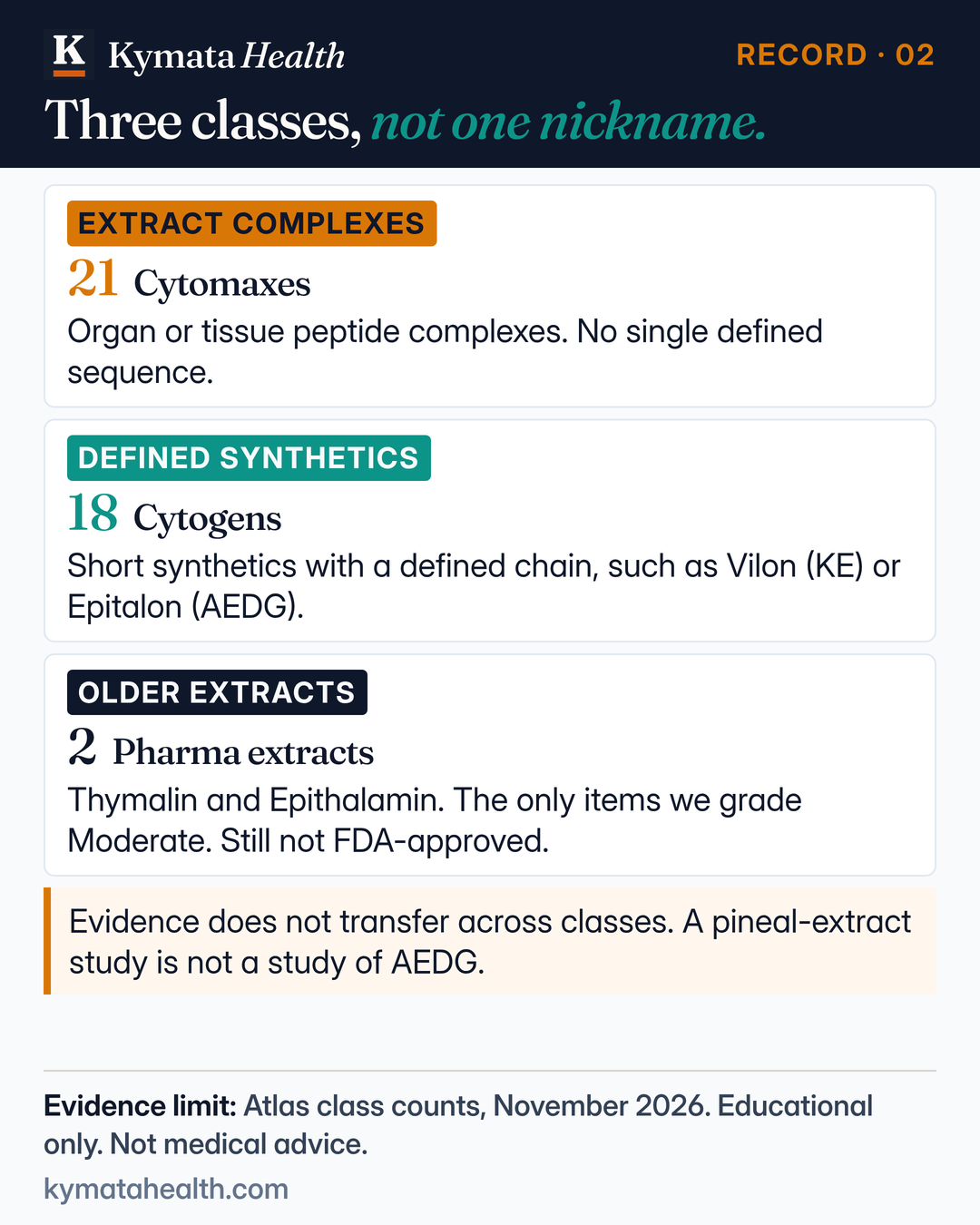
The Atlas maps 41 Khavinson bioregulators in three classes: 21 Cytomaxes (extract complexes), 18 Cytogens (defined short synthetics) and 2 pharmaceutical extracts. Two reach our Moderate tier, one is Early human and 38 are Low. Evidence does not transfer across classes, and none of the 41 is FDA-approved.

Researched and written by Kymata Health EditorialSources cited inlineHow we checkReport an error

Evidence limit

Evidence limit: The counts and tiers in this article are from our Khavinson Atlas: 41 mapped items, of which two reach our Moderate tier (the extracts Epithalamin and Thymalin), one sits in Early human (synthetic Epitalon), and 38 are Low. Most of the underlying literature is Russian, often small or developer-linked, and largely unreplicated in independent Western trials. None of the 41 is FDA-approved. This is a map of what was tested, not a recommendation to use anything.

Educational only. Not medical advice.

Key takeaways

  • The Atlas maps 41 canonical Khavinson bioregulators, grouped by tissue. They are not one kind of thing. Twenty-one are Cytomaxes (organ-extract complexes with no single defined sequence). Eighteen are Cytogens (short synthetic peptides with a defined chain). Two (Thymalin and Epithalamin) are older pharmaceutical extracts.
  • A result on one class does not transfer to another. A study of a pineal extract is not a study of the synthetic tetrapeptide designed to mimic it. Record 01 covered that citation error in detail.
  • Our evidence tiers, assigned from what was actually measured: 2 Moderate, 1 Early human, 38 Low. We record some form of human report for 15 of the 41; for 26, the retained record is cell or animal work, or we found no study of the named product itself.
  • The one large, independent Western phase III in this family (Glu-Trp, Thymogen’s sequence, tested as IM862) did not beat placebo in AIDS-related Kaposi sarcoma (PMID 15598977). That trial asked an oncology question, not an aging one. It is the subject of Record 03.
  • None of the 41 is approved by the U.S. Food and Drug Administration. A foreign registration or a patent is not US proof of safety or efficacy.

How to use this page, and the Atlas

Most of what is written about “Khavinson peptides” either sells them or dismisses them as a block. This page does neither. It is a written companion to the free Khavinson Atlas: a 30-page PDF that sorts the same 41 items by tissue, records what was measured, and says, page by page, how thin that record is.

The Atlas is ungated. It contains no doses, vendors, or buy links. It rates evidence, not products. Corrections go on our corrections page.

This article explains the map: the three classes, the tiers we use, the citation errors the map is meant to prevent, and the limits that apply to every row.

Stacked class counts for phones: 21 Cytomaxes (extract complexes), 18 Cytogens (defined short synthetics), and 2 pharmaceutical extracts. Evidence does not transfer across classes.
Class counts as of the November 2026 Atlas edition. A result on one class does not transfer to another.

Three classes, not one family nickname

“Khavinson bioregulator” is a research-program label, not a chemical identity. The 41 items fall into three classes in the Atlas.

Cytomaxes (21 of 41) are described as natural peptide complexes from a named organ or tissue: liver, thymus, vessels, cartilage, and so on. They do not have a single defined amino-acid sequence. A study of one extract does not establish a result for a different organ’s extract, and it does not establish a result for a synthetic chain that was later associated with that organ.

Cytogens (18 of 41) are short synthetic peptides, usually two to four amino acids, with a defined sequence: Vilon (KE), Thymogen (EW), Vesugen (KED), Pinealon (EDR), Cartalax (AED), Epitalon (AEDG), and the rest of the 18. These are defined molecules. They are still not interchangeable with each other, and they are not interchangeable with the extracts in the same tissue aisle.

Pharmaceutical extracts (2 of 41) sit slightly apart: Thymalin, a calf-thymus extract registered as a drug in Russia, and Epithalamin, a pineal extract. These two have the largest human follow-ups in the map, and they are the only items we grade Moderate. They are still extracts, still developer-linked in those reports, and still not FDA-approved.

The idea that a short peptide taken by mouth reliably reaches a target organ because of PEPT1 transporters is a hypothesis. We have not found a published human pharmacokinetic study that tests that claim for these products. Until such a study exists, tissue labels on a map are a filing system, not proof of delivery.

Stacked Atlas evidence tiers for phones: 2 Moderate (extracts), 1 Early human (synthetic Epitalon), and 38 Low. Fifteen of 41 have some human report; 26 have none of the named product itself.
Atlas evidence tiers: 2 Moderate, 1 Early human, 38 Low. None of the 41 is FDA-approved.

How the Atlas grades the 41

The tiers answer one question: what, if anything, was tested in people, and how strong is that record?

Moderate (2): Epithalamin and Thymalin. Both are extracts. Their main human record is a 266-person, 6- to 8-year report from developer-linked institutes in St. Petersburg and Kiev (PMID 14523363).

Epithalamin also has a 15-year follow-up of 79 older coronary patients (PMID 22451889): 26 of 39 who had received the extract plus usual care, and 16 of 40 who had received usual care alone, were alive at 15 years.

Those papers are real, and they have real limits: small arms behind the headline “266,” crude mortality ratios, no independent replication in PubMed, and, as Record 01 documented, a citation habit of attaching them to synthetic Epitalon, which they did not test. “Moderate” on our scale means “a human outcome record worth reading closely,” not “settled” or “approved.”

Early human (1): Epitalon, the synthetic tetrapeptide AEDG. What has been tested with AEDG includes telomerase work in cultured cells (PMID 12937682), a mouse lifespan study in which mean lifespan did not change (PMID 14501183), a 2025 independent cell-line paper that later required a figure correction, and a 2002 developer-linked clinical report in retinal disease.

We have not found a Western randomized controlled trial, a human dose-finding study, or a measured human half-life. That is a narrower record than the extract cohorts, and it is a different material.

Low (38). This is most of the map. For 26 of the 41, the Atlas records no human study of the product itself, only tissue-targeted cell or animal work, often from the developer’s institute, or no study of the named product at all.

The remaining items in this tier have some human report, usually small, often uncontrolled or confounded, and not independently replicated. A human report is not the same as a well-controlled trial.

Vilon’s 520-person paper (Trofimova, Trofimov and Ivko, Vrach 2021) is a useful example: a large sample, developer-run, not indexed in PubMed, with immune markers compared with each group’s own baseline rather than between groups. We reviewed that paper separately. Size is not the same as design.

These tiers are ours. They are a reading of the retained record, dated and open to correction if a primary paper shows we have missed something.
Two errors the map is built to catch

The first is the material error. The 266-person and 15-year papers tested Epithalamin, a pineal extract, not synthetic Epitalon. Record 01 is the close read. If a thread treats those citations as Epitalon evidence, the map has already failed its first job.

The second is the “one family, one result” error. Thymogen (Glu-Trp) is the only sequence in this set with a large, independent Western phase III behind it. As IM862, it was tested in 202 people with AIDS-related Kaposi sarcoma (Noy et al., Journal of Clinical Oncology, 2005, PMID 15598977).

Response was 23% versus 21% on placebo. Median time to progression was shorter on the drug, 16 weeks versus 35 weeks. The authors concluded it was not superior to placebo and might accelerate progression.

That is an oncology trial of a defined dipeptide, not a test of “Khavinson peptides,” of aging, or of everyday supplement use. It also cuts the other way: a null in this setting does not automatically disprove every other molecule, and a small Russian cohort does not override a phase III null. Record 03 takes this trial in full.

A third, quieter error is the name trap. Ovagen (EDL) is filed in this program for the liver, not the ovary. N-acetyl-epitalon-amidate is not AEDG. Later Records in this series take those one at a time. The rule is the same: read the sequence and the methods, not the nickname.

US and Russian status are not the same thing

None of the 41 is FDA-approved in the United States. Thymalin and Thymogen are registered as drugs in Russia; other items are sold there as dietary supplements or remain research materials. A foreign drug registration is a fact about that country’s law. It is not a US finding of safety or efficacy, and it is not a reason to treat a patent, a catalog listing, or a conference abstract as a completed clinical program.

The Atlas states this on its opening pages, and this article repeats it because status is one of the easiest things to blur in a social-media thread.

What the Atlas deliberately does not contain

It does not contain doses as advice, vendors, or buy links. It does not rank products for purchase. It does not tell anyone to start or stop a substance. Where a human report exists, it records what was measured and what the design can and cannot show. Where the record is cells and animals, it says so. Where we found no study of the named product, it says that too.

If a later paper changes a row, the correction should be dated. That is how a map stays honest.

This article describes what published studies and our Atlas recorded. It is not a recommendation to start, stop, or use any substance, and it is not a substitute for care from a licensed clinician.

Questions

Is “Khavinson peptide” one molecule?

No. The Atlas maps 41 items in three classes: 21 Cytomaxes (extract complexes), 18 Cytogens (defined short synthetics), and two pharmaceutical extracts (Thymalin and Epithalamin).

How many have a strong human trial record?

On our tiers, two are Moderate and one is Early human. Thirty-eight are Low. We record some human report for 15 of the 41. Most of those reports are small, developer-linked, or both. There is one large independent Western phase III, of Glu-Trp as IM862, and it did not beat placebo in its indication (PMID 15598977).

Does a result on an extract apply to the matching synthetic?

No. Evidence does not transfer across materials. See Record 01 for Epithalamin versus Epitalon.

Are any of the 41 FDA-approved?

No.

Does this article recommend use?

No. It is a map of what was tested. It is not medical advice, and it is not a product review.

Medical disclaimer: This article is for educational and informational purposes only. It does not constitute medical advice. Consult a qualified healthcare provider before using any peptide.

Share this article

References

  1. 1Peptides of pineal gland and thymus prolong human lifeKhavinson VKh, Morozov VG, Neuro Endocrinol Lett. 2003 · PMID: 14523363
  2. 2Peptide geroprotector from the pituitary gland inhibits rapid aging of elderly people: results of 15-year follow-upKorkushko OV, Khavinson VKh, Shatilo VB, Antonyk-Sheglova IA, Bull Exp Biol Med. 2011 · PMID: 22451889 · DOI: 10.1007/s10517-011-1332-x
  3. 3Epithalon peptide induces telomerase activity and telomere elongation in human somatic cellsKhavinson VKh, Bondarev IE, Butyugov AA, Bull Exp Biol Med. 2003 · PMID: 12937682
  4. 4Effect of Epitalon on biomarkers of aging, life span and spontaneous tumor incidence in female Swiss-derived SHR miceAnisimov VN, Khavinson VKh, Popovich IG, et al., Biogerontology 2003 · PMID: 14501183
  5. 5Angiogenesis inhibitor IM862 is ineffective against AIDS-Kaposi’s sarcoma in a phase III trialNoy A, Scadden DT, Lee J, et al., J Clin Oncol. 2005 · PMID: 15598977 · DOI: 10.1200/JCO.2005.11.043
  6. 6Ways to increase the body’s reserve capacitiesTrofimova SV, Trofimov AV, Ivko OM, Vrach 2021 · DOI: 10.29296/25877305-2021-03-05

Educational only. Not medical advice.

We earn a commission on some links. That never changes a rank. How we make money: kymatahealth.com/affiliate-disclosure.