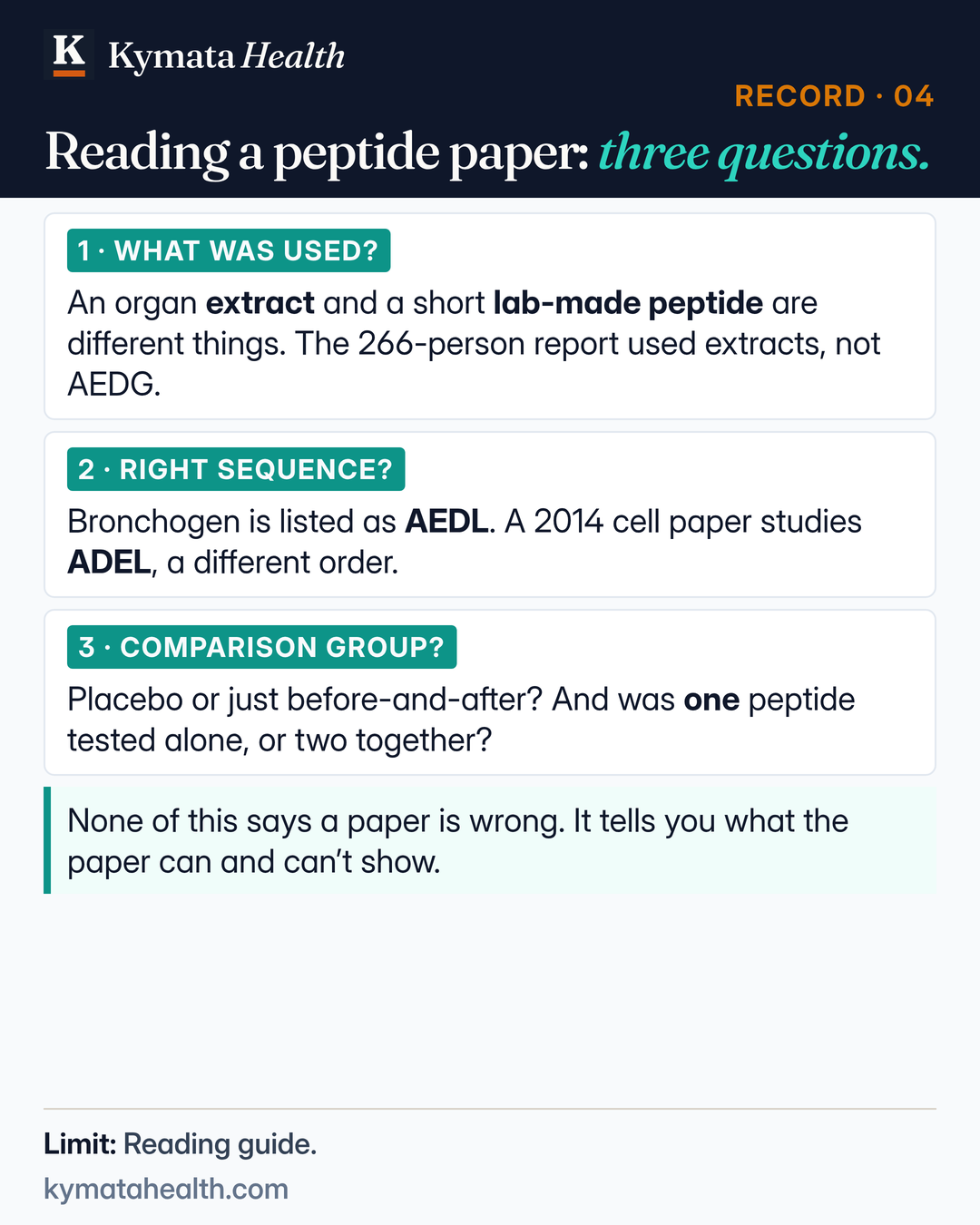
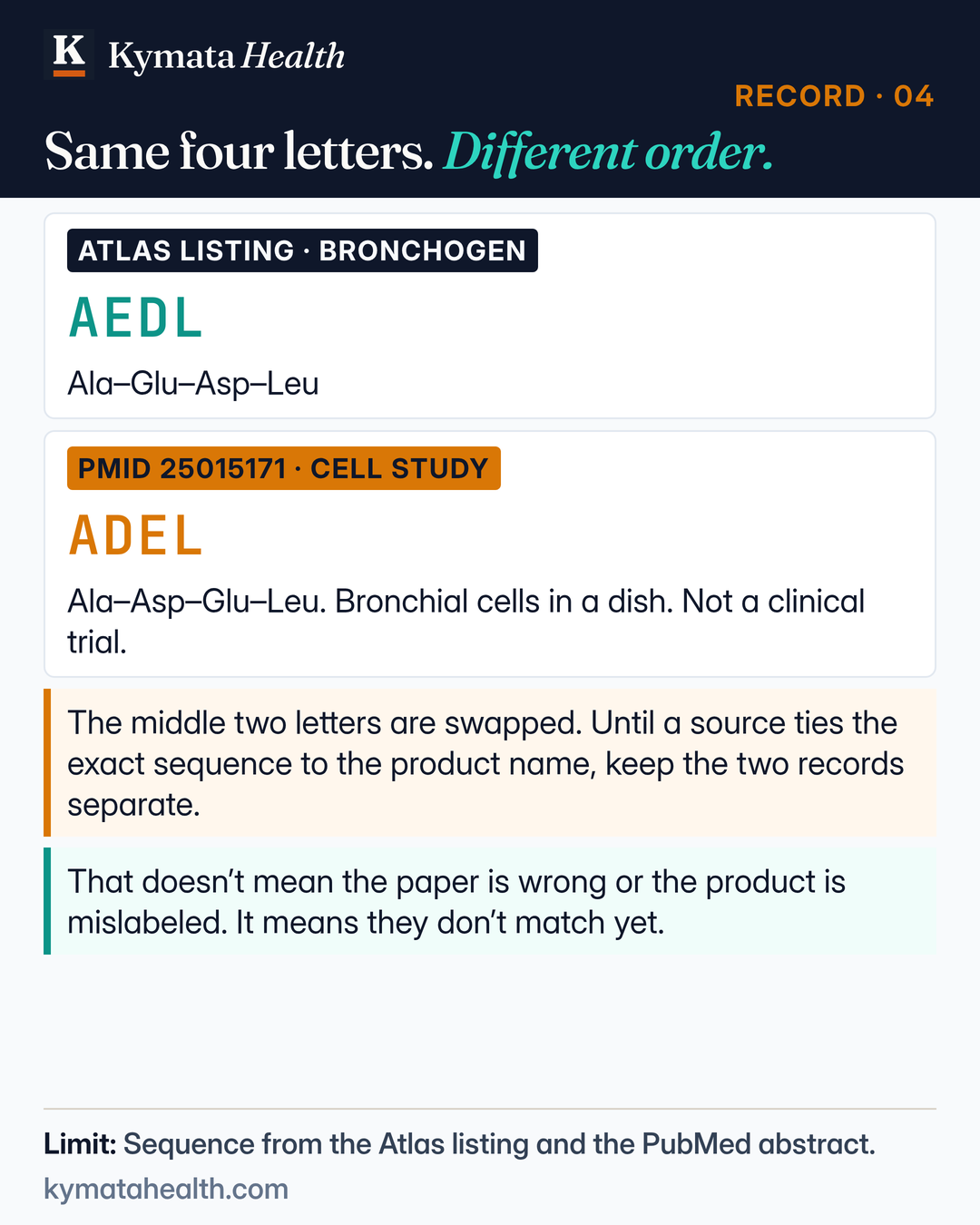
Two things to look for here.
A comparison group. A change from baseline in a group where everybody got the treatment is a different finding from a difference versus a placebo. Both are information. They just answer different questions.
One peptide at a time. If two peptides were given together, the result belongs to the pair, not to either one.
The Thymogen trial (PMID 15598977; see Record 03) is a clean example of a comparison group: 104 people on the peptide, 98 on placebo, a registered plan and a set comparison. Response was 23% on the peptide and 21% on placebo. That is what a controlled test looks like, and it is why the earlier 36% figure from smaller, uncontrolled studies didn’t carry over.
At the other end of the range are several human reports on Pinealon (EDR) and Vesugen (KED). From their PubMed abstracts, none can be read as a single-peptide trial:
- PMID 22708445 describes Pinealon on its own in locomotive-brigade workers, over two weeks. The abstract doesn’t give a sample size, a comparison group, or mention Vesugen.
- PMID 23734521 compares 150 lorry drivers with 150 metal craftsmen, which is an occupational comparison. The abstract says the best effect came from combined use of pinealon and vezugen. It doesn’t say how many people were treated, how they were assigned, the dose, route or duration. The 300-person comparison isn’t a verified trial headcount.
- PMID 26390612 names both Pinealon and Vesugen in 32 people. (The abstract also gives 18 men and 12 women, which adds up to 30, a difference we can’t resolve without the full text.) It doesn’t clearly describe separate versus combined groups, and it doesn’t describe a placebo.
- PMID 28539017 reports 110 people in a comparison of several anti-aging methods, including combined use of Vezugen and Pinealon. How people were assigned, whether anyone was blinded, and whether there was a placebo aren’t described in the abstract, and Pinealon’s own effect can’t be separated.
Record 06 stays inside those limits. The habit is simple: if the abstract doesn’t mention a comparison group, don’t invent one. If two peptides were given together, don’t report it as a test of one. If a number is missing, leave it out.
The 520-person Vilon paper (Trofimova et al., Vrach, 2021) is a different case. It’s a large report from the developer’s side and it isn’t indexed in PubMed. According to the full text it describes a placebo group (276 on Vilon, 244 on placebo), but the immune-marker results are reported before and after within each group, and blinding isn’t described. A placebo group is a real feature, and we count it. We’ll call the paper what it is and not upgrade it.