
The peptide field guide
SS-31 + MOTS-c
A vendor mitochondrial pairing of SS-31 (elamipretide) with MOTS-c, a 16-amino-acid peptide encoded in mitochondrial DNA; not Forzinity.
Elamipretide alone is FDA-approved as Forzinity for Barth syndrome. MOTS-c is research-only. No study has tested the pair, and the blend is not FDA-approved.
Explore this compoundConceptual editorial illustration; not a measured molecular structure, product photograph or treatment result.
02 / At a glance
At a glance
Key facts
- Also known as
- Elamipretide MOTS-c, mitochondrial stack, SS-31/MOTS-c
- Type
- Peptide Stack
- Evidence level
- Cell and animal research: human benefit remains unproven.
- US regulatory status
- Not FDA-approved, research chemical
- Updated
Identity
A vendor mitochondrial pairing of SS-31 (elamipretide) with MOTS-c, a 16-amino-acid peptide encoded in mitochondrial DNA; not Forzinity.
Research context
Elamipretide binds cardiolipin on the inner mitochondrial membrane and received FDA accelerated approval in September 2025 for Barth syndrome; MOTS-c is an AMPK-linked metabolic signal that reduced diet-induced insulin resistance in mice (Lee 2015).
Evidence limits
Elamipretide alone is FDA-approved as Forzinity for Barth syndrome. MOTS-c is research-only. No study has tested the pair, and the blend is not FDA-approved.
Read the technical profile and study-use reference
Quick answer
Evidence: LowNamed mitochondrial blend of SS-31 (elamipretide) plus MOTS-c. Elamipretide is FDA accelerated-approved as Forzinity™ for Barth syndrome ≥30 kg (Sep 2025). That product is not this stack. MOTS-c remains research-only. Gray-market combo vials are not a Barth protocol and are not an approved combination.
- In published studies
- No study of the combination published
Research summary, not medical advice.
At a glance
Kymata peptide profile · Aug 31, 2026- Common vials
- 10 mg
- CAS
- N/A (blend)
- In published studies
- No study of the combination published
- Half-life
- ~4 h (elamipretide) / estimated hours (MOTS-c)
03 / Identity and origin
Identity and origin
Also called Elamipretide MOTS-c, mitochondrial stack, SS-31/MOTS-c. Vendor mitochondrial blend (elamipretide + MOTS-c).
Read the sequence and compound record
Compound card
- Class
- Vendor mitochondrial blend (elamipretide + MOTS-c)
- Formula
- Elamipretide + MOTS-c
- CAS
- N/A (blend)
- Described by
- SS-31: Stealth BioTherapeutics (Forzinity). MOTS-c: Cohen / Lee MDP work
04 / How it may work
How it may work
Vendor mitochondrial blend (elamipretide + MOTS-c)
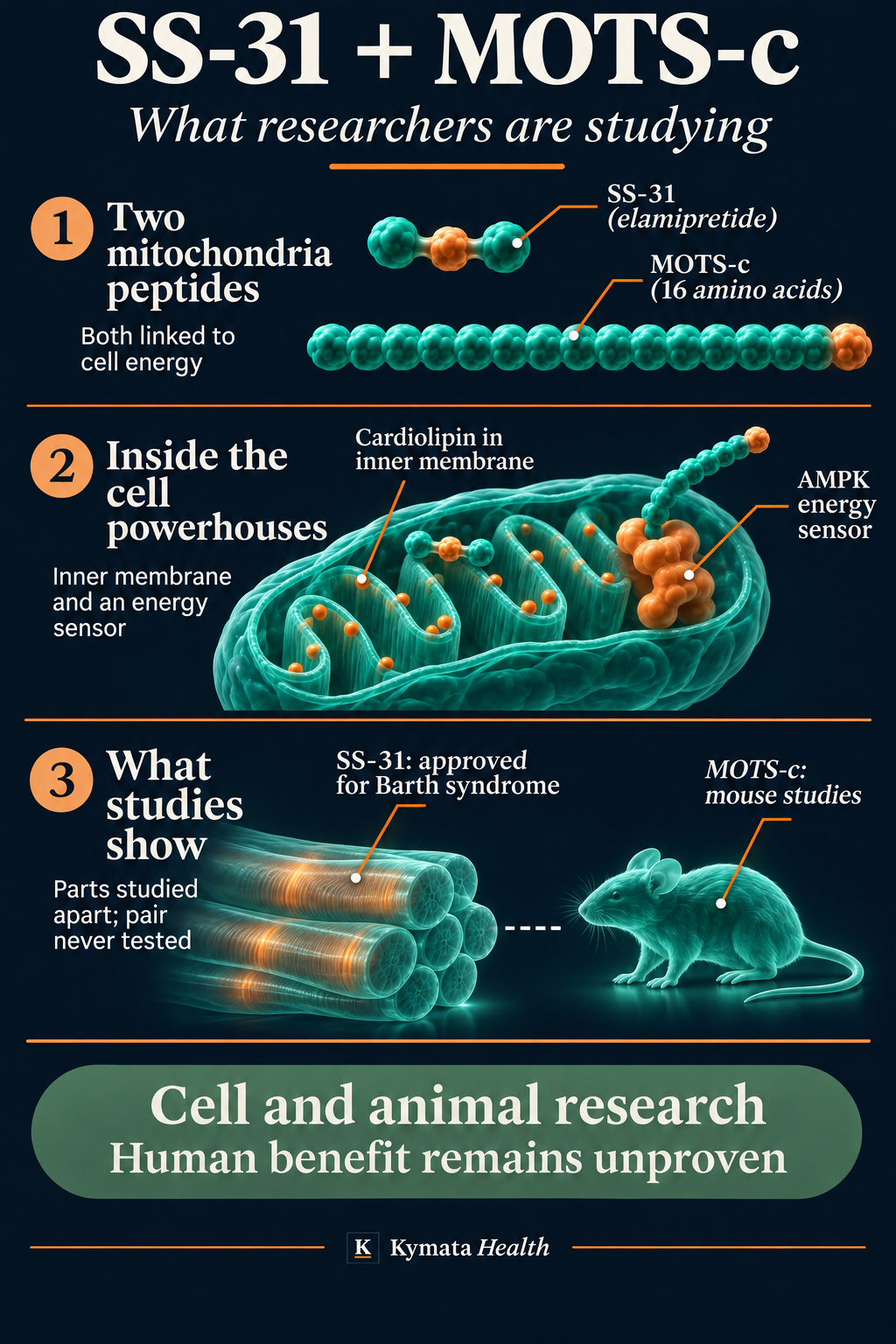
A vendor mitochondrial pairing of SS-31 (elamipretide) with MOTS-c, a 16-amino-acid peptide encoded in mitochondrial DNA; not Forzinity. Elamipretide binds cardiolipin on the inner mitochondrial membrane and received FDA accelerated approval in September 2025 for Barth syndrome; MOTS-c is an AMPK-linked metabolic signal that reduced diet-induced insulin resistance in mice (Lee 2015). Elamipretide alone is FDA-approved as Forzinity for Barth syndrome. MOTS-c is research-only. No study has tested the pair, and the blend is not FDA-approved. The drawing is a schematic, not a measured molecular structure, a product photograph or a treatment result. Illustration review: 19 November 2026, against this page’s own mechanism, evidence and regulatory records.
A sequence model is not provided for this record. Read the identity and evidence notes; an illustration does not verify a molecular structure.
Illustration notes and source record
Read the source record on this page. Laboratory, topical and injected studies are separate evidence; this illustration does not establish an indication or a treatment outcome.

How it works
SourcedSS-31 (elamipretide) binds cardiolipin on the inner mitochondrial membrane. MOTS-c is a 16-aa peptide encoded in the mitochondrial 12S rRNA region, studied as an AMPK-linked metabolic signal.
Elamipretide received FDA accelerated approval in September 2025 as Forzinity™ for Barth syndrome in patients ≥30 kg. That is a single-agent, single-indication product. This stack is a research-chem pairing. Do not copy Forzinity dosing onto a blended vial.
Source: MOTS-c PMID: 25738459; Forzinity FDA accelerated approval Sep 2025
Forzinity is elamipretide for Barth syndrome. MOTS-c is not on that label. A gray-market combo is not mitochondrial-disease care.
05 / Evidence and limits
Evidence and limits
Limits of current evidence
2 limits- No combined RCT.
- Barth-syndrome labeling does not travel to a combo powder.
What it is studied for
- Barth syndrome: High
- Research stack SKU: Low
Verdict
A named blend of SS-31 and MOTS-c. Forzinity is not this stack. MOTS-c remains research-only. Use the singles for identity; use the blend calculator for math.
06 / Product forms and access
Product forms and access
Regulatory & legal status
- FDA status (US)
- Research OnlySS-31 is Forzinity™ for Barth syndrome alone. MOTS-c is research-only. The blend is not approved
- WADA status (2026)
- Prohibited (S4)Competitive athletes subject to anti-doping controls should not use SS-31 + MOTS-c. Per FDA’s PCAC briefing document (July 2026), which says MOTS-c is listed as a prohibited substance in the Global DRO database, drawn from WADA’s hormone and metabolic modulators class (S4). Athletes should check the current WADA list.
- US compounding
- Not eligible / not available
This blend is outside HHS’s Oct 28, 2026 policy for MOTS-c: the HHS policy document (Oct 28, 2026) allows only a single active ingredient per product. The combination is not an approved product.
News, Oct 28: what the HHS peptide compounding policy does and does not do →
07 / Tools and practical checks
Tools and practical checks
Blend calculator
10 mg + 2 mL BAC water → 5 mg/mL · concentration of the advertised powder, not a dose. No study has tested the blend.
Reconstitution math
U-100 syringe| Vial | Water | Concentration |
|---|---|---|
| 10 mg lyophilized | 2 mL BAC | 5 mg/mL |
08 / Published study use
Published study use
What published studies gave, in whom, and the source. Not a dose for you.
What studies used
No study of the combination- No published study has tested SS-31 and MOTS-c together.
- SS-31 (FDA label): Forzinity’s approved strength is 280 mg/3.5 mL (80 mg/mL) in single-patient-use vials; the prescribing information sets the regimen, including a reduced regimen in severe renal impairment not on dialysis. Forzinity label, DailyMed (opens in new tab)
- MOTS-c: No human dosing study has been published.
- MOTS-c: Mice given it developed less diet-induced and age-related insulin resistance. Lee 2015, PMID 25738459 (opens in new tab)
- MOTS-c: Mice: injections three times a week, started late in life, raised physical capacity. In people, the study measured MOTS-c the body makes during exercise; it did not give the peptide to anyone. Reynolds 2021, PMID 33473109 (opens in new tab)
- The doses quoted online come from animal work and vendor or forum sources.
A record of what researchers gave, in whom; not a dose for you.
Administration
- Route / form
- Not established: no study of the pair.
Who it is for
2 uses| Category | Fit | What exists |
|---|---|---|
| Barth syndrome | High | That is Forzinity (elamipretide alone), prescribed. Not this page. |
| Research stack SKU | Low | Two mitochondrial-adjacent peptides in one bottle. No combo approval. |
09 / Safety and interactions
Safety and interactions
What the record says
Elamipretide’s label covers one rare disease (Barth syndrome). Mixing it with MOTS-c does not create a sports-performance protocol. Injection-site reactions; unknown combo safety.
10 / Comparisons and goal guides
Comparisons and goal guides
SS-31 + MOTS-c vs. SS-31 (elamipretide)
3 attributesCanonical comparison: SS-31 + MOTS-c vs SS-31 (elamipretide) · SS-31 (elamipretide) evidence profile
| Attribute | SS-31 + MOTS-c | SS-31 (elamipretide) |
|---|---|---|
| Identity | Elamipretide + MOTS-c blend | Elamipretide alone |
| FDA | Not an approved combination | Forzinity™ accelerated approval (Barth, Sep 2025) |
| Job | Vendor mitochondrial stack | Labeled Barth product or research vial |
11 / Common questions
Common questions
Common questions
2 answersIs SS-31 FDA-approved?
Elamipretide is Forzinity, accelerated approval Sep 2025 for Barth syndrome ≥30 kg. Research vials and this blend are not that product.
Can I use Forzinity doses in this calculator?
No. Use the PI. This page is identity for a vendor stack plus reconstitution arithmetic.
12 / Sources and references
Sources and references
1 paper cited on this page.
Sources
1 paper- 1“MOTS-c is a mitochondrial-encoded peptide.”Lee C et al. Cell Metabolism (2015). PMID: 25738459
14 / Prescription options
Prescription options
Prescription options: compare licensed telehealth providers
Some peptide therapies are available only by prescription after a consult with a licensed clinician.
Compare telehealth →15 / Peptide library
Peptide library
Keep reading: Peptide research library
Peptide research library: every pagePeptide libraryBrowse all topics
- Selank + SemaxPrevious in this topic · A brain-imaging study gave 52 healthy participants either Selank, Semax or placebo in separate groups.
- GHKNext in this topic · Copper-free Gly-His-Lys: the Limitless-style “GHK Basic” SKU, distinct from blue GHK-Cu.
- Follistatin 315Follistatin-315 (FS315) is the main form of follistatin found in human blood.
- N-Acetyl Epitalon AmidateThe published telomere experiments tested parent Epitalon in cultured human cells.
- ProstamaxSynthetic tetrapeptide Lys-Glu-Asp-Pro (KEDP), the Khavinson prostate-line peptide sold as Prostamax.
Regulatory and sport classification
- Not FDA-approved, research chemical
- WADA (S4): prohibited in sport, per FDA’s PCAC briefing document