
The peptide field guide
Pramlintide
A synthetic amylin analog approved as Symlin for use with mealtime insulin.
FDA-approved as Symlin; Drugs@FDA now lists it as discontinued.
Explore this compoundConceptual editorial illustration; not a measured molecular structure, product photograph or treatment result.
02 / At a glance
At a glance
Key facts
- Also known as
- Symlin, amylin analog, AC137
- Type
- Amylin analogue (not a GLP-1 agonist)
- Evidence level
- FDA-approved as Symlin: now listed as discontinued.
- US regulatory status
- FDA-approved as Symlin® (March 2005) as an adjunct for type 1 or type 2 diabetes treated with mealtime insulin when glucose goals are not met on optimal insulin; Drugs@FDA lists all three Symlin presentations as discontinued
- Updated
Identity
A synthetic amylin analog approved as Symlin for use with mealtime insulin.
Research context
Trials added it to mealtime insulin in type 1 and type 2 diabetes and found lower blood sugar after meals and modest weight loss.
Evidence limits
FDA-approved as Symlin; Drugs@FDA now lists it as discontinued.
Read the technical profile and study-use reference
Quick answer
Evidence: HighMealtime amylin analog (Symlin), approved in 2005 as an adjunct to mealtime insulin in type 1 and type 2 diabetes; Drugs@FDA lists all three presentations as discontinued. Labeled in micrograms, with a boxed warning for severe hypoglycemia with insulin. An amylin analogue, not a GLP-1 agonist and not cagrilintide.
- FDA label dose
- FDA label (Symlin): dose and schedule set by the prescriber and the label
Research summary, not medical advice.
At a glance
Kymata peptide profile · Nov 21, 2026- Molecular weight
- 3949.4 g/mol
- CAS
- 151126-32-8
- FDA label dose
- FDA label (Symlin): dose and schedule set by the prescriber and the label
- Half-life
- Approximately 48 minutes in healthy individuals (Symlin label)
- Common vials
- Ready-to-use solution; no water is added
03 / Identity and origin
Identity and origin
Also called Symlin, amylin analog, AC137. Mealtime amylin analog (Symlin); adjunct to insulin.
Read the sequence and compound record
Compound card
- Sequence
- Amylin analog (Pro25,28,29)
- Class
- Mealtime amylin analog (Symlin); adjunct to insulin
- Formula
- C171H267N51O53S2
- Molecular weight
- 3949.4 g/mol
- CAS
- 151126-32-8
- Described by
- Amylin Pharmaceuticals (later AstraZeneca), 2005 (US approval)
- Bioavailability
- About 30% to 40% absolute subcutaneous bioavailability (Symlin label)
04 / How it may work
How it may work
Mealtime amylin analog (Symlin); adjunct to insulin
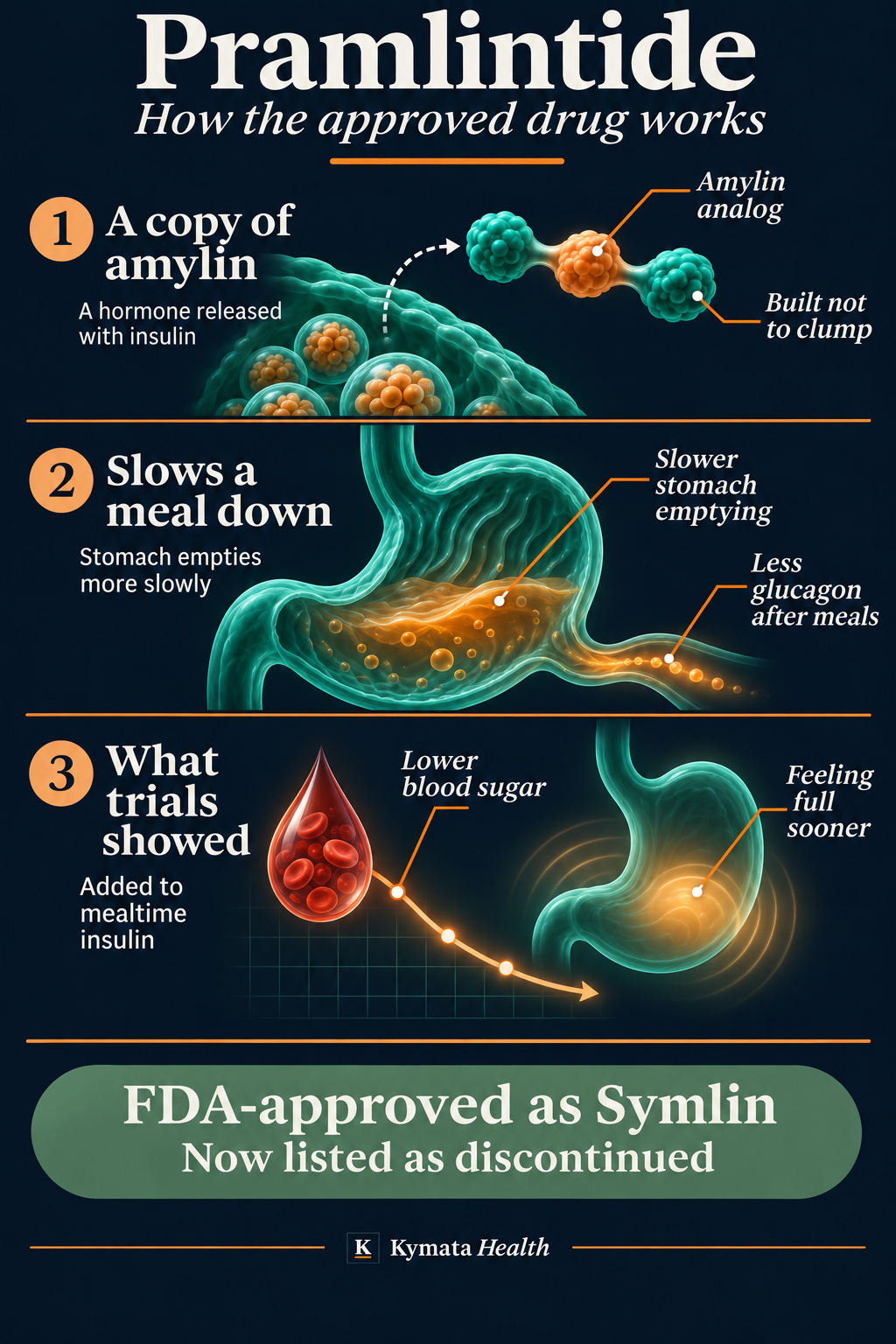
A synthetic amylin analog approved as Symlin for use with mealtime insulin. Trials added it to mealtime insulin in type 1 and type 2 diabetes and found lower blood sugar after meals and modest weight loss. FDA-approved as Symlin; Drugs@FDA now lists it as discontinued. The drawing is a schematic, not a measured molecular structure, a product photograph or a treatment result. Illustration review: 19 November 2026, against this page’s own mechanism, evidence and regulatory records.
A sequence model is not provided for this record. Read the identity and evidence notes; an illustration does not verify a molecular structure.
Illustration notes and source record
What can pramlintide add to mealtime insulin?
Slowing the rise after a meal. Pramlintide mimics amylin, a hormone normally released with insulin. It slows the movement of food out of the stomach, so glucose from a meal enters the bloodstream more gradually.
The benefit and the tradeoff. In meal tests with 40 people with type 1 diabetes, adding pramlintide to mealtime insulin reduced the rise in blood sugar compared with placebo. The combination also raises the risk of dangerously low blood sugar.
After a meal, how quickly food leaves the stomach affects how quickly blood sugar rises.
Earlier contextual illustration
Read the source record on this page. Laboratory, topical and injected studies are separate evidence; this illustration does not establish an indication or a treatment outcome.

How it works
SourcedPramlintide (Symlin) is a synthetic analog of human amylin, a beta-cell hormone co-secreted with insulin. It slows gastric emptying, suppresses post-meal glucagon and promotes satiety. Proline substitutions at positions 25, 28 and 29 keep it from aggregating the way native amylin does.
In a 14-day randomized placebo-controlled study of 84 people with type 1 diabetes (Kolterman 1996, PMID 8778001), pramlintide, then coded AC137, blunted the rise in glucose after a standard liquid meal without changing the response to an insulin infusion. In a randomized single-blind placebo-controlled five-way crossover study of 40 people with type 1 diabetes (19 on regular insulin, 21 on insulin lispro; Weyer 2003, PMID 14578242), 60 mcg pramlintide given at or 15 minutes before a meal prevented the early post-meal glucose surge, and injections at all four tested times reduced the 4-hour glucose excursion by 36% to more than 100% versus placebo.
FDA approved Symlin (pramlintide acetate) in March 2005 as an adjunctive treatment in patients with type 1 or type 2 diabetes who use mealtime insulin therapy and have failed to achieve desired glucose control despite optimal insulin therapy, and Drugs@FDA now lists all three Symlin presentations as discontinued.
Source: Symlin label; Whitehouse 2002 (PMID 11919132); Hollander 2003 (PMID 12610038)
05 / Evidence and limits
Evidence and limits
Placebo-controlled trials alongside insulin; one obesity trial
Human evidence
Placebo-controlled trials alongside insulin; one obesity trial- In a 52-week double-blind placebo-controlled trial of 480 people with type 1 diabetes (Whitehouse 2002, PMID 11919132), HbA1c fell 0.67 percentage points with mealtime pramlintide versus 0.16 with placebo at week 13, and a placebo-corrected difference persisted through week 52 without a higher overall rate of severe hypoglycemia.
- In a 29-week double-blind placebo-controlled trial of 296 people with type 1 diabetes on intensive insulin therapy (Edelman 2006, PMID 17003291), HbA1c fell 0.5 percentage points in both groups, while pramlintide reduced post-meal glucose excursions and body weight (-1.3 vs +1.2 kg) but had a higher severe hypoglycemia rate (0.57 vs 0.30 events per patient-year).
- In a 52-week double-blind placebo-controlled trial of 656 people with insulin-treated type 2 diabetes (Hollander 2003, PMID 12610038), the 120 mcg twice-daily pramlintide arm lowered HbA1c by 0.62 percentage points from baseline, significantly more than placebo, with a mean weight change of -1.4 kg versus +0.7 kg on placebo.
- In a 16-week randomized double-blind placebo-controlled phase 2 trial of 204 non-insulin-treated adults with obesity, with or without type 2 diabetes (Aronne 2007, PMID 17504894), those who completed pramlintide treatment lost 3.7% more body weight (3.6 kg) than placebo completers, with withdrawal rates of 29% and 25%.
Use-case scores
0–100–10 against the evidence we have, not a gym ranking. Hidden domains do not apply here.
- Metabolic / weight7.5/10Labeled adjunct to mealtime insulin in type 1 and type 2 diabetes, backed by 29- to 52-week placebo-controlled trials. Haircut because HbA1c and weight changes were modest, severe hypoglycemia is the boxed risk, and Drugs@FDA lists every Symlin presentation as discontinued.
Limits of current evidence
4 limits- In a 16-week randomized double-blind placebo-controlled phase 2 trial of 204 non-insulin-treated adults with obesity, with or without type 2 diabetes (Aronne 2007, PMID 17504894), those who completed pramlintide treatment lost 3.7% more body weight (3.6 kg) than placebo completers, with withdrawal rates of 29% and 25%.
- Symlin’s FDA indication was diabetes treated with mealtime insulin, never obesity; the Aronne 2007 trial escalated above any Symlin label regimen.
- Cagrilintide acts on the same amylin receptor family; no study here supports combining them.
- Drugs@FDA lists every Symlin presentation as discontinued; a historical approval does not establish current supply.
Trial FinderRecruiting now: 2 open registrations for pramlintide
What it is studied for
- T1D / T2D on mealtime insulin: High
- Postprandial glucose: High
- Weight loss without diabetes: Low
Verdict
Pramlintide is Symlin, a mealtime amylin analog approved in 2005 as an add-on to insulin; Drugs@FDA now lists all three Symlin presentations as discontinued. It is an amylin analogue, not a GLP-1 agonist and not cagrilintide. Severe hypoglycemia with insulin is the boxed warning. A research powder is not Symlin.
06 / Product forms and access
Product forms and access
Regulatory & legal status
- FDA status (US)
- ApprovedFDA-approved as Symlin® (March 2005) as an adjunct for type 1 or type 2 diabetes treated with mealtime insulin when glucose goals are not met on optimal insulin; Drugs@FDA lists all three Symlin presentations as discontinued
- WADA status (2026)
- Not ListedNot currently on the WADA 2026 Prohibited List. Policies may change. Verify before competition.
- Classification
- Prescription Drug
07 / Tools and practical checks
Tools and practical checks
No separate record is provided here. Read the linked evidence and limitations for this compound.
08 / Published study use
Published study use
What the label states, for the patients it is approved for, and the source. Not a dose for you.
What the FDA label says
FDA label- Approved Symlin strengths were the SymlinPen 60 and SymlinPen 120 pen-injectors at 1,000 mcg/mL, and the label measured doses in micrograms, with separate regimens for type 1 and type 2 diabetes and a boxed warning for severe hypoglycemia with insulin. Symlin label, DailyMed (opens in new tab)
The label’s dosing, for the patients it is approved for; the prescriber sets the dose.
Administration
- Route / form
- Subcutaneous injection, separate from insulin (Symlin label)
Timeline
3 stages- Week 13
In Whitehouse 2002 (PMID 11919132), HbA1c fell 0.67 points with pramlintide versus 0.16 with placebo in type 1 diabetes.
- Week 29
In Edelman 2006 (PMID 17003291), HbA1c fell 0.5 points in both groups; pramlintide lowered post-meal glucose and weight but had more severe hypoglycemia.
- Week 52
In Hollander 2003 (PMID 12610038), the best pramlintide arm lowered HbA1c 0.62 points in insulin-treated type 2 diabetes.
Who it is for
3 uses| Category | Fit | What exists |
|---|---|---|
| T1D / T2D on mealtime insulin | High | Symlin was labeled as an add-on to mealtime insulin when glucose control was not reached on optimal insulin therapy. Drugs@FDA now lists it as discontinued. |
| Postprandial glucose | High | Placebo-controlled studies measured lower post-meal glucose excursions alongside insulin (PMID 14578242; PMID 17003291). |
| Weight loss without diabetes | Low | One 16-week phase 2 trial (PMID 17504894); never an FDA indication. |
09 / Safety and interactions
Safety and interactions
What the record says
Symlin carries a boxed warning that use with insulin increases the risk of severe hypoglycemia, particularly in type 1 diabetes, seen within 3 hours of an injection. It is contraindicated in people with a serious hypersensitivity reaction to Symlin, hypoglycemia unawareness or confirmed gastroparesis. The label lists pediatric patients among those who should not be considered for therapy, noting that safety and effectiveness in children have not been established. The label says pramlintide and insulin are not mixed in the same syringe. Nausea was the most common adverse reaction. Any insulin change is a prescriber decision.
10 / Comparisons and goal guides
Comparisons and goal guides
There is no separate comparison record on this page. Similar names do not establish that products or their evidence are interchangeable.
11 / Common questions
Common questions
Common questions
6 answersWhat was Symlin approved for, and is it still sold?
FDA approved Symlin (pramlintide acetate) in March 2005 as an adjunctive treatment in patients with type 1 or type 2 diabetes who use mealtime insulin therapy and have failed to achieve desired glucose control despite optimal insulin therapy. Drugs@FDA now lists all three Symlin presentations as discontinued.
What strengths did Symlin come in?
Approved strengths of Symlin were a 5 mL vial at 600 mcg/mL and the SymlinPen 60 (1.5 mL) and SymlinPen 120 (2.7 mL) pen-injectors at 1,000 mcg/mL, all ready-to-use solutions and all now listed as discontinued. The vial and the pens have different concentrations, so a chart for one does not apply to the other.
Can pramlintide be mixed with insulin in the same syringe?
No. The Symlin label states that pramlintide and insulin are given as separate injections and not mixed, because mixing can change how each is absorbed.
Did pramlintide lower HbA1c in type 2 diabetes?
Modestly. In a 52-week double-blind placebo-controlled trial of 656 people with insulin-treated type 2 diabetes (Hollander 2003, PMID 12610038), the 120 mcg twice-daily pramlintide arm lowered HbA1c by 0.62 percentage points from baseline, significantly more than placebo, with a mean weight change of -1.4 kg versus +0.7 kg on placebo.
Is pramlintide an obesity drug?
It was never approved for obesity. In a 16-week randomized double-blind placebo-controlled phase 2 trial of 204 non-insulin-treated adults with obesity, with or without type 2 diabetes (Aronne 2007, PMID 17504894), those who completed pramlintide treatment lost 3.7% more body weight (3.6 kg) than placebo completers, with withdrawal rates of 29% and 25%.
Is Pramlintide FDA-approved?
Yes. FDA-approved as Symlin® (March 2005) as an adjunct for type 1 or type 2 diabetes treated with mealtime insulin when glucose goals are not met on optimal insulin; Drugs@FDA lists all three Symlin presentations as discontinued.
12 / Sources and references
Sources and references
8 sources cited on this page.
Sources
8 sources- 1“Effect of 14 days’ subcutaneous administration of the human amylin analogue, pramlintide (AC137), on an intravenous insulin challenge and response to a standard liquid meal in patients with IDDM.”Kolterman OG et al. Diabetologia (1996). PMID: 8778001 DOI: 10.1007/BF00400683
- 2“Pramlintide reduces postprandial glucose excursions when added to regular insulin or insulin lispro in subjects with type 1 diabetes: a dose-timing study.”Weyer C et al. Diabetes Care (2003). PMID: 14578242 DOI: 10.2337/diacare.26.11.3074
- 3“A randomized study and open-label extension evaluating the long-term efficacy of pramlintide as an adjunct to insulin therapy in type 1 diabetes.”Whitehouse F et al. Diabetes Care (2002). PMID: 11919132 DOI: 10.2337/diacare.25.4.724
- 4“A double-blind, placebo-controlled trial assessing pramlintide treatment in the setting of intensive insulin therapy in type 1 diabetes.”Edelman S et al. Diabetes Care (2006). PMID: 17003291 DOI: 10.2337/dc06-0042
- 5“Pramlintide as an adjunct to insulin therapy improves long-term glycemic and weight control in patients with type 2 diabetes: a 1-year randomized controlled trial.”Hollander PA et al. Diabetes Care (2003). PMID: 12610038 DOI: 10.2337/diacare.26.3.784
- 6“Progressive reduction in body weight after treatment with the amylin analog pramlintide in obese subjects: a phase 2, randomized, placebo-controlled, dose-escalation study.”Aronne L et al. Journal of Clinical Endocrinology and Metabolism (2007). PMID: 17504894 DOI: 10.1210/jc.2006-2003
- 7“Symlin (pramlintide acetate): prescribing information, revised December 2019.”AstraZeneca DailyMed (2019). Prescribing information
- 8“Symlin (pramlintide acetate) injection: original 2005 labeling, NDA 021332.”US Food and Drug Administration Drugs@FDA (2005). Prescribing information
14 / Prescription options
Prescription options
Prescription options: compare licensed telehealth providers
Some peptide therapies are available only by prescription after a consult with a licensed clinician.
Compare telehealth →15 / Peptide library
Peptide library
Keep reading: Peptide research library
Peptide research library: every pagePeptide libraryBrowse all topics
- PemvidutidePrevious in this topic · Altimmune GLP-1/glucagon dual agonist (ALT-801).
- SetmelanotideNext in this topic · Setmelanotide (Imcivree) is an MC4R agonist FDA-approved for obesity due to genetically confirmed POMC, PCSK1 or LEPR deficiency, Bardet-Biedl syndrome, or acquired hypothalamic…
- SurvodutideBoehringer/Zealand GLP-1/glucagon dual agonist (BI 456906).
- BremelanotideBremelanotide (Vyleesi, PT-141) is a melanocortin-receptor agonist FDA-approved as an as-needed injection for acquired, generalized hypoactive sexual desire disorder in…
- Kisspeptin-10Kisspeptin-10 is the 10-amino-acid active fragment of kisspeptin, which stimulates GnRH release through KISS1R; it has been studied in small human physiology trials of LH and…
Regulatory and sport classification
- FDA-approved