
The peptide field guide
Setmelanotide
An MC4R agonist approved as Imcivree for specific rare genetic forms of obesity.
FDA-approved for rare genetic obesity only. A genetic diagnosis is required.
Explore this compoundConceptual editorial illustration; not a measured molecular structure, product photograph or treatment result.
02 / At a glance
At a glance
Key facts
- Also known as
- Imcivree, RM-493, MC4R agonist
- Type
- Weight Management
- Evidence level
- FDA-approved for rare genetic obesity: prescription only.
- US regulatory status
- FDA-approved as Imcivree® (2020) for obesity due to POMC, PCSK1 or LEPR deficiency; extended to Bardet-Biedl syndrome (2022) and acquired hypothalamic obesity (March 2026)
- Updated
Identity
An MC4R agonist approved as Imcivree for specific rare genetic forms of obesity.
Research context
In the pivotal trials most people with POMC or LEPR deficiency lost at least a tenth of their body weight over about a year.
Evidence limits
FDA-approved for rare genetic obesity only. A genetic diagnosis is required.
Read the technical profile and study-use reference
Quick answer
Evidence: HighSetmelanotide (Imcivree) is an MC4R agonist FDA-approved for obesity due to genetically confirmed POMC, PCSK1 or LEPR deficiency, Bardet-Biedl syndrome, or acquired hypothalamic obesity.
- FDA label dose
- FDA label (Imcivree): dose and schedule set by the prescriber and the label
Research summary, not medical advice.
At a glance
Kymata peptide profile · Aug 31, 2026- Half-life
- 11-12 hours
- Common vials
- 10 mg
- Molecular weight
- 1117.3 g/mol
- CAS
- 920014-72-8
- FDA label dose
- FDA label (Imcivree): dose and schedule set by the prescriber and the label
03 / Identity and origin
Identity and origin
Also called Imcivree, RM-493, MC4R agonist. MC4R agonist (Imcivree; labeled rare genetic obesity).
Read the sequence and compound record
Compound card
- Class
- MC4R agonist (Imcivree; labeled rare genetic obesity)
- Formula
- C49H68N18O9S2
- Molecular weight
- 1117.3 g/mol
- CAS
- 920014-72-8
- Described by
- Rhythm Pharmaceuticals, 2020
- Bioavailability
- ~82% (SC)
04 / How it may work
How it may work
MC4R agonist (Imcivree; labeled rare genetic obesity)
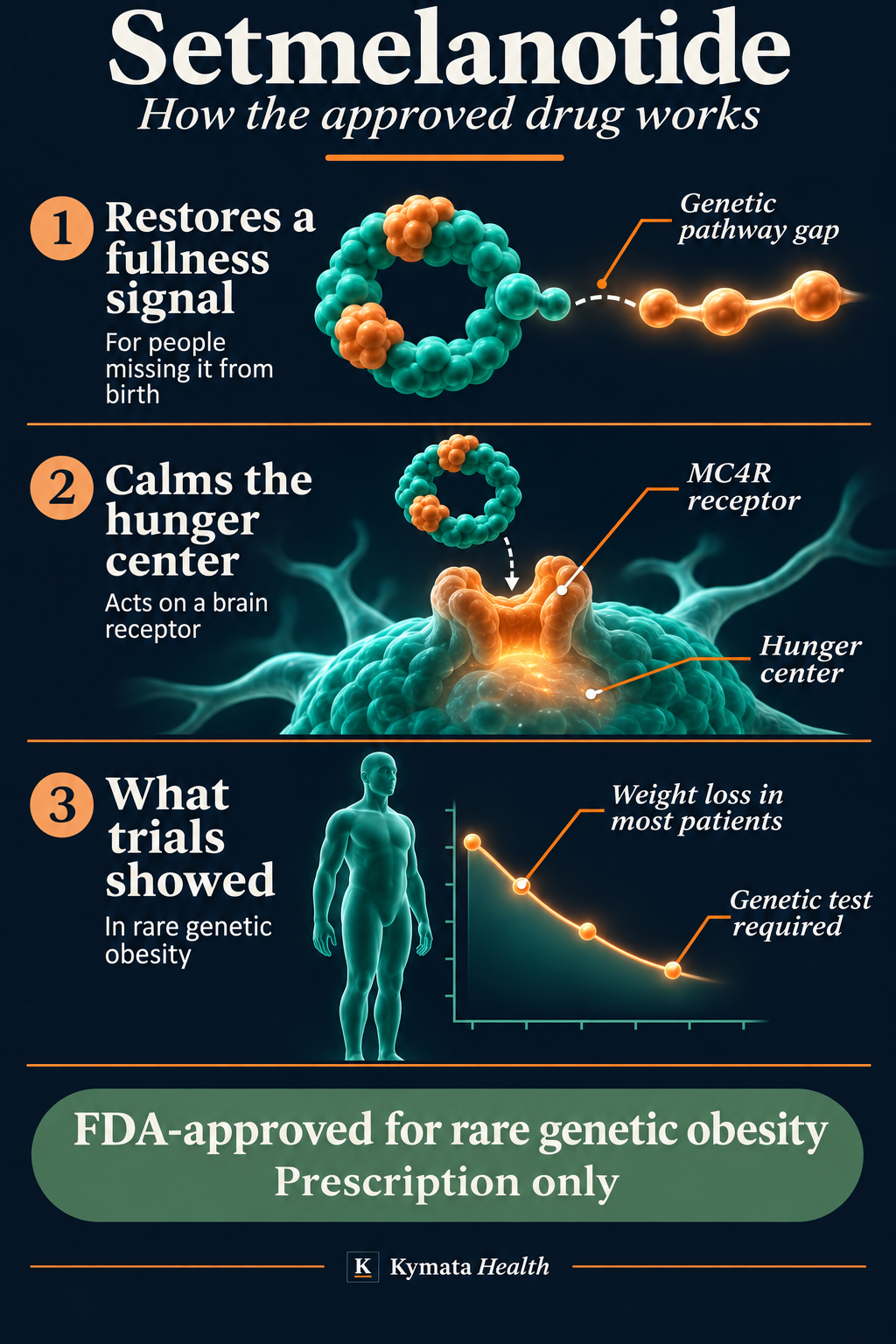
An MC4R agonist approved as Imcivree for specific rare genetic forms of obesity. In the pivotal trials most people with POMC or LEPR deficiency lost at least a tenth of their body weight over about a year. FDA-approved for rare genetic obesity only. A genetic diagnosis is required. The drawing is a schematic, not a measured molecular structure, a product photograph or a treatment result. Illustration review: 19 November 2026, against this page’s own mechanism, evidence and regulatory records.
A sequence model is not provided for this record. Read the identity and evidence notes; an illustration does not verify a molecular structure.
Illustration notes and source record
Read the source record on this page. Laboratory, topical and injected studies are separate evidence; this illustration does not establish an indication or a treatment outcome.

How it works
SourcedSetmelanotide (Imcivree®) is a melanocortin-4 receptor (MC4R) agonist developed specifically for rare genetic obesity disorders caused by deficiencies in the leptin-melanocortin pathway. It directly activates MC4R in the hypothalamus to restore satiety signaling that is absent or blunted in patients with loss-of-function mutations in POMC (pro-opiomelanocortin), PCSK1 (proprotein convertase subtilisin/kexin type 1), LEPR (leptin receptor) or BBS (Bardet-Biedl syndrome) genes; its label also covers acquired hypothalamic obesity. In the pivotal trials, 8 of 10 people with POMC deficiency and 5 of 11 with LEPR deficiency lost at least 10% of body weight at about one year (PMID 33137293).
Source: Phase 3 NEJM
05 / Evidence and limits
Evidence and limits
Use-case scores
0–100–10 against the evidence we have, not a gym ranking. Hidden domains do not apply here.
- Metabolic / weight7/10Imcivree is labeled for POMC/PCSK1/LEPR deficiency, Bardet-Biedl syndrome and acquired hypothalamic obesity. Ceiling 9; haircut because a vial of unknown fill is not Imcivree and common obesity is not those conditions.
Limits of current evidence
2 limits- Genotype-restricted label. BMI-alone is the wrong patient.
- Hyperpigmentation is on-mechanism.
Trial FinderRecruiting now: 2 open registrations for setmelanotide
What it is studied for
- Genetic Obesity Syndromes: High
Verdict
Setmelanotide (Imcivree) is FDA-approved only for obesity with a known cause in the leptin-melanocortin pathway: POMC, PCSK1 or LEPR deficiency, Bardet-Biedl syndrome and, since March 2026, acquired hypothalamic obesity. It is not a treatment for common obesity. In its pivotal trials, 8 of 10 people with POMC deficiency and 5 of 11 with LEPR deficiency lost at least 10% of body weight in about a year (PMID 33137293).
06 / Product forms and access
Product forms and access
Regulatory & legal status
- FDA status (US)
- ApprovedFDA-approved as Imcivree® (2020) for obesity due to POMC, PCSK1 or LEPR deficiency; extended to Bardet-Biedl syndrome (2022) and acquired hypothalamic obesity (March 2026)
- WADA status (2026)
- Not ListedNot currently on the WADA 2026 Prohibited List. Policies may change. Verify before competition.
- Classification
- Prescription Drug
07 / Tools and practical checks
Tools and practical checks
Dose it
10 mg + 2 mL BAC water → 5 mg/mL · 1 unit (U-100) = 50 mcg.
Reconstitution math
U-100 syringe| Vial | Water | Concentration |
|---|---|---|
| 10 mg lyophilized | 2 mL BAC | 5 mg/mL |
08 / Published study use
Published study use
What the label states, for the patients it is approved for, and the source. Not a dose for you.
What the FDA label says
FDA label- Imcivree, for obesity from BBS or POMC, PCSK1 or LEPR deficiency (adults and children 12 and older): 2 mg once a day under the skin for 2 weeks; the maintenance dose for patients 6 and older is 3 mg once a day. Imcivree label, DailyMed (opens in new tab)
- For acquired hypothalamic obesity the label starts at 0.5 mg once a day for 2 weeks. Imcivree label, DailyMed (opens in new tab)
The label’s dosing, for the patients it is approved for; the prescriber sets the dose.
Administration
- Route / form
- Subcutaneous injection (abdomen)
Timeline
2 stages- Month 1-3
Hunger reduction often dramatic in genetically affected patients. Early weight loss.
- About 1 year
In single-arm phase 3 trials, 8 of 10 people with POMC deficiency and 5 of 11 with LEPR deficiency lost at least 10% of body weight (PMID 33137293).
Who it is for
1 use| Category | Fit | What exists |
|---|---|---|
| Genetic Obesity Syndromes | High | Imcivree label: POMC, PCSK1 or LEPR deficiency, Bardet-Biedl syndrome and acquired hypothalamic obesity. First targeted treatment for these patients. |
09 / Safety and interactions
Safety and interactions
What the record says
FDA-approved (Imcivree). NOT for general obesity: only for the conditions on its label (POMC, PCSK1 or LEPR deficiency, Bardet-Biedl syndrome, acquired hypothalamic obesity). Side effects: hyperpigmentation (MC1R off-target), injection site reactions, sexual adverse events. The label requires a genetic test or clinical diagnosis before prescribing.
10 / Comparisons and goal guides
Comparisons and goal guides
There is no separate comparison record on this page. Similar names do not establish that products or their evidence are interchangeable.
11 / Common questions
Common questions
Common questions
4 answersCan setmelanotide be used for general obesity?
No. Setmelanotide is a targeted therapy for specific rare genetic mutations in the leptin-melanocortin (MC4R) pathway. It is not indicated for common obesity without one of these conditions.
When was setmelanotide approved for hypothalamic obesity?
On March 19, 2026, the FDA approved Imcivree for acquired hypothalamic obesity in people aged 4 and older, the first approved treatment for it (Rhythm Pharmaceuticals announcement). It was first approved in November 2020 for POMC, PCSK1 or LEPR deficiency, and for Bardet-Biedl syndrome in June 2022.
What genetic conditions qualify for setmelanotide?
The Imcivree label (revised April 2026) covers POMC, PCSK1 or LEPR deficiency confirmed by a genetic test and Bardet-Biedl syndrome, from age 2, and acquired hypothalamic obesity, from age 4. The diagnosis comes before the first dose.
Is Setmelanotide FDA-approved?
Yes. FDA-approved as Imcivree® (2020) for obesity due to POMC, PCSK1 or LEPR deficiency; extended to Bardet-Biedl syndrome (2022) and acquired hypothalamic obesity (March 2026).
12 / Sources and references
Sources and references
2 papers cited on this page.
Sources
2 papers- 1“Efficacy and safety of setmelanotide, an MC4R agonist, in individuals with severe obesity due to LEPR or POMC deficiency: single-arm, open-label, multicentre, phase 3 trials.”Clément K et al. Lancet Diabetes Endocrinol (2020). PMID: 33137293
- 2“Rhythm Pharmaceuticals announces FDA approval of IMCIVREE (setmelanotide) for patients with acquired hypothalamic obesity.”Rhythm Pharmaceuticals Company announcement (2026).
14 / Prescription options
Prescription options
Prescription options: compare licensed telehealth providers
Some peptide therapies are available only by prescription after a consult with a licensed clinician.
Compare telehealth →15 / Peptide library
Peptide library
Keep reading: Peptide research library
Peptide research library: every pagePeptide libraryBrowse all topics
- PramlintidePrevious in this topic · Mealtime amylin analog (Symlin), approved in 2005 as an adjunct to mealtime insulin in type 1 and type 2 diabetes; Drugs@FDA lists all three presentations as discontinued.
- SurvodutideNext in this topic · Boehringer/Zealand GLP-1/glucagon dual agonist (BI 456906).
- BremelanotideBremelanotide (Vyleesi, PT-141) is a melanocortin-receptor agonist FDA-approved as an as-needed injection for acquired, generalized hypoactive sexual desire disorder in…
- Kisspeptin-10Kisspeptin-10 is the 10-amino-acid active fragment of kisspeptin, which stimulates GnRH release through KISS1R; it has been studied in small human physiology trials of LH and…
- EnclomipheneEnclomiphene is the trans-isomer of clomiphene citrate, a selective estrogen receptor modulator that raises LH, FSH and testosterone; it was studied in Phase 3 trials in men with…
Regulatory and sport classification
- FDA-approved