
The peptide field guide
Survodutide
A dual GLP-1 and glucagon receptor agonist from Boehringer Ingelheim and Zealand Pharma.
Investigational drug in phase 3 trials. Not FDA-approved.
Explore this compoundConceptual editorial illustration; not a measured molecular structure, product photograph or treatment result.
02 / At a glance
At a glance
Key facts
- Also known as
- BI 456906, GLP-1/glucagon dual agonist BI
- Type
- Weight Management
- Evidence level
- Investigational drug: not FDA-approved.
- US regulatory status
- Investigational; not FDA-approved
- Updated
Identity
A dual GLP-1 and glucagon receptor agonist from Boehringer Ingelheim and Zealand Pharma.
Research context
In a phase 2 trial in adults with biopsy-confirmed MASH, liver inflammation improved without worsening fibrosis more often than on placebo; obesity and liver phase 3 trials are ongoing.
Evidence limits
Investigational drug in phase 3 trials. Not FDA-approved.
Read the technical profile and study-use reference
Quick answer
Evidence: EmergingBoehringer/Zealand GLP-1/glucagon dual agonist (BI 456906). Phase 2/3. Not an approved US obesity pen on this catalog date. Not a DIY MASH protocol.
- In published studies
- Trial amounts are recorded under What studies used (PMID 38330987)
Research summary, not medical advice.
At a glance
Kymata peptide profile · Oct 30, 2026- Common vials
- 2.4 mg / 4.8 mg
- Molecular weight
- ~4100 Da
- In published studies
- Trial amounts are recorded under What studies used (PMID 38330987)
- Half-life
- ~6-8 days (once weekly)
03 / Identity and origin
Identity and origin
Also called BI 456906, GLP-1/glucagon dual agonist BI. Once-weekly dual agonist (Boehringer / Zealand).
Read the sequence and compound record
Compound card
- Sequence
- Acyl-modified GLP-1/glucagon dual agonist (BI 456906)
- Class
- Once-weekly dual agonist (Boehringer / Zealand)
- Formula
- Acyl-modified GCGr/GLP-1R dual peptide
- Molecular weight
- ~4100 Da
- Described by
- Boehringer Ingelheim / Zealand Pharma, 2022
- Bioavailability
- ~85% SC (estimated)
04 / How it may work
How it may work
Once-weekly dual agonist (Boehringer / Zealand)
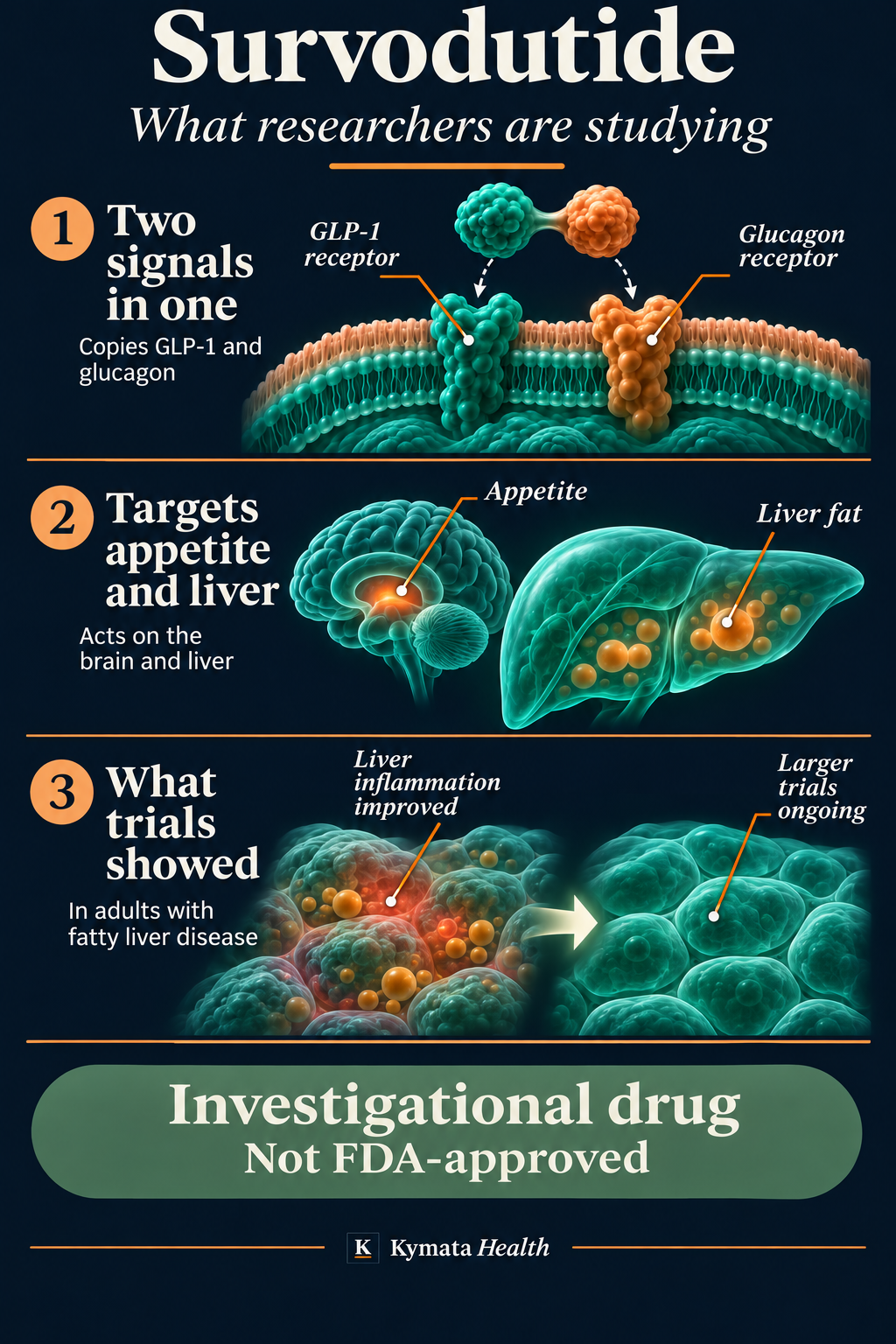
A dual GLP-1 and glucagon receptor agonist from Boehringer Ingelheim and Zealand Pharma. In a phase 2 trial in adults with biopsy-confirmed MASH, liver inflammation improved without worsening fibrosis more often than on placebo; obesity and liver phase 3 trials are ongoing. Investigational drug in phase 3 trials. Not FDA-approved. The drawing is a schematic, not a measured molecular structure, a product photograph or a treatment result. Illustration review: 19 November 2026, against this page’s own mechanism, evidence and regulatory records.
A sequence model is not provided for this record. Read the identity and evidence notes; an illustration does not verify a molecular structure.
Illustration notes and source record
Read the source record on this page. Laboratory, topical and injected studies are separate evidence; this illustration does not establish an indication or a treatment outcome.

How it works
SourcedSurvodutide (BI 456906) is a dual glucagon/GLP-1 receptor agonist (GCGr/GLP-1R) developed by Boehringer Ingelheim and Zealand Pharma. It uses a higher glucagon-to-GLP-1 activity ratio than pemvidutide or mazdutide, designed to add glucagon-receptor effects on liver fat and energy use to GLP-1 effects on appetite and insulin. In a phase 2 trial in 293 adults with biopsy-confirmed MASH (metabolic dysfunction-associated steatohepatitis) and F1-F3 fibrosis, MASH improved without fibrosis worsening in 43-62% vs 14% on placebo at 48 weeks (PMID 38847460). In the phase 2 obesity trial, 0.6 to 4.8 mg once weekly for 46 weeks lowered weight 6.2% to 14.9%, against 2.8% on placebo (PMID 38330987).
Source: SYNCHRONIZE Phase 2
05 / Evidence and limits
Evidence and limits
Use-case scores
0–100–10 against the evidence we have, not a gym ranking. Hidden domains do not apply here.
- Metabolic / weight7.5/10Phase 2 obesity plus MASH-adjacent program, Phase 3 underway. Ceiling 8 for Phase 2–3; haircut because no US label and a powder is not SYNCHRONIZE material.
Limits of current evidence
3 limits- Obesity and MASH programs are not a consumer reconstitution hobby.
- This site will not treat MASH from a peptide page.
- Not interchangeable with pemvidutide or mazdutide.
Trial FinderRecruiting now: 8 open registrations for survodutide
What it is studied for
- Obesity: High
- MASH (Liver Disease): Moderate
Verdict
Survodutide is Boehringer/Zealand’s dual GLP-1/glucagon agonist. Phase 2 numbers are large. Do not treat liver-trial language as a DIY MASH protocol.
06 / Product forms and access
Product forms and access
Regulatory & legal status
- FDA status (US)
- InvestigationalInvestigational; not FDA-approved
- WADA status (2026)
- Not ListedNot currently on the WADA 2026 Prohibited List. Policies may change. Verify before competition.
- US compounding
- Not eligible / not available
07 / Tools and practical checks
Tools and practical checks
Dose it
4.8 mg + 2 mL BAC water → 2.4 mg/mL · 1 unit (U-100) = 24 mcg.
Reconstitution math
U-100 syringe| Vial | Water | Concentration |
|---|---|---|
| 4.8 mg vial | 2.0 mL BAC | 2.4 mg/mL |
08 / Published study use
Published study use
What published studies gave, in whom, and the source. Not a dose for you.
What studies used
Phase 2 trial- 387 adults with a BMI of 27 or more and no diabetes: 0.6, 2.4, 3.6 or 4.8 mg once a week under the skin, or placebo, for 46 weeks, with 20 weeks of dose escalation. le Roux 2024, PMID 38330987 (opens in new tab)
- These are trial doses given under trial monitoring, not a schedule for anyone outside a trial.
A record of what researchers gave, in whom; not a dose for you.
Administration
- Route / form
- Route used in studies: injection under the skin (trials).
Who it is for
2 uses| Category | Fit | What exists |
|---|---|---|
| Obesity | High | Phase 3: weight fell 12.2-13.0% at 76 weeks vs 5.4% on placebo in 725 adults with obesity and no diabetes (PMID 42253238). |
| MASH (Liver Disease) | Moderate | Phase 2: MASH improved without fibrosis worsening in 43-62% vs 14% on placebo at 48 weeks; fibrosis improved by a stage in 34-36% vs 22% (PMID 38847460). No phase 3 result yet. |
09 / Safety and interactions
Safety and interactions
What the record says
Phase 3 obesity and MASH trials ongoing. GI profile consistent with GLP-1 class. Higher glucagon agonism means higher energy expenditure but potential for slightly more cardiovascular effects, and monitoring is ongoing in trials.
10 / Comparisons and goal guides
Comparisons and goal guides
There is no separate comparison record on this page. Similar names do not establish that products or their evidence are interchangeable.
11 / Common questions
Common questions
Common questions
2 answersWhat makes survodutide different from tirzepatide?
Tirzepatide is GIP+GLP-1; survodutide is Glucagon+GLP-1. Glucagon receptor agonism is more directly linked to hepatic fat oxidation (making survodutide a leading MASH drug candidate) while GIP helps insulin sensitization in adipose tissue.
Is survodutide FDA-approved?
No. Phase 3 trials are ongoing. Phase 2 MASH data is promising enough that Boehringer Ingelheim has initiated Phase 3 MASH and obesity pivotal trials.
12 / Sources and references
Sources and references
1 paper cited on this page.
Sources
1 paper- 1“"Survodutide for overweight/obesity (Phase 2)".”Lautenbach A et al. Nature Medicine (2024).
14 / Prescription options
Prescription options
Prescription options: compare licensed telehealth providers
Some peptide therapies are available only by prescription after a consult with a licensed clinician.
Compare telehealth →15 / Peptide library
Peptide library
Keep reading: Peptide research library
Peptide research library: every pagePeptide libraryBrowse all topics
- SetmelanotidePrevious in this topic · Setmelanotide (Imcivree) is an MC4R agonist FDA-approved for obesity due to genetically confirmed POMC, PCSK1 or LEPR deficiency, Bardet-Biedl syndrome, or acquired hypothalamic…
- BremelanotideNext in this topic · Bremelanotide (Vyleesi, PT-141) is a melanocortin-receptor agonist FDA-approved as an as-needed injection for acquired, generalized hypoactive sexual desire disorder in…
- Kisspeptin-10Kisspeptin-10 is the 10-amino-acid active fragment of kisspeptin, which stimulates GnRH release through KISS1R; it has been studied in small human physiology trials of LH and…
- EnclomipheneEnclomiphene is the trans-isomer of clomiphene citrate, a selective estrogen receptor modulator that raises LH, FSH and testosterone; it was studied in Phase 3 trials in men with…
- Palmitoyl Tripeptide-1Palmitoyl Tripeptide-1 (Pal-GHK) is a widely used cosmetic peptide and an ingredient in blends such as Matrixyl 3000.
Regulatory and sport classification
- Investigational; not FDA-approved