
The peptide field guide
Pemvidutide
A balanced dual GLP-1 and glucagon receptor agonist from Altimmune, studied mainly for liver fat.
Investigational drug. Not FDA-approved.
Explore this compoundConceptual editorial illustration; not a measured molecular structure, product photograph or treatment result.
02 / At a glance
At a glance
Key facts
- Also known as
- ALT-801, GLP-1/glucagon dual agonist
- Type
- Weight Management
- Evidence level
- Investigational drug: not FDA-approved.
- US regulatory status
- Investigational; not FDA-approved
- Updated
Identity
A balanced dual GLP-1 and glucagon receptor agonist from Altimmune, studied mainly for liver fat.
Research context
In the phase 2b IMPACT trial in MASH, MASH resolved in more people on pemvidutide than on placebo at 24 weeks.
Evidence limits
Investigational drug. Not FDA-approved.
Read the technical profile and study-use reference
Quick answer
Evidence: EmergingAltimmune GLP-1/glucagon dual agonist (ALT-801). Phase 2 MOMENTUM. Not a US obesity pen. This site will not treat MASH from a peptide page.
- In published studies
- Trial amounts are recorded under What studies used (PMID 41237796)
Research summary, not medical advice.
At a glance
Kymata peptide profile · Oct 30, 2026- Half-life
- ~7 days (once weekly)
- Common vials
- 2.4 mg
- Molecular weight
- ~4200 Da
- In published studies
- Trial amounts are recorded under What studies used (PMID 41237796)
03 / Identity and origin
Identity and origin
Also called ALT-801, GLP-1/glucagon dual agonist. Once-weekly dual agonist (Altimmune).
Read the sequence and compound record
Compound card
- Sequence
- GLP-1/glucagon dual agonist (ALT-801)
- Class
- Once-weekly dual agonist (Altimmune)
- Formula
- Dual GLP-1/GCGr peptide analog
- Molecular weight
- ~4200 Da
- Described by
- Altimmune Inc., 2022
- Bioavailability
- ~85% (SC estimated)
04 / How it may work
How it may work
Once-weekly dual agonist (Altimmune)
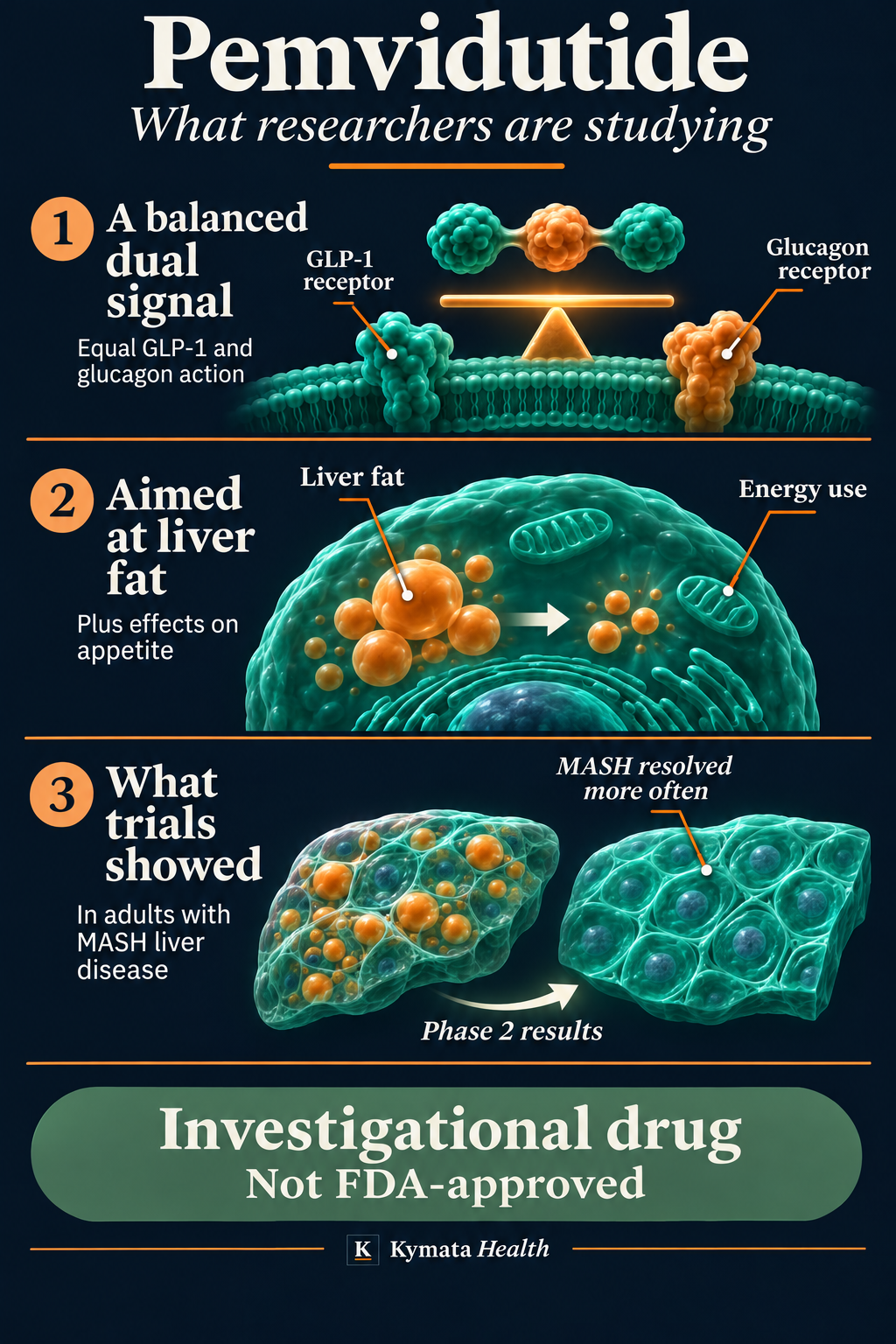
A balanced dual GLP-1 and glucagon receptor agonist from Altimmune, studied mainly for liver fat. In the phase 2b IMPACT trial in MASH, MASH resolved in more people on pemvidutide than on placebo at 24 weeks. Investigational drug. Not FDA-approved. The drawing is a schematic, not a measured molecular structure, a product photograph or a treatment result. Illustration review: 19 November 2026, against this page’s own mechanism, evidence and regulatory records.
A sequence model is not provided for this record. Read the identity and evidence notes; an illustration does not verify a molecular structure.
Illustration notes and source record
Read the source record on this page. Laboratory, topical and injected studies are separate evidence; this illustration does not establish an indication or a treatment outcome.

How it works
SourcedPemvidutide (ALT-801) is a balanced GLP-1/glucagon dual receptor agonist developed by Altimmune. Its differentiating design: balanced 1:1 GLP-1:GCGr activity ratio, designed to add glucagon-receptor effects on liver fat and energy use to GLP-1 effects on appetite. In the phase 2b IMPACT trial in MASH, 1.2 mg and 1.8 mg once weekly resolved MASH in 58% and 52% of patients at 24 weeks, against 20% on placebo (PMID 41237796).
Source: MOMENTUM Phase 2
05 / Evidence and limits
Evidence and limits
Use-case scores
0–100–10 against the evidence we have, not a gym ranking. Hidden domains do not apply here.
- Metabolic / weight7/10Phase 2 MOMENTUM. Ceiling 8 for Phase 2–3; haircut to 7 because Phase 2 is not a label and muscle-sparing language is a trial observation, not a guarantee on a powder.
Limits of current evidence
3 limits- MOMENTUM lean-mass language is a Phase 2 observation, not a body-recomp indication.
- This site will not treat MASH or NAFLD from a peptide page.
- Not interchangeable with survodutide or mazdutide. Different sponsors, different ratios.
Trial FinderRecruiting now: 1 open registration for pemvidutide
What it is studied for
- Obesity / Lean Mass: Insufficient human evidence
- Metabolic Liver Disease (MASH): Emerging
Verdict
Pemvidutide is Altimmune’s dual GLP-1/glucagon program, often discussed for liver fat. Phase 2 is not a US obesity pen. A research vial is not MOMENTUM.
06 / Product forms and access
Product forms and access
Regulatory & legal status
- FDA status (US)
- InvestigationalInvestigational; not FDA-approved
- WADA status (2026)
- Not ListedNot currently on the WADA 2026 Prohibited List. Policies may change. Verify before competition.
- US compounding
- Not eligible / not available
07 / Tools and practical checks
Tools and practical checks
Dose it
2.4 mg + 1 mL BAC water → 2.4 mg/mL · 1 unit (U-100) = 24 mcg.
Reconstitution math
U-100 syringe| Vial | Water | Concentration |
|---|---|---|
| 2.4 mg vial | 1.0 mL BAC | 2.4 mg/mL |
08 / Published study use
Published study use
What published studies gave, in whom, and the source. Not a dose for you.
What studies used
Phase 2 trials (fatty liver)- 212 people with biopsy-confirmed MASH and fibrosis stage F2 or F3: 1.2 mg or 1.8 mg once a week under the skin, without titration, or placebo, for 24 weeks. Noureddin 2025, PMID 41237796 (opens in new tab)
- These are trial doses given under trial monitoring, not a schedule for anyone outside a trial.
A record of what researchers gave, in whom; not a dose for you.
Administration
- Route / form
- Route used in studies: injection under the skin (trials).
Who it is for
2 uses| Category | Fit | What exists |
|---|---|---|
| Obesity / Lean Mass | Insufficient human evidence | No head-to-head trial against semaglutide. Phase 2 MOMENTUM lean-mass results were presented by the sponsor, not in a peer-reviewed paper. |
| Metabolic Liver Disease (MASH) | Emerging | Phase 2 trials: liver fat fell vs placebo at 12 weeks (PMID 39002641); MASH resolution was met and fibrosis improvement missed at 24 weeks (PMID 41237796). |
09 / Safety and interactions
Safety and interactions
What the record says
GI profile consistent with GLP-1 class. No head-to-head trial has tested a lean-mass advantage over semaglutide.
10 / Comparisons and goal guides
Comparisons and goal guides
There is no separate comparison record on this page. Similar names do not establish that products or their evidence are interchangeable.
11 / Common questions
Common questions
Common questions
2 answersDoes pemvidutide preserve muscle better than semaglutide?
That has not been shown: no head-to-head trial has compared them. Pemvidutide is investigational and not FDA-approved. Its developer argues that glucagon-receptor activity spares lean mass, but that is a hypothesis to test in a comparative trial.
Is pemvidutide FDA-approved?
No. Altimmune’s first Phase 3 trial (PERFORMA, in MASH) began enrolling in August 2026, after its Phase 2 MOMENTUM and IMPACT results.
12 / Sources and references
Sources and references
1 paper cited on this page.
Sources
1 paper- 1“"Pemvidutide (ALT-801) Phase 2 MOMENTUM trial results".”Altimmune Inc. (MOMENTUM Phase 2 data) Obesity Week / Press Release (2024).
14 / Prescription options
Prescription options
Prescription options: compare licensed telehealth providers
Some peptide therapies are available only by prescription after a consult with a licensed clinician.
Compare telehealth →15 / Peptide library
Peptide library
Keep reading: Peptide research library
Peptide research library: every pagePeptide libraryBrowse all topics
- OrforglipronPrevious in this topic · Lilly oral small-molecule GLP-1 receptor agonist (LY3502970), FDA-approved as Foundayo tablets in April 2026 for weight reduction and long-term maintenance in adults with…
- PramlintideNext in this topic · Mealtime amylin analog (Symlin), approved in 2005 as an adjunct to mealtime insulin in type 1 and type 2 diabetes; Drugs@FDA lists all three presentations as discontinued.
- SetmelanotideSetmelanotide (Imcivree) is an MC4R agonist FDA-approved for obesity due to genetically confirmed POMC, PCSK1 or LEPR deficiency, Bardet-Biedl syndrome, or acquired hypothalamic…
- SurvodutideBoehringer/Zealand GLP-1/glucagon dual agonist (BI 456906).
- BremelanotideBremelanotide (Vyleesi, PT-141) is a melanocortin-receptor agonist FDA-approved as an as-needed injection for acquired, generalized hypoactive sexual desire disorder in…
Regulatory and sport classification
- Investigational; not FDA-approved