
The peptide field guide
Palmitoyl Tripeptide-1
Palmitoyl tripeptide-1 is the GHK tripeptide, a sequence found in collagen, with a palmitoyl tail added to help it enter the skin; it is one half of the Matrixyl 3000 blend and is not injectable GHK-Cu.
Cosmetic ingredient, not a drug. No controlled human study of it on its own.
Explore this compoundConceptual editorial illustration; not a measured molecular structure, product photograph or treatment result.
02 / At a glance
At a glance
Key facts
- Also known as
- Pal-GHK, Biopeptide CL
- Type
- Cosmetic Peptide
- Evidence level
- Cosmetic ingredient: not a drug.
- US regulatory status
- Cosmetic ingredient, not a drug
- Updated
Identity
Palmitoyl tripeptide-1 is the GHK tripeptide, a sequence found in collagen, with a palmitoyl tail added to help it enter the skin; it is one half of the Matrixyl 3000 blend and is not injectable GHK-Cu.
Research context
It is designed as a signal peptide that prompts dermal fibroblasts to make collagen, an effect reported in laboratory cell studies; in three women it stayed in the outer skin layer after a serum (Trzaska 2026), and the one skin study combined it with baicalin against baseline (Wang 2026).
Evidence limits
Cosmetic ingredient, not a drug. No controlled human study of it on its own.
Read the technical profile and study-use reference
Quick answer
Evidence: LowPalmitoyl Tripeptide-1 (Pal-GHK) is a widely used cosmetic peptide and an ingredient in blends such as Matrixyl 3000. It is designed as a signal peptide meant to prompt dermal fibroblasts to make more collagen; no controlled human trial has tested it alone.
- In published studies
- No controlled human study published
Research summary, not medical advice.
At a glance
Kymata peptide profile · Oct 30, 2026- Molecular weight
- 578.8 g/mol
- In published studies
- No controlled human study published
- Half-life
- No human topical half-life has been published
- Common vials
- Topical cosmetic ingredient; not a calculator product
03 / Identity and origin
Identity and origin
Also called Pal-GHK, Biopeptide CL. Palmitoyl-GHK (topical matrikine; not injectable GHK-Cu).
Read the sequence and compound record
Compound card
- Class
- Palmitoyl-GHK (topical matrikine; not injectable GHK-Cu)
- Formula
- C30H54N6O5
- Molecular weight
- 578.8 g/mol
- Described by
- Sederma (Croda)
- Bioavailability
- Found in the outer skin layer after a serum; deeper levels not measured (PMID 42790608)
04 / How it may work
How it may work
Palmitoyl-GHK (topical matrikine; not injectable GHK-Cu)
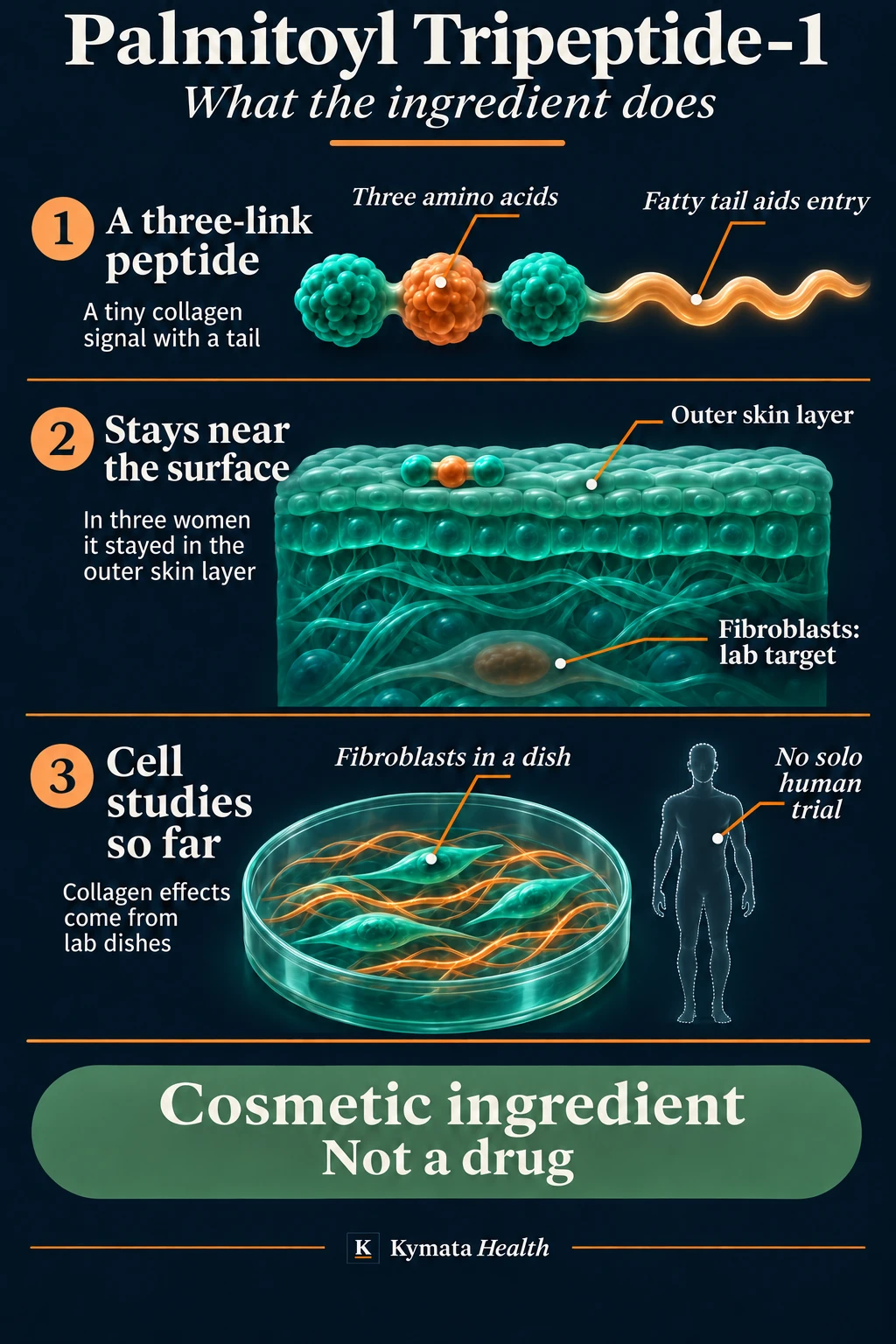
Palmitoyl tripeptide-1 is the GHK tripeptide, a sequence found in collagen, with a palmitoyl tail added to help it enter the skin; it is one half of the Matrixyl 3000 blend and is not injectable GHK-Cu. It is designed as a signal peptide that prompts dermal fibroblasts to make collagen, an effect reported in laboratory cell studies; in three women it stayed in the outer skin layer after a serum (Trzaska 2026), and the one skin study combined it with baicalin against baseline (Wang 2026). Cosmetic ingredient, not a drug. No controlled human study of it on its own. The drawing is a schematic, not a measured molecular structure, a product photograph or a treatment result. Illustration review: 22 November 2026, against this page’s own mechanism, evidence and regulatory records.
A sequence model is not provided for this record. Read the identity and evidence notes; an illustration does not verify a molecular structure.
Illustration notes and source record
Read the source record on this page. Laboratory, topical and injected studies are separate evidence; this illustration does not establish an indication or a treatment outcome.

How it works
Palmitoyl tripeptide-1 (pal-GHK) is the three amino acids glycine, histidine and lysine with a palmitoyl fatty-acid chain attached. It is not GHK-Cu: there is no copper, and it is sold only as a cosmetic ingredient. Its supplier, Sederma, described it as a signal peptide that stimulated collagen in its laboratory work (Lintner 2000, PMID 18503476).
In a 2026 study of three women, a Matrixyl 3000 serum left both of its peptides (pal-GHK and palmitoyl tetrapeptide-7) throughout the outer skin layer, the stratum corneum, at levels that fell with depth, on the surfaces of the cells rather than inside them (Trzaska 2026, PMID 42790608). That study did not look below the stratum corneum or at any skin outcome.
Palmitoyl tripeptide-1 alone is sold as Biopeptide CL. With palmitoyl tetrapeptide-7 it makes Matrixyl 3000. Original Matrixyl is palmitoyl pentapeptide-4, a different peptide (Croda ingredient pages). The 93-woman Matrixyl trial tested palmitoyl pentapeptide-4, not this ingredient.
05 / Evidence and limits
Evidence and limits
No controlled trial of this ingredient
Human evidence
No controlled trial of this ingredient- Studies listed here
- 2
- In 30 Chinese women aged 27 to 40 who used a day cream with baicalin and a night cream with pal-GHK for 8 weeks, nasolabial fold depth was 36.35% lower than at baseline; the paper calls the trial controlled but describes no comparison group, so the two ingredients' effects cannot be separated (Wang 2026, PMID 41527525).
- In three women, both peptides of a Matrixyl 3000 serum were detected through the stratum corneum after 0.5 to 5 hours, with no skin outcome measured (Trzaska 2026, PMID 42790608).
- No published trial has compared pal-GHK alone with a matching product without it.
Limits of current evidence
2 limits- No controlled trial of it alone; the 93-woman Matrixyl trial tested a different peptide.
- Oil-soluble cosmetic, not BAC-water math.
Published Trial Data
2 trials| Study | Phase | Summary | Source |
|---|---|---|---|
| Wang 2026, baicalin day cream plus pal-GHK night cream | Cosmetic study | In 30 women over 8 weeks, nasolabial fold depth was 36.35% lower than baseline; no comparison group is described, so neither ingredient's contribution can be isolated (PMID 41527525). | Source |
| Trzaska 2026, where the Matrixyl 3000 peptides went | Skin-penetration study | In three women, tape strips showed both peptides throughout the stratum corneum, falling with depth and unchanged between 0.5 and 5 hours (PMID 42790608). | Source |
What it is studied for
- Wrinkles (appearance): Insufficient human evidence
Verdict
Palmitoyl tripeptide-1 is a topical GHK analog. Not GHK-Cu vials.
06 / Product forms and access
Product forms and access
Regulatory & legal status
- FDA status (US)
- Not approvedPalmitoyl tripeptide-1, a topical cosmetic ingredient, not an FDA-approved drug. Cosmetic ingredients do not need FDA approval before sale; a product intended for a therapeutic use or to affect the body's structure or function is regulated as a drug (FDA, checked Nov 22, 2026)
- WADA status (2026)
- Not ListedNot currently on the WADA 2026 Prohibited List. Policies may change. Verify before competition.
- US compounding
- Not eligible / not available
07 / Tools and practical checks
Tools and practical checks
No separate record is provided here. Read the linked evidence and limitations for this compound.
08 / Published study use
Published study use
What published studies gave, in whom, and the source. Not a dose for you.
What studies used
No controlled human study- We found no published controlled human study of palmitoyl tripeptide-1 on its own in PubMed.
- 30 women used a baicalin day cream and a palmitoyl tripeptide-1 night cream for 8 weeks; nasolabial fold depth was 36.35% lower than baseline, with no comparison group described. Wang 2026, PMID 41527525 (opens in new tab)
A record of what researchers gave, in whom; not a dose for you.
Administration
- Route / form
- Route used in studies: creams and serums applied to the skin.
Who it is for
1 use| Category | Fit | What exists |
|---|---|---|
| Wrinkles (appearance) | Insufficient human evidence | Only a regimen combining it with baicalin has been studied, against baseline (PMID 41527525). The often-cited 93-woman trial tested a different peptide (PMID 18492182). |
09 / Safety and interactions
Safety and interactions
What the record says
A cosmetic ingredient, not a drug. The small studies here reported no safety problems, but they tested whole products in few people and cannot establish tolerability across skin types or formulas.
10 / Comparisons and goal guides
Comparisons and goal guides
There is no separate comparison record on this page. Similar names do not establish that products or their evidence are interchangeable.
11 / Common questions
Common questions
Common questions
5 answersIs palmitoyl tripeptide-1 the same as Matrixyl?
It is one of the two peptides in Matrixyl 3000, alongside palmitoyl tetrapeptide-7. Original Matrixyl is palmitoyl pentapeptide-4, a different peptide, and its 12-week trial (PMID 18492182) does not apply to this ingredient.
Has it been shown to reduce wrinkles?
Not on its own. The one human efficacy study combined it with a baicalin cream and compared results with baseline, not with a control (PMID 41527525). A separate study found it stays in the outer skin layer after a serum (PMID 42790608).
Was the Matrixyl 3000 blend itself tested for wrinkle reduction?
Not in a controlled trial. The one skin study of the blend measured where its two peptides went in three women and found them in the outer skin layer, with no wrinkle outcome (PMID 42790608). The 8-week wrinkle study used palmitoyl tripeptide-1 with a separate baicalin cream and compared results with baseline (PMID 41527525).
Is it GHK-Cu?
No. It is the GHK sequence with a fatty-acid chain and no copper, sold as a cosmetic ingredient. Evidence for injectable or copper-bound GHK does not apply to it.
Is Palmitoyl Tripeptide-1 FDA-approved?
No. Palmitoyl tripeptide-1, a topical cosmetic ingredient, not an FDA-approved drug. Cosmetic ingredients do not need FDA approval before sale; a product intended for a therapeutic use or to affect the body's structure or function is regulated as a drug (FDA, checked Nov 22, 2026).
12 / Sources and references
Sources and references
5 papers cited on this page.
Sources
5 papers- 1“Targeting Circadian Rhythm for the Regulation of Skin Collagen Metabolism.”Wang C, Song T, Zhang Y, et al. Journal of Cosmetic Dermatology (2026). PMID: 41527525 DOI: 10.1111/jocd.70638
- 2“Permeation behaviour of cosmetic actives into the human stratum corneum.”Trzaska AH, Kotowska AM, Starr NJ, et al. International Journal of Pharmaceutics (2026). PMID: 42790608 DOI: 10.1016/j.ijpharm.2026.127447
- 3“Biologically active peptides: from a laboratory bench curiosity to a functional skin care product.”Lintner K, Peschard O International Journal of Cosmetic Science (2000). PMID: 18503476 DOI: 10.1046/j.1467-2494.2000.00010.x
- 4“Topical palmitoyl pentapeptide provides improvement in photoaged human facial skin.”Robinson LR, Fitzgerald NC, Doughty DG, et al. International Journal of Cosmetic Science (2005). PMID: 18492182 DOI: 10.1111/j.1467-2494.2005.00261.x
- 5“FDA Authority Over Cosmetics: How Cosmetics Are Not FDA-Approved, but Are FDA-Regulated.”US Food and Drug Administration FDA (2026).
14 / Prescription options
Prescription options
Prescription options: compare licensed telehealth providers
Some peptide therapies are available only by prescription after a consult with a licensed clinician.
Compare telehealth →15 / Peptide library
Peptide library
Keep reading: Peptide research library
Peptide research library: every pagePeptide libraryBrowse all topics
- EnclomiphenePrevious in this topic · Enclomiphene is the trans-isomer of clomiphene citrate, a selective estrogen receptor modulator that raises LH, FSH and testosterone; it was studied in Phase 3 trials in men with…
- α-Defensin 1 (HNP-1)Next in this topic · α-Defensin 1 (HNP-1) is a small cationic antimicrobial peptide stored in human neutrophil granules; it has been studied in laboratory and animal models for killing bacteria and…
- Lactoferricin BLactoferricin B is a 25-amino-acid antimicrobial fragment released when pepsin digests bovine lactoferrin.
- LarazotideLarazotide (AT-1001) is an oral octapeptide designed to regulate intestinal tight junctions; it was studied in Phase 2 and Phase 3 trials in adults with celiac disease, and the…
- Pentosan PolysulfatePentosan polysulfate sodium (PPS) is a carbohydrate drug, not a peptide.
Regulatory and sport classification
- Cosmetic ingredient, not a drug