
The peptide field guide
Larazotide
An oral gut-acting peptide studied for keeping intestinal tight junctions closed.
Human trials in celiac disease gave mixed results. Benefit is not established.
Explore this compoundConceptual editorial illustration; not a measured molecular structure, product photograph or treatment result.
02 / At a glance
At a glance
Key facts
- Also known as
- AT-1001, Larazotide acetate, zonulin antagonist
- Type
- Clinical / Pharmaceutical
- Evidence level
- Human trials, mixed results: benefit not established.
- US regulatory status
- Investigational; not FDA-approved
- Updated
Identity
An oral gut-acting peptide studied for keeping intestinal tight junctions closed.
Research context
In a phase 2b celiac trial only one dose group improved on symptoms, and a pooled analysis of four trials found no change in gut permeability.
Evidence limits
Human trials in celiac disease gave mixed results. Benefit is not established.
Read the technical profile and study-use reference
Quick answer
Evidence: LowLarazotide (AT-1001) is an oral octapeptide designed to regulate intestinal tight junctions; it was studied in Phase 2 and Phase 3 trials in adults with celiac disease, and the Phase 3 trial stopped in 2022 for futility.
- In published studies
- Trial amounts are recorded under What studies used (PMID 25683116)
Research summary, not medical advice.
At a glance
Kymata peptide profile · Oct 30, 2026- Common vials
- N/A (oral)
- Molecular weight
- ~620 Da
- In published studies
- Trial amounts are recorded under What studies used (PMID 25683116)
- Half-life
- Short (~minutes), acts locally in gut lumen
03 / Identity and origin
Identity and origin
Also called AT-1001, Larazotide acetate, zonulin antagonist. Tight-junction octapeptide (AT-1001; celiac development casualty).
Read the sequence and compound record
Compound card
- Class
- Tight-junction octapeptide (AT-1001; celiac development casualty)
- Formula
- C25H44N8O10·C2H4O2 (acetate salt)
- Molecular weight
- ~620 Da
- Described by
- Alba Therapeutics / Innovate Biopharmaceuticals, 2004
- Bioavailability
- Local (gut-acting), minimal systemic absorption
04 / How it may work
How it may work
Tight-junction octapeptide (AT-1001; celiac development casualty)
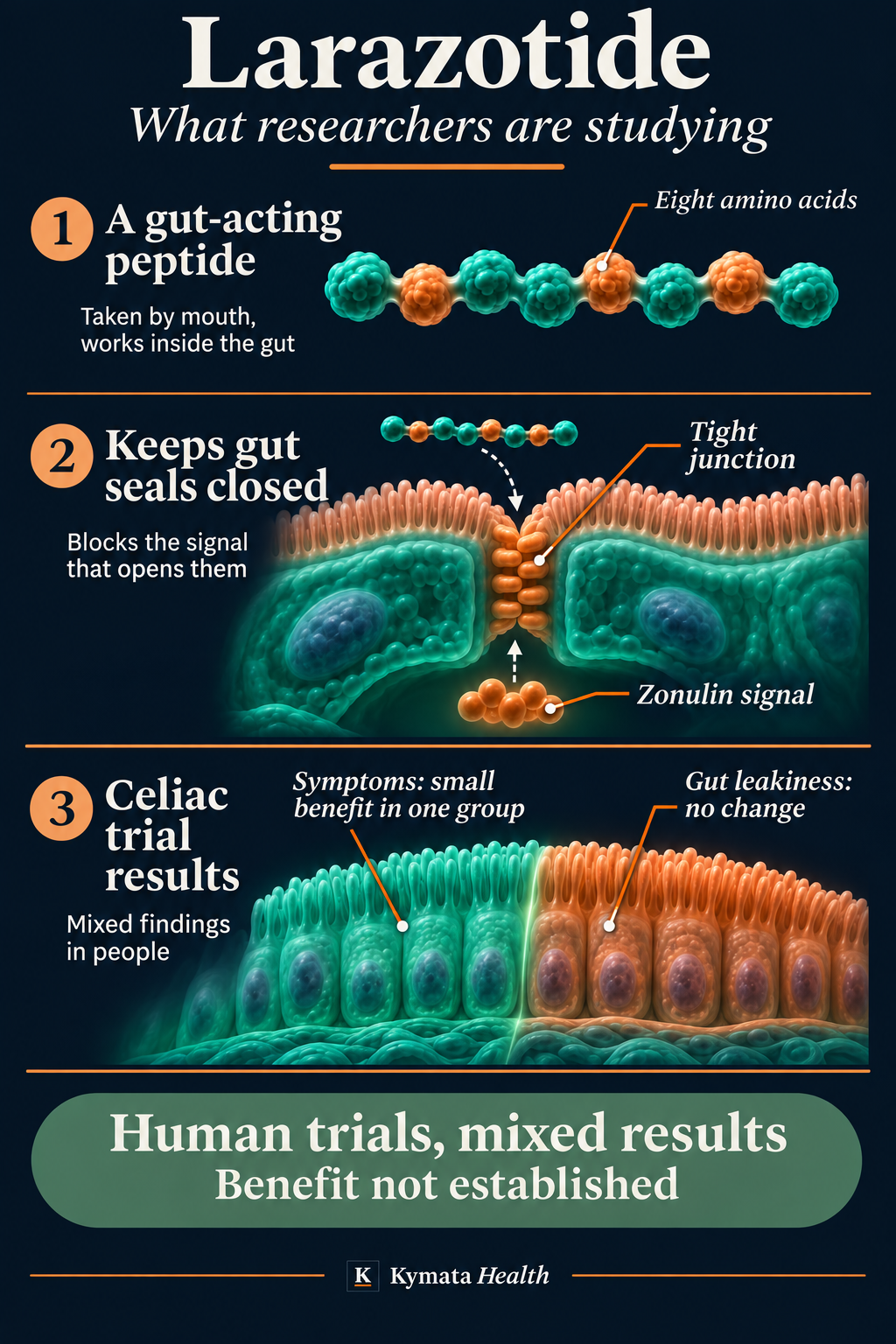
An oral gut-acting peptide studied for keeping intestinal tight junctions closed. In a phase 2b celiac trial only one dose group improved on symptoms, and a pooled analysis of four trials found no change in gut permeability. Human trials in celiac disease gave mixed results. Benefit is not established. The drawing is a schematic, not a measured molecular structure, a product photograph or a treatment result. Illustration review: 19 November 2026, against this page’s own mechanism, evidence and regulatory records.
A sequence model is not provided for this record. Read the identity and evidence notes; an illustration does not verify a molecular structure.
Illustration notes and source record
Read the source record on this page. Laboratory, topical and injected studies are separate evidence; this illustration does not establish an indication or a treatment outcome.

How it works
SourcedLarazotide acetate (AT-1001) is a tight junction regulator peptide that prevents the permeation of zonulin (the primary modulator of intestinal permeability) from opening tight junctions in the gut epithelium. In celiac disease and leaky gut syndromes, zonulin triggers paracellular permeability, allowing dietary antigens (including gliadin fragments) to cross the epithelial barrier and trigger immune responses. Larazotide competes with zonulin at tight junction receptors to maintain barrier integrity. Phase 2b trials in celiac disease showed significant reduction in gastrointestinal symptoms and mucosal permeability markers.
Source: Phase 3
05 / Evidence and limits
Evidence and limits
Use-case scores
0–100–10 against the evidence we have, not a gym ranking. Hidden domains do not apply here.
- Injury & tissue3/10Celiac zonulin-pathway program did not become an approved drug. Not a leaky-gut supplement.
Limits of current evidence
1 limit- This site will not treat celiac disease from a larazotide page.
What it is studied for
- Celiac Disease / Gut Permeability: Low
- Leaky Gut (General): Emerging
Verdict
Larazotide was developed for celiac disease. That program did not deliver a US approval. It is not a gluten-free pill and not BPC-157.
06 / Product forms and access
Product forms and access
Regulatory & legal status
- FDA status (US)
- InvestigationalInvestigational; not FDA-approved
- WADA status (2026)
- Not ListedNot currently on the WADA 2026 Prohibited List. Policies may change. Verify before competition.
- US compounding
- Not eligible / not available
07 / Tools and practical checks
Tools and practical checks
No separate record is provided here. Read the linked evidence and limitations for this compound.
08 / Published study use
Published study use
What published studies gave, in whom, and the source. Not a dose for you.
What studies used
Phase 2 trials- 342 adults with celiac disease on a gluten-free diet: 0.5, 1 or 2 mg by mouth three times a day, or placebo, for 12 weeks. Only the 0.5 mg dose met the main symptom outcome. Leffler 2015, PMID 25683116 (opens in new tab)
A record of what researchers gave, in whom; not a dose for you.
Administration
- Route / form
- Route used in studies: by mouth.
Who it is for
2 uses| Category | Fit | What exists |
|---|---|---|
| Celiac Disease / Gut Permeability | Low | Phase 2b: symptom benefit at the lowest dose only (PMID 25683116). Permeability did not differ from placebo across four randomized trials (PMID 34339872). |
| Leaky Gut (General) | Emerging | Mechanism supports study in non-celiac intestinal permeability disorders. |
09 / Safety and interactions
Safety and interactions
What the record says
Oral research peptide. Not FDA-approved. Phase 2b showed good tolerability. Not a replacement for gluten-free diet in celiac. Phase 3 trials for celiac non-responsive disease have been initiated.
10 / Comparisons and goal guides
Comparisons and goal guides
There is no separate comparison record on this page. Similar names do not establish that products or their evidence are interchangeable.
11 / Common questions
Common questions
Common questions
3 answersCan larazotide be used for leaky gut outside of celiac disease?
It is being researched for multiple tight-junction disorders (IBD, NASH, COVID-related gut permeability). Celiac disease is the most studied indication. Off-label use exists but human evidence is Phase 2 only.
How was larazotide given in studies?
By mouth: 342 adults with celiac disease took 0.5, 1 or 2 mg three times a day, or placebo, for 12 weeks; only 0.5 mg met the main outcome (PMID 25683116). It acts locally in the gut lumen.
Is Larazotide FDA-approved?
No. Investigational; not FDA-approved.
12 / Sources and references
Sources and references
1 paper cited on this page.
Sources
1 paper- 1“"Larazotide acetate for persistent symptoms of celiac disease despite a gluten-free diet: a randomized controlled trial".”Leffler DA et al. Gastroenterology (2015). PMID: 25683116
14 / Prescription options
Prescription options
Prescription options: compare licensed telehealth providers
Some peptide therapies are available only by prescription after a consult with a licensed clinician.
Compare telehealth →15 / Peptide library
Peptide library
Keep reading: Peptide research library
Peptide research library: every pagePeptide libraryBrowse all topics
- Lactoferricin BPrevious in this topic · Lactoferricin B is a 25-amino-acid antimicrobial fragment released when pepsin digests bovine lactoferrin.
- Pentosan PolysulfateNext in this topic · Pentosan polysulfate sodium (PPS) is a carbohydrate drug, not a peptide.
- hCGHuman chorionic gonadotropin is an LH-receptor agonist used as a prescription fertility and hypogonadism drug.
- IGF-1 DESIGF-1 DES lacks the first three amino acids of mature IGF-1.
- Somatropin191-amino-acid recombinant human growth hormone, the hormone itself rather than a secretagogue.
Regulatory and sport classification
- Investigational; not FDA-approved