
The peptide field guide
Lactoferricin B
Lactoferricin B (LfcinB) is an antimicrobial peptide released when pepsin digests cow lactoferrin, from amino acids 17 to 41 of that protein; it is not lactoferrin itself.
Cell and animal studies. No human study of lactoferricin B itself. Not FDA-approved.
Explore this compoundConceptual editorial illustration; not a measured molecular structure, product photograph or treatment result.
02 / At a glance
At a glance
Key facts
- Also known as
- LfcinB, bovine lactoferricin, f(17-41)
- Type
- Antimicrobial
- Evidence level
- Cell and animal research: human benefit remains unproven.
- US regulatory status
- Not FDA-approved, research chemical
- Updated
Identity
Lactoferricin B (LfcinB) is an antimicrobial peptide released when pepsin digests cow lactoferrin, from amino acids 17 to 41 of that protein; it is not lactoferrin itself.
Research context
In laboratory studies it binds lipopolysaccharide on bacteria and disrupts their membranes; in cell and animal studies it also damaged some cancer cells, including by triggering apoptosis through the mitochondria.
Evidence limits
Cell and animal studies. No human study of lactoferricin B itself. Not FDA-approved.
Read the technical profile and study-use reference
Quick answer
Evidence: LowLactoferricin B is a 25-amino-acid antimicrobial fragment released when pepsin digests bovine lactoferrin. Its antibacterial activity was measured in cultures, and it was detected in one adult’s stomach after the person drank whole bovine lactoferrin.
- In published studies
- No human dosing study published
Research summary, not medical advice.
At a glance
Kymata peptide profile · Nov 22, 2026- Molecular weight
- 3125.8 g/mol
- In published studies
- No human dosing study published
- Half-life
- No human half-life established
- Common vials
- Laboratory reagent; not a calculator product
03 / Identity and origin
Identity and origin
Also called LfcinB, bovine lactoferricin, f(17-41). Bovine lactoferrin-derived AMP fragment.
Read the sequence and compound record
Compound card
- Class
- Bovine lactoferrin-derived AMP fragment
- Formula
- C141H226N46O29S3
- Molecular weight
- 3125.8 g/mol
- PubChem CID
- 16132444
- Described by
- Derived from bovine lactoferrin; isolated by Bellamy et al., 1992, 1992
04 / How it may work
How it may work
Bovine lactoferrin-derived AMP fragment
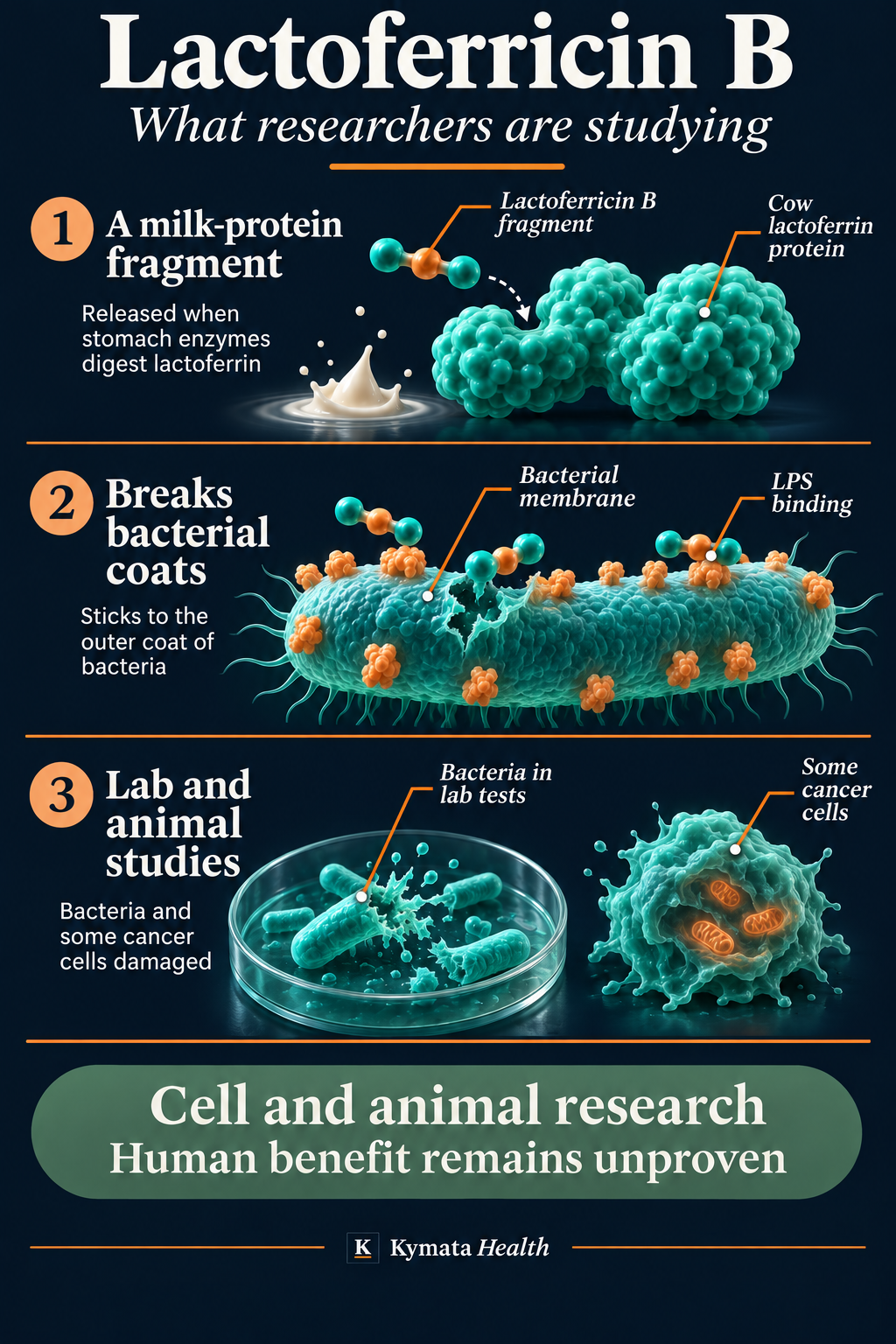
Lactoferricin B (LfcinB) is an antimicrobial peptide released when pepsin digests cow lactoferrin, from amino acids 17 to 41 of that protein; it is not lactoferrin itself. In laboratory studies it binds lipopolysaccharide on bacteria and disrupts their membranes; in cell and animal studies it also damaged some cancer cells, including by triggering apoptosis through the mitochondria. Cell and animal studies. No human study of lactoferricin B itself. Not FDA-approved. The drawing is a schematic, not a measured molecular structure, a product photograph or a treatment result. Illustration review: 19 November 2026, against this page’s own mechanism, evidence and regulatory records.
A sequence model is not provided for this record. Read the identity and evidence notes; an illustration does not verify a molecular structure.
Illustration notes and source record
Read the source record on this page. Laboratory, topical and injected studies are separate evidence; this illustration does not establish an indication or a treatment outcome.

How it works
SourcedLactoferricin B (LfcinB) is a cationic peptide released when pepsin digests bovine lactoferrin (bovine residues 17-41). Bellamy and colleagues (1992, PMID 1599934) isolated an antimicrobial peptide from pepsin digests of human and bovine lactoferrin, located it near the N-terminus away from the iron-binding sites, and found the bovine peptide caused rapid loss of colony-forming ability in Gram-negative and Gram-positive bacteria at 0.3 to 3.0 µM in culture.
Bellamy and colleagues (1993, PMID 8300449) showed in culture that 14C-labeled lactoferricin B bound rapidly to E. coli and Bacillus subtilis, that Mg2+ or Ca2+ reduced binding, and that the peptide inhibited bacterial proline uptake about as well as polymyxin B. These are culture findings; no person has received the isolated fragment.
Source: Bellamy et al., 1992 (PMID 1599934) and 1993 (PMID 8300449); Kuwata et al., 1998 (PMID 9920391)
05 / Evidence and limits
Evidence and limits
One adult digestion study and bacterial cultures
Human evidence
One adult digestion study and bacterial cultures- Kuwata and colleagues (1998, PMID 9920391) used affinity mass spectrometry on gastric contents from one adult 10 minutes after ingestion of bovine lactoferrin and detected lactoferricin at about 17 µg/mL along with larger partly digested fragments, without measuring blood absorption or any clinical outcome.
- Vorland and colleagues (1998, PMID 10066056) found bovine lactoferricin the most active of four species' lactoferricins in MIC and MBC assays, moderately active against E. coli ATCC 25922 and S. aureus ATCC 25923 and inactive against P. mirabilis and Y. enterocolitica in culture.
Limits of current evidence
2 limits- The gastric study sampled one adult after ingestion of whole bovine lactoferrin; it measured neither absorption into the blood nor any clinical outcome (PMID 9920391).
- A culture concentration around a bacterium does not tell how much a person could safely take.
What it is studied for
- Reference page for Lactoferricin B. Concentration arithmetic is not a treatment protocol.
Verdict
Lactoferricin B is a fragment of lactoferrin, tested in bacterial cultures and detected in one adult’s stomach after drinking whole lactoferrin. Supplement-aisle lactoferrin is a different product. Not a Lyme protocol.
06 / Product forms and access
Product forms and access
Regulatory & legal status
- FDA status (US)
- Research Only
- WADA status (2026)
- Not ListedLactoferricin B is not named on WADA’s 2026 Prohibited List, and class S0 prohibits pharmacological substances not covered elsewhere that lack governmental approval for human therapeutic use. Verify before competition.
- US compounding
- Not eligible / not available
07 / Tools and practical checks
Tools and practical checks
No separate record is provided here. Read the linked evidence and limitations for this compound.
08 / Published study use
Published study use
What published studies gave, in whom, and the source. Not a dose for you.
What studies used
Bacterial cultures and one human stomach sample- We found no published human dosing study of lactoferricin B itself. Human studies of milk lactoferrin use the whole protein, a different product.
- The bovine fragment isolated from pepsin digests caused rapid loss of colony-forming ability in bacteria in culture. Bellamy 1992, PMID 1599934 (opens in new tab)
- Labeled lactoferricin B bound rapidly to E. coli and Bacillus subtilis in culture; calcium or magnesium reduced binding. Bellamy 1993, PMID 8300449 (opens in new tab)
- Lactoferricin was detected in one adult’s stomach after the person drank whole bovine lactoferrin; no one received the isolated fragment. Kuwata 1998, PMID 9920391 (opens in new tab)
A record of what researchers gave, in whom; not a dose for you.
09 / Safety and interactions
Safety and interactions
What the record says
Research compound only. These studies do not establish a safe amount of isolated lactoferricin B to swallow, apply or inject, and they provide no basis for replacing a prescribed antimicrobial. It is derived from bovine milk protein.
10 / Comparisons and goal guides
Comparisons and goal guides
There is no separate comparison record on this page. Similar names do not establish that products or their evidence are interchangeable.
11 / Common questions
Common questions
Common questions
3 answersIs lactoferricin B the same as lactoferrin?
No. Lactoferricin B is a 25-amino-acid fragment released when pepsin digests bovine lactoferrin. Lactoferrin is the whole milk glycoprotein, and a study of a lactoferrin supplement tests the whole protein.
What did researchers find in the human stomach?
In one adult, lactoferricin was detected in gastric contents 10 minutes after the person drank whole bovine lactoferrin (PMID 9920391). The study did not measure absorption into the blood or any clinical outcome.
Is Lactoferricin B FDA-approved?
No. Not FDA-approved, research chemical.
12 / Sources and references
Sources and references
4 papers cited on this page.
Sources
4 papers- 1“Identification of the bactericidal domain of lactoferrin.”Bellamy W et al. Biochimica et Biophysica Acta (1992). PMID: 1599934 DOI: 10.1016/0167-4838(92)90346-F
- 2“Role of cell-binding in the antibacterial mechanism of lactoferricin B.”Bellamy WR et al. Journal of Applied Bacteriology (1993). PMID: 8300449
- 3“Lactoferricin of bovine origin is more active than lactoferricins of human, murine and caprine origin.”Vorland LH et al. Scandinavian Journal of Infectious Diseases (1998). PMID: 10066056 DOI: 10.1080/00365549850161557
- 4“Direct evidence of the generation in human stomach of an antimicrobial peptide domain (lactoferricin) from ingested lactoferrin.”Kuwata H et al. Biochimica et Biophysica Acta (1998). PMID: 9920391 DOI: 10.1016/S0167-4838(98)00224-6
14 / Prescription options
Prescription options
Prescription options: compare licensed telehealth providers
Some peptide therapies are available only by prescription after a consult with a licensed clinician.
Compare telehealth →15 / Peptide library
Peptide library
Keep reading: Peptide research library
Peptide research library: every pagePeptide libraryBrowse all topics
- α-Defensin 1 (HNP-1)Previous in this topic · α-Defensin 1 (HNP-1) is a small cationic antimicrobial peptide stored in human neutrophil granules; it has been studied in laboratory and animal models for killing bacteria and…
- LarazotideNext in this topic · Larazotide (AT-1001) is an oral octapeptide designed to regulate intestinal tight junctions; it was studied in Phase 2 and Phase 3 trials in adults with celiac disease, and the…
- Pentosan PolysulfatePentosan polysulfate sodium (PPS) is a carbohydrate drug, not a peptide.
- hCGHuman chorionic gonadotropin is an LH-receptor agonist used as a prescription fertility and hypogonadism drug.
- IGF-1 DESIGF-1 DES lacks the first three amino acids of mature IGF-1.
Regulatory and sport classification
- Not FDA-approved, research chemical