
The peptide field guide
α-Defensin 1 (HNP-1)
Alpha-defensin 1 (HNP-1) is a small cationic antimicrobial peptide stored in the granules of human neutrophils; it is not LL-37.
Laboratory and animal studies. No published human study gave it as a treatment. Not FDA-approved.
Explore this compoundConceptual editorial illustration; not a measured molecular structure, product photograph or treatment result.
02 / At a glance
At a glance
Key facts
- Also known as
- Human Neutrophil Peptide 1, HNP-1, DEFA1
- Sequence
- ACYCRIPACIAGERRYGTCIYQGRLWAFCC
- Evidence level
- Cell and animal research: human benefit remains unproven.
- US regulatory status
- Not FDA-approved, research chemical
- Updated
Identity
Alpha-defensin 1 (HNP-1) is a small cationic antimicrobial peptide stored in the granules of human neutrophils; it is not LL-37.
Research context
In laboratory studies it binds and opens pores in the membranes of bacteria, some fungi and enveloped viruses, and it attracts immune cells such as T cells and immature dendritic cells.
Evidence limits
Laboratory and animal studies. No published human study gave it as a treatment. Not FDA-approved.
Read the technical profile and study-use reference
Quick answer
Evidence: Lowα-Defensin 1 (HNP-1) is a small cationic antimicrobial peptide stored in human neutrophil granules; it has been studied in laboratory and animal models for killing bacteria and signalling to immune cells, not as a medicine.
- In published studies
- No human dosing study published
Research summary, not medical advice.
At a glance
Kymata peptide profile · Nov 22, 2026- In published studies
- No human dosing study published
- Half-life
- No human half-life established
- Common vials
- Laboratory reagent; not a calculator product
- Molecular weight
- 3442.1 g/mol (calculated)
03 / Identity and origin
Identity and origin
Also called Human Neutrophil Peptide 1, HNP-1, DEFA1. Human neutrophil granule peptide (HNP-1; AMP).
Read the sequence and compound record
Compound card
1 cell = 1 amino acid- Sequence
- ACYCRIPACIAGERRYGTCIYQGRLWAFCC
- Class
- Human neutrophil granule peptide (HNP-1; AMP)
- Formula
- C150H222N44O38S6 (calculated from the sequence with three disulfides)
- Molecular weight
- 3442.1 g/mol (calculated)
- Described by
- Isolated from human neutrophils by Ganz, Selsted and colleagues, 1985
04 / How it may work
How it may work
Human neutrophil granule peptide (HNP-1; AMP)
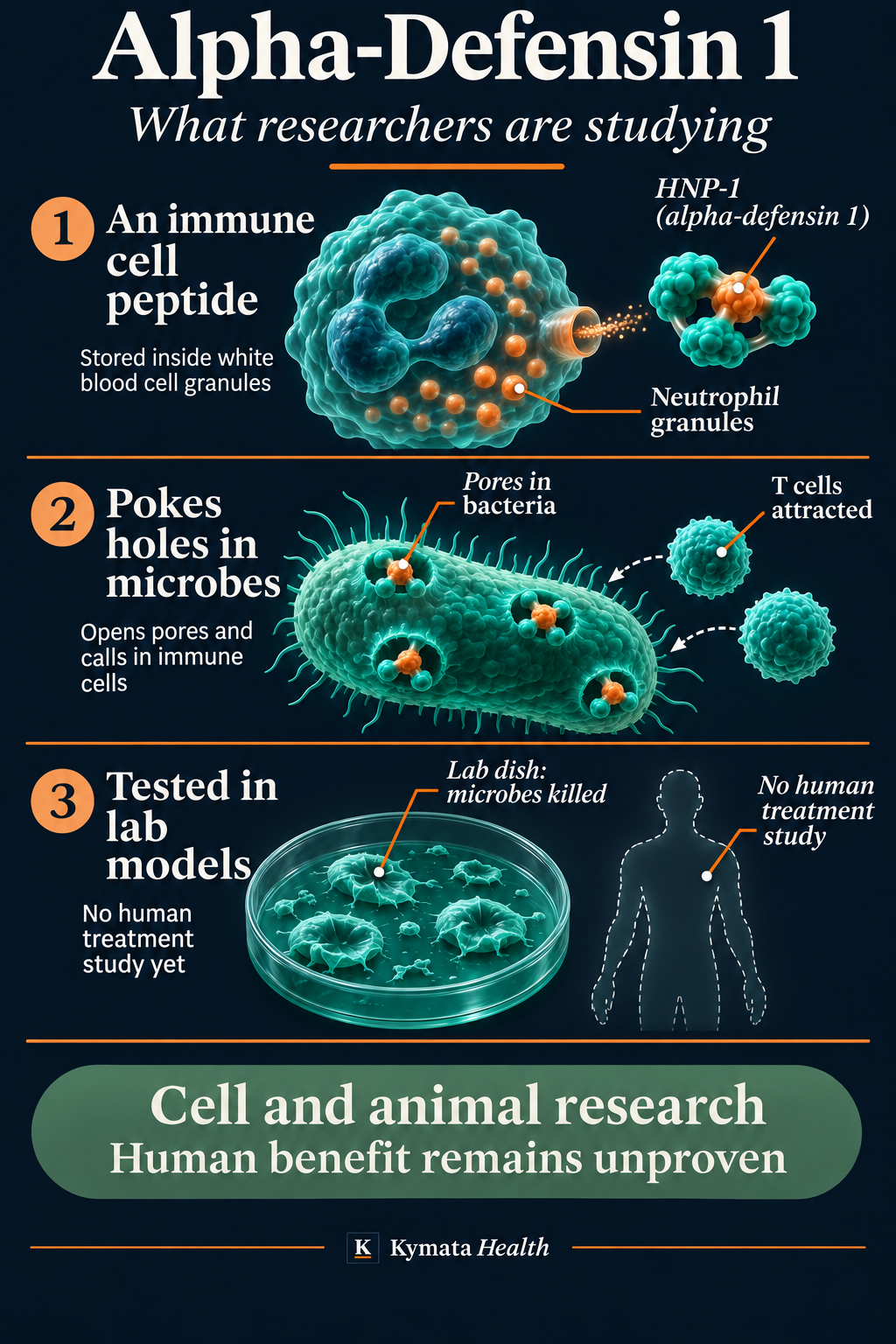
Alpha-defensin 1 (HNP-1) is a small cationic antimicrobial peptide stored in the granules of human neutrophils; it is not LL-37. In laboratory studies it binds and opens pores in the membranes of bacteria, some fungi and enveloped viruses, and it attracts immune cells such as T cells and immature dendritic cells. Laboratory and animal studies. No published human study gave it as a treatment. Not FDA-approved. The drawing is a schematic, not a measured molecular structure, a product photograph or a treatment result. Illustration review: 19 November 2026, against this page’s own mechanism, evidence and regulatory records.
A sequence model is not provided for this record. Read the identity and evidence notes; an illustration does not verify a molecular structure.
Illustration notes and source record
Read the source record on this page. Laboratory, topical and injected studies are separate evidence; this illustration does not establish an indication or a treatment outcome.

How it works
SourcedHuman alpha-defensin 1 (HNP-1, human neutrophil peptide 1) is a small cationic antimicrobial peptide stored in the azurophil granules of human neutrophils. Selsted and colleagues (1985, PMID 4056036) sequenced HNP-1, HNP-2 and HNP-3 purified from human neutrophils and found 29- to 30-residue peptides identical except at the N-terminus, with HNP-1 reading ACYCRIPACIAGERRYGTCIYQGRLWAFCC.
In Ganz and colleagues' 1985 culture experiments (PMID 2997278, Tables I and III), purified HNP-1 at 50 µg/mL lowered colony-forming S. aureus 502A by 2.1 and 2.3 log10 units (more than a hundredfold) over two hours in two experiments while untreated controls grew, and the HNP 1-3 mixture killed bacteria only when the buffer contained nutrients. Blood donors supplied the neutrophils; no person received HNP-1. HNP-1 is not LL-37 and not a beta-defensin; the Paneth-cell defensins HD5 and HD6 are different alpha-defensins.
Source: Selsted et al., 1985 (PMID 4056036); Ganz et al., 1985 (PMID 2997278, Tables I and III)
05 / Evidence and limits
Evidence and limits
Human donor cells and laboratory cultures · no person received HNP-1
Human evidence
Human donor cells and laboratory cultures · no person received HNP-1- Blood donors provided the neutrophils. Researchers purified the peptides from the cells before adding them to microbes in culture (PMIDs 4056036, 2997278).
- In Ganz and colleagues' 1985 culture experiments (PMID 2997278, Tables I and III), purified HNP-1 at 50 µg/mL lowered colony-forming S. aureus 502A by 2.1 and 2.3 log10 units (more than a hundredfold) over two hours in two experiments while untreated controls grew, and the HNP 1-3 mixture killed bacteria only when the buffer contained nutrients.
Limits of current evidence
2 limits- The HNP 1-3 mixture and purified HNP-1 were separate preparations; a mixture result cannot be assigned to HNP-1.
- A count of surviving bacteria in culture says nothing directly about symptoms, recovery or the safety of a dose in people.
What it is studied for
- Reference page for α-Defensin 1 (HNP-1). Concentration arithmetic is not a treatment protocol.
Verdict
α-defensin-1 is an endogenous antimicrobial peptide from human neutrophils. Purified HNP-1 killed bacteria in culture; no person has received it. Vials are not a substitute for indicated antimicrobials. Not LL-37.
06 / Product forms and access
Product forms and access
Regulatory & legal status
- FDA status (US)
- Research Only
- WADA status (2026)
- Not ListedHNP-1 is not named on WADA’s 2026 Prohibited List, and class S0 prohibits pharmacological substances not covered elsewhere that lack governmental approval for human therapeutic use. Verify before competition.
- US compounding
- Not eligible / not available
07 / Tools and practical checks
Tools and practical checks
No separate record is provided here. Read the linked evidence and limitations for this compound.
08 / Published study use
Published study use
What published studies gave, in whom, and the source. Not a dose for you.
What studies used
Laboratory cultures; no human dosing study- We found no published human study that gave alpha-defensin 1 (HNP-1) as a treatment.
- HNP-1, HNP-2 and HNP-3 were purified from human neutrophils and sequenced. Selsted 1985, PMID 4056036 (opens in new tab)
- Purified HNP-1 lowered colony-forming S. aureus 502A by more than a hundredfold over two hours in culture; the HNP 1-3 mixture killed bacteria only when the buffer contained nutrients. Ganz 1985, Tables I and III, PMID 2997278 (opens in new tab)
A record of what researchers gave, in whom; not a dose for you.
09 / Safety and interactions
Safety and interactions
What the record says
Research peptide only. The experiments did not examine adverse effects or dosing in people, and they provide no basis for replacing a prescribed antimicrobial.
10 / Comparisons and goal guides
Comparisons and goal guides
There is no separate comparison record on this page. Similar names do not establish that products or their evidence are interchangeable.
11 / Common questions
Common questions
Common questions
4 answersWhat did HNP-1 do to bacteria in the original experiment?
In two two-hour culture experiments, purified HNP-1 lowered colony-forming Staphylococcus aureus strain 502A by more than a hundredfold while untreated controls grew (Ganz 1985, PMID 2997278, Table III). The HNP 1-3 mixture killed bacteria only when the buffer contained nutrients (Table I).
Has HNP-1 been given to people?
No. Human donors supplied the neutrophils from which HNP-1 was purified; the peptide was applied to microbes in the laboratory. No study measured safety or recovery in anyone treated with it.
Is HNP-1 made by Paneth cells?
No. HNP-1 is stored in neutrophil granules. Paneth cells in the gut make different alpha-defensins, HD5 and HD6.
Is α-Defensin 1 (HNP-1) FDA-approved?
No. Not FDA-approved, research chemical.
12 / Sources and references
Sources and references
2 papers cited on this page.
Sources
2 papers- 1“Primary structures of three human neutrophil defensins.”Selsted ME et al. Journal of Clinical Investigation (1985). PMID: 4056036 DOI: 10.1172/JCI112121
- 2“Defensins. Natural peptide antibiotics of human neutrophils.”Ganz T et al. Journal of Clinical Investigation (1985). PMID: 2997278 DOI: 10.1172/JCI112120
14 / Prescription options
Prescription options
Prescription options: compare licensed telehealth providers
Some peptide therapies are available only by prescription after a consult with a licensed clinician.
Compare telehealth →15 / Peptide library
Peptide library
Keep reading: Peptide research library
Peptide research library: every pagePeptide libraryBrowse all topics
- Palmitoyl Tripeptide-1Previous in this topic · Palmitoyl Tripeptide-1 (Pal-GHK) is a widely used cosmetic peptide and an ingredient in blends such as Matrixyl 3000.
- Lactoferricin BNext in this topic · Lactoferricin B is a 25-amino-acid antimicrobial fragment released when pepsin digests bovine lactoferrin.
- LarazotideLarazotide (AT-1001) is an oral octapeptide designed to regulate intestinal tight junctions; it was studied in Phase 2 and Phase 3 trials in adults with celiac disease, and the…
- Pentosan PolysulfatePentosan polysulfate sodium (PPS) is a carbohydrate drug, not a peptide.
- hCGHuman chorionic gonadotropin is an LH-receptor agonist used as a prescription fertility and hypogonadism drug.
Regulatory and sport classification
- Not FDA-approved, research chemical