
The peptide field guide
Pentosan Polysulfate
Pentosan polysulfate sodium (Elmiron), a semi-synthetic heparin-like polysaccharide; not a peptide.
FDA-approved as Elmiron capsules for the bladder pain or discomfort of interstitial cystitis. Prescription only.
Explore this compoundConceptual editorial illustration; not a measured molecular structure, product photograph or treatment result.
02 / At a glance
At a glance
Key facts
- Also known as
- Elmiron, PPS, SP-54, Cartrophen Vet (veterinary injection)
- Type
- Clinical / Pharmaceutical
- Evidence level
- FDA-approved for interstitial cystitis: prescription only.
- US regulatory status
- FDA-approved as Elmiron® (1996), oral, for interstitial cystitis bladder pain
- Updated
Identity
Pentosan polysulfate sodium (Elmiron), a semi-synthetic heparin-like polysaccharide; not a peptide.
Research context
It is thought to cling to the bladder lining and add to its glycosaminoglycan layer, reducing contact between irritants in urine and the bladder wall; its label warns of retinal pigment changes (maculopathy) with long-term use.
Evidence limits
FDA-approved as Elmiron capsules for the bladder pain or discomfort of interstitial cystitis. Prescription only.
Read the technical profile and study-use reference
Quick answer
Evidence: HighPentosan polysulfate sodium (PPS) is a carbohydrate drug, not a peptide. Its oral capsule, Elmiron, is FDA-approved for bladder pain or discomfort from interstitial cystitis. Trials found different results for pain and for a broader symptom score, and its label warns about changes in the retina.
- FDA label dose
- FDA label (Elmiron): dose and schedule set by the prescriber and the label
Research summary, not medical advice.
At a glance
Kymata peptide profile · Nov 22, 2026- Common vials
- N/A (oral)
- CAS
- 37319-17-8
- FDA label dose
- FDA label (Elmiron): dose and schedule set by the prescriber and the label
- Half-life
- Plasma radioactivity half-life about 20–27 hours after oral radiolabeled doses (Elmiron label)
- Molecular weight
- 4000–6000 Da (Elmiron label)
03 / Identity and origin
Identity and origin
Also called Elmiron, PPS, SP-54, Cartrophen Vet (veterinary injection). Sulfated polysaccharide (a carbohydrate drug, not a peptide).
Read the sequence and compound record
Compound card
- Class
- Sulfated polysaccharide (a carbohydrate drug, not a peptide)
- Formula
- Sulfated xylan polymer (variable chain; no single molecular formula)
- Molecular weight
- 4000–6000 Da (Elmiron label)
- CAS
- 37319-17-8
- Described by
- Elmiron: Janssen Pharmaceuticals (US labeler), 1996 (US approval)
- Bioavailability
- About 6% of an oral dose is absorbed (Elmiron label)
04 / How it may work
How it may work
Sulfated polysaccharide (a carbohydrate drug, not a peptide)
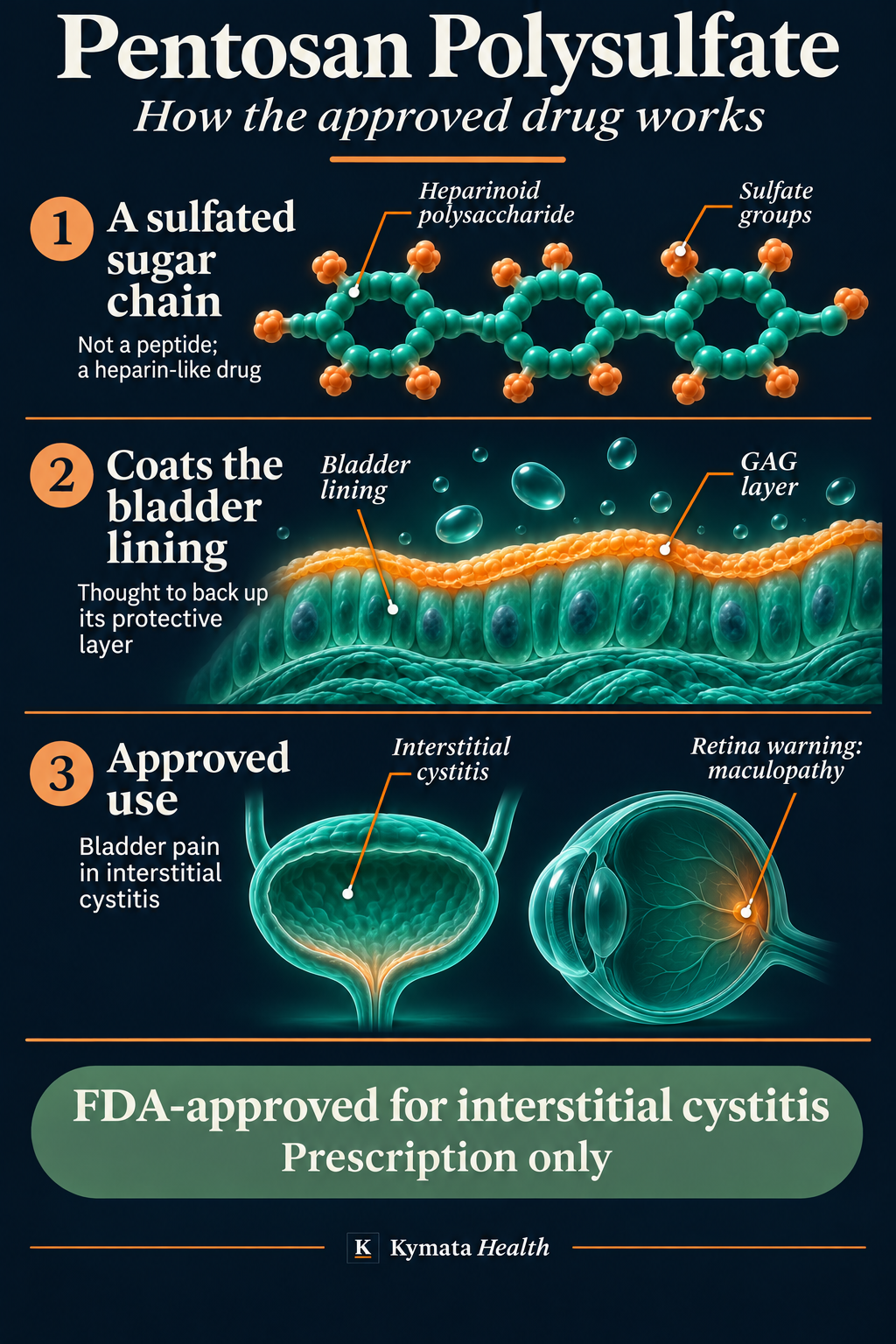
Pentosan polysulfate sodium (Elmiron), a semi-synthetic heparin-like polysaccharide; not a peptide. It is thought to cling to the bladder lining and add to its glycosaminoglycan layer, reducing contact between irritants in urine and the bladder wall; its label warns of retinal pigment changes (maculopathy) with long-term use. FDA-approved as Elmiron capsules for the bladder pain or discomfort of interstitial cystitis. Prescription only. The drawing is a schematic, not a measured molecular structure, a product photograph or a treatment result. Illustration review: 19 November 2026, against this page’s own mechanism, evidence and regulatory records.
A sequence model is not provided for this record. Read the identity and evidence notes; an illustration does not verify a molecular structure.
Illustration notes and source record
Read the source record on this page. Laboratory, topical and injected studies are separate evidence; this illustration does not establish an indication or a treatment outcome.

How it works
SourcedPentosan polysulfate sodium (PPS, Elmiron®) is a semi-synthetic, heparin-like sulfated polysaccharide (a sulfated xylan made from beechwood hemicellulose). It is not a peptide. The Elmiron label says its mechanism in interstitial cystitis is not known; the usual explanation is that it adheres to the bladder lining and adds to its glycosaminoglycan layer. It is also a weak anticoagulant. Elmiron has been sold in the US for interstitial cystitis since 1996. Injectable PPS is a veterinary product for osteoarthritis in some countries; laboratory and animal studies of cartilage are not a human joint indication.
Source: Elmiron prescribing information (revised July 2024); Nickel et al., PMID 25245489
05 / Evidence and limits
Evidence and limits
Use-case scores
0–100–10 against the evidence we have, not a gym ranking. Hidden domains do not apply here.
- Injury & tissue4/10A human knee pilot of an injectable form measured pain, stiffness and function. It did not test whether cartilage regrew, and the oral Elmiron label covers interstitial cystitis.
Limits of current evidence
2 limits- The bladder trials used different entry criteria and measured different outcomes. Neither tells an individual how soon relief will begin.
- The knee study tested an injectable formulation. Its findings cannot establish the effects of the oral capsule on knee cartilage.
Published Trial Data
3 trials| Study | Phase | Summary | Source |
|---|---|---|---|
| Bladder pain trial in the Elmiron label | Not specified | In the label’s blinded, randomized, placebo-controlled trial of 151 patients who met NIH interstitial cystitis criteria by cystoscopy, cytology and biopsy, 28 of 74 (38%) taking Elmiron and 13 of 74 (18%) taking placebo reported more than 50% improvement in bladder pain at 3 months (p = 0.005). | Source |
| Broader symptom-score trial | Not specified | In a double-blind randomized trial of 368 adults enrolled by symptom score without cystoscopy criteria, neither pentosan group differed significantly from placebo on the primary endpoint, a 30% or greater fall in the Interstitial Cystitis Symptom Index at 24 weeks; the trial stopped early after an interim analysis at 54% of its target enrollment (Nickel et al. 2015, PMID 25245489). | Source |
| Knee osteoarthritis pilot (injectable) | Not specified | In a randomized, double-blind pilot of 114 adults with knee osteoarthritis, four weekly intramuscular injections of pentosan polysulfate improved 3 of 7 direct clinical measures, including pain at rest and stiffness, compared with Ringer’s solution control injections (Ghosh et al. 2005, PMID 24678076). The trial did not measure cartilage regrowth. | Source |
Trial FinderRecruiting now: 2 open registrations for pentosan Polysulfate
What it is studied for
- Interstitial Cystitis: High
- Osteoarthritis / Joint Repair: Low
Verdict
In the trial in the Elmiron label, more people taking the drug than placebo reported their bladder pain had more than halved. A later, broader trial found no difference from placebo on an overall symptom score. The retinal warning matters when weighing continued use with a prescriber.
06 / Product forms and access
Product forms and access
Regulatory & legal status
- FDA status (US)
- ApprovedFDA-approved as Elmiron® (1996), oral, for interstitial cystitis bladder pain
- WADA status (2026)
- Not ListedNot currently on the WADA 2026 Prohibited List. Policies may change. Verify before competition.
- Classification
- Prescription Drug
07 / Tools and practical checks
Tools and practical checks
No separate record is provided here. Read the linked evidence and limitations for this compound.
08 / Published study use
Published study use
What the label states, for the patients it is approved for, and the source. Not a dose for you.
What the FDA label says
FDA label- Elmiron (interstitial cystitis): approved strength 100 mg oral capsule; the label calls for reassessment after 3 months. Elmiron label, DailyMed (opens in new tab)
- The label has no intramuscular dose.
The label’s dosing, for the patients it is approved for; the prescriber sets the dose.
Administration
- Route / form
- Oral prescription capsule (Elmiron)
Timeline
2 stages- 3 months
The Elmiron label says patients should be reassessed after 3 months; it does not promise a time to relief.
- 24-week symptom study
The later trial assessed the overall symptom score at 24 weeks (PMID 25245489). Study visits cannot predict when one person will feel better.
Who it is for
2 uses| Category | Fit | What exists |
|---|---|---|
| Interstitial Cystitis | High | Elmiron label: relief of bladder pain or discomfort associated with interstitial cystitis. |
| Osteoarthritis / Joint Repair | Low | Not an FDA-approved use. Injectable PPS is a veterinary product in some countries; human osteoarthritis use is investigational. |
09 / Safety and interactions
Safety and interactions
What the record says
FDA-approved orally (Elmiron). The label warns of retinal pigmentary changes (pigmentary maculopathy), most often reported after long-term use, and suggests a baseline retinal examination within six months of starting and periodic exams during treatment. Most cases followed 3 or more years of use, but some occurred sooner; reported symptoms include difficulty reading, slow adjustment to dim light and blurred vision, and changes may progress after the medicine is stopped. It is a weak anticoagulant, so the label warns about bleeding risk, and mild liver-enzyme rises were reported.
10 / Comparisons and goal guides
Comparisons and goal guides
There is no separate comparison record on this page. Similar names do not establish that products or their evidence are interchangeable.
11 / Common questions
Common questions
Common questions
4 answersWhen does the Elmiron label suggest an eye exam, and why?
Long-term oral pentosan polysulfate (Elmiron) has been linked to a pigmentary maculopathy, first described in 2018 in patients with years of exposure (PMID 29801663). The label suggests a baseline retinal examination, including OCT and autofluorescence imaging, within six months of starting and periodic exams while treatment continues. For people with pre-existing eye conditions it recommends a comprehensive retinal exam before treatment. Retinal changes can progress even after the medicine is stopped, so follow-up continues.
What did the bladder studies measure?
The label’s blinded trial asked people meeting NIH cystoscopy-based interstitial cystitis criteria how much their bladder pain had eased: 38% on Elmiron and 18% on placebo reported more than 50% improvement at 3 months. A later trial of 368 adults enrolled by symptom questionnaire, without cystoscopy criteria, found no significant difference from placebo on the overall symptom score at 24 weeks (PMID 25245489).
Does pentosan polysulfate work for osteoarthritis or repair cartilage?
That has not been established. Osteoarthritis is not an FDA-approved use and the Elmiron label has no injectable form. A small pilot of an injectable preparation in 114 adults improved some pain and stiffness measures but did not measure cartilage (PMID 24678076), and injectable PPS for joints is a veterinary product in some countries.
Is Pentosan Polysulfate FDA-approved?
Yes. FDA-approved as Elmiron® (1996), oral, for interstitial cystitis bladder pain.
12 / Sources and references
Sources and references
4 sources cited on this page.
Sources
4 sources- 1“Elmiron (pentosan polysulfate sodium) capsules: prescribing information, revised July 2024.”Janssen Pharmaceuticals DailyMed (2024). Prescribing information
- 2“Pentosan polysulfate sodium for treatment of interstitial cystitis/bladder pain syndrome: insights from a randomized, double-blind, placebo controlled study.”Nickel JC et al. Journal of Urology (2015). PMID: 25245489 DOI: 10.1016/j.juro.2014.09.036
- 3“Effects of pentosan polysulfate in osteoarthritis of the knee: a randomized, double-blind, placebo-controlled pilot study.”Ghosh P et al. Current Therapeutic Research, Clinical and Experimental (2005). PMID: 24678076 DOI: 10.1016/j.curtheres.2005.12.012
- 4“"Pigmentary Maculopathy Associated with Chronic Exposure to Pentosan Polysulfate Sodium".”Pearce WA, Chen R, Jain N Ophthalmology (2018). PMID: 29801663
14 / Prescription options
Prescription options
Prescription options: compare licensed telehealth providers
Some peptide therapies are available only by prescription after a consult with a licensed clinician.
Compare telehealth →15 / Peptide library
Peptide library
Keep reading: Peptide research library
Peptide research library: every pagePeptide libraryBrowse all topics
- LarazotidePrevious in this topic · Larazotide (AT-1001) is an oral octapeptide designed to regulate intestinal tight junctions; it was studied in Phase 2 and Phase 3 trials in adults with celiac disease, and the…
- hCGNext in this topic · Human chorionic gonadotropin is an LH-receptor agonist used as a prescription fertility and hypogonadism drug.
- IGF-1 DESIGF-1 DES lacks the first three amino acids of mature IGF-1.
- Somatropin191-amino-acid recombinant human growth hormone, the hormone itself rather than a secretagogue.
- N-Acetyl Semax AmidateN-terminal acetylated, C-terminal amidated Semax (Ac-MEHFPGP-NH2).
Regulatory and sport classification
- FDA-approved