
The peptide field guide
Pinalex
A commercial eye tablet blend that combines an ocular peptide fraction with antioxidant cofactors such as lutein and astaxanthin; not Retinalamin, Visoluten or a Cytomed Cytomax.
No published study of this blend. Sold as an oral product, not a drug. Not FDA-approved.
Explore this compoundConceptual editorial illustration; not a measured molecular structure, product photograph or treatment result.
02 / At a glance
At a glance
Key facts
- Also known as
- Pinalex Tab, Пиналекс, ocular peptide tablet
- Type
- Khavinson Bioregulator
- Evidence level
- Dietary supplement: not FDA-approved.
- US regulatory status
- Not FDA-approved; sold as an oral product, not as a drug
- Updated
Identity
A commercial eye tablet blend that combines an ocular peptide fraction with antioxidant cofactors such as lutein and astaxanthin; not Retinalamin, Visoluten or a Cytomed Cytomax.
Research context
Vendor labels describe it for visual fatigue and age-related sharpness of vision; no Pinalex-specific human study is indexed, and carotenoid eye research is a separate body of evidence from Khavinson retinal peptides.
Evidence limits
No published study of this blend. Sold as an oral product, not a drug. Not FDA-approved.
Read the technical profile and study-use reference
Quick answer
Evidence: LowPinalex is two commercial eye products: Pinalex Tab, a swallowed tablet with the AA-6 retinal peptide complex plus carotenoids and vitamins, and Pinalex Eye Balm for eyelid skin with AA-3, AA-6 and AA-7. It is not Retinalamin, not Normoftal and not a Cytomed Cytomax.
- Class and target
- Stability analog (not a Khavinson original) · Eye (commercial tablet and eyelid balm)
- Product label
- Vendor tablet (oral); see the label
Research summary, not medical advice.
At a glance
Kymata peptide profile · Nov 21, 2026- Frequency
- Per label
- Product label
- Vendor tablet (oral); see the label
- Half-life
- Not established in humans
- Common vials
- Oral tablets and eye drops; no reconstitution in this calculator
03 / Identity and origin
Identity and origin
Also called Pinalex Tab, Пиналекс, ocular peptide tablet. Commercial eye products: Pinalex Tab (oral) and Pinalex Eye Balm (eyelid skin); not Retinalamin, not Visoluten.
Read the sequence and compound record
Compound card
- Class
- Commercial eye products: Pinalex Tab (oral) and Pinalex Eye Balm (eyelid skin); not Retinalamin, not Visoluten
04 / How it may work
How it may work
Commercial eye products: Pinalex Tab (oral) and Pinalex Eye Balm (eyelid skin); not Retinalamin, not Visoluten
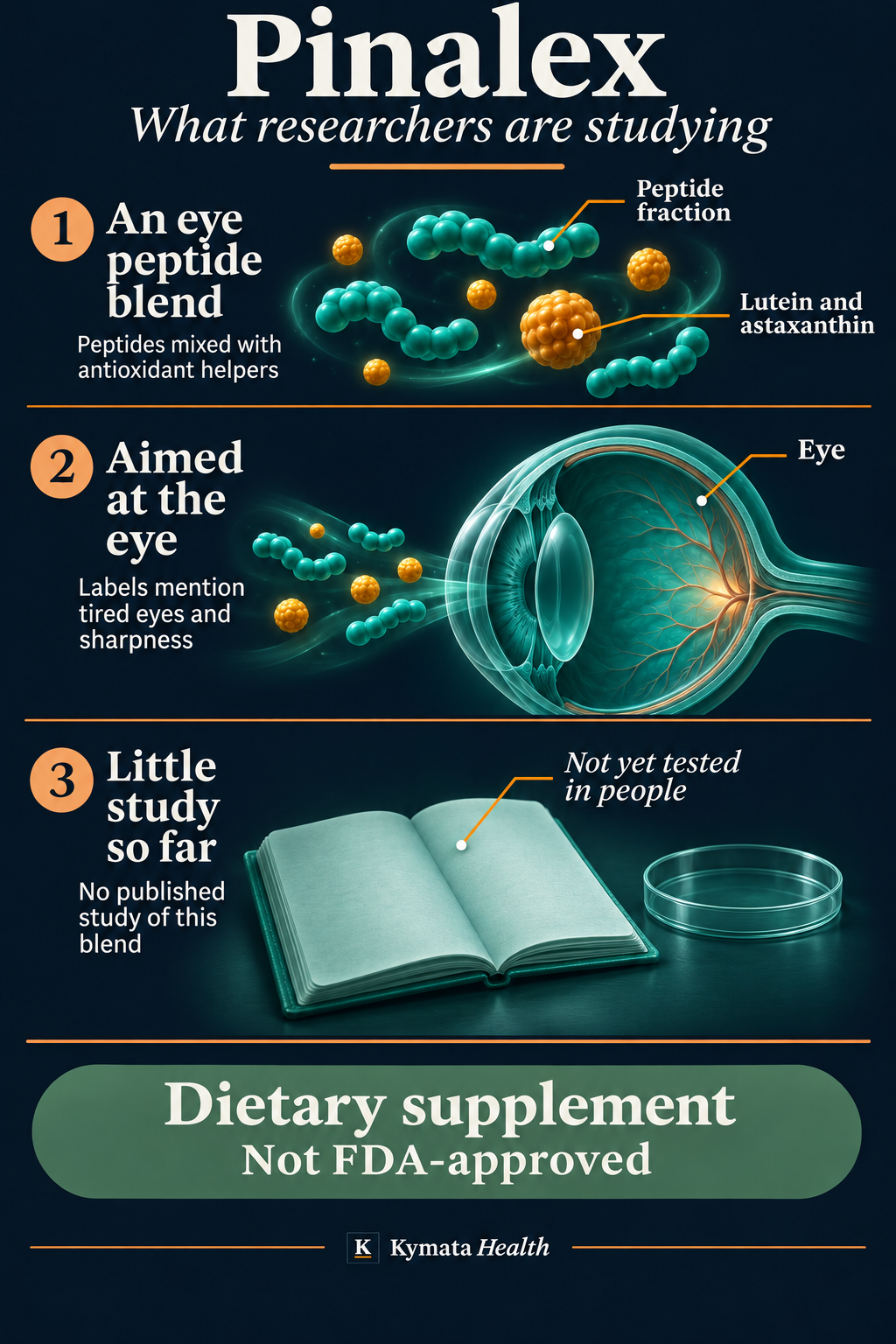
A commercial eye tablet blend that combines an ocular peptide fraction with antioxidant cofactors such as lutein and astaxanthin; not Retinalamin, Visoluten or a Cytomed Cytomax. Vendor labels describe it for visual fatigue and age-related sharpness of vision; no Pinalex-specific human study is indexed, and carotenoid eye research is a separate body of evidence from Khavinson retinal peptides. No published study of this blend. Sold as an oral product, not a drug. Not FDA-approved. The drawing is a schematic, not a measured molecular structure, a product photograph or a treatment result. Illustration review: 19 November 2026, against this page’s own mechanism, evidence and regulatory records.
A sequence model is not provided for this record. Read the identity and evidence notes; an illustration does not verify a molecular structure.
Illustration notes and source record
Read the source record on this page. Laboratory, topical and injected studies are separate evidence; this illustration does not establish an indication or a treatment outcome.

How it works
SourcedPinalex is two products. Pinalex Tab is swallowed; its registration names taurine, succinic acid, astaxanthin, beta-carotene and vitamins B1, B2, B6, B12 and E alongside the AA-6 retinal peptide complex, and the product page also lists bilberry juice and grape-skin extract. Pinalex Eye Balm is applied to eyelid skin and lists the AA-3 (spleen), AA-6 (retina) and AA-7 (vessel wall) peptide complexes. Neither product has a published study. The Khavinson ocular line also includes Visoluten (oral Cytomax), Normoftal (cytogen) and Retinalamin (injectable extract).
Source: Registration RU.77.99.11.003.R.003089.09.22; no Pinalex study in PubMed
05 / Evidence and limits
Evidence and limits
Limits of current evidence
3 limits- No published study of Pinalex Tab or Pinalex Eye Balm was found.
- AREDS2 tested lutein, zeaxanthin and other nutrients, not Pinalex; Retinalamin (PMID 32366071) is an injected retinal extract.
- Not a glaucoma or AMD treatment, and Pinalex Eye Balm is not an eye drop.
What it is studied for
- Catalog identity: Low
Verdict
Pinalex is two products: Pinalex Tab, an oral supplement with the AA-6 retinal peptide complex plus carotenoids and vitamins, and Pinalex Eye Balm, an eyelid-skin product with AA-3, AA-6 and AA-7 peptide complexes. No study has tested either one; AREDS2 nutrients and Retinalamin injections are separate evidence.
06 / Product forms and access
Product forms and access
Regulatory & legal status
- FDA status (US)
- Not approvedNot FDA-approved; sold as an oral product, not as a drug
- WADA status (2026)
- Not ListedNot currently on the WADA 2026 Prohibited List. Policies may change. Verify before competition.
- Classification
- OTC Supplement
- US compounding
- Not eligible / not available
Stability analog (not a Khavinson original) · Eye (commercial tablet and eyelid balm)
Identity
Adjacent (not padded into the 41)- Class
- Stability analog (not a Khavinson original)
- Organ
- Eye (commercial tablet and eyelid balm)
- Target
- Eye
- System
- Visual
- Sequence
- Mixture / not a single CAS
In these Khavinson catalog sets
1 setManufacturer-style organ combinations, not FDA protocols. Every name links to its own page.
The Khavinson school
Pinalex is filed here as stability analog (not a khavinson original), targeting the eye (commercial tablet and eyelid balm). Khavinson's St. Petersburg group moved from organ extracts (Cytamins) to capsule complexes (Cytomaxes) to synthetic short peptides (Cytogens); most of the evidence comes from that one group, with little independent Western replication.
Read the full background, the proposed epigenetic mechanism, the literature limits, and how we count the canonical 41 on the Khavinson bioregulators index.
History of this molecule
English stack pages drop “Pinalex” into the vision protocol next to Visoluten. Pinalex Tab’s registration names taurine, succinic acid, astaxanthin, beta-carotene and vitamins alongside the AA-6 complex; the eyelid balm is a separate topical product.
That is a nutraceutical line, not a Khavinson sequence paper. The Khavinson ocular map is three products: Visoluten (oral extract), Normoftal (cytogen), Retinalamin (injectable extract).
We add this page so /stacks/vision is not a dead end, then we send readers to the three actual Khavinson ocular identities.
Not a glaucoma or AMD treatment. Pinalex Tab is an oral supplement; Pinalex Eye Balm is an eyelid-skin product, not an eye drop. Carotenoid amounts on a label do not make the peptide fraction evidence-based.
Full 41-map: Khavinson bioregulators index · Khavinson catalog sets
07 / Tools and practical checks
Tools and practical checks
No separate record is provided here. Read the linked evidence and limitations for this compound.
08 / Published study use
Published study use
Per label
Dosing
1 row| Phase | Dose | Frequency | Notes |
|---|---|---|---|
| Vendor tablet | Per label | Oral | Not parabulbar Retinalamin. |
Administration
- Route / form
- Swallowed tablets. Not a Cytomed Cytomax, not a sublingual melt, and not a reconstitution vial.
- Timing
- Any timing is on the manufacturer’s label; it is not a studied schedule, and this page does not restate it.
- Empty stomach?
- Label only: Food timing, if any, is on the manufacturer’s label. No published study sets it, and this page does not restate it.
Pinalex: Swallowed tablet blend vs Not Retinalamin
2 routesSwallowed tablet blend
- Bioavailability
- Swallowed tablets with water. Not a Cytomed Cytomax, not Normoftal cytogen, not a sublingual melt. Blend: ocular peptide fraction plus lutein/astaxanthin-class cofactors on typical vendor labels.
- Dose note
- The tablet insert carries the manufacturer’s directions. No mg/mL. For the Khavinson ocular triad, see Visoluten / Normoftal / Retinalamin.
- Advantages
- This is the actual SKU: a tablet. Oral column is the product.
- Searchable name so vision stacks are not a dead end.
- Not a sublingual tablet. Nobody manufactures this SKU that way.
- Considerations
- Not in the 41. Analog/adjacent commercial blend.
- Do not launder AREDS or Retinalamin onto this bottle.
- Not a glaucoma or AMD drug.
Not Retinalamin
- Bioavailability
- Pinalex is a swallowed commercial eye tablet (peptide fraction plus antioxidant cofactors on typical labels). It is not Retinalamin. There is no reconstitution step and no parabulbar presentation.
- Dose note
- IM and parabulbar use are clinician techniques with no home arithmetic. If the plan is CIS injectable retina extract, that is the Retinalamin page. If the plan is Cytomed ocular Cytomax, that is Visoluten.
- Advantages
- Keeps a blend from stealing Retinalamin’s hospital route.
- Tablets do not go in the reconstitution calculator (empty rows are correct).
- Not an eye drop.
- Considerations
- Not a Khavinson original sequence paper.
- Carotenoid label items are not AREDS2 and not Retinalamin series.
- Gray-market “Pinalex vials” would be a different, dishonest SKU.
Who it is for
1 use| Category | Fit | What exists |
|---|---|---|
| Catalog identity | Low | Named on vision stacks. No study of either Pinalex product exists; the Khavinson ocular pages are Visoluten, Normoftal and Retinalamin. |
09 / Safety and interactions
Safety and interactions
What the record says
Not a glaucoma or AMD treatment. Pinalex Tab is an oral supplement; Pinalex Eye Balm is an eyelid-skin product, not an eye drop. AREDS2 found more lung cancers in its beta-carotene arm, mostly in former smokers, and the National Eye Institute says current and former smokers should choose the AREDS2 formula for that reason; Pinalex Tab’s registration lists beta-carotene.
10 / Comparisons and goal guides
Comparisons and goal guides
There is no separate comparison record on this page. Similar names do not establish that products or their evidence are interchangeable.
11 / Common questions
Common questions
Common questions
6 answersIs Pinalex Visoluten?
No. Visoluten is the Cytomed ocular Cytomax.
Why is it on the stacks hub?
Eye protocols name it. We keep the name so search works, then we route to Visoluten, Cerluten, and Ventfort as the Khavinson pages in that stack.
What did AREDS2 find, and does it apply to Pinalex?
The AREDS2 randomized, double-masked trial (PMID 23644932) of 4,203 people aged 50-85 at risk of advanced AMD found 5-year progression of 29% with added lutein plus zeaxanthin versus 31% with placebo (HR 0.90, P=.12), with more lung cancers in the beta-carotene arm, mostly in former smokers. It did not test Pinalex.
Is the Retinalamin glaucoma study about Pinalex?
Erichev and colleagues (2020, PMID 32366071; Russian, English abstract) compared intramuscular plus retrobulbar, retrobulbar and intramuscular Retinalamin in 498 eyes with open-angle glaucoma and compensated eye pressure, reporting gains in total retinal threshold sensitivity in early and moderate stages and no significant change in visual acuity. Retinalamin is an injectable retinal extract, not Pinalex.
Is Pinalex an eye drop?
No. Pinalex Eye Balm is applied to the eyelid skin, and Pinalex Tab is swallowed. Neither goes into the eye.
Is Pinalex FDA-approved?
No. Not FDA-approved; sold as an oral product, not as a drug.
12 / Sources and references
Sources and references
6 papers cited on this page.
Sources
6 papers- 1“Lutein + zeaxanthin and omega-3 fatty acids for age-related macular degeneration: the AREDS2 randomized clinical trial (did not test Pinalex).”Age-Related Eye Disease Study 2 Research Group JAMA (2013). PMID: 23644932 DOI: 10.1001/jama.2013.4997
- 2“Peptide bioregulators: delivery and efficacy (Retinalamin, not Pinalex).”Erichev VP et al. Vestnik Oftalmologii (2020). PMID: 32366071 DOI: 10.17116/oftalma202013602156
- 3“Pinalex Tab, state registration RU.77.99.11.003.R.003089.09.22 (6 Sept 2022).”Eurasian Economic Union Registration certificate (2022).
- 4“Pinalex Tab product page.”Peptides (manufacturer) Product page (2026).
- 5“Pinalex Eye Balm product page.”Peptides (manufacturer) Product page (2026).
- 6“AREDS/AREDS2 nutritional supplements for age-related macular degeneration.”National Eye Institute NIH patient information (2026).
14 / Prescription options
Prescription options
Prescription options: compare licensed telehealth providers
Some peptide therapies are available only by prescription after a consult with a licensed clinician.
Compare telehealth →15 / Peptide library
Peptide library
← Back to Peptide LibraryKhavinson catalog sets
Keep reading: Peptide research library
Peptide research library: every pagePeptide libraryBrowse all topics
- GPL FemmePrevious in this topic · GPL Femme is a boxed geroprotector kit: thyroid, vessels, brain, liver, and pineal (Thyreogen, Ventfort, Cerluten, Svetinorm, Endoluten).
- MariTideNext in this topic · Amgen investigational antibody-peptide conjugate (AMG 133 / MariTide): GIP receptor antagonist plus GLP-1 receptor agonism, studied on a monthly-class schedule in obesity programs.
- Named combinationsWolverine, CJC-1295 + Ipamorelin, GLOW and KLOW: what is in each blend, why none has a combination trial, and US status.
- AmycretinNovo Nordisk investigational dual amylin and GLP-1 receptor agonist (amycretin), studied in oral and injectable obesity programs.
- VK2735Viking Therapeutics investigational dual GLP-1/GIP receptor agonist (VK2735), studied in subcutaneous and oral obesity programs.
Regulatory and sport classification
- Not FDA-approved; sold as an oral product, not as a drug