
The peptide field guide
Kyotorphin
Kyotorphin (Tyr-Arg) is a natural two-amino-acid peptide first isolated from cow brain in 1979 at Kyoto University.
Human measurements and animal experiments. No human treatment study of native kyotorphin. Not FDA-approved.
Explore this compoundConceptual editorial illustration; not a measured molecular structure, product photograph or treatment result.
02 / At a glance
At a glance
Key facts
- Also known as
- L-Tyrosyl-L-arginine, Tyr-Arg, L-Tyr-L-Arg, KTP, Dipeptide-1
- Sequence
- L-Tyr-L-Arg
- Evidence level
- Cell and animal research: human benefit remains unproven.
- US regulatory status
- Not FDA-approved
- Updated
Identity
Kyotorphin (Tyr-Arg) is a natural two-amino-acid peptide first isolated from cow brain in 1979 at Kyoto University.
Research context
It released met-enkephalin from guinea pig nerve tissue (Shiomi 1981); human studies measured the body’s own kyotorphin in spinal fluid and blood, and the systemic pain-test effect in rats came from the amidated derivative KTP-NH2 (Ribeiro 2011).
Evidence limits
Human measurements and animal experiments. No human treatment study of native kyotorphin. Not FDA-approved.
Read the technical profile and study-use reference
Quick answer
Evidence: LowResearchers have measured native kyotorphin (Tyr-Arg) in human spinal fluid and blood. In a sickle cell pain study they gave intravenous arginine and measured the resulting change in kyotorphin. The identified studies do not establish that giving kyotorphin relieves pain in people.
- In published studies
- No human treatment dose established for native kyotorphin
Research summary, not medical advice.
At a glance
Kymata peptide profile · Nov 22, 2026- Molecular weight
- 337.37 g/mol
- CAS
- 70904-56-2
- In published studies
- No human treatment dose established for native kyotorphin
- Half-life
- No human half-life established
- Common vials
- Research vial; no sourced vial preset in this calculator
03 / Identity and origin
Identity and origin
Also called L-Tyrosyl-L-arginine, Tyr-Arg, L-Tyr-L-Arg, KTP, Dipeptide-1. Endogenous L-tyrosyl-L-arginine dipeptide.
Read the sequence and compound record
Compound card
- Sequence
- L-Tyr-L-Arg
- Class
- Endogenous L-tyrosyl-L-arginine dipeptide
- Formula
- C15H23N5O4
- Molecular weight
- 337.37 g/mol
- CAS
- 70904-56-2
- Described by
- Hiroshi Takagi and colleagues, 1979
- Bioavailability
- Human absorption of administered native kyotorphin has not been established.
04 / How it may work
How it may work
Endogenous L-tyrosyl-L-arginine dipeptide
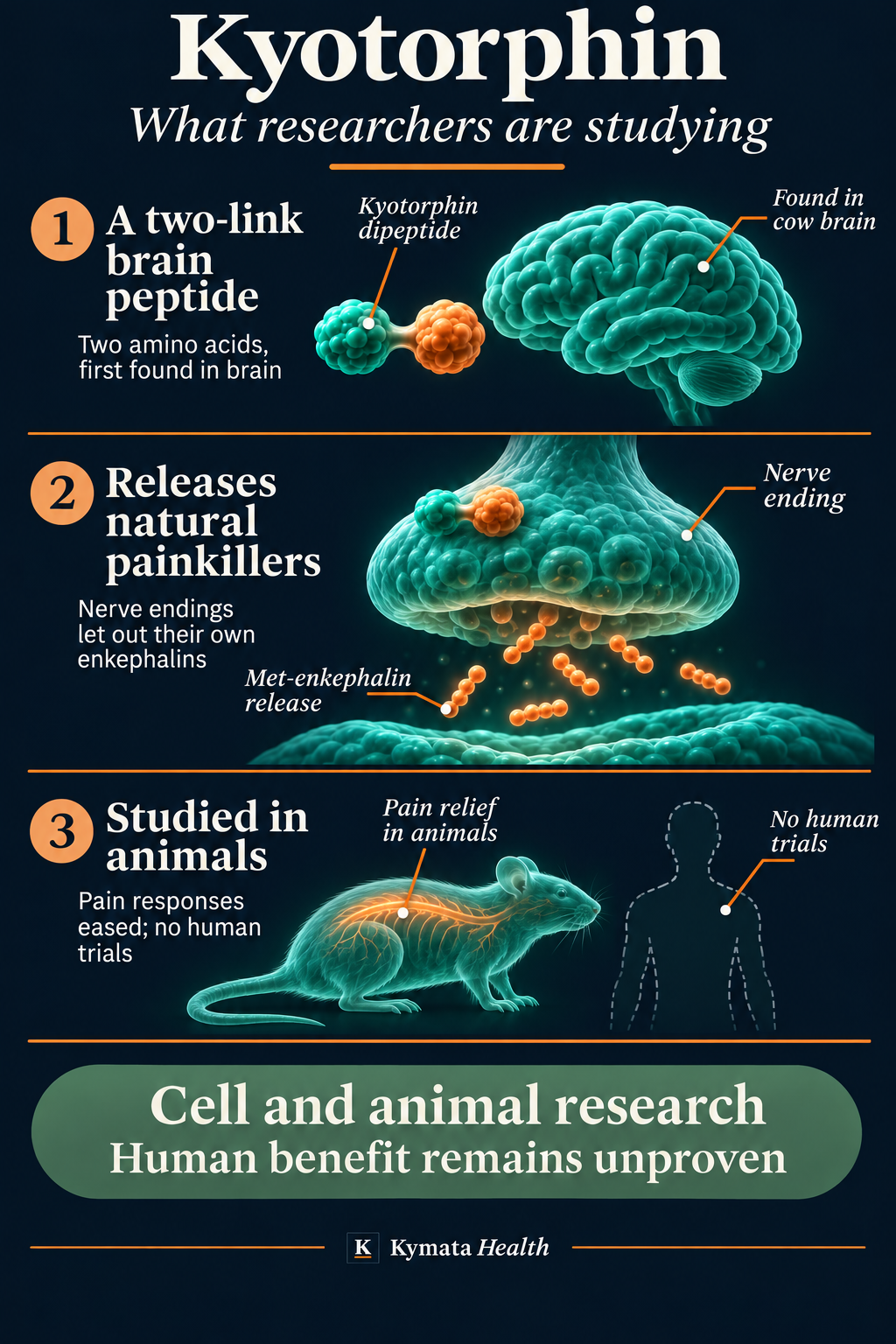
Kyotorphin (Tyr-Arg) is a natural two-amino-acid peptide first isolated from cow brain in 1979 at Kyoto University. It released met-enkephalin from guinea pig nerve tissue (Shiomi 1981); human studies measured the body’s own kyotorphin in spinal fluid and blood, and the systemic pain-test effect in rats came from the amidated derivative KTP-NH2 (Ribeiro 2011). Human measurements and animal experiments. No human treatment study of native kyotorphin. Not FDA-approved. The drawing is a schematic, not a measured molecular structure, a product photograph or a treatment result. Illustration review: 19 November 2026, against this page’s own mechanism, evidence and regulatory records.
A sequence model is not provided for this record. Read the identity and evidence notes; an illustration does not verify a molecular structure.
Illustration notes and source record
Read the source record on this page. Laboratory, topical and injected studies are separate evidence; this illustration does not establish an indication or a treatment outcome.

How it works
SourcedTakagi and colleagues isolated kyotorphin from bovine brain in 1979. Its two amino acids are L-tyrosine and L-arginine. Adding it to slices of guinea pig striatum or spinal cord increased release of met-enkephalin, an opioid peptide. A separate rodent study found that naloxone reversed changes in heat responses after central delivery and found no inhibition of the purified enkephalin-degrading enzymes it tested. These experiments leave the mechanism in people unresolved.
Source: PMIDs 228202, 7272759, 24198785, 38527291 and 21366550
Background & History
Takagi and colleagues isolated this two-amino-acid peptide from bovine brain in 1979. Later experiments examined nerve signaling in animals and measured its concentration in human spinal fluid and blood.
05 / Evidence and limits
Evidence and limits
Human researchers measured the body’s own kyotorphin in spinal fluid or blood. The available studies did not give patients the native peptide to treat pain.
Human evidence
Human researchers measured the body’s own kyotorphin in spinal fluid or blood. The available studies did not give patients the native peptide to treat pain.- Santos and colleagues measured spinal-fluid kyotorphin in 25 people with Alzheimer’s disease and 13 controls. Mean concentrations were 1.8 nM and 3.4 nM, respectively. The study did not test a diagnostic cutoff or treatment.
- An earlier study reported less kyotorphin-like material in spinal fluid from patients with persistent pain. A concentration difference alone cannot tell whether the peptide causes or relieves pain.
- In a pediatric sickle cell study, 13 participants received intravenous arginine. Their plasma kyotorphin rose after the infusion and returned to baseline by four hours. The treatment was arginine.
Limits of current evidence
2 limits- Spinal-fluid measurements can show a group difference without showing what giving the peptide would do.
- In rats with streptozotocin-induced brain changes, native kyotorphin given into the brain improved object recognition. Spatial memory did not improve significantly. A separate rat study of amyloid used the amidated derivative KTP-NH₂.
What it is studied for
- Release of the opioid peptide met-enkephalin from animal nerve tissue
- Spinal-fluid measurements in people with persistent pain or Alzheimer’s disease
- Changes in blood kyotorphin after intravenous arginine in a pediatric sickle cell study
Verdict
Researchers have measured native kyotorphin in people. The available human studies do not establish a dose for pain or a treatment for Alzheimer’s disease.
06 / Product forms and access
Product forms and access
Regulatory & legal status
- FDA status (US)
- Research OnlyFDA lists the substance identity under UNII 02N30CW3X0. No approved kyotorphin drug product was identified.
- WADA status (2026)
- Not ListedThe 2026 WADA List does not name kyotorphin. Section S0 covers otherwise unaddressed pharmacological substances without approval for human therapeutic use from any regulatory health authority. Verify before competition.
- Classification
- Research Chemical
- US compounding
- Not eligible / not available
07 / Tools and practical checks
Tools and practical checks
No separate record is provided here. Read the linked evidence and limitations for this compound.
08 / Published study use
Published study use
What published studies gave, in whom, and the source. Not a dose for you.
What studies used
Human measurements and animal experiments- A spinal-fluid study compared 25 people with Alzheimer’s disease and 13 controls. It measured the kyotorphin already present. Santos et al., cerebrospinal fluid, PMID 24198785 (opens in new tab)
- A pediatric trial in 13 participants hospitalized for sickle cell pain gave intravenous arginine and measured blood kyotorphin. It supplies no human dose for kyotorphin itself. Korman et al., arginine study, PMID 38527291 (opens in new tab)
- Male rats received the native peptide or its amidated derivative. Only the derivative prolonged heat-response times after oral or intraperitoneal administration in the reported tests. Ribeiro et al., rat comparison, PMID 21366550 (opens in new tab)
A record of what researchers gave, in whom; not a dose for you.
Administration
- Route / form
- No human route or dose is established for treatment with native kyotorphin.
09 / Safety and interactions
Safety and interactions
What the record says
The identified studies do not establish human safety, tolerance or physical dependence after dosing native kyotorphin. In an animal experiment, morphine-tolerant animals showed cross-tolerance to kyotorphin. A separate rat experiment that reported withdrawal used D-Arg kyotorphin, a different molecule.
Interactions & Contraindications
Human interaction studies of administered native kyotorphin were not identified.
10 / Comparisons and goal guides
Comparisons and goal guides
There is no separate comparison record on this page. Similar names do not establish that products or their evidence are interchangeable.
11 / Common questions
Common questions
Common questions
5 answersHas native kyotorphin been shown to relieve pain in people?
The studies identified here measured kyotorphin already present in human spinal fluid or blood. A sickle cell pain study administered arginine. These studies do not establish that giving kyotorphin treats pain.
What did the Alzheimer’s disease study find?
Mean spinal-fluid kyotorphin was 1.8 nM in 25 people with Alzheimer’s disease and 3.4 nM in 13 controls. The groups were compared at one point in time. The study did not test treatment or establish when a result would diagnose the disease.
Why do studies distinguish KTP from KTP-NH₂?
KTP is native kyotorphin. KTP-NH₂ has an amide at one end. In male Wistar rats, the amidated molecule delayed responses to heat after oral or intraperitoneal administration. Native KTP produced no such effect in the same tests.
Can kyotorphin be described as free of dependence risk?
Human studies of dependence after treatment with native kyotorphin were not identified. The animal literature includes cross-tolerance to native kyotorphin after morphine exposure and withdrawal after prolonged exposure to a D-Arg analogue.
Is Kyotorphin FDA-approved?
No. FDA lists the substance identity under UNII 02N30CW3X0. No approved kyotorphin drug product was identified.
12 / Sources and references
Sources and references
10 papers cited on this page.
Sources
10 papers- 1“A novel analgesic dipeptide from bovine brain is a possible Met-enkephalin releaser.”Takagi H et al. Nature (1979). PMID: 228202 DOI: 10.1038/282410a0
- 2“Mechanism of kyotorphin-induced release of Met-enkephalin from guinea pig striatum and spinal cord.”Shiomi H et al. Brain Research (1981). PMID: 7272759 DOI: 10.1016/0006-8993(81)91070-2
- 3“Moderate protective effect of Kyotorphin against the late consequences of intracerebroventricular streptozotocin model of Alzheimer’s disease.”Angelova H et al. Amino Acids (2019). PMID: 31520285 DOI: 10.1007/s00726-019-02784-5
- 4“The Neuroprotective Action of Amidated-Kyotorphin on Amyloid β Peptide-Induced Alzheimer’s Disease Pathophysiology.”Belo RF et al. Frontiers in Pharmacology (2020). PMID: 32733240 DOI: 10.3389/fphar.2020.00985
- 5“A characterization of kyotorphin (Tyr-Arg)-induced antinociception.”Vaught JL, Chipkin RE European Journal of Pharmacology (1982). PMID: 7047176 DOI: 10.1016/0014-2999(82)90622-7
- 6“Kyotorphin like substance in human cerebrospinal fluid of patients with persistent pain.”Nishimura K et al. Masui (1991). PMID: 1766121
- 7“Neuropeptide Kyotorphin (Tyrosyl-Arginine) has Decreased Levels in the Cerebro-Spinal Fluid of Alzheimer’s Disease Patients: Potential Diagnostic and Pharmacological Implications.”Santos SM et al. Frontiers in Aging Neuroscience (2013). PMID: 24198785 DOI: 10.3389/fnagi.2013.00068
- 8“Impact of arginine therapy on kyotorphin in children with sickle cell disease and vaso-occlusive pain.”Korman R et al. Blood Advances (2024). PMID: 38527291 DOI: 10.1182/bloodadvances.2023012209
- 9“Inhibition of nociceptive responses after systemic administration of amidated kyotorphin.”Ribeiro MM et al. British Journal of Pharmacology (2011). PMID: 21366550 DOI: 10.1111/j.1476-5381.2011.01290.x
- 10“Physical dependence produced by chronic intracerebroventricular infusion of [D-Arg]kyotorphin or thiorphan to rats.”Bean AJ, Vaught JL European Journal of Pharmacology (1984). PMID: 6096157 DOI: 10.1016/0014-2999(84)90627-7
14 / Prescription options
Prescription options
Prescription options: compare licensed telehealth providers
Some peptide therapies are available only by prescription after a consult with a licensed clinician.
Compare telehealth →15 / Peptide library
Peptide library
Keep reading: Peptide research library
Peptide research library: every pagePeptide libraryBrowse all topics
- MatrixylPrevious in this topic · Matrixyl (palmitoyl pentapeptide-4) is a cosmetic lipopeptide whose KTTKS sequence raised collagen production in fibroblast cultures; one 12-week split-face trial in 93 women…
- TabimorelinNext in this topic · Tabimorelin (NN703) is an orally active growth hormone secretagogue that reached Phase 2 trials in adults with growth hormone deficiency before its development stopped.
- ProstatilenProstatilen (Samprost, Vitaprost) is a polypeptide extract of bovine prostate registered as a medicine in Russia; Russian clinical studies examined it in prostatitis and prostate…
- RetinalaminRetinalamin is a polypeptide extract of animal retina registered as a medicine in Russia, given by intramuscular injection or by injection next to the eye; Russian clinical…
- EpithalaminEpithalamin is a polypeptide extract of animal pineal glands from the Khavinson group, the natural predecessor of synthetic Epitalon; Russian studies, including long-term…
Regulatory and sport classification
- Not FDA-approved