
The peptide field guide
Desmopressin
A vasopressin analog that helps the kidneys hold on to water.
FDA-approved for several uses. Low blood sodium is the main risk.
Explore this compoundConceptual editorial illustration; not a measured molecular structure, product photograph or treatment result.
02 / At a glance
At a glance
Key facts
- Also known as
- DDAVP, Minirin, 1-desamino-8-D-arginine vasopressin
- Type
- Clinical / Pharmaceutical
- Evidence level
- FDA-approved for several uses: prescription only.
- US regulatory status
- FDA-approved (DDAVP® and generic tablets, nasal spray and injection)
- Updated
Identity
A vasopressin analog that helps the kidneys hold on to water.
Research context
It is prescribed for diabetes insipidus, severe bedwetting and some bleeding disorders.
Evidence limits
FDA-approved for several uses. Low blood sodium is the main risk.
Read the technical profile and study-use reference
Quick answer
Desmopressin (DDAVP) is a synthetic vasopressin analog selective for the V2 receptor, FDA-approved for central diabetes insipidus, primary nocturnal enuresis, and some bleeding disorders (hemophilia A and von Willebrand disease). These uses belong to different formulations. Adult trials of a now-discontinued sublingual product studied waking to urinate because of excess nighttime urine production.
- FDA label dose
- FDA label (DDAVP tablets): dose and schedule set by the prescriber and the label
Research summary, not medical advice.
At a glance
Kymata peptide profile · Nov 22, 2026- Molecular weight
- 1069.2 g/mol
- CAS
- 16679-58-6
- FDA label dose
- FDA label (DDAVP tablets): dose and schedule set by the prescriber and the label
- Half-life
- 1.5 to 2.5 hours in the pharmacokinetic studies described in the DDAVP tablet label
- Common vials
- Tablets, nasal spray or injection; no reconstitution in this calculator
03 / Identity and origin
Identity and origin
Also called DDAVP, Minirin, 1-desamino-8-D-arginine vasopressin. Synthetic vasopressin analog with product-specific indications.
Read the sequence and compound record
Compound card
- Class
- Synthetic vasopressin analog with product-specific indications
- Formula
- C46H64N14O12S2
- Molecular weight
- 1069.2 g/mol
- CAS
- 16679-58-6
- PubChem CID
- 5311065
- Described by
- Ferring Pharmaceuticals (DDAVP), 1967 (first synthesis)
- Bioavailability
- Oral tablet bioavailability is about 5% of intranasal and 0.16% of intravenous (DDAVP tablet label)
04 / How it may work
How it may work
Synthetic vasopressin analog with product-specific indications
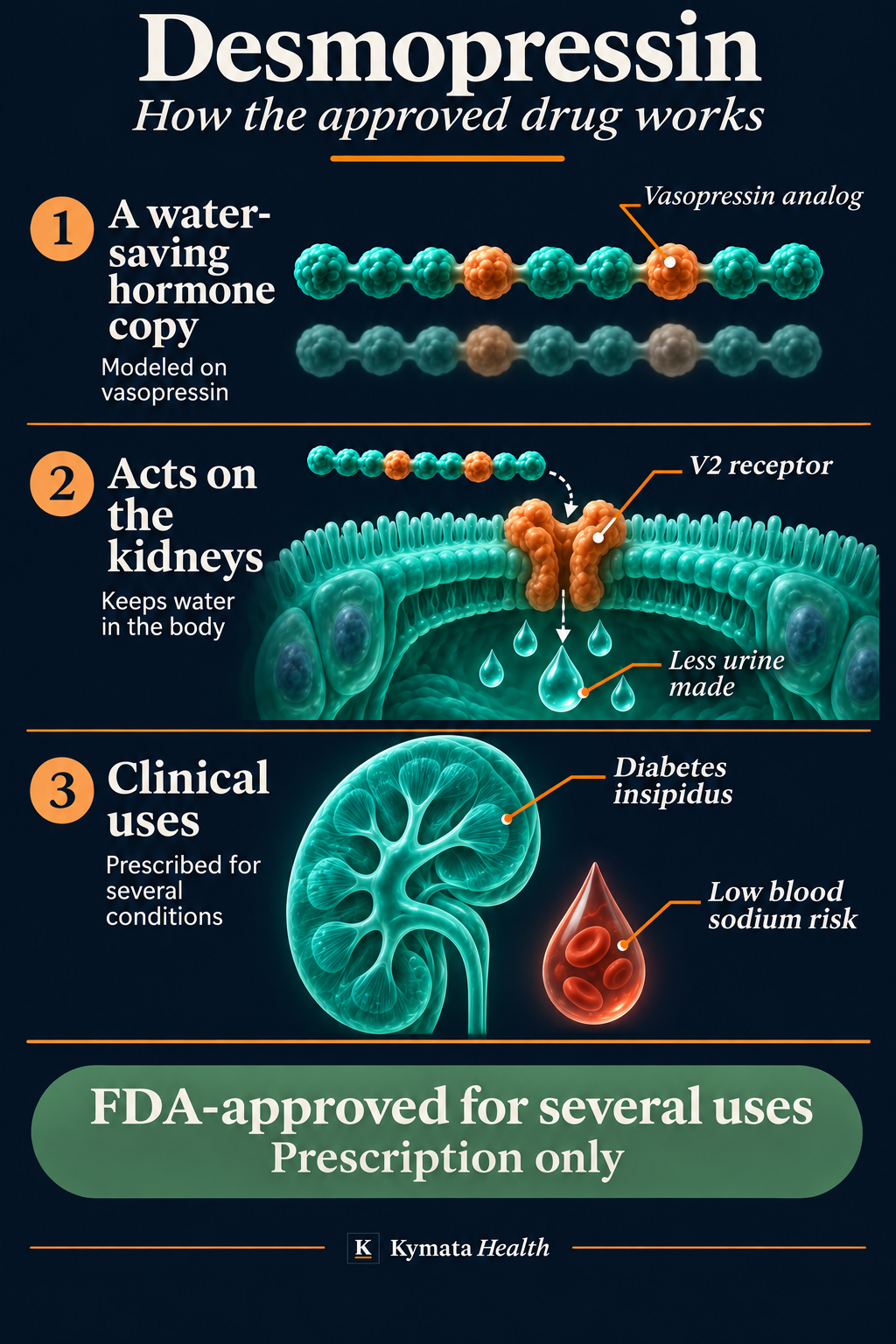
A vasopressin analog that helps the kidneys hold on to water. It is prescribed for diabetes insipidus, severe bedwetting and some bleeding disorders. FDA-approved for several uses. Low blood sodium is the main risk. The drawing is a schematic, not a measured molecular structure, a product photograph or a treatment result. Illustration review: 19 November 2026, against this page’s own mechanism, evidence and regulatory records.
A sequence model is not provided for this record. Read the identity and evidence notes; an illustration does not verify a molecular structure.
Illustration notes and source record
Read the source record on this page. Laboratory, topical and injected studies are separate evidence; this illustration does not establish an indication or a treatment outcome.

How it works
SourcedDesmopressin (DDAVP) is a synthetic analog of the endogenous antidiuretic hormone arginine vasopressin (AVP). By modifying AVP (deaminating the N-terminus and substituting D-arginine for L-arginine), developers increased its antidiuretic potency while almost completely eliminating the vasopressor (blood pressure-raising) effect.
It acts selectively on V2 receptors in the renal collecting ducts, increasing water reabsorption and concentrating urine. Its labeled uses include central diabetes insipidus and primary nocturnal enuresis (tablets), and some forms of hemophilia A and von Willebrand disease (DDAVP injection), through release of von Willebrand factor and factor VIII.
Source: DDAVP tablet, injection and nasal spray prescribing information; NOCDURNA label (2018)
Background & History
Desmopressin (DDAVP) was first synthesized in 1967 by modifying natural vasopressin, giving a longer-acting antidiuretic with little blood-pressure effect. Its labeled uses include central diabetes insipidus and primary nocturnal enuresis, and the injection is labeled to raise factor VIII and von Willebrand factor in some patients with hemophilia A or von Willebrand disease.
05 / Evidence and limits
Evidence and limits
Separate trials in adults with excess nighttime urine production
Human evidence
Separate trials in adults with excess nighttime urine production- In two 3-month randomized, double-blind, placebo-controlled trials described in the NOCDURNA label, adults who woke at least twice a night to urinate and produced more than a third of their daily urine at night (237 women and 230 men randomized) averaged 0.3 fewer nighttime voids than placebo in women and 0.4 fewer in men.
- Both placebo and active groups improved from baseline, and these are group averages; the trials did not study childhood bedwetting. The label’s efficacy table analyzed 232 women and 230 men.
- The original publications analyzed broader nocturia populations, 261 women (−0.22 voids vs placebo, PMID 23454404) and 385 men (−0.37 and −0.41 for two doses, PMID 23454402); the label estimates apply to its nocturnal-polyuria population.
Limits of current evidence
2 limits- Waking to urinate can have several causes. The NOCDURNA trial results apply to adults with excess nighttime urine production who met the study criteria.
- The nasal diabetes-insipidus spray has a different label from a swallowed tablet. The injection’s bleeding indications also require a specific diagnosis and qualifying factor VIII levels.
Trial FinderRecruiting now: 9 open registrations for desmopressin
What it is studied for
- Central diabetes insipidus
- Nocturnal enuresis
- Hemophilia A
- Von Willebrand disease Type 1
Verdict
Desmopressin can reduce urine production. Its swallowed, sublingual, nasal and injectable products have different indications and safety information. Excess water retention can cause dangerously low blood sodium.
06 / Product forms and access
Product forms and access
Regulatory & legal status
- FDA status (US)
- ApprovedFDA-approved (DDAVP® and generic tablets, nasal spray and injection)
- WADA status (2026)
- Prohibited (S5)Competitive athletes subject to anti-doping controls should not use Desmopressin.
- Classification
- Prescription Drug
07 / Tools and practical checks
Tools and practical checks
No separate record is provided here. Read the linked evidence and limitations for this compound.
08 / Published study use
Published study use
What the label states, for the patients it is approved for, and the source. Not a dose for you.
What the FDA label says
FDA label- DDAVP tablets: approved strengths 0.1 mg and 0.2 mg, labeled for central diabetes insipidus and primary nocturnal enuresis. DDAVP tablets label, DailyMed (opens in new tab)
- DDAVP injection: approved strength 4 mcg/mL (1 mL ampule and 10 mL vial), labeled for central diabetes insipidus, hemophilia A and type 1 von Willebrand disease. DDAVP injection label, DailyMed (opens in new tab)
- Desmopressin nasal spray: approved strength 10 mcg per 0.1 mL spray, labeled for central diabetes insipidus and not for bedwetting. Desmopressin nasal spray label, DailyMed (opens in new tab)
The label’s dosing, for the patients it is approved for; the prescriber sets the dose.
Administration
- Route / form
- Swallowed DDAVP tablet, central-diabetes-insipidus nasal spray, DDAVP injection and the discontinued NOCDURNA sublingual tablet each have a distinct US label.
Timeline
2 stages- About 1 hour (tablets)
The DDAVP tablet label reports onset of the antidiuretic effect at around 1 hour, with a peak at about 4 to 7 hours.
- Three-month nocturia trials
The NOCDURNA trials measured the change in average nighttime voids and the share of patients whose average fell by at least a third.
Who it is for
3 uses| Category | Fit | What exists |
|---|---|---|
| Diabetes Insipidus / Enuresis | High | DDAVP tablets are labeled for central diabetes insipidus and primary nocturnal enuresis. The nasal spray is labeled for central diabetes insipidus only; its label excludes bedwetting because postmarketing reports showed a higher risk of hyponatremia and hyponatremic convulsions than with tablets. |
| Adult nocturnal polyuria | Discontinued product | NOCDURNA sublingual tablets were labeled for adults waking at least twice nightly to urinate because of excess nighttime urine production. Drugs@FDA lists both strengths as discontinued. |
| Selected bleeding disorders | High | The DDAVP injection label covers hemophilia A and mild to moderate type 1 von Willebrand disease with factor VIII levels above 5%. The tablet’s bedwetting indication does not extend to bleeding. |
09 / Safety and interactions
Safety and interactions
What the record says
FDA-approved. The major risk is hyponatremia (low blood sodium) from water retention, which can cause seizures; the labels address fluid intake. The DDAVP tablet label contraindicates use with moderate to severe renal impairment (creatinine clearance below 50 mL/min), hyponatremia or a history of it, and hypersensitivity to desmopressin. The NOCDURNA and DDAVP injection labels carry boxed warnings for hyponatremia; the NOCDURNA warning called for a normal sodium level before starting, checks within the first week and at about one month, periodic checks after that, and more frequent monitoring at age 65 or older.
Interactions & Contraindications
The NOCDURNA label names medicines that can increase hyponatremia risk, including tricyclic antidepressants, SSRIs, NSAIDs, chlorpromazine, opiate analgesics and carbamazepine. The labels address fluid intake during use; any change is a prescriber decision.
10 / Comparisons and goal guides
Comparisons and goal guides
Combinations: what has been tested
1 pairing- + Vasopressin →Desmopressin is a synthetic, V2-selective analogue of vasopressin. They act on the same receptor family and are not combined.
11 / Common questions
Common questions
Common questions
4 answersAre adult nocturia and bedwetting the same labeled use?
No. Primary nocturnal enuresis means bedwetting during sleep, and the swallowed DDAVP tablet carries that indication. NOCDURNA was studied in adults who wake to urinate because of nocturnal polyuria, meaning excess nighttime urine production.
Why do the product labels discuss blood sodium?
Desmopressin helps the kidney retain water, and retaining too much can dilute sodium and cause serious illness, including seizures. The NOCDURNA and DDAVP injection labels carry boxed warnings about hyponatremia.
How is desmopressin different from vasopressin?
Vasopressin raises blood pressure (V1 receptors) and retains water (V2 receptors). Desmopressin is modified to act mainly on V2 receptors, so it retains water with little effect on blood pressure.
Is Desmopressin FDA-approved?
Yes. FDA-approved (DDAVP® and generic tablets, nasal spray and injection).
12 / Sources and references
Sources and references
7 sources cited on this page.
Sources
7 sources- 1“DDAVP (desmopressin acetate) tablets: prescribing information.”Ferring Pharmaceuticals DailyMed (2021). Prescribing information
- 2“DDAVP injection: prescribing information, revised July 2022.”Ferring Pharmaceuticals DailyMed (2022). Prescribing information
- 3“Desmopressin acetate nasal spray solution: prescribing information, revised May 2025.”Oceanside Pharmaceuticals DailyMed (2025). Prescribing information
- 4“NOCDURNA (desmopressin acetate) sublingual tablets: prescribing information, June 2018.”Ferring Pharmaceuticals Drugs@FDA (2018). Prescribing information
- 5“NOCDURNA, NDA 022517: product status (both strengths discontinued).”US Food and Drug Administration Drugs@FDA (2018). Prescribing information
- 6“Efficacy and safety of low dose desmopressin orally disintegrating tablet in women with nocturia: results of a multicenter, randomized, double-blind, placebo controlled, parallel group study.”Sand PK, Dmochowski RR, Reddy J, van der Meulen EA Journal of Urology (2013). PMID: 23454404 DOI: 10.1016/j.juro.2013.02.037
- 7“Efficacy and safety of low dose desmopressin orally disintegrating tablet in men with nocturia: results of a multicenter, randomized, double-blind, placebo controlled, parallel group study.”Weiss JP, Herschorn S, Albei CD, van der Meulen EA Journal of Urology (2013). PMID: 23454402 DOI: 10.1016/j.juro.2012.12.112
14 / Prescription options
Prescription options
Prescription options: compare licensed telehealth providers
Some peptide therapies are available only by prescription after a consult with a licensed clinician.
Compare telehealth →15 / Peptide library
Peptide library
Keep reading: Peptide research library
Peptide research library: every pagePeptide libraryBrowse all topics
- CortexinPrevious in this topic · Cortexin is a polypeptide extract of animal brain cortex registered as a medicine in Russia, given by injection; Russian clinical studies examined it after stroke and brain injury.
- LeuprorelinNext in this topic · Leuprorelin (leuprolide) is a synthetic GnRH agonist that, given continuously, suppresses testosterone and estrogen.
- TetracosactideTetracosactide (cosyntropin) helps clinicians investigate whether the adrenal glands can make enough cortisol.
- VasopressinVasopressin is a hormone that narrows blood vessels and helps the kidneys retain water.
- Thymosin Beta-4Thymosin β4 is the endogenous 43-amino-acid G-actin-sequestering peptide (CAS 77591-33-4, ~4963 Da).
Regulatory and sport classification
- WADA (S5): prohibited in sport at all times
- FDA-approved