
The peptide field guide
Lixisenatide
Lixisenatide is a GLP-1 receptor agonist, an exendin-4 analog with six added lysines.
In the US it is sold with insulin glargine as Soliqua for adults with type 2 diabetes; stand-alone Adlyxin left the US market in 2023.
Explore this compoundConceptual editorial illustration; not a measured molecular structure, product photograph or treatment result.
02 / At a glance
At a glance
Key facts
- Also known as
- Adlyxin, Lyxumia, AVE0010
- Type
- Weight Management
- Evidence level
- FDA-approved for type 2 diabetes: prescription only.
- US regulatory status
- FDA-approved in Soliqua® 100/33 (with insulin glargine); the stand-alone Adlyxin® (2016) was discontinued by Sanofi (2023)
- Updated
Identity
Lixisenatide is a GLP-1 receptor agonist, an exendin-4 analog with six added lysines.
Research context
Ingredient-record comparison only; no efficacy, dose or medication-adjustment comparison is shown.
Evidence limits
In the US it is sold with insulin glargine as Soliqua for adults with type 2 diabetes; stand-alone Adlyxin left the US market in 2023.
Read the technical profile and study-use reference
Quick answer
Evidence: StrongOnce-daily short-acting GLP-1 RA (Adlyxin / Lyxumia); stand-alone Adlyxin was withdrawn from US sale in 2023, and in the US it is sold with insulin glargine as Soliqua. Post-meal glucose is the labeled job. This database has no vial fill.
- In published studies
- Trial amounts are recorded under What studies used (PMID 22432104)
Research summary, not medical advice.
At a glance
Kymata peptide profile · Nov 19, 2026- Half-life
- ~3 hours
- Common vials
- 0.05 mg / 0.1 mg
- Molecular weight
- 4858.5 g/mol
- CAS
- 320367-13-3
- In published studies
- Trial amounts are recorded under What studies used (PMID 22432104)
03 / Identity and origin
Identity and origin
Also called Adlyxin, Lyxumia, AVE0010. GLP-1 receptor agonist: single-agent and combination product labels.
Read the sequence and compound record
Compound card
- Sequence
- Exendin-4 analog with C-terminal hexa-lysine
- Class
- GLP-1 receptor agonist: single-agent and combination product labels
- Formula
- C215H347N61O65S
- Molecular weight
- 4858.5 g/mol
- CAS
- 320367-13-3
- Described by
- Sanofi, 2016
- Bioavailability
- Absolute bioavailability is not quantified in the reviewed labels
04 / How it may work
How it may work
GLP-1 receptor agonist: single-agent and combination product labels
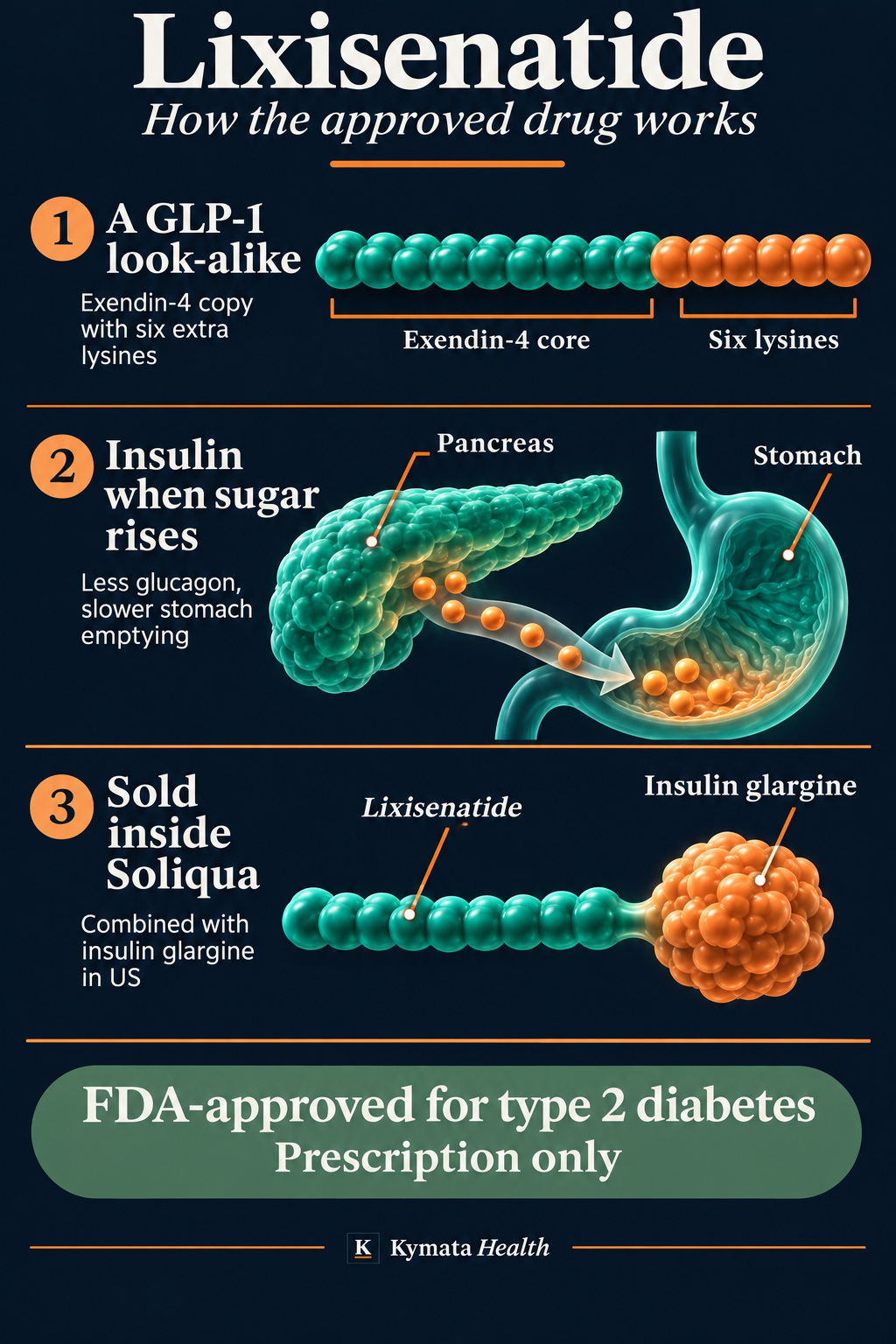
The guide shows lixisenatide as an exendin-4 analog with six added lysines that acts on GLP-1 receptors: more insulin when blood sugar rises, less glucagon and slower stomach emptying. Stand-alone Adlyxin left the US market in 2023; in the US, lixisenatide is sold with insulin glargine as Soliqua for adults with type 2 diabetes. The drawing is a schematic, not a measured molecular structure, a product photograph or a treatment result. Illustration review: 22 November 2026, against this page’s own mechanism, evidence and regulatory records.
The retained sequence field is a descriptive analogue label, not a complete verified residue string; no sequence model is shown.
Illustration notes and source record
Read the source record on this page. Laboratory, topical and injected studies are separate evidence; this illustration does not establish an indication or a treatment outcome.

How it works
SourcedThe Adlyxin label revised September 2023 describes single-agent lixisenatide as an adjunct to diet and exercise to improve glycemic control in adults with type 2 diabetes. It is not an indication limited to basal-insulin add-on use. The Soliqua label revised March 2026 describes a different product containing insulin glargine plus lixisenatide. Both labels describe lixisenatide as a GLP-1 receptor agonist that increases glucose-dependent insulin release, decreases glucagon secretion and slows gastric emptying. These mechanisms do not establish superiority over another GLP-1 product, and separate studies cannot turn kilograms and percentage weight changes in different populations into a head-to-head comparison.
Source: GetGoal trials
05 / Evidence and limits
Evidence and limits
Use-case scores
0–100–10 against the evidence we have, not a gym ranking. Hidden domains do not apply here.
- Metabolic / weight7.5/10Approval evidence concerns labeled type 2 diabetes products. This score is not a personal benefit estimate or a head-to-head weight-loss ranking.
Limits of current evidence
3 limits- Adlyxin prescribing information revised September 2023: single-agent lixisenatide, indicated as an adjunct to diet and exercise in adults with type 2 diabetes; not restricted to use with basal insulin.
- Soliqua prescribing information revised March 2026: a separate insulin glargine/lixisenatide combination product, also indicated as an adjunct to diet and exercise in adults with type 2 diabetes.
- Separate product studies and unlike weight-outcome units do not establish a head-to-head weight-loss comparison with semaglutide. A label or historical approval does not establish present availability: DailyMed still hosts the Adlyxin label although Sanofi withdrew the product from US sale in 2023.
Trial FinderRecruiting now: 3 open registrations for lixisenatide
What it is studied for
- Type 2 diabetes label scope: Label-specific
- Product comparisons: Separate evidence
Verdict
Adlyxin contains lixisenatide alone; Soliqua contains insulin glargine plus lixisenatide. The reviewed labels describe adult type 2 diabetes uses alongside diet and exercise, with product-specific warnings. Sanofi stopped selling stand-alone Adlyxin in the US in 2023 for business reasons; in the US, lixisenatide remains available inside Soliqua. Neither label establishes research-powder equivalence or current stock.
06 / Product forms and access
Product forms and access
Regulatory & legal status
- FDA status (US)
- ApprovedFDA-approved in Soliqua® 100/33 (with insulin glargine); the stand-alone Adlyxin® (2016) was discontinued by Sanofi (2023)
- WADA status (2026)
- Not ListedNot currently on the WADA 2026 Prohibited List. Policies may change. Verify before competition.
- Classification
- Prescription Drug
07 / Tools and practical checks
Tools and practical checks
No separate record is provided here. Read the linked evidence and limitations for this compound.
08 / Published study use
Published study use
What published studies gave, in whom, and the source. Not a dose for you.
What studies used
Approved drug; stand-alone US product withdrawn- Sanofi stopped selling stand-alone Adlyxin in the US in 2023. DailyMed still hosts its September 2023 label; in the US, lixisenatide is now sold inside Soliqua, combined with insulin glargine.
- GetGoal-Mono: 361 adults with type 2 diabetes, once a day under the skin, 10 µg rising to 20 µg over 1 or 2 weeks, or placebo, for 12 weeks. Fonseca 2012, PMID 22432104 (opens in new tab)
A record of what researchers gave, in whom; not a dose for you.
Administration
- Route / form
- Labeled subcutaneous products; formulation-specific administration decisions belong to the prescribing team.
Who it is for
2 uses| Category | Fit | What exists |
|---|---|---|
| Type 2 diabetes label scope | Label-specific | The reviewed Adlyxin and Soliqua labels describe adult type 2 diabetes indications alongside diet and exercise; their ingredients and contraindications differ. |
| Product comparisons | Separate evidence | Single-agent and combination-product results need their own populations, comparators and outcomes. A shared ingredient does not establish interchangeability. |
09 / Safety and interactions
Safety and interactions
What the record says
The reviewed Adlyxin label (September 2023), section 4, lists severe hypersensitivity to lixisenatide or its components. The reviewed Soliqua label (March 2026), section 4, lists episodes of hypoglycemia and serious hypersensitivity to insulin glargine, lixisenatide or its excipients. Neither reviewed section 4 lists MTC/MEN2; this is not a personal safety clearance. Product warnings include pancreatitis and hypoglycemia risks, with additional insulin-related risks for Soliqua. Medication adjustment is a prescribing-team decision, not an instruction supplied by this page.
10 / Comparisons and goal guides
Comparisons and goal guides
There is no separate comparison record on this page. Similar names do not establish that products or their evidence are interchangeable.
11 / Common questions
Common questions
Common questions
4 answersWhat makes lixisenatide different from semaglutide?
The reviewed Adlyxin and Soliqua labels describe lixisenatide products for adult type 2 diabetes. Lixisenatide slows gastric emptying, but that does not establish the strongest glucose effect or superior weight loss. Separate trials and unlike outcome units are not a head-to-head comparison with semaglutide.
Are Adlyxin and Soliqua the same product?
No. Adlyxin is single-agent lixisenatide; Soliqua contains insulin glargine plus lixisenatide. Their concentrations, ingredients and warnings belong to their respective product labels, not a generic peptide protocol. A published label does not confirm current pharmacy stock.
Where can I read lixisenatide prescribing information?
The Sources section links the official DailyMed Adlyxin prescribing information reviewed here (September 2023 revision) and the separate Soliqua label (March 2026 revision). Sections 1, 4 and 5 distinguish indications, contraindications and warnings. The approval-category guide under Related Articles explains why a labeled medicine and a research powder are different categories.
Is Lixisenatide FDA-approved?
Yes. FDA-approved in Soliqua® 100/33 (with insulin glargine); the stand-alone Adlyxin® (2016) was discontinued by Sanofi (2023).
12 / Sources and references
Sources and references
2 sources cited on this page.
Sources
2 sources- 1“Adlyxin (lixisenatide): prescribing information, revised September 2023.”Sanofi DailyMed (2023). Prescribing information
- 2“Soliqua (insulin glargine and lixisenatide): prescribing information, revised March 2026.”Sanofi DailyMed (2026). Prescribing information
14 / Prescription options
Prescription options
Prescription options: compare licensed telehealth providers
Some peptide therapies are available only by prescription after a consult with a licensed clinician.
Compare telehealth →15 / Peptide library
Peptide library
Keep reading: Peptide research library
Peptide research library: every pagePeptide libraryBrowse all topics
- ExenatidePrevious in this topic · First-in-class GLP-1 RA (Byetta BID / Bydureon weekly).
- MazdutideNext in this topic · Mazdutide (IBI362) is Innovent’s GLP-1/glucagon dual agonist, approved in China for obesity and type 2 diabetes but not by the FDA.
- Peptides by goalEvidence and US status for the compounds named for each goal and combination.
- OrforglipronLilly oral small-molecule GLP-1 receptor agonist (LY3502970), FDA-approved as Foundayo tablets in April 2026 for weight reduction and long-term maintenance in adults with…
- PemvidutideAltimmune GLP-1/glucagon dual agonist (ALT-801).
Regulatory and sport classification
- FDA-approved