Evidence limit: This article tells four commonly mixed-up substances apart. It is not a head-to-head trial and it isn't a verdict on whether any of them "works." Thymosin alpha-1 is not a Khavinson peptide. None of these materials is FDA-approved for the longevity or "immune support" uses sometimes implied in marketing.
Thymalin, Vilon, Thymogen: Which Is Which
Thymalin, Vilon, Thymogen and thymosin alpha-1 get lumped together as thymus peptides. Here is what each one is, and what has actually been tested.
Quick answer
Four names often get lumped together as thymus peptides, but they are four different things: Thymalin is a thymus extract, Vilon (Lys-Glu) and Thymogen (Glu-Trp) are two-amino-acid peptides, and thymosin alpha-1 is a 28-amino-acid peptide that is not a Khavinson peptide. Each has its own, separate evidence.
Researched and written by Kymata Health EditorialSources cited inlineHow we checkReport an error
Thymalin, Vilon, Thymogen and thymosin alpha-1 get lumped together as thymus peptides. Here is what each one is, and what has actually been tested.
Evidence limit
Trial FinderRecruiting now: 9 open registrations for thymosin Alpha-1
Key takeaways
- Four names often get lumped together as "thymus peptides." They're four different things.
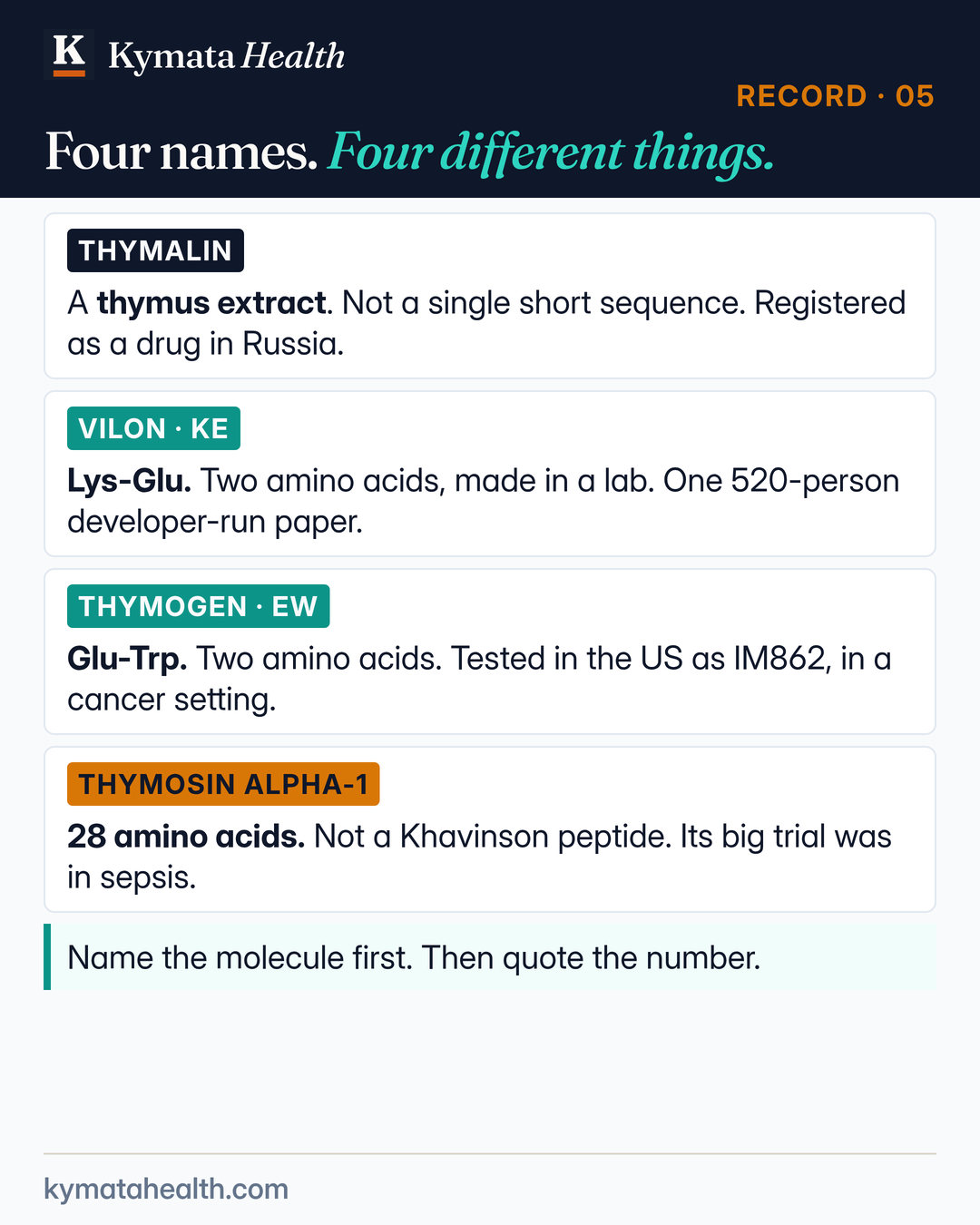
- Thymalin is an extract made from thymus tissue.
- Vilon is a two-amino-acid peptide, Lys-Glu (KE).
- Thymogen is another two-amino-acid peptide, Glu-Trp (EW). The same sequence was tested in the US as IM862 (Record 03).
- Thymosin alpha-1 is a 28-amino-acid peptide. It isn't part of the Khavinson family at all, and its big trial was in sepsis.
- Each has its own evidence, small and early for the Khavinson ones. Naming the molecule before quoting the headcount keeps them from getting mixed up.
Why the names get stacked
"Thymus peptides" is a handy phrase. The organ is the same, so it's easy to assume the story is the same. But an extract, two tiny peptides and a much larger one don't share a single body of evidence.
The Khavinson catalog already splits the first three apart. Thymalin is one of two extracts on the Atlas, alongside Epithalamin. Vilon and Thymogen are defined short peptides, KE and EW. Thymosin alpha-1 sits outside the catalog entirely, with its own research history.
So here's each one on its own.
Thymalin: an extract
Thymalin is prepared from thymus tissue. Unlike Vilon, it isn't a single short sequence.
The most-cited human report is Khavinson and colleagues, PMID 14523363: 266 older adults treated with Thymalin, Epithalamin, or both, and followed for six to eight years in centers in St. Petersburg and Kiev. It's one of the longest follow-ups in this whole family, and Record 13 reads it closely.
It's a record of extracts, not of a defined peptide like KE or EW. The study was run by the developers' own group, and we haven't found an independent replication in PubMed.
Thymalin is registered as a drug in Russia. It isn't FDA-approved in the US.
Vilon: just two amino acids
Vilon is Lys-Glu (KE), a two-amino-acid peptide made in a lab. It isn't Thymalin with the long chains trimmed off. A result on the extract doesn't automatically become a result on KE.
The human report most often cited is Trofimova and colleagues, Vrach, 2021 (DOI 10.29296/25877305-2021-03-05): 520 people, run by the developer's institute, on Vilon/Regevil. It isn't indexed in PubMed. According to the full text, people were randomized to two groups, 276 on Vilon and 244 on placebo. Immune markers and complaints are reported before and after within each group. Blinding isn't described.
The placebo group is a real design feature, and we count it. It's still a developer-run report that hasn't been repeated independently. It's early data, and it's about KE.
If you'd like a side-by-side of Vilon and Thymogen without anything to buy, our comparison page is here: Vilon vs Thymogen. It's a quick read, not a replacement for the papers.
Thymogen: Glu-Trp, and the US trial
Thymogen is Glu-Trp (EW). Record 03 is its full story. In short: the same sequence was developed in the US as IM862 and tested in a 202-person randomized, double-blind, placebo-controlled phase III trial in AIDS-related Kaposi sarcoma (Noy et al., Journal of Clinical Oncology, 2005; NCT00003879).
Response was 23% on IM862 and 21% on placebo. Median time to progression was 16 weeks on IM862 versus 35 weeks on placebo, and the authors concluded the drug wasn't better than placebo.
That's a cancer result for that sequence. It doesn't speak to Thymalin, Vilon, or general immune health.
In Russia, Thymogen is registered as a drug. In the US it isn't approved.
Thymosin alpha-1: a different molecule
Thymosin alpha-1 is a 28-amino-acid peptide, much longer than KE or EW. It isn't a Khavinson peptide, and it doesn't belong on the same list. It comes up here only because it's so often named alongside the others.
Its largest modern trial, TESTS (Wu and colleagues, BMJ; PMID 39814420; NCT02867267), was in sepsis. It enrolled 1,106 adults, with 1,089 in the main analysis. 28-day mortality was 23.4% versus 24.1%, a hazard ratio of 0.97 (95% CI 0.76 to 1.24). A 30 May 2025 correction (doi: 10.1136/bmj.r1098) changed the reported hazard ratio from 0.99 to 0.97, and the conclusion stayed the same.
That's a well-run, independent trial of thymosin alpha-1 in a very sick population. It tells you nothing about KE, EW, or a thymus extract.
Tiny doors for tiny peptides: PEPT1 and PEPT2
Here’s a question people ask. If a peptide is just a short chain of amino acids, how would it get into the body at all?
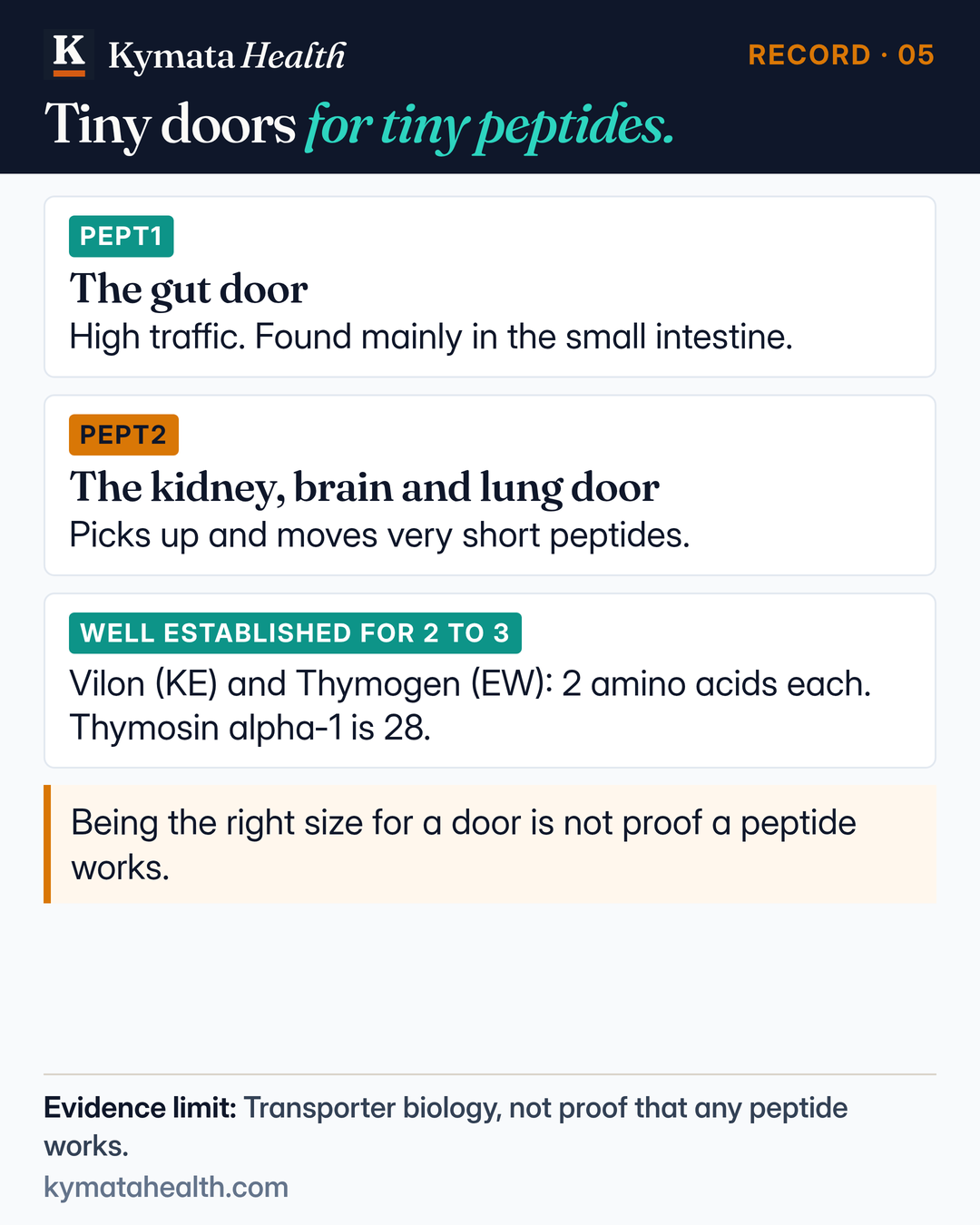
Part of the answer is that the body already has built-in doors for very short peptides. They’re proteins in cell walls called PEPT1 and PEPT2. Think of them as tiny doors that let very short peptides in (PMIDs 14977407, 23506874).
PEPT1 works mainly in the gut. PEPT2 is found mainly in the kidneys, brain and lungs (PMIDs 18668438, 36139448).
They work as a pair. PEPT1 is the high-traffic door that takes up short peptides at the gut. PEPT2 is the more sensitive door that picks them up and moves them around in the kidney and brain. That’s why they matter here: they’re the best-known reason very short chains can get into cells at all.
How does this fit Vilon and Thymogen? Vilon (KE) and Thymogen (EW) are two amino acids each. Thymalin is an extract, a mixture rather than one chain, and thymosin alpha-1 is 28 amino acids, far longer than these doors take. Well established for chains of two and three amino acids, which is the right size for these doors. What isn’t established is that either one uses them. We haven’t found a published human uptake study for either.
To be clear about what this does and doesn’t show: it’s background biology about how short peptides can travel. It doesn’t show that either one reaches its target tissue, and it doesn’t show that either one works.
What mixing them up costs
Lumping these four together does a quiet kind of damage. It lets the strongest design borrow credit for the weakest object, or the other way around.
The IM862 trial is a serious trial, but it isn't a Thymalin result just because both words sit near "thymus." The TESTS trial is a big modern trial, but it isn't a Vilon result because thymosin alpha-1 is a longer thymus-related peptide. The 266-person extract report isn't a dipeptide study. And the 520-person Vilon paper, with its placebo group, doesn't inherit the independence of a Western trial.
Each paper can be read on its own terms. The habit worth keeping is simple: name the molecule, then quote the number.
Russian drug registration, where it exists for Thymalin or Thymogen, is a regulatory fact in Russia. It isn't an FDA approval, and it isn't a finding that something works for aging or everyday "immune support." Record 10 takes that up on its own.
Questions
Are these four the same thing?
No. An extract, two different two-amino-acid peptides, and a 28-amino-acid peptide.
Which one has had a large Western trial in the Khavinson family?
Glu-Trp, as IM862, in a cancer setting. It didn't beat placebo there.
Is the 520-person Vilon paper a placebo-controlled trial?
It describes randomization to a placebo group (276 versus 244), with results reported before and after within each group. Blinding isn't described, it's developer-run, and it isn't in PubMed.
Is thymosin alpha-1 a Khavinson peptide?
No. TESTS was a sepsis trial of a different molecule.
Is any of this FDA-approved for "immune support" or aging?
No. Some of these names are registered as drugs in Russia. That isn't a US approval.
Does this article recommend using any of them?
No. It's a record of what was studied, in whom, and how.
Share this article
References
- 1Peptides of pineal gland and thymus prolong human life.Khavinson VKh, Morozov VG, Neuro Endocrinol Lett. 2003 · PMID: 14523363
- 2Angiogenesis inhibitor IM862 is ineffective against AIDS-Kaposi's sarcoma in a phase III trialNoy A, Scadden DT, Lee J, et al., J Clin Oncol. 2005 · PMID: 15598977
- 3The efficacy and safety of thymosin α1 for sepsis (TESTS): multicentre, double blinded, randomised, placebo controlled, phase 3 trialWu J, Pei F, Zhou L, et al., BMJ 2025 · PMID: 39814420 · DOI: 10.1136/bmj-2024-082583
- 4Developer-run Vilon report (Russian journal Vrach; not indexed in PubMed)Trofimova S, et al., Vrach 2021 · DOI: 10.29296/25877305-2021-03-05
- 5Molecular and integrative physiology of intestinal peptide transportDaniel H, Annu Rev Physiol. 2004 · PMID: 14977407
- 6Peptide transporters and their roles in physiological processes and drug dispositionRubio-Aliaga I, Daniel H, Xenobiotica 2008 · PMID: 18668438
- 7Proton-coupled oligopeptide transporter family SLC15: physiological, pharmacological and pathological implicationsSmith DE, Clémençon B, Hediger MA, Mol Aspects Med. 2013 · PMID: 23506874
- 8Biology of Peptide Transporter 2 in Mammals: New Insights into Its Function, Structure and RegulationWang C, Chu C, Ji X, et al., Cells 2022 · PMID: 36139448
Related

Readers also read


Ask about this article
Answers come from this page and our other evidence pages, with links.
Keep reading: Peptide research library
Previous in this topicThree Quick Questions to Ask About Any Khavinson Peptide PaperNext in this topicBPC-157
- TB-500TB-500, in the identity reviewed here, is the N-acetylated seven-amino-acid fragment Ac-LKKTETQ. It corresponds to a region of thymosin beta-4, a longer 43-amino-acid peptide…
- SemaglutideOnce-weekly GLP-1 receptor agonist. FDA-approved as Ozempic (T2D) and Wegovy (chronic weight management); Rybelsus is the oral SNAC tablet. STEP/SELECT describe branded pens, not…
- TirzepatideDual GIP/GLP-1 agonist. FDA-approved as Mounjaro (T2D) and Zepbound (obesity). SURMOUNT/SURPASS describe branded pens, not a compounded vial. Do not stack with semaglutide. Not…