Evidence limit: This article sticks to what can be verified from the PubMed abstracts of four papers (PMIDs 22708445, 23734521, 26390612, and 28539017). We haven't re-read the full PDFs for this series. Where an abstract is silent, whether on sample size, how people were assigned, dose, route, duration, blinding, or whether two peptides were given together, we say so and don't fill the gap from secondary sources. None of these materials is FDA-approved.
Pinealon and Vesugen: What's Been Reported
What Pinealon (EDR) and Vesugen (KED) are, and what four small human reports say in plain words, including what each abstract leaves out. Early data.
Quick answer
Pinealon (Glu-Asp-Arg, EDR) and Vesugen (Lys-Glu-Asp, KED) are two three-amino-acid peptides from the Khavinson family. Four small human reports mention them: one covers Pinealon alone, two clearly describe the two together, and one names both without making the groups clear. None describes a randomized, placebo-controlled test of a single peptide. This is early human data, not repeated yet.
Researched and written by Kymata Health EditorialSources cited inlineHow we checkReport an error
What Pinealon (EDR) and Vesugen (KED) are, and what four small human reports say in plain words, including what each abstract leaves out. Early data.
Evidence limit
Key takeaways
- Pinealon is a three-amino-acid peptide, Glu-Asp-Arg (EDR). Vesugen is another, Lys-Glu-Asp (KED). They come from the same Russian research family and are often mentioned together.
- Four small human reports show up in PubMed under these names. They're small and early, and we haven't found independent repeats.
- Only one of the four abstracts describes Pinealon without mentioning Vesugen (PMID 22708445). Two clearly describe the two given together (PMIDs 23734521 and 28539017). The fourth names both but doesn't make the groups clear (PMID 26390612).
- That means the reports are early human data. None of the abstracts describes a randomized, placebo-controlled test of a single peptide.
- No big Western trial exists for either one. That isn't a finding. One common explanation is that short peptides are hard to patent and expensive to test, so few companies pay for large trials.
What they are
Pinealon is three amino acids in a row: Glu-Asp-Arg, or EDR. Vesugen is also three: Lys-Glu-Asp, or KED. They sit in the Khavinson family of short peptides, which came out of research in St. Petersburg. Pinealon is usually discussed in the context of the brain and nervous system, and Vesugen as a "vessel" peptide.
They're different sequences, so a result with both isn't a result for either one alone. That matters, because the human reports often involve both.
What has been reported in people
A handful of small human reports exist, and they're worth knowing about. Here's what each abstract says, in plain words. Where the abstract is quiet, we leave it quiet.
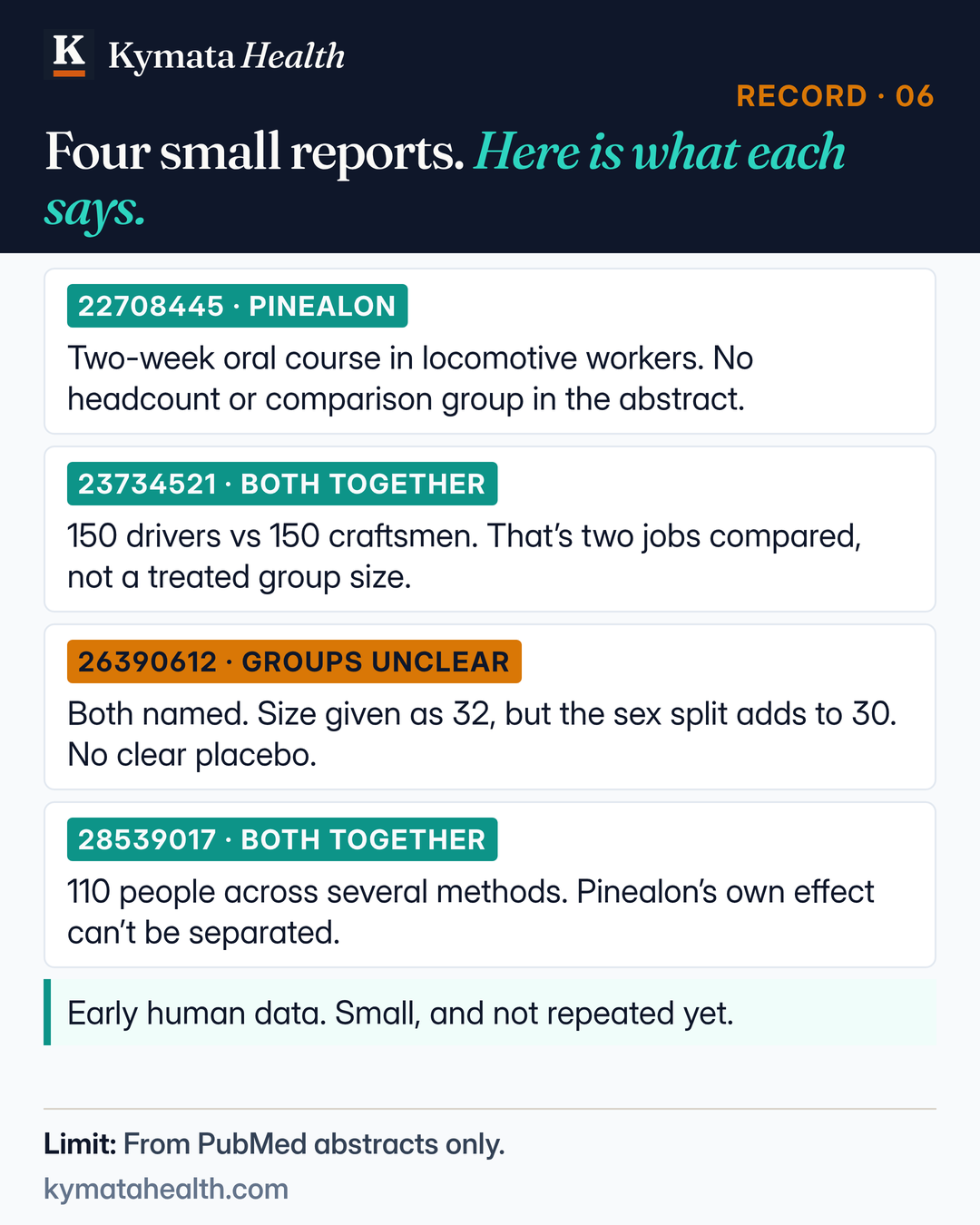
PMID 22708445 (Nazimko, 2012). This is the one abstract in the set that talks about Pinealon without Vesugen. It describes an oral preparation given to locomotive-brigade workers for two weeks, in an occupational, functional setting. The abstract doesn't say how many people took part and doesn't describe a comparison group, random assignment or blinding.
PMID 23734521 (Bashkireva, 2012). This compares 150 lorry drivers with 150 metal craftsmen. The abstract says bioregulating peptides improved psychoemotional measures, and that "the best effect was obtained in case of combined application of several cytogens (pinealon and vezugen)." The 150-versus-150 split is two kinds of workers, so it isn't the number of people who got a peptide. The abstract doesn't give how many were treated, how they were assigned, or the dose, route, duration or a placebo.
PMID 26390612 (Meshchaninov and colleagues, 2015). This names both Pinealon and Vesugen. The abstract gives a study size of 32 people, ages 41 to 83, and also says 18 men and 12 women, which adds up to 30. That mismatch is in the abstract itself, and we can't settle it without the full text, so we show both numbers. The authors report effects they describe as geroprotective and anabolic, and also report prooxidant activity and lower CD34+ cells. No placebo is described, and it doesn't describe the groups. It says Vesugen showed a more visible effect than Pinealon, which hints the two were looked at separately, but the abstract does not say how they were given.
PMID 28539017 (Myakotnykh and colleagues, 2016). This reports 110 people in a comparison of several approaches, including carbon-dioxide baths, hyperbaric oxygen, massage, and the combined use of Vezugen and Pinealon. The authors report the biggest change in biological age in the combined-peptide group. The abstract doesn't describe how people were assigned, whether anyone was blinded, or a placebo.
Some write-ups of these papers include extra numbers, such as a 15-versus-17 split of one study's groups. Those aren't in the abstracts we verified, so we don't use them.
What these reports can't tell us
This is the honest part, and it's the same for most of the Khavinson family.
- No single-peptide test. In two of four abstracts the peptides were given together, and in a third it isn't clear. That makes it impossible to pin an effect on Pinealon alone or Vesugen alone.
- No placebo-controlled test in the abstracts. None describes random assignment against a placebo, so expectation and selection can't be ruled out.
- Big-looking numbers that aren't trial sizes. 150 and 150 is a comparison of two jobs, not a treated group. 110 people is a comparison of several methods, not a Pinealon trial.
- Missing details. Without a treated-group size, we can't say how many people took a peptide in PMID 23734521. Without a group diagram, we can't say what design PMID 26390612 used.
- No sleep trial. We haven't found a controlled sleep trial of Pinealon alone. Sleep claims that lean on these four papers, or on sources we haven't verified, are outside this record.
None of that says the reports are wrong. It says they're small early reports, and a full-text read might add denominators and group diagrams. If it does, we'll update this article.
Tiny doors for tiny peptides: PEPT1 and PEPT2
Here’s a question people ask. If a peptide is just a short chain of amino acids, how would it get into the body at all?
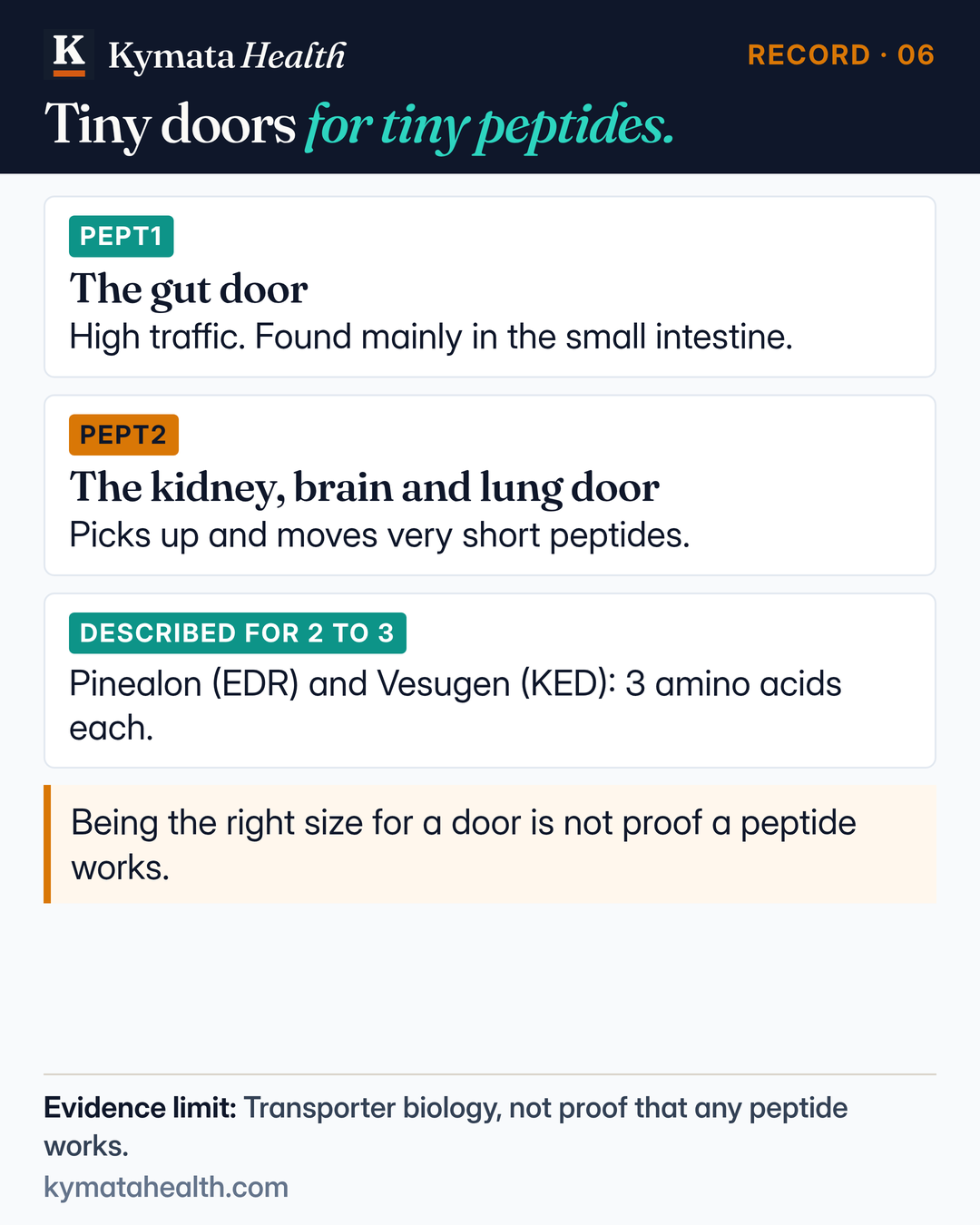
Part of the answer is that the body already has built-in doors for very short peptides. They’re proteins in cell walls called PEPT1 and PEPT2. Think of them as tiny doors that let very short peptides in (PMIDs 14977407, 23506874).
PEPT1 works mainly in the gut. PEPT2 is found mainly in the kidneys, brain and lungs (PMIDs 18668438, 36139448).
They work as a pair. PEPT1 is the high-traffic door that takes up short peptides at the gut. PEPT2 is the more sensitive door that picks them up and moves them around in the kidney and brain. That’s why they matter here: they’re a well-described route by which di- and tripeptides can enter cells.
How does this fit Pinealon and Vesugen? Pinealon (EDR) and Vesugen (KED) are three amino acids each. Those transporters are described for di- and tripeptides, which is the size of these two peptides. What isn’t established is that either one uses them. We haven’t found a published human uptake study for either.
To be clear about what this does and doesn’t show: it’s background biology about how short peptides can travel. It doesn’t show that either one reaches its target tissue, and it doesn’t show that either one works.
Why there isn't more
A real controlled trial of a three-amino-acid peptide costs a lot of money. Short natural sequences are often described as hard to patent, which would leave little payoff for a company that funds one. That's a big part of why we have four small abstracts and not a well-funded trial. It's a gap in funding as much as a gap in evidence, and it's why we describe this as early human data rather than a closed question.
What this article is
This article describes what PubMed abstracts report and what they leave out. It is not a recommendation to start, stop, or use any substance, and it is not a substitute for care from a licensed clinician.
Questions
Do Pinealon and Vesugen have a large placebo-controlled trial?
Not in the abstracts we verified.
Were they usually given together?
Two of four abstracts clearly describe combined use. One describes Pinealon only. One names both and doesn't make the groups clear.
Can I use the 300-person driver-and-craftsmen comparison as a trial size?
No. It's a comparison of two occupations, and the abstract doesn't give a treated-group size.
Is there a verified Pinealon-only sleep trial?
We haven't found one.
Is this a recommendation to use either peptide?
No. None of these materials is FDA-approved.
Share this article
References
- 1Analysis of some parameters of biological age and adaptation possibilities of workers of locomotive brigadesNazimko VA, Morgul' EV, Petrova OA, et al., Adv Gerontol 2012 · PMID: 22708445
- 2The peptide correction of neurotic disorders among professional truck-driversBashkireva AS, Artamonova VG, Adv Gerontol 2012 · PMID: 23734521
- 3Effect of synthetic peptides on aging of patients with chronic polymorbidity and organic brain syndrome of the central nervous system in remissionMeshchaninov VN, Tkachenko EL, Zharkov SV, et al., Adv Gerontol 2015 · PMID: 26390612
- 4Comparative analysis of different methods of geroprotectiveMyakotnykh VS, Torgashov MN, Egorin KV, et al., Adv Gerontol 2016 · PMID: 28539017
- 5Molecular and integrative physiology of intestinal peptide transportDaniel H, Annu Rev Physiol. 2004 · PMID: 14977407
- 6Peptide transporters and their roles in physiological processes and drug dispositionRubio-Aliaga I, Daniel H, Xenobiotica 2008 · PMID: 18668438
- 7Proton-coupled oligopeptide transporter family SLC15: physiological, pharmacological and pathological implicationsSmith DE, Clémençon B, Hediger MA, Mol Aspects Med. 2013 · PMID: 23506874
- 8Biology of Peptide Transporter 2 in Mammals: New Insights into Its Function, Structure and RegulationWang C, Chu C, Ji X, et al., Cells 2022 · PMID: 36139448
Related

Readers also read


Ask about this article
Answers come from this page and our other evidence pages, with links.
Keep reading: Peptide research library
Previous in this topicThymalin, Vilon, Thymogen, Thymosin Alpha-1: Which Is WhichNext in this topicBPC-157
- TB-500TB-500, in the identity reviewed here, is the N-acetylated seven-amino-acid fragment Ac-LKKTETQ. It corresponds to a region of thymosin beta-4, a longer 43-amino-acid peptide…
- SemaglutideOnce-weekly GLP-1 receptor agonist. FDA-approved as Ozempic (T2D) and Wegovy (chronic weight management); Rybelsus is the oral SNAC tablet. STEP/SELECT describe branded pens, not…
- TirzepatideDual GIP/GLP-1 agonist. FDA-approved as Mounjaro (T2D) and Zepbound (obesity). SURMOUNT/SURPASS describe branded pens, not a compounded vial. Do not stack with semaglutide. Not…