Search
Conceptual render of a short peptide chain docking into a cell-membrane receptor.

Twice-Yearly Cholesterol Shot Cut Major Heart Events: What ORION-4 Found (Leqvio)

Novartis says twice-yearly Leqvio (inclisiran) cut major heart events in ORION-4, a 16,000-person trial. What it tested, how it works, what is not yet public.

By Kymata Health EditorialPublished 8 min read10 sourcesNo paid links in this articleEducation, not medical advice

Quick answer

On Nov 23, 2026, Novartis announced that its cholesterol drug Leqvio (inclisiran), given twice a year after two starting injections, lowered the risk of major adverse cardiovascular events (coronary heart disease death, heart attack, ischemic stroke or urgent coronary revascularization) versus placebo in ORION-4, an Oxford-led trial of more than 16,000 people with established heart or vascular disease. It is the first outcomes result for an siRNA cholesterol drug. The size of the benefit has not been released; full results are planned for the first half of 2027. Leqvio is a Novartis drug licensed from Alnylam, not an Eli Lilly drug.

Researched and written by Kymata Health EditorialSources cited inlineHow we checkReport an error

In short

ORION-4 met its primary endpoint: inclisiran (Leqvio) produced “a statistically significant and clinically meaningful reduction in major adverse cardiovascular events (MACE)” when added to standard care, Novartis said on Nov 23, 2026 (Novartis release). MACE in this trial means coronary heart disease death, heart attack, fatal or non-fatal ischemic stroke, or urgent coronary revascularization.

The trial randomized 16,124 adults with established atherosclerotic cardiovascular disease (ASCVD) to inclisiran or placebo (ClinicalTrials.gov NCT03705234). It was led by the University of Oxford with the TIMI Study Group, and co-sponsored by Oxford and Novartis.

What is not public: the hazard ratio, the percentage reduction, event counts and the secondary results. Every outlet that covered the announcement, including HCPLive and MedPath, notes the same gap. Any number you see quoted for ORION-4’s benefit today did not come from the trial.

Health news, not medical advice. Checked Nov 24, 2026. Leqvio is a prescription medicine; whether it fits a given person is a decision for their clinician.

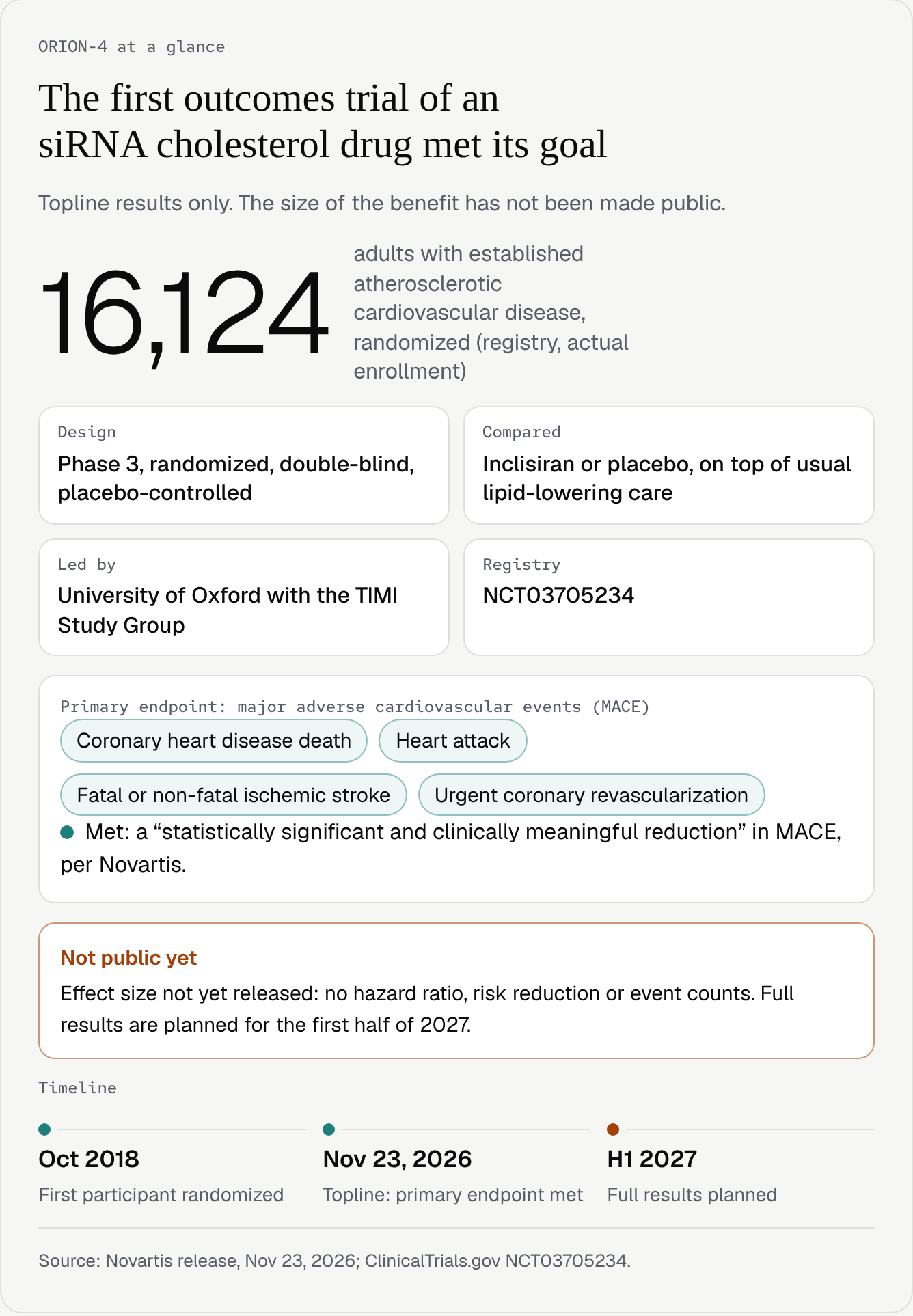
ORION-4 at a glance
The first outcomes trial of an siRNA cholesterol drug met its goal
Topline results only. The size of the benefit has not been made public.
16,124adults with established atherosclerotic cardiovascular disease, randomized (registry, actual enrollment)
Design
Phase 3, randomized, double-blind, placebo-controlled
Compared
Inclisiran or placebo, on top of usual lipid-lowering care
Led by
University of Oxford with the TIMI Study Group
Registry
NCT03705234
Primary endpoint: major adverse cardiovascular events (MACE)
Coronary heart disease deathHeart attackFatal or non-fatal ischemic strokeUrgent coronary revascularization
Met: a “statistically significant and clinically meaningful reduction” in MACE, per Novartis.
Not public yet
Effect size not yet released: no hazard ratio, risk reduction or event counts. Full results are planned for the first half of 2027.
Timeline
Oct 2018First participant randomized
Nov 23, 2026Topline: primary endpoint met
H1 2027Full results planned
Source: Novartis release, Nov 23, 2026; ClinicalTrials.gov NCT03705234.
Topline only: the size of the benefit has not been made public.
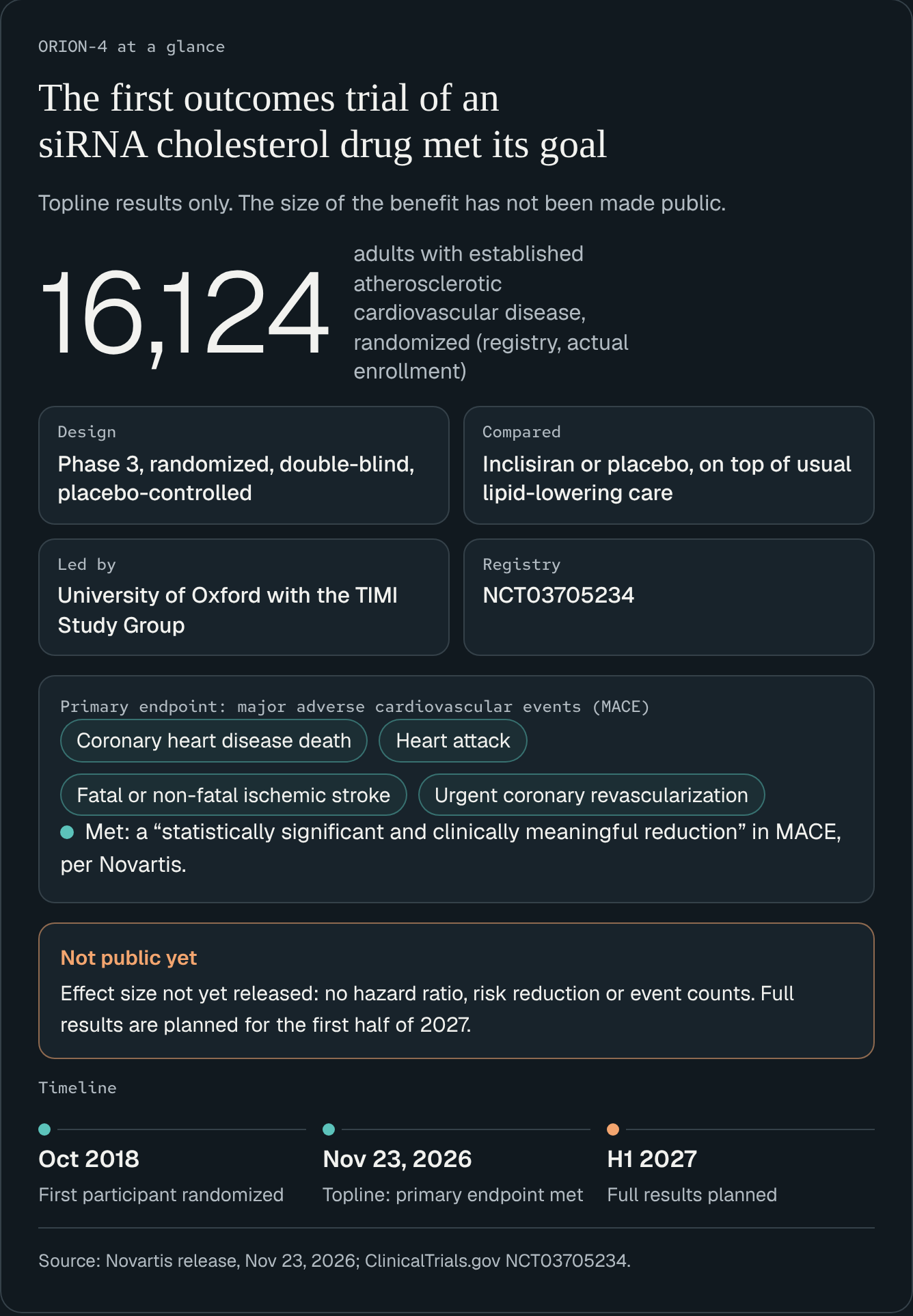
ORION-4 at a glance: 16,124 adults with established atherosclerotic cardiovascular disease randomized to inclisiran or placebo on top of usual care, in a phase 3, double-blind, placebo-controlled trial led by the University of Oxford with the TIMI Study Group (NCT03705234). Primary endpoint: coronary heart disease death, heart attack, fatal or non-fatal ischemic stroke, or urgent coronary revascularization. Met, per Novartis; effect size not yet released, full results planned for the first half of 2027.The full-size image, for saving or sharingORION-4 at a glance: 16,124 adults with established atherosclerotic cardiovascular disease randomized to inclisiran or placebo on top of usual care, in a phase 3, double-blind, placebo-controlled trial led by the University of Oxford with the TIMI Study Group (NCT03705234). Primary endpoint: coronary heart disease death, heart attack, fatal or non-fatal ischemic stroke, or urgent coronary revascularization. Met, per Novartis; effect size not yet released, full results planned for the first half of 2027.The full-size image, for saving or sharing

At a glance

Compounds

Whose drug is it?

The tweet that spread the news on Nov 23 did not name the company, and many readers assumed it was an Eli Lilly drug. It is not. Leqvio is marketed by Novartis, which holds the rights “under a license and collaboration agreement with Alnylam Pharmaceuticals”, the company that developed the siRNA technology (Novartis release). Novartis acquired the program when it bought The Medicines Company in 2019 (pharmaphorum).

Lilly has its own RNA-based heart programs, but they target a different particle, lipoprotein(a); see the landscape section below.

What ORION-4 tested

  • Who: adults with established ASCVD: a prior heart attack, a prior ischemic stroke, or peripheral artery disease treated with revascularization or aneurysm repair. Men had to be 40 or older and women 55 or older (registry).
  • Design: phase 3, randomized, double-blind (masked to participants, care providers, investigators and outcome assessors), placebo-controlled. The first participant was randomized in October 2018 (registry).
  • Comparison: inclisiran or a saline placebo, on top of each participant’s usual lipid-lowering care. Both groups followed the labeled schedule: an injection at the start, another at 3 months, then every 6 months (registry).
  • Primary endpoint: time to the first major adverse cardiovascular event (coronary heart disease death, heart attack, fatal or non-fatal ischemic stroke, or urgent coronary revascularization). The protocol planned a median follow-up of about five years; the actual follow-up has not been reported.
  • Secondary endpoints: MACE in people already on a high-intensity statin, the combination of coronary heart disease death or heart attack, and cardiovascular death (Novartis release). No secondary results have been released.

The topline result is Oxford’s analysis, presented to the trial’s steering committee and reported by Novartis. Full results are planned for publication in the first half of 2027, probably at a cardiology meeting (pharmaphorum).

“ORION-4 provides evidence that inclisiran is well tolerated and can reduce the risk of major cardiovascular events in people with established vascular disease.”

Professor Louise Bowman, Oxford Population Health, lead ORION-4 investigator, in the Novartis release of Nov 23, 2026.

How inclisiran lowers LDL cholesterol

Inclisiran is a small interfering RNA (siRNA), a short double strand of RNA, not a protein antibody and not a pill. Its target is PCSK9, a protein the liver makes that marks LDL receptors for destruction (Leqvio prescribing information, section 12.1).

  1. A sugar tag sends it to the liver. The siRNA carries N-acetylgalactosamine (GalNAc), which binds asialoglycoprotein receptors (ASGPR) on liver cells, so the drug is taken up by the liver (FDA pharmacology review).
  2. It silences the PCSK9 message. Inside the cell, the drug’s antisense strand loads into the RNA-induced silencing complex (RISC), which breaks down the messenger RNA for PCSK9, so less PCSK9 protein is made.
  3. More LDL receptors survive. With less PCSK9, LDL receptors are recycled back to the cell surface instead of being destroyed.
  4. More LDL leaves the blood. More receptors catch more LDL particles, and LDL cholesterol in the bloodstream falls.

Because the effect lives inside the liver cell rather than in the blood, one injection keeps working for months. That is why the label schedule needs only two maintenance injections a year.

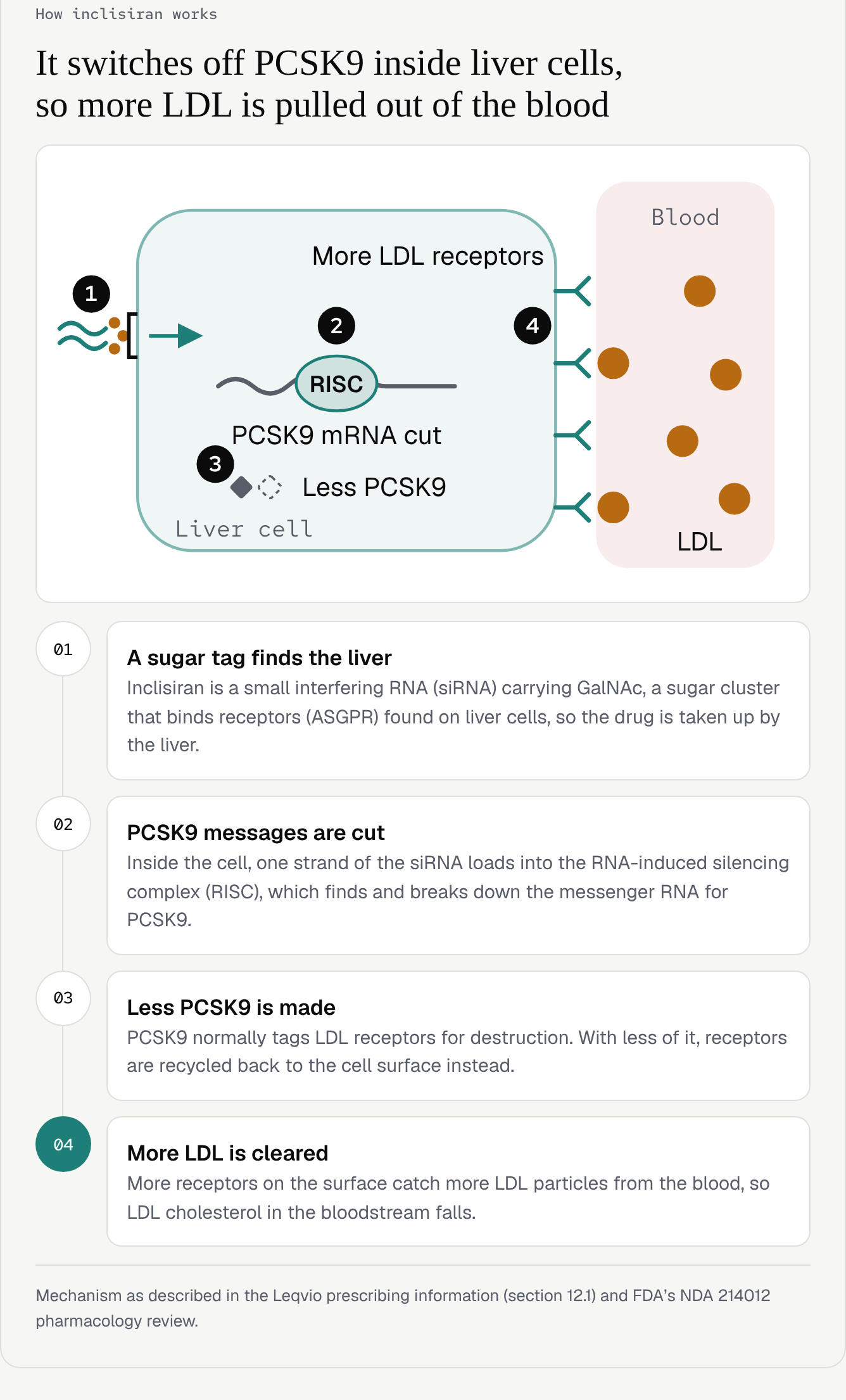
How inclisiran works
It switches off PCSK9 inside liver cells, so more LDL is pulled out of the blood
BloodLiver cellRISCPCSK9 mRNA cutLess PCSK9LDLMore LDL receptors
A sugar tag finds the liver
Inclisiran is a small interfering RNA (siRNA) carrying GalNAc, a sugar cluster that binds receptors (ASGPR) found on liver cells, so the drug is taken up by the liver.
PCSK9 messages are cut
Inside the cell, one strand of the siRNA loads into the RNA-induced silencing complex (RISC), which finds and breaks down the messenger RNA for PCSK9.
Less PCSK9 is made
PCSK9 normally tags LDL receptors for destruction. With less of it, receptors are recycled back to the cell surface instead.
More LDL is cleared
More receptors on the surface catch more LDL particles from the blood, so LDL cholesterol in the bloodstream falls.
Mechanism as described in the Leqvio prescribing information (section 12.1) and FDA’s NDA 214012 pharmacology review.
A schematic, not to scale. Source: Leqvio prescribing information and FDA review.
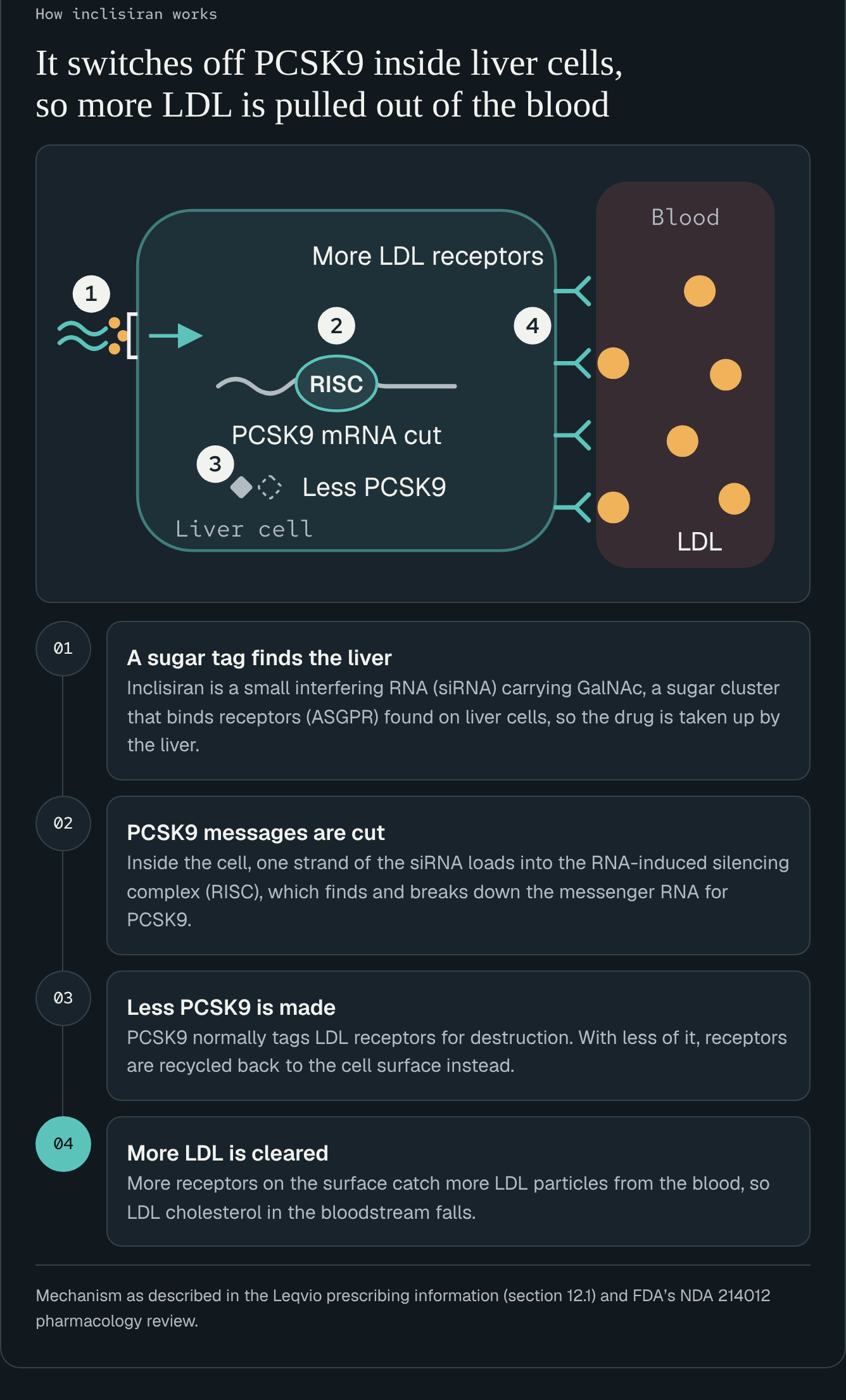
How inclisiran works, in four steps: 1, a GalNAc sugar tag carries the siRNA into liver cells through ASGPR receptors; 2, inside the cell RISC breaks down PCSK9 messenger RNA; 3, less PCSK9 is made, so LDL receptors are recycled to the surface; 4, more receptors clear more LDL cholesterol from the blood.The full-size image, for saving or sharingHow inclisiran works, in four steps: 1, a GalNAc sugar tag carries the siRNA into liver cells through ASGPR receptors; 2, inside the cell RISC breaks down PCSK9 messenger RNA; 3, less PCSK9 is made, so LDL receptors are recycled to the surface; 4, more receptors clear more LDL cholesterol from the blood.The full-size image, for saving or sharing

The labeled schedule, and why it matters

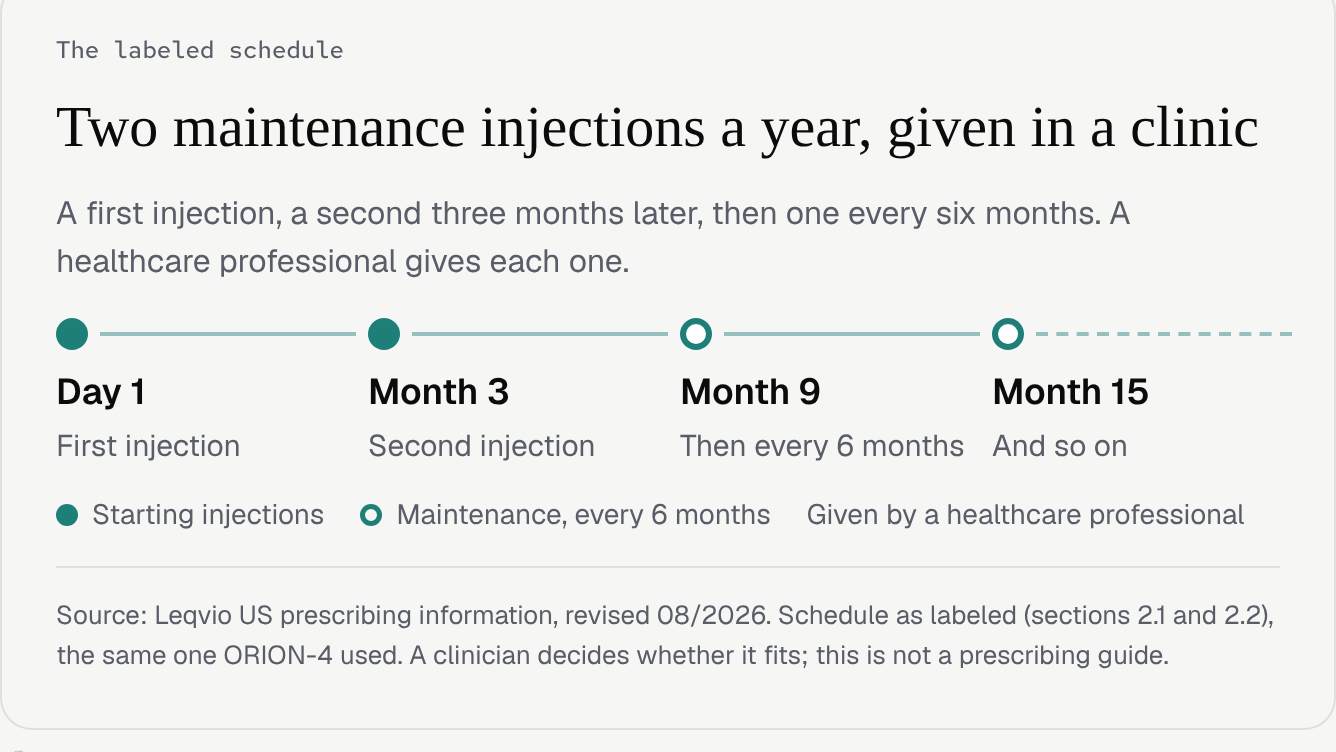
The Leqvio label gives one approved strength, in a single-dose prefilled syringe, given “initially, again at 3 months, and then every 6 months”, and says it “should be administered by a healthcare professional” (Leqvio prescribing information, sections 2 and 3). It is not a self-injected pen.

That has two practical consequences. Adherence is built in: each injection happens at a visit, so there is no daily pill to forget. And it is given on top of a statin in most people, not instead of one; ORION-4 tested it added to standard care.

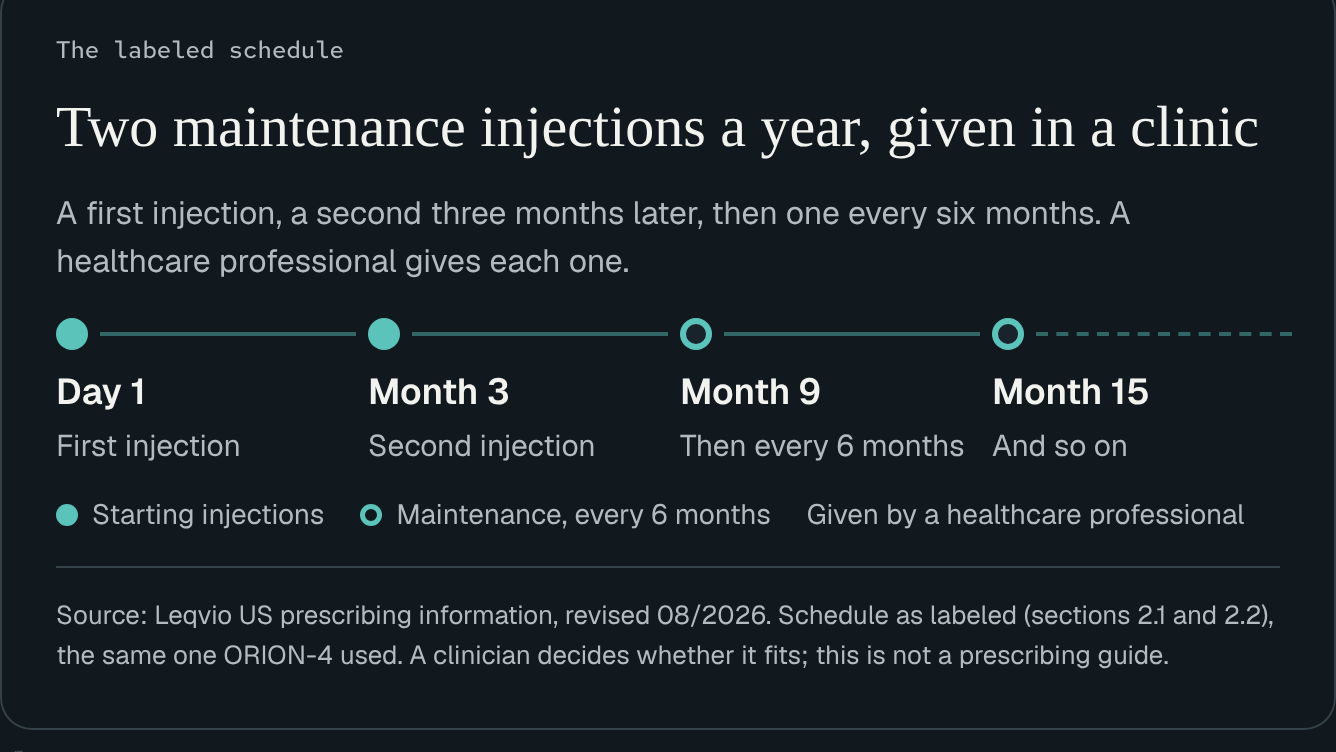
The labeled schedule
Two maintenance injections a year, given in a clinic
A first injection, a second three months later, then one every six months. A healthcare professional gives each one.
Day 1First injection
Month 3Second injection
Month 9Then every 6 months
Month 15And so on
Starting injectionsMaintenance, every 6 monthsGiven by a healthcare professional
Source: Leqvio US prescribing information, revised 08/2026. Schedule as labeled (sections 2.1 and 2.2), the same one ORION-4 used. A clinician decides whether it fits; this is not a prescribing guide.
Leqvio US prescribing information, revised 08/2026.
The labeled Leqvio schedule as a timeline: a first injection on day 1, a second at month 3, then one every 6 months (month 9, month 15 and on), each given by a healthcare professional.The full-size image, for saving or sharingThe labeled Leqvio schedule as a timeline: a first injection on day 1, a second at month 3, then one every 6 months (month 9, month 15 and on), each given by a healthcare professional.The full-size image, for saving or sharing

What was already known about inclisiran

Before ORION-4, inclisiran’s evidence was about LDL cholesterol, not heart events. In the 18-month ORION-10 and ORION-11 trials of 1,561 and 1,617 people with ASCVD or equivalent risk whose LDL stayed high on statins (Ray et al., NEJM 2020, PMID 32187462), inclisiran lowered LDL cholesterol by 52.3% and 49.9% versus placebo at day 510.

The FDA first approved Leqvio on Dec 22, 2021, to lower LDL cholesterol. In July 2025 it allowed use without a statin (monotherapy) in adults with high cholesterol (Novartis), and in February 2026 it added children 12 and older with familial hypercholesterolemia. The current label states that outcomes trials of statins and PCSK9 antibodies show lower LDL lowers cardiovascular risk; it makes no outcomes claim for Leqvio itself (prescribing information, section 1).

ORION-4 is the first trial to test that question for inclisiran directly. Novartis plans to submit ORION-4 together with its second outcomes trial, VICTORION-2 PREVENT (17,004 participants, NCT05030428), by the end of 2027 (Fierce Pharma).

How it compares with statins and PCSK9 antibodies

Three kinds of drugs now lower LDL through the liver. They differ in how they are given and in how much outcomes evidence each has.

How it compares with statins and PCSK9 antibodies
StatinsPCSK9 antibodies (evolocumab, alirocumab)Inclisiran (Leqvio)
How it worksSlows cholesterol production in the liverAntibody binds PCSK9 in the bloodsiRNA stops PCSK9 being made in the liver
How it is givenPill, by mouthInjection under the skin, usually at homeInjection under the skin, by a healthcare professional
How oftenEvery dayEvery 2 or 4 weeks, or monthlyStart, 3 months, then every 6 months
Heart-outcomes evidenceDecades of outcomes trialsFOURIER, ODYSSEY OUTCOMES, VESALIUS-CVORION-4 topline met; full data in 2027

PCSK9 antibodies have published effect sizes. In FOURIER, 27,564 people with ASCVD on statins had a hazard ratio of 0.85 for the primary endpoint with evolocumab (Sabatine et al., PMID 28304224); in ODYSSEY OUTCOMES, 18,924 people after an acute coronary syndrome had a hazard ratio of 0.85 with alirocumab (Schwartz et al., PMID 30403574). VESALIUS-CV, presented in November 2025, extended evolocumab’s evidence to 12,257 people without a prior heart attack or stroke (PMID 41211925). Whether inclisiran’s benefit is larger, smaller or similar cannot be judged until ORION-4 is published.

The wider landscape, including Lilly

  • Lipoprotein(a), a separate target. Eli Lilly’s lepodisiran is also a GalNAc-siRNA, but it silences lipoprotein(a), not PCSK9. In the 320-person phase 2 ALPACA trial (Nissen et al., NEJM 2025, PMID 40162643) it lowered Lp(a) sharply; its outcomes trial, ACCLAIM-Lp(a), is not expected to finish before 2029 (NCT06292013).
  • A cautionary result. At the American Heart Association’s 2026 meeting, the HORIZON trial of pelacarsen, a Novartis Lp(a) drug, reported no benefit in people with established ASCVD, as summarized by the National Lipid Association (NLA). Lowering a blood marker does not guarantee fewer heart events, which is why ORION-4’s outcome data matter.
  • Pills that target PCSK9. Merck’s oral PCSK9 inhibitor enlicitide (Lipfendra) was approved by the FDA in July 2026 to lower LDL cholesterol; its outcomes trial is still running.

Benefits and caveats

What it offers, on the evidence so far:

  • Sustained LDL lowering with two maintenance injections a year (ORION-10 and ORION-11).
  • Given in a clinic, which takes daily adherence out of the equation.
  • Works on top of statins, the setting ORION-4 tested.
  • Now, a positive outcomes trial: a lower risk of major cardiovascular events versus placebo.

What to keep in mind:

  • The size of the benefit is not known yet. Until the full results are published, nobody outside the trial team can say how many events it avoided.
  • Side effects: in the label’s pooled placebo-controlled trials, injection-site reactions were the most common (8% versus 2% with placebo), followed by joint pain (5% versus 4%) and bronchitis (4% versus 3%); serious allergic reactions, including anaphylaxis and angioedema, are a contraindication (prescribing information, sections 4 to 6).
  • Prescription only, for adults with high LDL cholesterol and some teens with familial hypercholesterolemia, per the label.
  • Not a reason to stop a statin. ORION-4 added inclisiran to standard care. Any change to a cholesterol plan is a conversation with a clinician.

Cost has been the main barrier to wider use of PCSK9-lowering drugs (TCTMD); coverage varies by insurer.

What happens next

  • First half of 2027: the full ORION-4 results, with the effect size, safety data and secondary endpoints (Novartis release).
  • 2027: VICTORION-2 PREVENT reads out. Together the two trials have enrolled more than 33,000 people.
  • By the end of 2027: Novartis expects to submit both trials to regulators (Fierce Pharma). Until a label change, Leqvio’s US label stays an LDL-lowering label.

For the drug itself (how it works, the label, side effects and the trials so far), see the inclisiran reference page. Coverage consulted for this article: HCPLive, MedPath, pharmaphorum, Fierce Pharma, TCTMD and the National Lipid Association.

Questions

What did the ORION-4 trial find?

Novartis announced on Nov 23, 2026 that ORION-4 met its primary endpoint: inclisiran (Leqvio) added to standard care produced a statistically significant and clinically meaningful reduction in major adverse cardiovascular events (coronary heart disease death, heart attack, fatal or non-fatal ischemic stroke, or urgent coronary revascularization) compared with placebo, in 16,124 people with established atherosclerotic cardiovascular disease.

How much did inclisiran lower the risk of major heart events in ORION-4?

That has not been released. The Nov 23, 2026 announcement reported only the combined endpoint (major adverse cardiovascular events), with no hazard ratio, percentage reduction, event counts or separate results for heart attack or stroke. Full results are planned for publication in the first half of 2027.

Is Leqvio an Eli Lilly drug?

No. Leqvio (inclisiran) is marketed by Novartis, which licensed it from Alnylam Pharmaceuticals. Eli Lilly is not involved in Leqvio or ORION-4. Lilly’s own siRNA heart drug, lepodisiran, targets lipoprotein(a) instead of PCSK9.

How often is Leqvio given?

The Leqvio label schedule is an injection at the start, another at 3 months, and then one every 6 months, given by a healthcare professional (Leqvio US prescribing information, revised 08/2026). ORION-4 used the same schedule.

How does inclisiran work?

Inclisiran is a small interfering RNA with a GalNAc sugar tag that directs it into liver cells. There it uses RNA interference to break down the messenger RNA for PCSK9, so less PCSK9 is made, more LDL receptors are recycled to the cell surface, and more LDL cholesterol is cleared from the blood.

How is inclisiran different from Repatha or Praluent?

Repatha (evolocumab) and Praluent (alirocumab) are antibodies that bind PCSK9 in the blood, injected every 2 or 4 weeks or monthly, usually at home, and they have published outcomes trials (FOURIER and ODYSSEY OUTCOMES, each with a hazard ratio of 0.85). Inclisiran stops the liver making PCSK9 and is given twice a year after two starting injections; its outcomes trial is positive but not yet published.

What are the side effects of Leqvio?

In the label’s pooled placebo-controlled trials, the most common were injection-site reactions (8% versus 2% with placebo), joint pain (5% versus 4%) and bronchitis (4% versus 3%). It must not be used after a serious allergic reaction to inclisiran; anaphylaxis and angioedema have been reported.

Can Leqvio replace a statin?

ORION-4 tested inclisiran added to standard care, mostly statins, not instead of them. The label has allowed use without a statin since July 2025, but whether to change a cholesterol plan is a decision to make with a clinician.

Medical disclaimer: This article is for educational and informational purposes only. It does not constitute medical advice. Talk to a qualified healthcare provider before starting, stopping or changing any medicine, hormone or supplement.

Share this article

References

  1. 1Twice-yearly Leqvio (inclisiran) reduced cardiovascular event risk in first outcomes study of an siRNA therapy in ASCVDNovartis, Novartis media release 2026 · Source
  2. 2HPS-4/TIMI 65/ORION-4: A Double-blind Randomized Placebo-controlled Trial Assessing the Effects of Inclisiran on Clinical Outcomes Among People With Atherosclerotic Cardiovascular Disease (NCT03705234)University of Oxford (sponsor), ClinicalTrials.gov 2026 · Source
  3. 3LEQVIO (inclisiran) injection, US prescribing information, revised 08/2026Novartis Pharmaceuticals Corporation, Prescribing information 2026 · Source
  4. 4NDA 214012 (inclisiran) pharmacology reviewUS Food and Drug Administration, Drugs@FDA 2022 · Source
  5. 5Two Phase 3 Trials of Inclisiran in Patients with Elevated LDL CholesterolRay KK, Wright RS, Kallend D et al., New England Journal of Medicine 2020 · PMID: 32187462 · DOI: 10.1056/NEJMoa1912387
  6. 6Evolocumab and Clinical Outcomes in Patients with Cardiovascular Disease (FOURIER)Sabatine MS et al., New England Journal of Medicine 2017 · PMID: 28304224 · DOI: 10.1056/NEJMoa1615664
  7. 7Alirocumab and Cardiovascular Outcomes after Acute Coronary Syndrome (ODYSSEY OUTCOMES)Schwartz GG et al., New England Journal of Medicine 2018 · PMID: 30403574 · DOI: 10.1056/NEJMoa1801174
  8. 8Evolocumab in Patients without a Previous Myocardial Infarction or Stroke (VESALIUS-CV)VESALIUS-CV Investigators, New England Journal of Medicine 2026 · PMID: 41211925 · DOI: 10.1056/NEJMoa2514428
  9. 9Lepodisiran, a Long-Duration Small Interfering RNA Targeting Lipoprotein(a) (ALPACA)Nissen SE et al., New England Journal of Medicine 2025 · PMID: 40162643 · DOI: 10.1056/NEJMoa2415818
  10. 10VICTORION-2 PREVENT: inclisiran and major adverse cardiovascular events in established cardiovascular disease (NCT05030428)Novartis (sponsor), ClinicalTrials.gov 2026 · Source

Educational only. Not medical advice.

We earn a commission on some links. That never changes a rank. How we make money: kymatahealth.com/affiliate-disclosure.