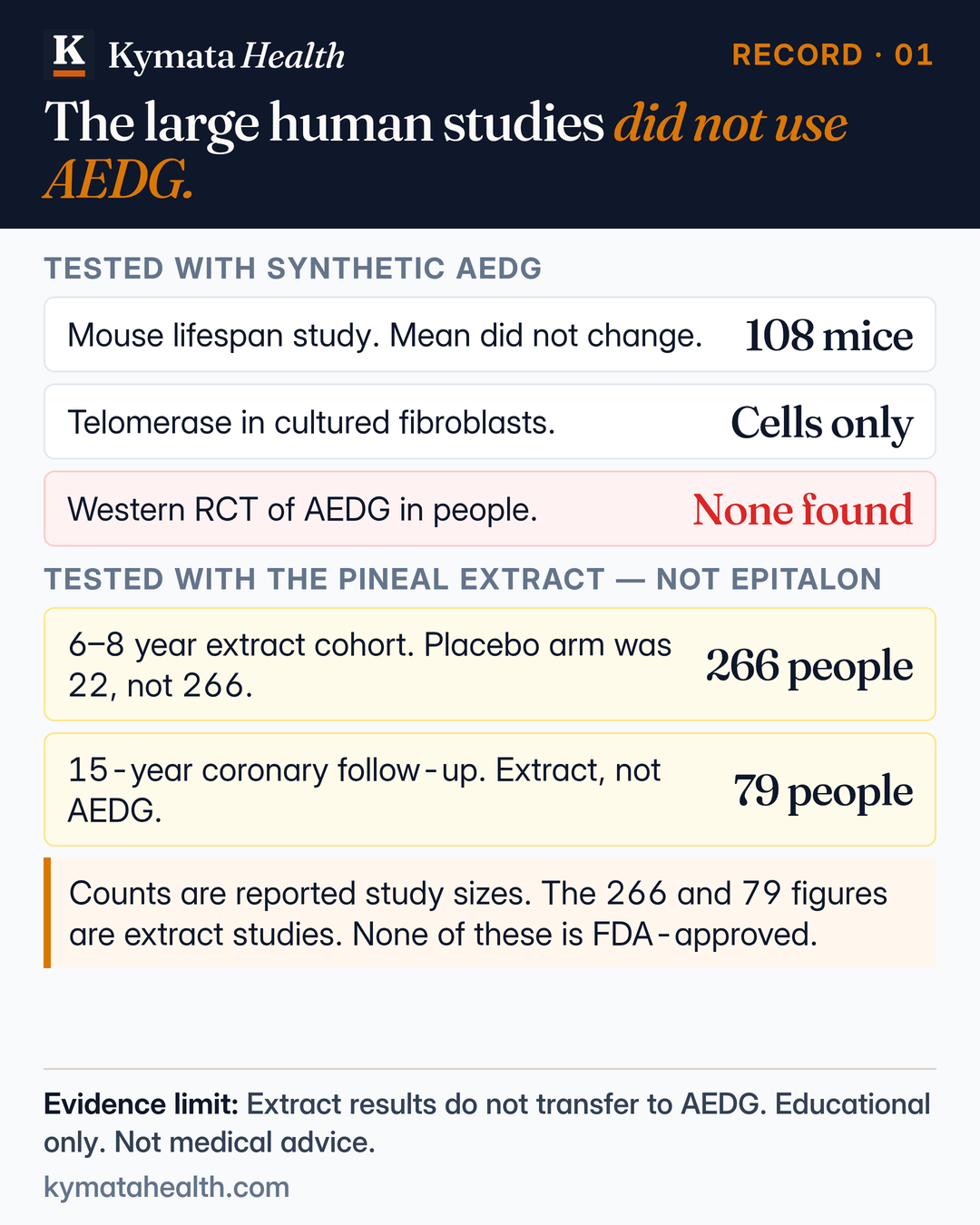
The paper most often stretched to cover Epitalon is Khavinson and Morozov, 2003, “Peptides of pineal gland and thymus prolong human life” (PMID 14523363). It describes 266 older adults followed for 6 to 8 years at the St. Petersburg Institute of Bioregulation and Gerontology and the Institute of Gerontology in Kiev.
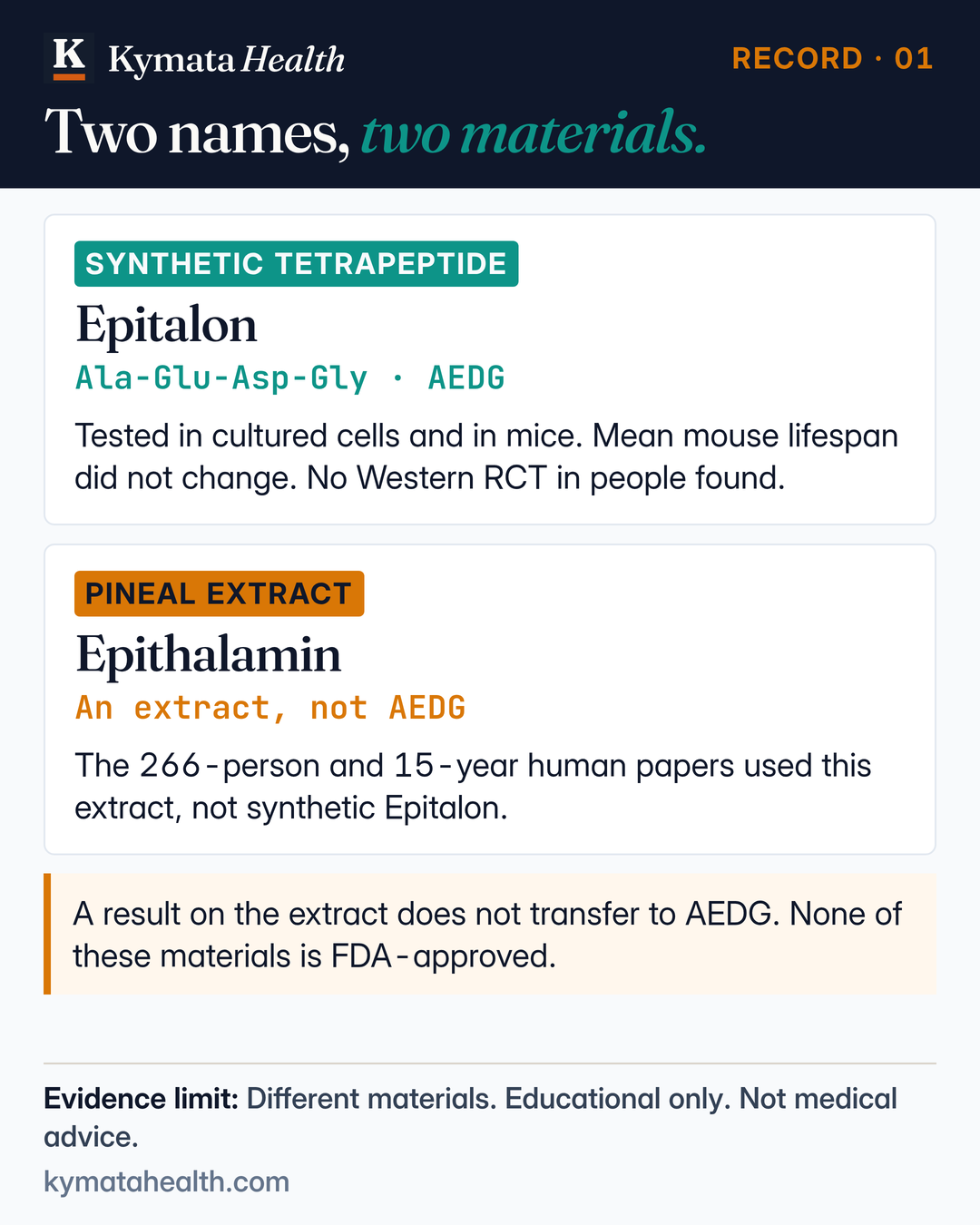
The materials were Thymalin, a thymic extract, and Epithalamin, a pineal extract. Synthetic AEDG is not the intervention.
The abstract reports large reductions in mortality versus control: 2.0- to 2.1-fold in the Thymalin group, 1.6- to 1.8-fold in the Epithalamin group, 2.5-fold with both, and 4.1-fold in a separate group treated annually for six years. The abstract does not give arm sizes, confidence intervals, or a full account of allocation and blinding.
The full text is more specific, and more limited, than the lead number “266” suggests. In the St. Petersburg cohort, 94 women were assigned by stratification randomization to placebo, Thymalin, Epithalamin, or both; the report describes the trial as double-blind. The placebo arm was 22 people; the treated arms in that mortality comparison were 24 people each. A separate group of 20 people received both extracts annually for six years. That annual group sits outside the main four-arm randomization, and it is the group behind the 4.1-fold figure. In the Kiev cohort of 152 people, eight-year mortality was reported as 13.6% in controls versus 6.6% on Thymalin and 8.5% on Epithalamin.
Even if one takes the full text on its own terms, several limits remain. The mortality contrasts in St. Petersburg rest on small arms, not on 266 evenly divided people. The effects are ratios of crude percentages, without confidence intervals in the abstract and without an independent replication in PubMed. The work was run by developer-linked institutes. And, for the present purpose, the decisive point is simpler: the preparation was Epithalamin, not Epitalon.