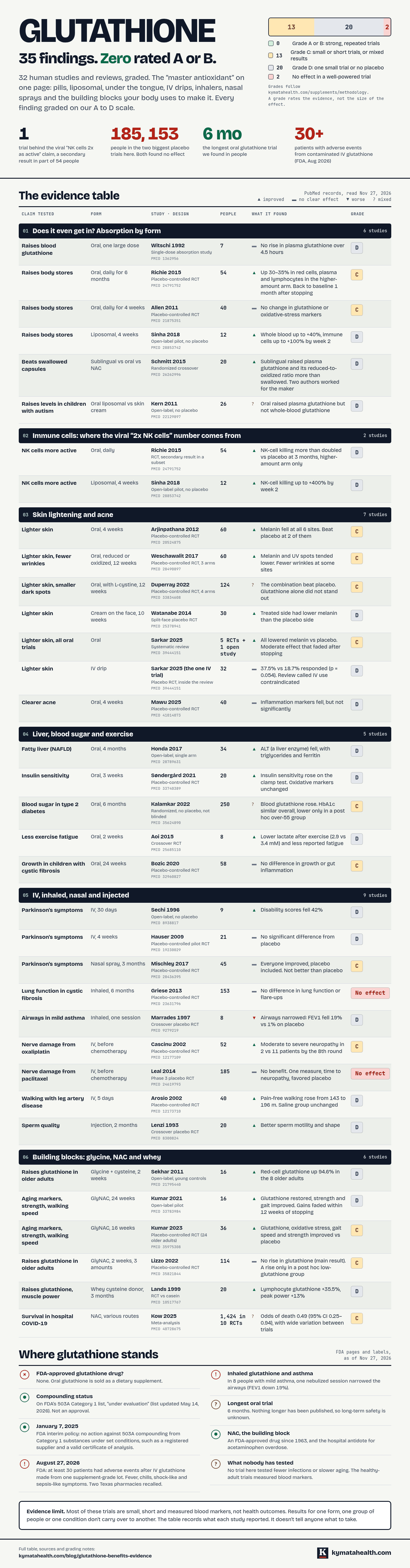
Evidence limit: This page covers 32 human studies and reviews we could check in PubMed (35 graded findings, since three papers answer two questions each), plus FDA records. Most of the studies are small and short, and many measured blood markers rather than health outcomes. A result for one form (a capsule, a drip, an inhaler), one group of people or one condition does not carry over to another. Nothing here is a study of long-term use beyond six months. The table records what each study reported. It does not tell anyone what to take.

Glutathione Benefits: 32 Human Studies, Graded
We graded 35 findings from 32 human studies of glutathione: pills, liposomal, IV, inhaled, NAC and GlyNAC. What holds up and where the research is thin.
Quick answer
Glutathione has real but thin human evidence. Of 35 findings from 32 human studies and reviews we graded, none reaches our A or B grade. Daily oral glutathione raised blood levels in a 6-month trial (PMID 24791752) but not in a 4-week one (PMID 21875351). Small oral trials lowered skin melanin modestly, and the effect faded after stopping (PMID 39444151). The two largest placebo-controlled trials, of inhaled and IV glutathione, found no effect (PMIDs 23631796, 24619793).
Researched and written by Kymata Health EditorialSources cited inlineHow we checkReport an error
We graded 35 findings from 32 human studies of glutathione: pills, liposomal, IV, inhaled, NAC and GlyNAC. What holds up and where the research is thin.
Evidence limit
Trial FinderRecruiting now: 12 open registrations for glutathione
At a glance
Compounds
The short answer
Glutathione is a small molecule your cells make from three amino acids: glutamate, cysteine and glycine. It is one of the body’s main antioxidants, and the liver uses it to process many drugs and toxins. None of that is in doubt. The open question is whether taking it, in a pill, a drip or a spray, changes anything you can measure in a healthy person.
- The grades: of 35 findings, none reaches grade A or B on our scale. 13 are grade C, 20 are grade D, and 2 are well-powered trials that found no effect.
- Absorption is not settled. A 6-month placebo trial found blood and cell levels rose 30 to 35% (PMID: 24791752). A 4-week trial found no change (PMID: 21875351). One large single dose did not raise plasma levels at all (PMID: 1362956).
- Skin lightening has the most trials. Five randomized trials of oral glutathione lowered skin melanin compared with placebo, by a moderate amount that faded after stopping (PMID: 39444151).
- The biggest trials were null. Inhaled glutathione in 153 people with cystic fibrosis and IV glutathione in 185 people on chemotherapy both found no benefit over placebo (PMID: 23631796, PMID: 24619793).
- IV drips carry their own risks. In August 2026 the FDA linked at least 30 patients’ adverse events to IV glutathione made from a supplement-grade ingredient (FDA).
- The building blocks are the most interesting lead. Glycine plus NAC (GlyNAC) raised glutathione and improved strength and walking speed in one 24-person placebo trial in older adults (PMID: 35975308). A larger 2-week trial did not raise glutathione (PMID: 35821844).
Where the “NK cells twice as active” number comes from
A widely shared post in November 2026 listed glutathione’s benefits and gave one number: natural killer (NK) cells, the immune cells that attack infected cells, “over 2x as active vs placebo after 3 months.” That number is real. It is worth knowing exactly what it is.
It comes from a 2015 trial at Penn State. 54 healthy non-smoking adults took oral glutathione or a placebo every day for six months. The main question was whether glutathione levels in the body went up, and they did. Immune markers were a secondary question, measured in a subset of the volunteers. In that subset, NK-cell killing activity was more than twice as high as placebo at three months, in the higher-amount group only (Richie and colleagues, European Journal of Nutrition, PMID: 24791752).
A 2018 pilot from the same research group gave liposomal glutathione to 12 people with no placebo group. NK-cell activity rose by up to 400% by week two (Sinha and colleagues, PMID: 28853742).
So here is the honest version. NK cells did look more active in a test tube, in two small studies by one group. Neither study measured whether anyone caught fewer colds or infections. A lab measure of immune cells is a reason to run a bigger trial. It is not yet evidence of better immunity.
Every human study, graded
Every row is one finding from a human study or review we read. Three papers appear twice because they answered two questions. The grade is for that study’s claim, on our A to D scale: C means small or short trials, or mixed results. D means a single small trial or no placebo group. No effect means a well-powered trial found no benefit. A grade rates how strong the evidence is, not how big the effect was.
| Claim tested | Form | Study | People | Design | What it found | Grade |
|---|---|---|---|---|---|---|
| Raises blood glutathione | Oral, one large dose | Witschi 1992, PMID: 1362956 | 7 | Single-dose absorption study | No clear effect. No rise in plasma glutathione over 4.5 hours | D |
| Raises body stores | Oral, daily for 6 months | Richie 2015, PMID: 24791752 | 54 | Placebo-controlled RCT | Improved. Up 30–35% in red cells, plasma and lymphocytes in the higher-amount arm. Back to baseline 1 month after stopping | C |
| Raises body stores | Oral, daily for 4 weeks | Allen 2011, PMID: 21875351 | 40 | Placebo-controlled RCT | No clear effect. No change in glutathione or oxidative-stress markers | C |
| Raises body stores | Liposomal, 4 weeks | Sinha 2018, PMID: 28853742 | 12 | Open-label pilot, no placebo | Improved. Whole blood up to +40%, immune cells up to +100% by week 2 | D |
| Beats swallowed capsules | Sublingual vs oral vs NAC | Schmitt 2015, PMID: 26262996 | 20 | Randomized crossover | Improved. Sublingual raised plasma glutathione and its reduced-to-oxidized ratio more than swallowed. Two authors worked for the maker | D |
| Raises levels in children with autism | Oral liposomal vs skin cream | Kern 2011, PMID: 22129897 | 26 | Open-label, no placebo | Mixed. Oral raised plasma glutathione but not whole-blood glutathione | D |
| NK cells more active | Oral, daily | Richie 2015, PMID: 24791752 | 54 | RCT, secondary result in a subset | Improved. NK-cell killing more than doubled vs placebo at 3 months, higher-amount arm only | D |
| NK cells more active | Liposomal, 4 weeks | Sinha 2018, PMID: 28853742 | 12 | Open-label pilot, no placebo | Improved. NK-cell killing up to +400% by week 2 | D |
| Lighter skin | Oral, 4 weeks | Arjinpathana 2012, PMID: 20524875 | 60 | Placebo-controlled RCT | Improved. Melanin fell at all 6 sites. Beat placebo at 2 of them | C |
| Lighter skin, fewer wrinkles | Oral, reduced or oxidized, 12 weeks | Weschawalit 2017, PMID: 28490897 | 60 | Placebo-controlled RCT, 3 arms | Improved. Melanin and UV spots tended lower. Fewer wrinkles at some sites | C |
| Lighter skin, smaller dark spots | Oral, with L-cystine, 12 weeks | Duperray 2022, PMID: 33834608 | 124 | Placebo-controlled RCT, 4 arms | Mixed. The combination beat placebo. Glutathione alone did not stand out | C |
| Lighter skin | Cream on the face, 10 weeks | Watanabe 2014, PMID: 25378941 | 30 | Split-face placebo RCT | Improved. Treated side had lower melanin than the placebo side | D |
| Lighter skin, all oral trials | Oral | Sarkar 2025, PMID: 39444151 | 5 RCTs + 1 open study | Systematic review | Improved. All lowered melanin vs placebo. Moderate effect that faded after stopping | C |
| Lighter skin | IV drip | Sarkar 2025 (the one IV trial), PMID: 39444151 | 32 | Placebo RCT, inside the review | No clear effect. 37.5% vs 18.7% responded (p = 0.054). Review called IV use contraindicated | D |
| Clearer acne | Oral, 4 weeks | Mawu 2025, PMID: 41014073 | 40 | Placebo-controlled RCT | No clear effect. Inflammation markers fell, but not significantly | D |
| Fatty liver (NAFLD) | Oral, 4 months | Honda 2017, PMID: 28789631 | 34 | Open-label, single arm | Improved. ALT (a liver enzyme) fell, with triglycerides and ferritin | D |
| Insulin sensitivity | Oral, 3 weeks | Søndergård 2021, PMID: 33740389 | 20 | Placebo-controlled RCT | Improved. Insulin sensitivity rose on the clamp test. Oxidative markers unchanged | D |
| Blood sugar in type 2 diabetes | Oral, 6 months | Kalamkar 2022, PMID: 35624890 | 250 | Randomized, no placebo, not blinded | Mixed. Blood glutathione rose. HbA1c similar overall, lower only in a post hoc over-55 group | C |
| Less exercise fatigue | Oral, 2 weeks | Aoi 2015, PMID: 25685110 | 8 | Crossover RCT | Improved. Lower lactate after exercise (2.9 vs 3.4 mM) and less reported fatigue | D |
| Growth in children with cystic fibrosis | Oral, 24 weeks | Bozic 2020, PMID: 32960827 | 58 | Placebo-controlled RCT | No clear effect. No difference in growth or gut inflammation | C |
| Parkinson's symptoms | IV, 30 days | Sechi 1996, PMID: 8938817 | 9 | Open-label, no placebo | Improved. Disability scores fell 42% | D |
| Parkinson's symptoms | IV, 4 weeks | Hauser 2009, PMID: 19230029 | 21 | Placebo-controlled pilot RCT | No clear effect. No significant difference from placebo | D |
| Parkinson's symptoms | Nasal spray, 3 months | Mischley 2017, PMID: 28436395 | 45 | Placebo-controlled RCT | No clear effect. Everyone improved, placebo included. Not better than placebo | C |
| Lung function in cystic fibrosis | Inhaled, 6 months | Griese 2013, PMID: 23631796 | 153 | Placebo-controlled RCT | No clear effect. No difference in lung function or flare-ups | No effect |
| Airways in mild asthma | Inhaled, one session | Marrades 1997, PMID: 9279219 | 8 | Crossover placebo RCT | Worse. Airways narrowed: FEV1 fell 19% vs 1% on placebo | D |
| Nerve damage from oxaliplatin | IV, before chemotherapy | Cascinu 2002, PMID: 12177109 | 52 | Placebo-controlled RCT | Improved. Moderate to severe neuropathy in 2 vs 11 patients by the 8th round | C |
| Nerve damage from paclitaxel | IV, before chemotherapy | Leal 2014, PMID: 24619793 | 185 | Phase 3 placebo RCT | No clear effect. No benefit. One measure, time to neuropathy, favored placebo | No effect |
| Walking with leg artery disease | IV, 5 days | Arosio 2002, PMID: 12173710 | 40 | Placebo-controlled RCT | Improved. Pain-free walking rose from 143 to 196 m. Saline group unchanged | D |
| Sperm quality | Injection, 2 months | Lenzi 1993, PMID: 8300824 | 20 | Crossover placebo RCT | Improved. Better sperm motility and shape | D |
| Raises glutathione in older adults | Glycine + cysteine, 2 weeks | Sekhar 2011, PMID: 21795440 | 16 | Open-label, young controls | Improved. Red-cell glutathione up 94.6% in the 8 older adults | D |
| Aging markers, strength, walking speed | GlyNAC, 24 weeks | Kumar 2021, PMID: 33783984 | 16 | Open-label pilot | Improved. Glutathione restored, strength and gait improved. Gains faded within 12 weeks of stopping | D |
| Aging markers, strength, walking speed | GlyNAC, 16 weeks | Kumar 2023, PMID: 35975308 | 36 | Placebo-controlled RCT (24 older adults) | Improved. Glutathione, oxidative stress, gait speed and strength improved vs placebo | C |
| Raises glutathione in older adults | GlyNAC, 2 weeks, 3 amounts | Lizzo 2022, PMID: 35821844 | 114 | Placebo-controlled RCT | No clear effect. No rise in glutathione (main result). A rise only in a post hoc low-glutathione group | C |
| Raises glutathione, muscle power | Whey cysteine donor, 3 months | Lands 1999, PMID: 10517767 | 20 | RCT vs casein | Improved. Lymphocyte glutathione +35.5%, peak power +13% | D |
| Survival in hospital COVID-19 | NAC, various routes | Kow 2025, PMID: 40728675 | 1,424 in 10 RCTs | Meta-analysis | Mixed. Odds of death 0.49 (95% CI 0.25–0.94), with wide variation between trials | C |
Two things jump out. First, most of the positive rows are small: 20 people, 12 people, 8 people. Second, the open-label studies (no placebo group) look much better than the placebo-controlled ones on the same question. The Parkinson’s rows show it plainly. Nine people given IV glutathione with no placebo group improved by 42% (PMID: 8938817). When 21 people were randomized against a placebo, the difference disappeared (PMID: 19230029).
Glutathione
35 findings. Zero rated A or B.
32 human studies and reviews, graded
- A0
- two or more agreeing trials, 300+ people
- B0
- one well-powered trial, or a consistent set
- C13
- small or short trials, or mixed results
- D20
- one small trial, or no placebo group
- No effect2
- a well-powered trial found no benefit
FormFindings by grade
Oral8 × C7 × D
Liposomal2 × D
Under the tongue1 × D
Skin cream1 × D
IV1 × C4 × D1 × No effect
Nasal spray1 × C
Inhaled1 × D1 × No effect
Injection1 × D
Building blocks3 × C3 × D
Sources: the 32 PubMed records in the table above, read November 27, 2026. Grades follow our supplement methodology. A grade rates how strong the evidence is, not how big the effect was.
Does oral glutathione even get absorbed?
This is the oldest argument about glutathione, and the short answer is: sometimes, slowly, and not by much.
The gut and liver break glutathione down with an enzyme called gamma-glutamyltransferase. In 1992, seven volunteers took one large dose and their plasma glutathione did not rise over the next four and a half hours. The authors concluded a single dose could not raise circulating levels in a useful way (PMID: 1362956).
Daily use over months looks different. In the 6-month Penn State trial, levels rose 30 to 35% in red cells, plasma and lymphocytes and 260% in cheek cells in the higher-amount group, then fell back to baseline within a month of stopping (PMID: 24791752). A 4-week Bastyr University trial in 40 adults found no change in glutathione or in oxidative-stress markers (PMID: 21875351). Our reading: time may matter, and so may how levels are measured. Two trials pointing in different directions is a grade C, not a verdict.
Here is how the other forms compare, by what has actually been tested:
- Liposomal (glutathione wrapped in fat bubbles): one 12-person pilot with no placebo found levels rose within one to two weeks (PMID: 28853742). There is no head-to-head trial against plain capsules.
- Under the tongue: one 20-person crossover in adults with metabolic syndrome found sublingual glutathione raised plasma levels more than swallowed glutathione or NAC. Two of the authors worked for the company that made the sublingual product (PMID: 26262996).
- Skin creams: in children with autism, an open-label trial found a transdermal cream did not raise plasma glutathione, while oral liposomal glutathione raised plasma but not whole-blood levels (PMID: 22129897).
- IV: reaches the blood directly. That solves absorption, but it does not show the extra glutathione gets into cells or changes outcomes. The IV trials below are the test of that.
- Building blocks: the body makes glutathione inside cells, and cysteine is usually the limiting ingredient. That is why researchers test NAC, glycine and whey. More on that below.
Skin lightening: real, modest, and it fades
Skin lightening is the use with the most randomized trials, mostly from Thailand and other Asian countries. Glutathione appears to push pigment cells toward a lighter form of melanin.
A 2024 systematic review in the International Journal of Dermatology found five randomized trials and one open study of oral glutathione. All of them lowered the skin melanin index compared with placebo (PMID: 39444151). The reviewers called the effect moderate and “unsustainable”: it faded once people stopped.
Individual trials show how modest it is. In 60 Bangkok medical students over four weeks, melanin dropped at all six skin sites measured, but beat placebo at only two of them (PMID: 20524875). In 124 women over 12 weeks, glutathione combined with L-cystine beat placebo, while glutathione alone did not stand out (PMID: 33834608). A 10-week split-face trial of an oxidized glutathione lotion found the treated side lighter than the placebo side (PMID: 25378941).
IV glutathione for skin is a different story. The same review found only one placebo-controlled IV trial: 37.5% of people on glutathione responded compared with 18.7% on placebo, which missed statistical significance (p = 0.054). The reviewers concluded that IV glutathione is “contraindicated due to lack of efficacy and side effects” (PMID: 39444151). A 2026 review added that many clinics give it with vitamin C, which makes its own effect hard to separate, and flagged liver, allergy, kidney and hormone concerns (PMID: 42751591).
For acne, one 40-person trial found inflammation markers fell, but not significantly (PMID: 41014073).
Our separate guide on glutathione injections compared with oral glutathione goes deeper on the skin trials.
Liver, blood sugar and aging
“Supports liver detox” is the most repeated glutathione claim. The liver does use glutathione to process drugs and toxins. Whether a supplement adds to that is a separate question, and it has barely been tested.
- Fatty liver: a Japanese pilot gave oral glutathione to 34 people with non-alcoholic fatty liver disease for four months, after three months of diet and exercise advice. ALT, a liver enzyme, fell, along with triglycerides and ferritin. There was no placebo group, and 29 people finished (PMID: 28789631). The authors called for larger trials. We did not find a placebo-controlled trial of oral glutathione for fatty liver on PubMed.
- Insulin sensitivity: a Danish trial in 20 men with obesity found insulin sensitivity rose after three weeks on the gold-standard clamp test, while oxidative-stress markers did not change (PMID: 33740389).
- Type 2 diabetes: an Indian trial added glutathione to diabetes medicines in 250 people for six months. Blood glutathione rose. HbA1c was similar overall and lower only in a subgroup over 55 that was analyzed after the fact. There was no placebo and no blinding (PMID: 35624890).
- Exercise: in 8 men, two weeks of glutathione lowered lactate after an hour of cycling and people reported less fatigue (PMID: 25685110).
- Children with cystic fibrosis: a 58-child placebo trial found no difference in growth or gut inflammation after 24 weeks (PMID: 32960827).
On aging, there is no trial of glutathione itself that measured how people age. The aging trials are of its building blocks, covered next.
Building blocks: NAC, glycine and whey
Instead of swallowing glutathione and hoping it survives digestion, you can supply the raw materials and let cells build it. This is the most active area of glutathione research.
The idea comes from Baylor College of Medicine. In 2011, eight older adults had about half the red-cell glutathione of eight younger adults. After two weeks of glycine and cysteine, their glutathione rose 94.6% and their oxidative-stress markers fell to the younger group’s level (PMID: 21795440). An open 24-week pilot of GlyNAC (glycine plus NAC) in eight older adults reported better strength, walking speed and several aging markers, which faded within 12 weeks of stopping (PMID: 33783984).
Then came a placebo trial. 24 older adults took GlyNAC or a placebo for 16 weeks. GlyNAC, not placebo, improved glutathione, oxidative stress, gait speed and strength (Kumar and colleagues, PMID: 35975308). That is the strongest result on this page, and it is still 12 people per group from one research team.
A Nestlé-led trial tested GlyNAC at three amounts in 114 healthy older adults for two weeks. It did not raise glutathione, its main goal. A rise showed up only in a subgroup with low glutathione and high oxidative stress at the start (PMID: 35821844). Shorter, healthier, different team: the two results do not cancel out, but they do say GlyNAC is not proven.
Whey protein is rich in cysteine. In a 1999 trial, 18 young adults finished three months of a whey-based cysteine donor or a casein placebo. Lymphocyte glutathione rose 35.5% and peak cycling power rose 13% in the whey group (PMID: 10517767).
NAC itself is an FDA-approved drug, first approved in 1963 (FDA). In hospitals it is the antidote for acetaminophen overdose, given to protect the liver (Acetadote label). A 2025 meta-analysis of 10 randomized trials in 1,424 hospital patients with COVID-19 found lower odds of death with NAC, with wide differences between trials (PMID: 40728675).
More on these: GlyNAC, NAC and our article on what the GlyNAC trials measured.
IV drips, nasal sprays and inhalers
The non-oral forms have the biggest and best-controlled trials of glutathione itself, and most of them came back empty.
- Chemotherapy nerve damage: a 52-person Italian trial found IV glutathione before oxaliplatin cut moderate to severe neuropathy (2 patients compared with 11 by the eighth round) without weakening the chemotherapy (PMID: 12177109). A 185-person US phase 3 trial with paclitaxel and carboplatin found no benefit, and one measure, time to neuropathy, favored placebo (PMID: 24619793). Different drugs, so both can be true. The bigger trial is the more reliable one for its own question.
- Parkinson’s disease: IV glutathione looked strong in a 9-person open study (PMID: 8938817) and showed no significant difference in a 21-person placebo trial (PMID: 19230029). A nasal spray trial in 45 people found everyone improved, placebo included, and glutathione was not better. One person on the higher amount developed cardiomyopathy (PMID: 28436395).
- Cystic fibrosis: 153 people inhaled glutathione or placebo twice a day for six months. Glutathione reached the lungs, but lung function, flare-ups and quality of life did not improve (PMID: 23631796).
- Asthma: in eight people with mild asthma, one nebulized session narrowed the airways, with FEV1 falling 19% compared with 1% on placebo. Cough and breathlessness followed. The authors pointed to sulfite formation (PMID: 9279219).
- Leg artery disease: 40 people had five days of IV glutathione or saline. Pain-free walking rose from 143 to 196 meters in the glutathione group (PMID: 12173710).
- Male fertility: a 20-man crossover trial of glutathione injections reported better sperm motility and shape (PMID: 8300824).
For IV drips sold for energy and wellness, see our comparison of NAD+ and glutathione IV drips.
What the FDA has said, 2019 to 2026
There is no FDA-approved glutathione drug. Oral glutathione is sold as a dietary supplement, which does not need FDA review before sale. Injectable glutathione in the US comes from compounding pharmacies.
- Compounding status: glutathione sits on FDA’s 503A “Category 1” list of bulk substances under evaluation, in the version updated May 14, 2026 (FDA list). That is not an approval. It means FDA has not yet decided whether pharmacies may compound with it.
- January 7, 2025: FDA’s interim policy said it does not intend to take action against 503A pharmacies compounding with Category 1 substances, under conditions that include an FDA-registered supplier and a valid certificate of analysis (FDA guidance).
- August 27, 2026: FDA reported at least 30 patients with adverse events after IV glutathione, alone or mixed with other ingredients. Several pharmacies had made it from one lot labeled dietary supplement grade, which is not suitable for injection. Reactions included fever, chills, signs of shock and sepsis-like symptoms consistent with endotoxin, and some people were hospitalized. Two Texas pharmacies recalled their glutathione injectables. FDA noted it had raised the same concern in 2019 (FDA alert).
FDA’s own advice in that alert was for clinicians to check which pharmacy compounded the glutathione and where its ingredient came from.
Safety: what the trials recorded
Across the oral trials in the table, glutathione was reported as well tolerated, including a 24-week trial in young children (PMID: 32960827). The longest oral trial we found ran six months (PMID: 24791752). Nothing longer has been published, so long-term safety is unknown.
The clearer signals come from the other routes. Inhaled glutathione narrowed the airways in people with asthma (PMID: 9279219). One person on the higher amount in the nasal spray trial developed cardiomyopathy (PMID: 28436395). Contaminated IV glutathione caused the 2026 adverse-event cluster above. Reviews of IV glutathione for skin list liver, allergic, kidney and hormone concerns (PMID: 42751591).
One more limit: none of these trials was big enough to catch rare side effects.
Where the research is thin
If you want to know what has not been tested, this is the list:
- No trial has tested whether glutathione in any form reduces infections, even though immune claims are the most common.
- No trial of glutathione itself has measured aging outcomes. The aging signal is from GlyNAC, in two small studies from one group.
- No placebo-controlled trial has tested “liver detox” in healthy people. The fatty-liver data are one open pilot.
- No head-to-head trial compares liposomal, sublingual and plain capsules on the same outcome.
- Many of the studies were run or funded by teams with a stake in the result: a product maker’s employees on the sublingual trial, a single lab behind most GlyNAC work. That does not make the results wrong. It is why independent replication matters.
The pattern on this page is common for supplements. Small, short, positive studies come first, and larger placebo trials often shrink the effect. Glutathione has had a handful of those larger trials, and most of them came back null.
How we graded these studies
We used the same scale as our supplement encyclopedia. Grade A: at least two agreeing randomized trials, or a meta-analysis, with 300 or more people. Grade B: at least one adequately powered randomized trial, or a consistent set of smaller ones. Grade C: small or short randomized trials, or mixed results. Grade D: a single small trial, or human data without a control group. No effect: adequately powered trials that found no benefit.
Each row is graded for its own claim, not for glutathione as a whole. We read every abstract on PubMed on November 27, 2026, and the full text where the abstract left out a number we report. For the compound’s full profile, see our glutathione supplement page.
Questions
Does oral glutathione actually get absorbed?
The trials disagree. One large single dose did not raise plasma levels (PMID: 1362956). Six months of daily use raised blood and cell levels 30 to 35% (PMID: 24791752), while four weeks did not (PMID: 21875351).
Is liposomal glutathione better absorbed than regular capsules?
No trial has compared them head to head. One 12-person liposomal pilot with no placebo found blood levels rose within two weeks (PMID: 28853742).
Does glutathione really make NK cells twice as active?
In one 54-person placebo trial, NK-cell activity was more than twice as high as placebo at three months, in a subset of volunteers in the higher-amount group (PMID: 24791752). No trial has tested whether that means fewer infections.
Does glutathione lighten skin?
Five small randomized trials of oral glutathione lowered skin melanin compared with placebo. A 2024 review called the effect moderate and said it faded after stopping (PMID: 39444151).
Do glutathione IV drips work for skin?
Only one placebo-controlled IV trial exists, and it narrowly missed significance. The review that found it called IV glutathione contraindicated for skin lightening (PMID: 39444151).
Is IV glutathione FDA-approved?
No. There is no FDA-approved glutathione drug. Glutathione is on FDA’s list of compounding substances still under evaluation, and in August 2026 FDA linked at least 30 adverse events to IV glutathione made from a supplement-grade ingredient.
Is NAC the same as glutathione?
No. NAC supplies cysteine, the building block cells usually run short of when making glutathione. NAC has been an FDA-approved drug since 1963 and is the hospital antidote for acetaminophen overdose.
What did the GlyNAC trials find?
In 24 older adults, 16 weeks of glycine plus NAC improved glutathione, strength and walking speed compared with placebo (PMID: 35975308). A 114-person, 2-week trial did not raise glutathione (PMID: 35821844).
Does glutathione help fatty liver?
One open pilot in 34 people found the liver enzyme ALT fell after four months, with no placebo group (PMID: 28789631). No placebo-controlled trial has followed.
Why is glutathione called the master antioxidant?
Because cells make a lot of it and it recycles other antioxidants. That describes what it does inside the body. It is not evidence that a supplement adds to it.
Medical disclaimer: This article describes what published studies and FDA records report. It is not a recommendation to start, stop or use any supplement or treatment, and it does not replace care from a licensed clinician who knows your history.
Share this article
References
- 1The systemic availability of oral glutathioneWitschi A, Reddy S, Stofer B, et al., Eur J Clin Pharmacol 1992 · PMID: 1362956 · DOI: 10.1007/BF02284971
- 2Randomized controlled trial of oral glutathione supplementation on body stores of glutathioneRichie JP Jr, Nichenametla S, Neidig W, et al., Eur J Nutr 2015 · PMID: 24791752 · DOI: 10.1007/s00394-014-0706-z
- 3Effects of oral glutathione supplementation on systemic oxidative stress biomarkers in human volunteersAllen J, Bradley RD, J Altern Complement Med 2011 · PMID: 21875351 · DOI: 10.1089/acm.2010.0716
- 4Oral supplementation with liposomal glutathione elevates body stores of glutathione and markers of immune functionSinha R, Sinha I, Calcagnotto A, et al., Eur J Clin Nutr 2018 · PMID: 28853742 · DOI: 10.1038/ejcn.2017.132
- 5Effects of N-acetylcysteine, oral glutathione (GSH) and a novel sublingual form of GSH on oxidative stress markers: A comparative crossover studySchmitt B, Vicenzi M, Garrel C, et al., Redox Biol 2015 · PMID: 26262996 · DOI: 10.1016/j.redox.2015.07.012
- 6A clinical trial of glutathione supplementation in autism spectrum disordersKern JK, Geier DA, Adams JB, et al., Med Sci Monit 2011 · PMID: 22129897 · DOI: 10.12659/msm.882125
- 7Glutathione as an oral whitening agent: a randomized, double-blind, placebo-controlled studyArjinpathana N, Asawanonda P, J Dermatolog Treat 2012 · PMID: 20524875 · DOI: 10.3109/09546631003801619
- 8Glutathione and its antiaging and antimelanogenic effectsWeschawalit S, Thongthip S, Phutrakool P, et al., Clin Cosmet Investig Dermatol 2017 · PMID: 28490897 · DOI: 10.2147/CCID.S128339
- 9The effects of the oral supplementation of L-Cystine associated with reduced L-Glutathione-GSH on human skin pigmentation: a randomized, double-blinded, benchmark- and placebo-controlled clinical trialDuperray J, Sergheraert R, Chalothorn K, et al., J Cosmet Dermatol 2022 · PMID: 33834608 · DOI: 10.1111/jocd.14137
- 10Skin-whitening and skin-condition-improving effects of topical oxidized glutathione: a double-blind and placebo-controlled clinical trial in healthy womenWatanabe F, Hashizume E, Chan GP, et al., Clin Cosmet Investig Dermatol 2014 · PMID: 25378941 · DOI: 10.2147/CCID.S68424
- 11Glutathione as a skin-lightening agent and in melasma: a systematic reviewSarkar R, Yadav V, Yadav T, et al., Int J Dermatol 2025 · PMID: 39444151 · DOI: 10.1111/ijd.17535
- 12Effectiveness of oral glutathione in reducing nitric oxide and IL-1α concentrations for clinical improvement in mild to moderate acne vulgaris: a randomized controlled trialMawu FO, Anwar AI, Djawad K, et al., Acta Dermatovenerol Alp Pannonica Adriat 2025 · PMID: 41014073
- 13Efficacy of glutathione for the treatment of nonalcoholic fatty liver disease: an open-label, single-arm, multicenter, pilot studyHonda Y, Kessoku T, Sumida Y, et al., BMC Gastroenterol 2017 · PMID: 28789631 · DOI: 10.1186/s12876-017-0652-3
- 14The effects of 3 weeks of oral glutathione supplementation on whole body insulin sensitivity in obese males with and without type 2 diabetes: a randomized trialSøndergård SD, Cintin I, Kuhlman AB, et al., Appl Physiol Nutr Metab 2021 · PMID: 33740389 · DOI: 10.1139/apnm-2020-1099
- 15Randomized Clinical Trial of How Long-Term Glutathione Supplementation Offers Protection from Oxidative Damage and Improves HbA1c in Elderly Type 2 Diabetic PatientsKalamkar S, Acharya J, Kolappurath Madathil A, et al., Antioxidants (Basel) 2022 · PMID: 35624890 · DOI: 10.3390/antiox11051026
- 16Glutathione supplementation suppresses muscle fatigue induced by prolonged exercise via improved aerobic metabolismAoi W, Ogaya Y, Takami M, et al., J Int Soc Sports Nutr 2015 · PMID: 25685110 · DOI: 10.1186/s12970-015-0067-x
- 17Oral Glutathione and Growth in Cystic Fibrosis: A Multicenter, Randomized, Placebo-controlled, Double-blind TrialBozic M, Goss CH, Tirouvanziam RM, et al., J Pediatr Gastroenterol Nutr 2020 · PMID: 32960827 · DOI: 10.1097/MPG.0000000000002948
- 18Reduced intravenous glutathione in the treatment of early Parkinson's diseaseSechi G, Deledda MG, Bua G, et al., Prog Neuropsychopharmacol Biol Psychiatry 1996 · PMID: 8938817 · DOI: 10.1016/s0278-5846(96)00103-0
- 19Randomized, double-blind, pilot evaluation of intravenous glutathione in Parkinson's diseaseHauser RA, Lyons KE, McClain T, et al., Mov Disord 2009 · PMID: 19230029 · DOI: 10.1002/mds.22401
- 20Phase IIb Study of Intranasal Glutathione in Parkinson's DiseaseMischley LK, Lau RC, Shankland EG, et al., J Parkinsons Dis 2017 · PMID: 28436395 · DOI: 10.3233/JPD-161040
- 21Inhalation treatment with glutathione in patients with cystic fibrosis. A randomized clinical trialGriese M, Kappler M, Eismann C, et al., Am J Respir Crit Care Med 2013 · PMID: 23631796 · DOI: 10.1164/rccm.201303-0427OC
- 22Nebulized glutathione induces bronchoconstriction in patients with mild asthmaMarrades RM, Roca J, Barberà JA, et al., Am J Respir Crit Care Med 1997 · PMID: 9279219 · DOI: 10.1164/ajrccm.156.2.9611001
- 23Neuroprotective effect of reduced glutathione on oxaliplatin-based chemotherapy in advanced colorectal cancer: a randomized, double-blind, placebo-controlled trialCascinu S, Catalano V, Cordella L, et al., J Clin Oncol 2002 · PMID: 12177109 · DOI: 10.1200/JCO.2002.07.061
- 24North Central Cancer Treatment Group/Alliance trial N08CA-the use of glutathione for prevention of paclitaxel/carboplatin-induced peripheral neuropathy: a phase 3 randomized, double-blind, placebo-controlled studyLeal AD, Qin R, Atherton PJ, et al., Cancer 2014 · PMID: 24619793 · DOI: 10.1002/cncr.28654
- 25Effect of glutathione infusion on leg arterial circulation, cutaneous microcirculation, and pain-free walking distance in patients with peripheral obstructive arterial disease: a randomized, double-blind, placebo-controlled trialArosio E, De Marchi S, Zannoni M, et al., Mayo Clin Proc 2002 · PMID: 12173710 · DOI: 10.4065/77.8.754
- 26Placebo-controlled, double-blind, cross-over trial of glutathione therapy in male infertilityLenzi A, Culasso F, Gandini L, et al., Hum Reprod 1993 · PMID: 8300824 · DOI: 10.1093/oxfordjournals.humrep.a137909
- 27Deficient synthesis of glutathione underlies oxidative stress in aging and can be corrected by dietary cysteine and glycine supplementationSekhar RV, Patel SG, Guthikonda AP, et al., Am J Clin Nutr 2011 · PMID: 21795440 · DOI: 10.3945/ajcn.110.003483
- 28Glycine and N-acetylcysteine (GlyNAC) supplementation in older adults improves glutathione deficiency, oxidative stress, mitochondrial dysfunction, inflammation, insulin resistance, endothelial dysfunction, genotoxicity, muscle strength, and cognition: Results of a pilot clinical trialKumar P, Liu C, Hsu JW, et al., Clin Transl Med 2021 · PMID: 33783984 · DOI: 10.1002/ctm2.372
- 29Supplementing Glycine and N-Acetylcysteine (GlyNAC) in Older Adults Improves Glutathione Deficiency, Oxidative Stress, Mitochondrial Dysfunction, Inflammation, Physical Function, and Aging Hallmarks: A Randomized Clinical TrialKumar P, Liu C, Suliburk J, et al., J Gerontol A Biol Sci Med Sci 2023 · PMID: 35975308 · DOI: 10.1093/gerona/glac135
- 30A Randomized Controlled Clinical Trial in Healthy Older Adults to Determine Efficacy of Glycine and N-Acetylcysteine Supplementation on Glutathione Redox Status and Oxidative DamageLizzo G, Migliavacca E, Lamers D, et al., Front Aging 2022 · PMID: 35821844 · DOI: 10.3389/fragi.2022.852569
- 31Effect of supplementation with a cysteine donor on muscular performanceLands LC, Grey VL, Smountas AA, J Appl Physiol (1985) 1999 · PMID: 10517767 · DOI: 10.1152/jappl.1999.87.4.1381
- 32Effect of N-Acetylcysteine on mortality in COVID-19 patients: A systematic review and meta-analysis of randomized controlled trialsKow CS, Ramachandram DS, Hasan SS, et al., Inflammopharmacology 2025 · PMID: 40728675 · DOI: 10.1007/s10787-025-01876-x
- 33Glutathione for skin lightening via intravenous, oral, and topical routes: a critical narrative review of current evidence, safety, and the evidence-practice gapAloraini K, Alangari A, Arif J, et al., J Med Life 2026 · PMID: 42751591 · DOI: 10.25122/jml-2026-0054
- 34FDA reminds compounders not to use dietary supplement grade glutathione for injectablesUS Food and Drug Administration, FDA 2026 · Source
- 35Bulk Drug Substances Nominated for Use in Compounding Under Section 503A of the FD&C Act (updated May 14, 2026)US Food and Drug Administration, FDA 2026 · Source
- 36Interim Policy on Compounding Using Bulk Drug Substances Under Section 503A of the FD&C ActUS Food and Drug Administration, FDA 2025 · Source
- 37Policy Regarding N-acetyl-L-cysteine: Guidance for IndustryUS Food and Drug Administration, FDA 2022 · Source
- 38ACETADOTE (acetylcysteine) injection, US prescribing informationCumberland Pharmaceuticals, DailyMed 2026 · Source
Related

Readers also read


Ask about this article
Answers come from this page and our other evidence pages, with links.
Keep reading: Supplements and vitamins
Previous in this topicHow to read a fish oil label in 60 seconds (and what EPA vs DHA actually changes)Next in this topicCheck an AI answer
- Trial sizeHow often supplement trials find a benefit, by the number of people in them, for every health goal.
- Evidence WatchEvery change to the graded studies on our supplement pages, dated, and what changed for the supplements you saved.
- CBD guide: cannabinoids, testing and the best CBD brandsEvidence-first CBD hub: cannabinoids, spectrum, lab reports, legal status and ranked CBD brands.