
The peptide field guide
Tesofensine
An oral dopamine, norepinephrine and serotonin reuptake inhibitor studied for weight loss; not a peptide or a GLP-1.
Investigational drug. Not FDA-approved.
Explore this compoundConceptual editorial illustration; not a measured molecular structure, product photograph or treatment result.
02 / At a glance
At a glance
Key facts
- Also known as
- NS2330, tesofensine oral
- Type
- Weight Management
- Evidence level
- Investigational drug: not FDA-approved.
- US regulatory status
- Investigational; not FDA-approved
- Updated
Identity
An oral dopamine, norepinephrine and serotonin reuptake inhibitor studied for weight loss; not a peptide or a GLP-1.
Research context
Obesity trials reported weight loss; heart rate, blood pressure, mood and sleep can change.
Evidence limits
Investigational drug. Not FDA-approved.
Read the technical profile and study-use reference
Quick answer
Evidence: ModerateOral triple monoamine reuptake inhibitor (dopamine, norepinephrine, serotonin) studied for obesity. Not a peptide. Not a GLP-1. Not reconstitution math. Sometimes discussed next to incretins as a plateau adjunct. That is pharmacology folklore, not a labeled stack.
- In published studies
- Trial amounts are recorded under What studies used (PMID 18950853)
Research summary, not medical advice.
At a glance
Kymata peptide profile · Oct 29, 2026- Common vials
- N/A (oral)
- Molecular weight
- ~492 Da class
- In published studies
- Trial amounts are recorded under What studies used (PMID 18950853)
- Half-life
- ~9 days (published oral class PK)
03 / Identity and origin
Identity and origin
Also called NS2330, tesofensine oral. Oral obesity research / regional medicine class (not a peptide).
Read the sequence and compound record
Compound card
- Sequence
- Small-molecule triple monoamine reuptake inhibitor (NS2330)
- Class
- Oral obesity research / regional medicine class (not a peptide)
- Formula
- Small molecule (NS2330)
- Molecular weight
- ~492 Da class
- Described by
- NeuroSearch lineage / subsequent sponsors, 2000s obesity programs
- Bioavailability
- Oral
04 / How it may work
How it may work
Oral obesity research / regional medicine class (not a peptide)
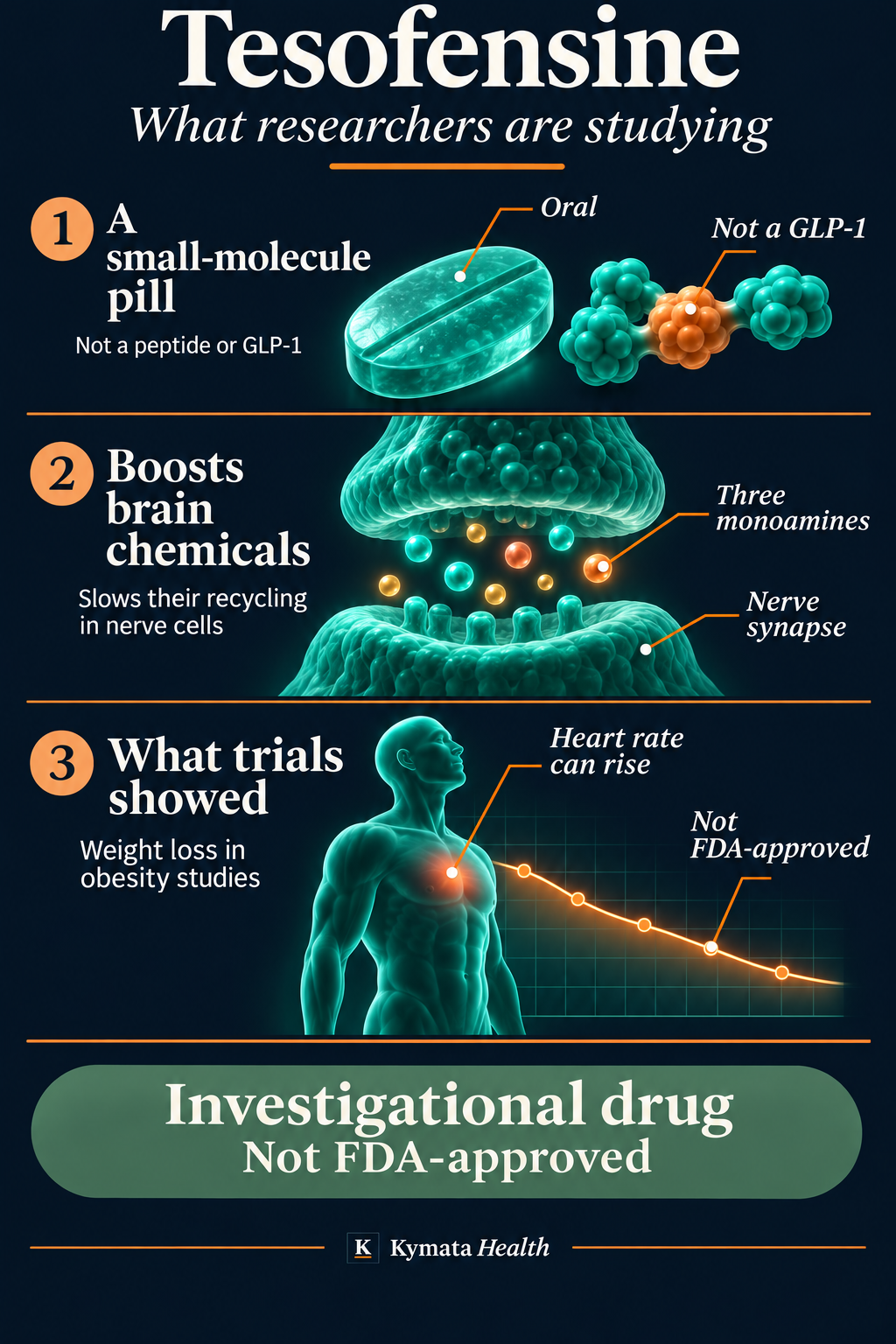
An oral dopamine, norepinephrine and serotonin reuptake inhibitor studied for weight loss; not a peptide or a GLP-1. Obesity trials reported weight loss; heart rate, blood pressure, mood and sleep can change. Investigational drug. Not FDA-approved. The drawing is a schematic, not a measured molecular structure, a product photograph or a treatment result. Illustration review: 19 November 2026, against this page’s own mechanism, evidence and regulatory records.
A sequence model is not provided for this record. Read the identity and evidence notes; an illustration does not verify a molecular structure.
Illustration notes and source record
Read the source record on this page. Laboratory, topical and injected studies are separate evidence; this illustration does not establish an indication or a treatment outcome.

How it works
SourcedTesofensine (NS2330) is an oral inhibitor of dopamine, norepinephrine, and serotonin reuptake studied for weight loss. It is not a GLP-1, not a peptide, and not something you put in the reconstitution calculator.
People search it next to incretins as a “plateau” adjunct. That is a pharmacology conversation, not a labeled stack and not a reason this site invents a combined protocol.
Source: Published tesofensine obesity trial literature; confirm jurisdiction and prescription status
05 / Evidence and limits
Evidence and limits
Use-case scores
0–100–10 against the evidence we have, not a gym ranking. Hidden domains do not apply here.
- Metabolic / weight5/10Human obesity trials exist for the monoamine mechanism. Haircut: not an FDA obesity pen; cardiovascular/psychiatric class cautions; not a peptide.
Limits of current evidence
3 limits- Not a peptide. Calculator math does not apply.
- Monoamine agents carry cardiovascular and psychiatric monitoring stories. This page is not a prescribing guide.
- Stacking folklore with tirzepatide is not a labeled protocol on this site.
What it is studied for
- Weight (oral non-peptide): Moderate
- Peptide reconstitution: Low
Verdict
Tesofensine is an oral monoamine reuptake obesity molecule, not a peptide and not a GLP-1. This is a reference page. It is taken by mouth, so there is no reconstitution arithmetic, and it has no labeled incretin combination.
06 / Product forms and access
Product forms and access
Regulatory & legal status
- FDA status (US)
- InvestigationalInvestigational; not FDA-approved
- WADA status (2026)
- Not ListedNot currently on the WADA 2026 Prohibited List. Policies may change. Verify before competition.
- US compounding
- Not eligible / not available
07 / Tools and practical checks
Tools and practical checks
No separate record is provided here. Read the linked evidence and limitations for this compound.
08 / Published study use
Published study use
What published studies gave, in whom, and the source. Not a dose for you.
What studies used
Phase 2 trial- 203 adults with obesity on a reduced-calorie diet: 0.25, 0.5 or 1.0 mg by mouth once a day, or placebo, for 24 weeks. At 0.5 mg heart rate rose by 7.4 beats a minute. Astrup 2008, PMID 18950853 (opens in new tab)
- These are trial doses given under trial monitoring, not a schedule for anyone outside a trial.
A record of what researchers gave, in whom; not a dose for you.
Administration
- Route / form
- Route used in studies: by mouth.
Who it is for
2 uses| Category | Fit | What exists |
|---|---|---|
| Weight (oral non-peptide) | Moderate | Real trial history. Clinician and jurisdiction decide legality and monitoring. |
| Peptide reconstitution | Low | Wrong category entirely. |
09 / Safety and interactions
Safety and interactions
What the record says
Central monoamine agent. Heart rate, blood pressure, mood, and sleep can move. Not for casual polypharmacy next to stimulants or other serotonergic drugs without a clinician. Not a peptide burn/PIP story.
10 / Comparisons and goal guides
Comparisons and goal guides
Appears in goal guides
1 guideGoal guides give the evidence and status for each compound, with no doses. A mention here is not a treatment plan.
11 / Common questions
Common questions
Common questions
3 answersIs tesofensine a peptide?
No. It is a small-molecule monoamine reuptake inhibitor.
Can I mix it with tirzepatide?
This site will not publish a stack protocol. Incretin + monoamine is a clinician problem, not a calculator problem.
Is Tesofensine FDA-approved?
No. Investigational; not FDA-approved.
12 / Sources and references
Sources and references
No separate record is provided here. Read the linked evidence and limitations for this compound.
14 / Prescription options
Prescription options
Prescription options: compare licensed telehealth providers
Some peptide therapies are available only by prescription after a consult with a licensed clinician.
Compare telehealth →15 / Peptide library
Peptide library
Keep reading: Peptide research library
Peptide research library: every pagePeptide libraryBrowse all topics
- EloralintidePrevious in this topic · Eli Lilly investigational long-acting amylin receptor agonist (eloralintide / LY3841136).
- NoopeptNext in this topic · Russian-developed dipeptide ester nootropic (omberacetam / GVS-111), usually taken oral or intranasal.
- PE-22-28PE-22-28 (mini-spadin) is a synthetic seven-amino-acid fragment of spadin (GVSWGLR) that changed behavior in mouse tests used to study depression.
- ThymopentinSynthetic pentapeptide (Arg-Lys-Asp-Val-Tyr) corresponding to thymopoietin residues 32–36 (TP-5).
- Ac-SDKPAc-SDKP is a four-amino-acid fragment of thymosin beta-4.
Regulatory and sport classification
- Investigational; not FDA-approved