
The peptide field guide
PE-22-28
A synthetic research peptide from the TREK-1 / spadin line.
Animal research only. Human benefit remains unproven.
Explore this compoundConceptual editorial illustration; not a measured molecular structure, product photograph or treatment result.
02 / At a glance
At a glance
Key facts
- Also known as
- PE22-28, PE 22-28, mini-spadin, GVSWGLR, spadin analog PE-22-28
- Sequence
- Gly-Val-Ser-Trp-Gly-Leu-Arg (GVSWGLR)
- Evidence level
- Cell and animal research: human benefit remains unproven.
- US regulatory status
- Not FDA-approved
- Updated
Identity
A synthetic research peptide from the TREK-1 / spadin line.
Research context
Preclinical work studies TREK-1 potassium-channel modulation in mouse depression models; there are no human trials, and it is not Semax.
Evidence limits
Animal research only. Human benefit remains unproven.
Read the technical profile and study-use reference
Quick answer
Evidence: LowPE-22-28 (mini-spadin) is a synthetic seven-amino-acid fragment of spadin (GVSWGLR) that changed behavior in mouse tests used to study depression. No clinical study was identified that gave PE-22-28 to people. Not an FDA antidepressant. Not Semax.
- In published studies
- No human dosing study identified
Research summary, not medical advice.
At a glance
Kymata peptide profile · Nov 22, 2026- CAS
- 1801959-12-5
- In published studies
- No human dosing study identified
- Half-life
- Not established in humans
- Common vials
- Research vial; no sourced vial preset in this calculator
- Molecular weight
- 773.9 g/mol (free peptide)
03 / Identity and origin
Identity and origin
Also called PE22-28, PE 22-28, mini-spadin, GVSWGLR, spadin analog PE-22-28. Synthetic seven-amino-acid fragment of the sortilin propeptide (mini-spadin).
Read the sequence and compound record
Compound card
- Sequence
- Gly-Val-Ser-Trp-Gly-Leu-Arg (GVSWGLR)
- Class
- Synthetic seven-amino-acid fragment of the sortilin propeptide (mini-spadin)
- Formula
- C35H55N11O9
- Molecular weight
- 773.9 g/mol (free peptide)
- CAS
- 1801959-12-5
- PubChem CID
- 165437303
- Described by
- Djillani and colleagues, 2017 study
- Bioavailability
- Not established in humans
04 / How it may work
How it may work
Synthetic seven-amino-acid fragment of the sortilin propeptide (mini-spadin)
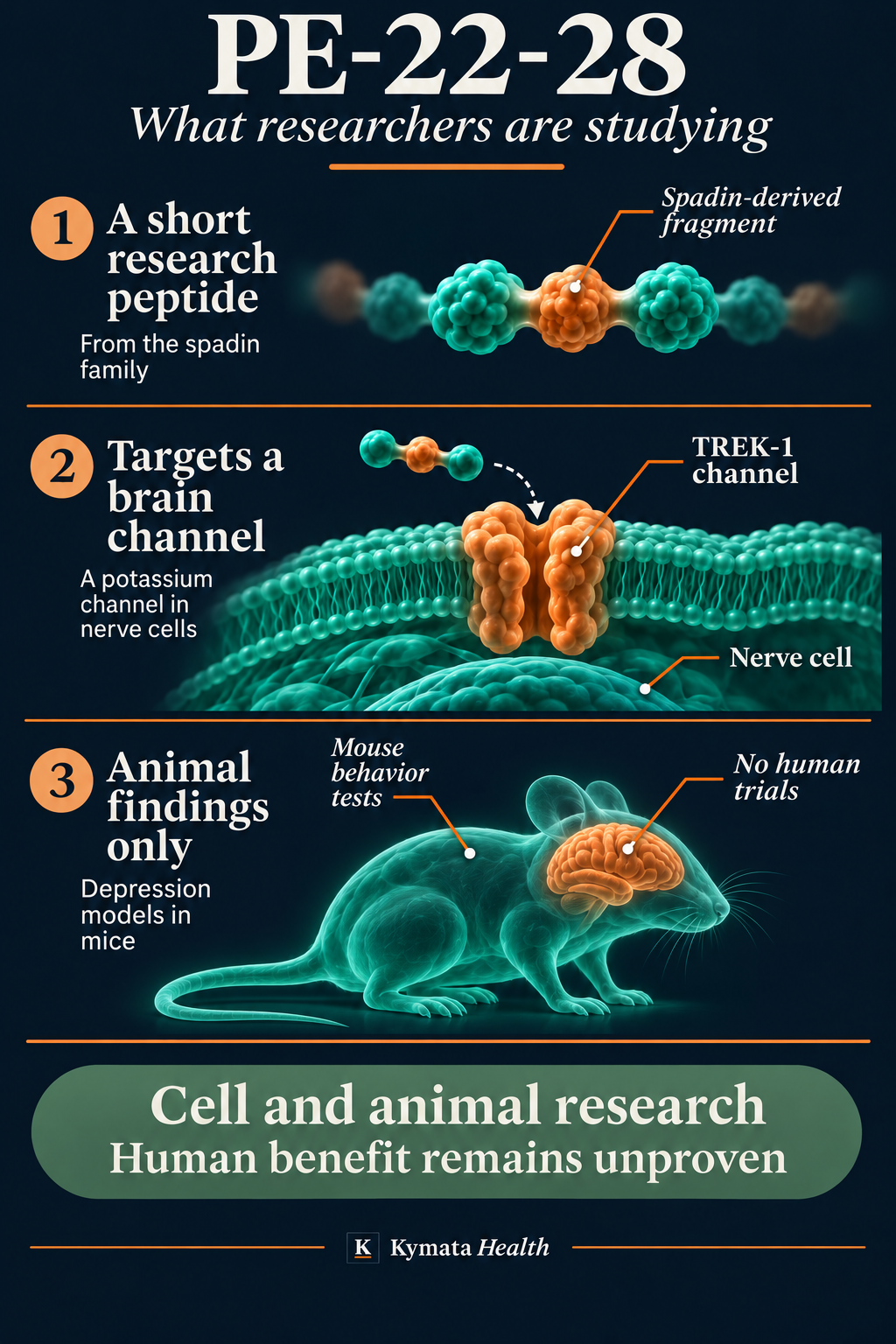
A synthetic research peptide from the TREK-1 / spadin line. Preclinical work studies TREK-1 potassium-channel modulation in mouse depression models; there are no human trials, and it is not Semax. Animal research only. Human benefit remains unproven. The drawing is a schematic, not a measured molecular structure, a product photograph or a treatment result. Illustration review: 19 November 2026, against this page’s own mechanism, evidence and regulatory records.
A sequence model is not provided for this record. Read the identity and evidence notes; an illustration does not verify a molecular structure.
Illustration notes and source record
Read the source record on this page. Laboratory, topical and injected studies are separate evidence; this illustration does not establish an indication or a treatment outcome.

How it works
SourcedPE-22-28 (mini-spadin) is residues 22–28 (GVSWGLR) of the 44-residue sortilin propeptide (UniProt Q99523); spadin is the longer 17-residue fragment, residues 12–28. In patch-clamp recordings on hTREK-1-expressing HEK cells and in mouse behavior tests (Djillani 2017, PMID 28955242), PE 22-28 blocked TREK-1 with an IC50 near 0.12 nanomolar, and mice given it were immobile for 91.8 seconds in the forced-swim test against 161.7 seconds after saline; the 14- to 23-hour half-effect times in that paper were measured for two chemically modified analogs, not for PE 22-28 itself.
In a mouse model of focal brain ischemia (Pietri 2019, PMID 31325429), mini-spadin acted on TREK-1 in two directions depending on the amount given, increasing channel activity at low exposure and blocking it at higher exposure, and improved motor and cognitive test performance and post-stroke depression measures. That is not a US antidepressant NDA and not Semax.
Source: Djillani et al., 2017 (PMID 28955242) and Pietri et al., 2019 (PMID 31325429)
05 / Evidence and limits
Evidence and limits
Cell and mouse experiments · no human administration study
Human evidence
Cell and mouse experiments · no human administration study- In the 2017 forced-swim test, mice given PE 22-28 were immobile for 91.8 seconds against 161.7 seconds after saline (PMID 28955242).
- In mice with experimental focal brain ischemia, mini-spadin improved motor and cognitive test performance and post-stroke depression measures (PMID 31325429). Clinical stroke and mood outcomes remain untested.
- In 45 patients with treatment-resistant major depression (Roulot 2018, PMID 30233189), serum levels of the body’s own sortilin-derived propeptide rose about a month after electroconvulsive therapy, and the rise was significant only among those who responded; no peptide was administered.
Limits of current evidence
3 limits- Time spent immobile measures behavior in mice. A clinical antidepressant trial would need to measure symptoms in people.
- The 14- to 23-hour half-effect times were measured for two chemically modified peptides, not unmodified PE-22-28, and are not a human plasma half-life.
- Not Semax, not Selank, not ketamine.
What it is studied for
- Catalog identity: Low
- Clinical depression care: Low
Verdict
PE-22-28 changed behavior in mice. Whether it relieves depression in people remains unknown; no study has given it to people.
06 / Product forms and access
Product forms and access
Regulatory & legal status
- FDA status (US)
- Research OnlyFDA’s approved-drug records and its list of bulk substances that may present significant safety risks contain no entry for PE 22-28 or spadin
- WADA status (2026)
- Not ListedThe WADA 2026 list does not name PE-22-28. Its S0 class covers pharmacological substances without approval for human therapeutic use. Verify before competition.
- Classification
- Research Chemical
- US compounding
- Not eligible / not available
07 / Tools and practical checks
Tools and practical checks
No separate record is provided here. Read the linked evidence and limitations for this compound.
08 / Published study use
Published study use
What published studies gave, in whom, and the source. Not a dose for you.
What studies used
Cell and mouse studies- Mice given unmodified PE 22-28 spent less time immobile in the forced-swim test. For two modified peptides, the behavioral effect took 14–23 hours to fall by half. Djillani 2017, PMID 28955242 (opens in new tab)
- In mice with focal brain ischemia, mini-spadin improved motor and cognitive test performance. Pietri 2019, PMID 31325429 (opens in new tab)
- Human lung cells were exposed to PE 22-28 in the laboratory as a TREK-1 blocker. We found no published or registered study that gave the peptide to people. Majumder 2026, PMID 41252294 (opens in new tab)
A record of what researchers gave, in whom; not a dose for you.
Administration
- Route / form
- No human route or dose established.
Who it is for
2 uses| Category | Fit | What exists |
|---|---|---|
| Catalog identity | Low | Listed because people search TREK-1 peptides. Not an endorsement. |
| Clinical depression care | Low | Not studied in people. Mood disorders belong with a clinician. |
09 / Safety and interactions
Safety and interactions
What the record says
In primary human alveolar epithelial cells exposed to high oxygen and mechanical stretch (Majumder 2026, PMID 41252294), PE 22-28 was used as a TREK-1 blocker and increased cytosolic reactive oxygen species, caspase activation and inflammatory mediator release, while mitochondrial reactive oxygen species were unchanged. That is a laboratory tool-compound result and cannot estimate risk in people; no clinical safety study of administered PE-22-28 was identified. Unknown purity on gray-market vials. Not for pregnancy.
10 / Comparisons and goal guides
Comparisons and goal guides
There is no separate comparison record on this page. Similar names do not establish that products or their evidence are interchangeable.
11 / Common questions
Common questions
Common questions
6 answersHow is PE-22-28 related to spadin?
PE-22-28, also called mini-spadin, is the last seven amino acids of spadin. Spadin has 17 amino acids (residues 12–28), and both come from the 44-amino-acid sortilin propeptide.
Has PE-22-28 been tested for depression in people?
We found no published or registered trial that gave PE-22-28 to people. The depression experiments measured mouse behavior. A separate study of 45 patients undergoing electroconvulsive therapy measured their own sortilin propeptide in blood, which rose in those who responded (PMID 30233189).
Where does the 14–23 hour figure come from?
Researchers measured the time for an effect on swimming behavior to fall by half in mice given two modified peptides. One replaced the first glycine with alanine. The other also had biotin attached. Neither experiment measured how fast unmodified PE-22-28 leaves human blood.
What is known about side effects in people?
No study was identified that followed people after a dose of PE-22-28. Used as a laboratory TREK-1 blocker on stressed human lung cells, it increased cytosolic reactive oxygen species (PMID 41252294). That result cannot tell the risk to a person.
Is PE-22-28 the same as PEPITEM?
No. PE-22-28 has seven amino acids from sortilin. PEPITEM has 14 amino acids (SVTEQGAELSNEER) from the protein 14-3-3 zeta/delta and restrains T-cell movement across inflamed blood-vessel lining (PMID 25894827).
Is PE-22-28 FDA-approved?
No. FDA’s approved-drug records and its list of bulk substances that may present significant safety risks contain no entry for PE 22-28 or spadin.
12 / Sources and references
Sources and references
5 papers cited on this page.
Sources
5 papers- 1“Shortened Spadin Analogs Display Better TREK-1 Inhibition, In Vivo Stability and Antidepressant Activity.”Djillani A, Pietri M, Moreno S, Heurteaux C, Mazella J, Borsotto M Frontiers in Pharmacology (2017). PMID: 28955242 DOI: 10.3389/fphar.2017.00643
- 2“First evidence of protective effects on stroke recovery and post-stroke depression induced by sortilin-derived peptides.”Pietri M, Djillani A, Mazella J, Borsotto M, Heurteaux C Neuropharmacology (2019). PMID: 31325429 DOI: 10.1016/j.neuropharm.2019.107715
- 3“Increased serum levels of sortilin-derived propeptide after electroconvulsive therapy in treatment-resistant depressed patients.”Roulot M, et al. Neuropsychiatric Disease and Treatment (2018). PMID: 30233189 DOI: 10.2147/NDT.S170165
- 4“Role of the two-pore domain potassium channel TREK-1 in hyperoxia- and mechanical stretch-induced alveolar epithelial injury.”Majumder N, et al. American Journal of Physiology. Lung Cellular and Molecular Physiology (2026). PMID: 41252294 DOI: 10.1152/ajplung.00143.2025
- 5“Homeostatic regulation of T cell trafficking by a B cell-derived peptide is impaired in autoimmune and chronic inflammatory disease.”Chimen M, et al. Nature Medicine (2015). PMID: 25894827 DOI: 10.1038/nm.3842
14 / Prescription options
Prescription options
Prescription options: compare licensed telehealth providers
Some peptide therapies are available only by prescription after a consult with a licensed clinician.
Compare telehealth →15 / Peptide library
Peptide library
Keep reading: Peptide research library
Peptide research library: every pagePeptide libraryBrowse all topics
- NoopeptPrevious in this topic · Russian-developed dipeptide ester nootropic (omberacetam / GVS-111), usually taken oral or intranasal.
- ThymopentinNext in this topic · Synthetic pentapeptide (Arg-Lys-Asp-Val-Tyr) corresponding to thymopoietin residues 32–36 (TP-5).
- Ac-SDKPAc-SDKP is a four-amino-acid fragment of thymosin beta-4.
- BromantaneAdamantane-derived actoprotector (Ladasten in Russia).
- NMNOral NAD+ precursor (nicotinamide mononucleotide).
Regulatory and sport classification
- Not FDA-approved