
The peptide field guide
Ac-SDKP
Ac-SDKP (N-acetyl-Ser-Asp-Lys-Pro, goralatide) is a natural four-amino-acid peptide made from thymosin beta-4; it is not TB-500 and not an ACE inhibitor.
Human drug-level and chemotherapy studies; the fibrosis results come from rats. Not FDA-approved.
Explore this compoundConceptual editorial illustration; not a measured molecular structure, product photograph or treatment result.
02 / At a glance
At a glance
Key facts
- Also known as
- N-acetyl-Ser-Asp-Lys-Pro, acetyl-SDKP, goralatide
- Type
- Immune & Thymic
- Evidence level
- Cell and animal research: human benefit remains unproven.
- US regulatory status
- Not FDA-approved, research chemical
- Updated
Identity
Ac-SDKP (N-acetyl-Ser-Asp-Lys-Pro, goralatide) is a natural four-amino-acid peptide made from thymosin beta-4; it is not TB-500 and not an ACE inhibitor.
Research context
The ACE enzyme breaks it down within minutes, so ACE inhibitors raise the body’s own levels; classical work found it holds back blood stem cell growth, and organ-fibrosis animal models report antifibrotic signaling.
Evidence limits
Human drug-level and chemotherapy studies; the fibrosis results come from rats. Not FDA-approved.
Read the technical profile and study-use reference
Quick answer
Evidence: LowAc-SDKP is a four-amino-acid fragment of thymosin beta-4. Researchers studied a synthetic version, goralatide, in healthy volunteers and during chemotherapy. Evidence that it can reduce scarring in the heart comes from experiments in rats.
- In published studies
- No established dose outside study protocols
Research summary, not medical advice.
At a glance
Kymata peptide profile · Nov 22, 2026- Molecular weight
- 487.5 g/mol
- CAS
- 120081-14-3
- In published studies
- No established dose outside study protocols
- Half-life
- Mean 4.5 minutes after a 12-hour intravenous infusion in healthy volunteers (Ezan 1994, PMID 7895600)
- Common vials
- Research vial; no sourced vial preset in this calculator
03 / Identity and origin
Identity and origin
Also called N-acetyl-Ser-Asp-Lys-Pro, acetyl-SDKP, goralatide. Naturally occurring four-amino-acid fragment of thymosin beta-4 (goralatide, seraspenide).
Read the sequence and compound record
Compound card
- Sequence
- N-acetyl-Ser-Asp-Lys-Pro
- Class
- Naturally occurring four-amino-acid fragment of thymosin beta-4 (goralatide, seraspenide)
- Formula
- C20H33N5O9
- Molecular weight
- 487.5 g/mol
- CAS
- 120081-14-3
- PubChem CID
- 65938
- Described by
- First isolated from fetal calf bone marrow by Lenfant and colleagues (PMID 2915977), 1989 (structure reported)
04 / How it may work
How it may work
Naturally occurring four-amino-acid fragment of thymosin beta-4 (goralatide, seraspenide)
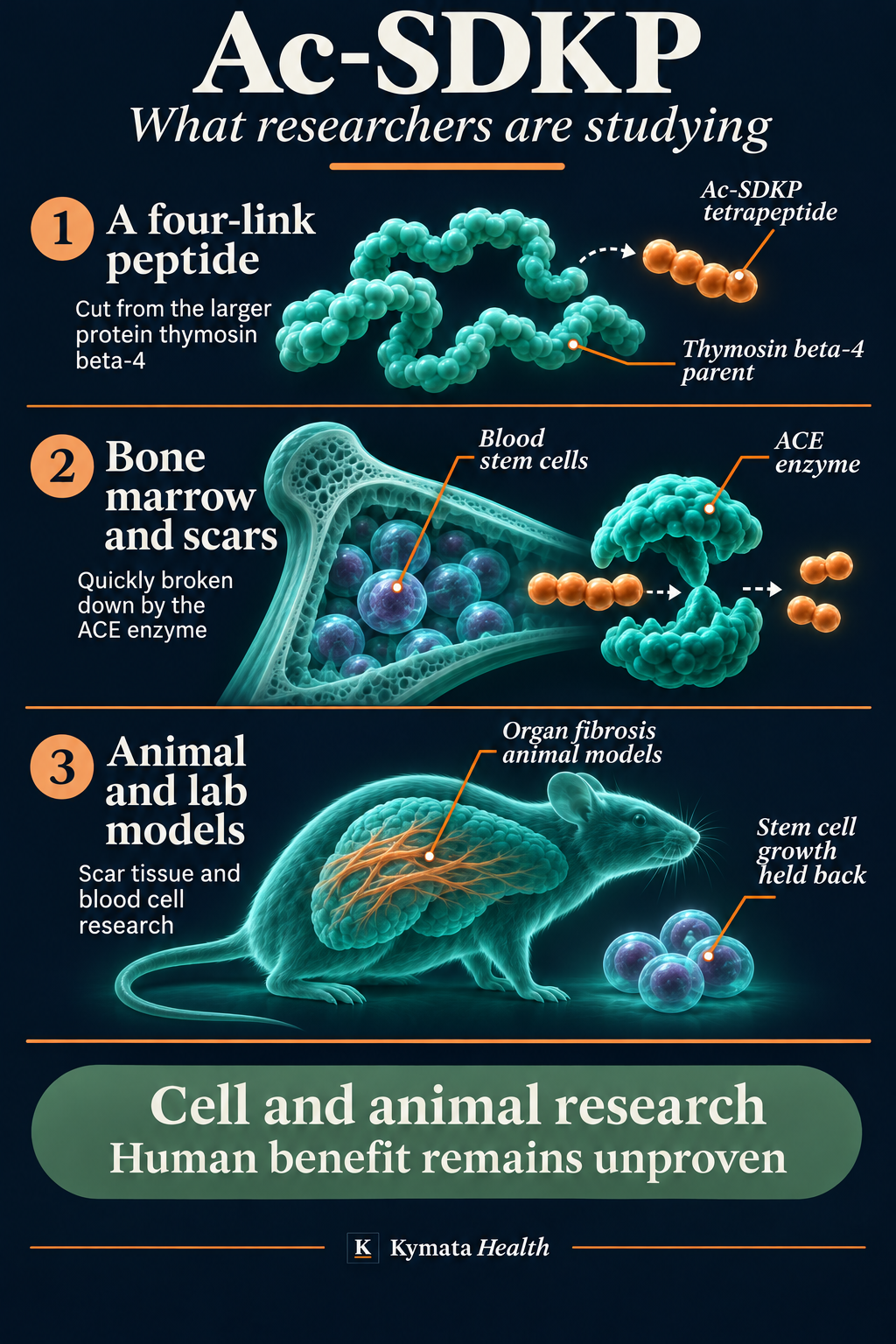
Ac-SDKP (N-acetyl-Ser-Asp-Lys-Pro, goralatide) is a natural four-amino-acid peptide made from thymosin beta-4; it is not TB-500 and not an ACE inhibitor. The ACE enzyme breaks it down within minutes, so ACE inhibitors raise the body’s own levels; classical work found it holds back blood stem cell growth, and organ-fibrosis animal models report antifibrotic signaling. Human drug-level and chemotherapy studies; the fibrosis results come from rats. Not FDA-approved. The drawing is a schematic, not a measured molecular structure, a product photograph or a treatment result. Illustration review: 19 November 2026, against this page’s own mechanism, evidence and regulatory records.
A sequence model is not provided for this record. Read the identity and evidence notes; an illustration does not verify a molecular structure.
Illustration notes and source record
Read the source record on this page. Laboratory, topical and injected studies are separate evidence; this illustration does not establish an indication or a treatment outcome.

How it works
SourcedLenfant and colleagues (1989, PMID 2915977) purified the tetrapeptide Ac-Ser-Asp-Lys-Pro from fetal calf bone marrow, confirmed its structure against a synthetic copy, and found both forms blocked recruitment of mouse blood stem cells into DNA synthesis. Lenfant and colleagues (1991, PMID 2069292) showed in bone marrow cell preparations that labeled thymosin beta-4 was processed into Ac-SDKP by cleavage of its Pro4-Asp5 bond.
Angiotensin-converting enzyme (ACE) breaks down Ac-SDKP. In a double-blind placebo-controlled crossover study (Azizi 1996, PMID 8609242) in eight healthy volunteers, a single dose of the ACE inhibitor captopril raised plasma Ac-SDKP a mean 5.5-fold (range 4 to 8.5-fold). That study measured the body's own peptide; it did not give Ac-SDKP or test treatment of organ scarring.
Source: PMID: 2915977, PMID: 2069292, PMID: 1300237, PMID: 7895600, PMID: 8535033, PMID: 8609242, PMID: 14581293
05 / Evidence and limits
Evidence and limits
One human pharmacokinetic study and two chemotherapy trials
Human evidence
One human pharmacokinetic study and two chemotherapy trials- In a pharmacokinetic study (Ezan 1994, PMID 7895600) of six healthy volunteers given seraspenide by 12-hour intravenous infusion, subcutaneous or intramuscular injection, and five patients on chemotherapy, seraspenide was eliminated with a mean half-life of 4.5 minutes after the infusion, with 100% and 81% bioavailability by the subcutaneous and intramuscular routes.
- In a double-blind randomized crossover phase I-II trial (Carde 1992, PMID 1300237) in 53 cancer patients receiving cytarabine or ifosfamide monochemotherapy, the authors reported significant protection of peripheral blood cells with seraspenide and no toxicity, without giving an effect size in the abstract.
- In a double-blind randomized placebo-controlled trial (Cappelaere 1995, PMID 8535033) in 84 patients with head-and-neck or esophageal squamous cell carcinoma receiving carboplatin and fluorouracil, goralatide did not significantly change mean nadir blood counts or the duration of blood toxicity across 221 cycles, and anemia and lymphopenia were more frequent with goralatide.
Limits of current evidence
4 limits- In rats with two-kidney, one-clip hypertension (Peng 2003, PMID 14581293), Ac-SDKP started eight weeks after fibrosis was established and continued for eight weeks reversed the rise in left-ventricular collagen in a dose-dependent manner and lowered cardiac TGF-beta and CTGF. No human study has tested it for fibrosis.
- The 4.5-minute half-life comes from the healthy volunteers after the intravenous infusion (PMID 7895600).
- ClinicalTrials.gov registrations found under goralatide are for Ac-SDKP-NH2, an amide analog used as a kidney-filtration tracer, which is a different compound.
- The WADA 2026 Prohibited List bans thymosin-beta-4 and its derivatives, such as TB-500, under section S2.3 and bans unapproved pharmacological substances under S0, but it does not name Ac-SDKP or goralatide.
What it is studied for
- Blood counts during chemotherapy: Mixed trial results
- Organ fibrosis: Animal evidence
Verdict
Goralatide has been given to healthy volunteers in a drug-level study (Ezan 1994) and to cancer patients in two chemotherapy trials, where one crossover trial reported blood-cell protection (Carde 1992) and a larger placebo-controlled trial found no significant difference in nadir counts (Cappelaere 1995). The evidence for reducing organ scarring described here comes from rats.
06 / Product forms and access
Product forms and access
Regulatory & legal status
- FDA status (US)
- Research Only
- WADA status (2026)
- Not ListedNot named on the WADA 2026 Prohibited List. Section S2.3 bans thymosin-beta-4 and its derivatives, such as TB-500, and S0 bans unapproved pharmacological substances. Verify before competition.
- US compounding
- Not eligible / not available
07 / Tools and practical checks
Tools and practical checks
No separate record is provided here. Read the linked evidence and limitations for this compound.
08 / Published study use
Published study use
What published studies gave, in whom, and the source. Not a dose for you.
What studies used
Human pharmacokinetics and randomized chemotherapy trials- Six healthy volunteers (12-hour intravenous infusion, subcutaneous or intramuscular injection) and five patients on chemotherapy: mean half-life 4.5 minutes after the infusion; 100% and 81% bioavailability by the subcutaneous and intramuscular routes. Ezan 1994, PMID 7895600 (opens in new tab)
- 84 patients on carboplatin and fluorouracil, placebo-controlled: no significant change in nadir blood counts across 221 cycles; anemia and lymphopenia more frequent with goralatide. Cappelaere 1995, PMID 8535033 (opens in new tab)
A record of what researchers gave, in whom; not a dose for you.
Administration
- Route / form
- Not established outside study protocols. The human studies used study-supplied intravenous, subcutaneous or intramuscular preparations (PMID 7895600).
Who it is for
2 uses| Category | Fit | What exists |
|---|---|---|
| Blood counts during chemotherapy | Mixed trial results | A 53-patient crossover trial reported blood-cell protection (PMID 1300237); an 84-patient placebo-controlled trial found no significant difference in nadir counts (PMID 8535033). |
| Organ fibrosis | Animal evidence | The heart-scarring result measured collagen in rat tissue (PMID 14581293). It does not establish a treatment for a person with fibrosis. |
09 / Safety and interactions
Safety and interactions
What the record says
Goralatide is an investigational drug with no approval from FDA or, as far as we found, any other regulator, and the human studies described here do not establish a treatment for fibrosis or a way to prepare a research vial. In the 84-patient trial, anemia and lymphopenia were more frequent with goralatide (PMID 8535033). The WADA 2026 Prohibited List bans thymosin-beta-4 and its derivatives under section S2.3 and unapproved pharmacological substances under S0; it does not name Ac-SDKP or goralatide.
10 / Comparisons and goal guides
Comparisons and goal guides
There is no separate comparison record on this page. Similar names do not establish that products or their evidence are interchangeable.
11 / Common questions
Common questions
Common questions
4 answersHas Ac-SDKP been given to people?
Yes. Goralatide (also called seraspenide) has been given to healthy volunteers in a drug-level study (Ezan 1994, PMID 7895600) and to cancer patients in two chemotherapy trials, where one crossover trial reported blood-cell protection (Carde 1992, PMID 1300237) and a larger placebo-controlled trial found no significant difference in nadir counts (Cappelaere 1995, PMID 8535033).
Has Ac-SDKP been shown to reverse fibrosis in people?
No. The reversal study measured left-ventricular collagen in rats with experimentally induced hypertension (PMID 14581293). The human studies measured drug levels or blood counts.
Is Ac-SDKP the same as TB-500?
No. Ac-SDKP is the first four amino acids of thymosin beta-4 (PMID 2069292). TB-500 as sold is usually Ac-LKKTETQ, a seven-amino-acid fragment from a different part of the protein. ACE inhibitors such as captopril raise the Ac-SDKP already circulating in the blood (PMID 8609242).
Is Ac-SDKP FDA-approved?
No. Not FDA-approved, research chemical.
12 / Sources and references
Sources and references
8 papers cited on this page.
Sources
8 papers- 1“Inhibitor of hematopoietic pluripotent stem cell proliferation: purification and determination of its structure.”Lenfant M et al. Proc Natl Acad Sci U S A (1989). PMID: 2915977 DOI: 10.1073/pnas.86.3.779
- 2“Formation of acetyl-Ser-Asp-Lys-Pro, a new regulator of the hematopoietic system, through enzymatic processing of thymosin beta 4.”Lenfant M et al. Ann N Y Acad Sci (1991). PMID: 2069292 DOI: 10.1111/j.1749-6632.1991.tb17229.x
- 3“Seraspenide (acetylSDKP): phase I-II trial study of inhibitor of hematopoiesis protects against toxicity of aracytine and ifosfamide monochemotherapies.”Carde P et al. C R Acad Sci III (1992). PMID: 1300237
- 4“Pharmacokinetics in healthy volunteers and patients of NAc-SDKP (seraspenide), a negative regulator of hematopoiesis.”Ezan E et al. Drug Metab Dispos (1994). PMID: 7895600
- 5“Randomized placebo trial of myeloprotection with goralatide in patients with squamous cell carcinoma of the upper respiratory and digestive tracts or esophagus, treated with a carboplatin-fluorouracil combination.”Cappelaere P et al. Bull Cancer (1995). PMID: 8535033
- 6“Acute angiotensin-converting enzyme inhibition increases the plasma level of the natural stem cell regulator N-acetyl-seryl-aspartyl-lysyl-proline.”Azizi M et al. J Clin Invest (1996). PMID: 8609242 DOI: 10.1172/JCI118484
- 7“Ac-SDKP reverses cardiac fibrosis in rats with renovascular hypertension.”Peng H et al. Hypertension (2003). PMID: 14581293 DOI: 10.1161/01.HYP.0000100423.24330.96
- 8“World Anti-Doping Code: 2026 Prohibited List (S2.3 thymosin-beta-4 and its derivatives; S0 non-approved substances).”World Anti-Doping Agency WADA (2026).
14 / Prescription options
Prescription options
Prescription options: compare licensed telehealth providers
Some peptide therapies are available only by prescription after a consult with a licensed clinician.
Compare telehealth →15 / Peptide library
Peptide library
Keep reading: Peptide research library
Peptide research library: every pagePeptide libraryBrowse all topics
- ThymopentinPrevious in this topic · Synthetic pentapeptide (Arg-Lys-Asp-Val-Tyr) corresponding to thymopoietin residues 32–36 (TP-5).
- BromantaneNext in this topic · Adamantane-derived actoprotector (Ladasten in Russia).
- NMNOral NAD+ precursor (nicotinamide mononucleotide).
- Aging and LongevityThe compounds that come up in longevity talk: GH secretagogues, epitalon, GHK-Cu and NAD+ precursors.
- Cognition and FocusSemax, selank, noopept and dihexa as they come up for focus and memory: what each has been studied for, in whom, its US status, and why no dose is given.
Regulatory and sport classification
- Not FDA-approved, research chemical