
The peptide field guide
Noopept
A Russian-developed dipeptide ester nootropic (omberacetam, GVS-111), usually taken by mouth or as a nasal spray; not Semax or Selank.
Small Russian human studies. Not FDA-approved.
Explore this compoundConceptual editorial illustration; not a measured molecular structure, product photograph or treatment result.
02 / At a glance
At a glance
Key facts
- Also known as
- GVS-111, omberacetam, N-phenylacetyl-L-prolylglycine ethyl ester
- Type
- Cognitive & Nootropic
- Evidence level
- Early human trials: benefit not yet confirmed.
- US regulatory status
- Not FDA-approved, research chemical
- Updated
Identity
A Russian-developed dipeptide ester nootropic (omberacetam, GVS-111), usually taken by mouth or as a nasal spray; not Semax or Selank.
Research context
In rats it raised hippocampal NGF and BDNF signals, and in cultured cells it switched on HIF-1; small Russian outpatient studies in mild cognitive disorders compared it with piracetam, without a placebo group.
Evidence limits
Small Russian human studies. Not FDA-approved.
Read the technical profile and study-use reference
Quick answer
Evidence: LowRussian-developed dipeptide ester nootropic (omberacetam / GVS-111), usually taken oral or intranasal. Not Semax. Not Selank. Not bromantane. Not a lyophilized recovery peptide.
- In published studies
- Trial amounts are recorded under What studies used (PMID 22500312)
Research summary, not medical advice.
At a glance
Kymata peptide profile · Oct 29, 2026- Molecular weight
- ~318.4 g/mol
- CAS
- 157115-85-0
- In published studies
- Trial amounts are recorded under What studies used (PMID 22500312)
- Half-life
- Minutes-class parent; metabolites persist longer
- Common vials
- Oral or intranasal; no reconstitution in this calculator
03 / Identity and origin
Identity and origin
Also called GVS-111, omberacetam, N-phenylacetyl-L-prolylglycine ethyl ester. Oral/intranasal nootropic (Russian lineage; not a US NDA).
Read the sequence and compound record
Compound card
- Sequence
- N-phenylacetyl-L-prolylglycine ethyl ester (omberacetam / GVS-111)
- Class
- Oral/intranasal nootropic (Russian lineage; not a US NDA)
- Formula
- C17H22N2O4
- Molecular weight
- ~318.4 g/mol
- CAS
- 157115-85-0
- Described by
- Zakusov Institute of Pharmacology (GVS-111 / Noopept lineage), 1990s
- Bioavailability
- Oral / intranasal (research and Russian product practice)
04 / How it may work
How it may work
Oral/intranasal nootropic (Russian lineage; not a US NDA)
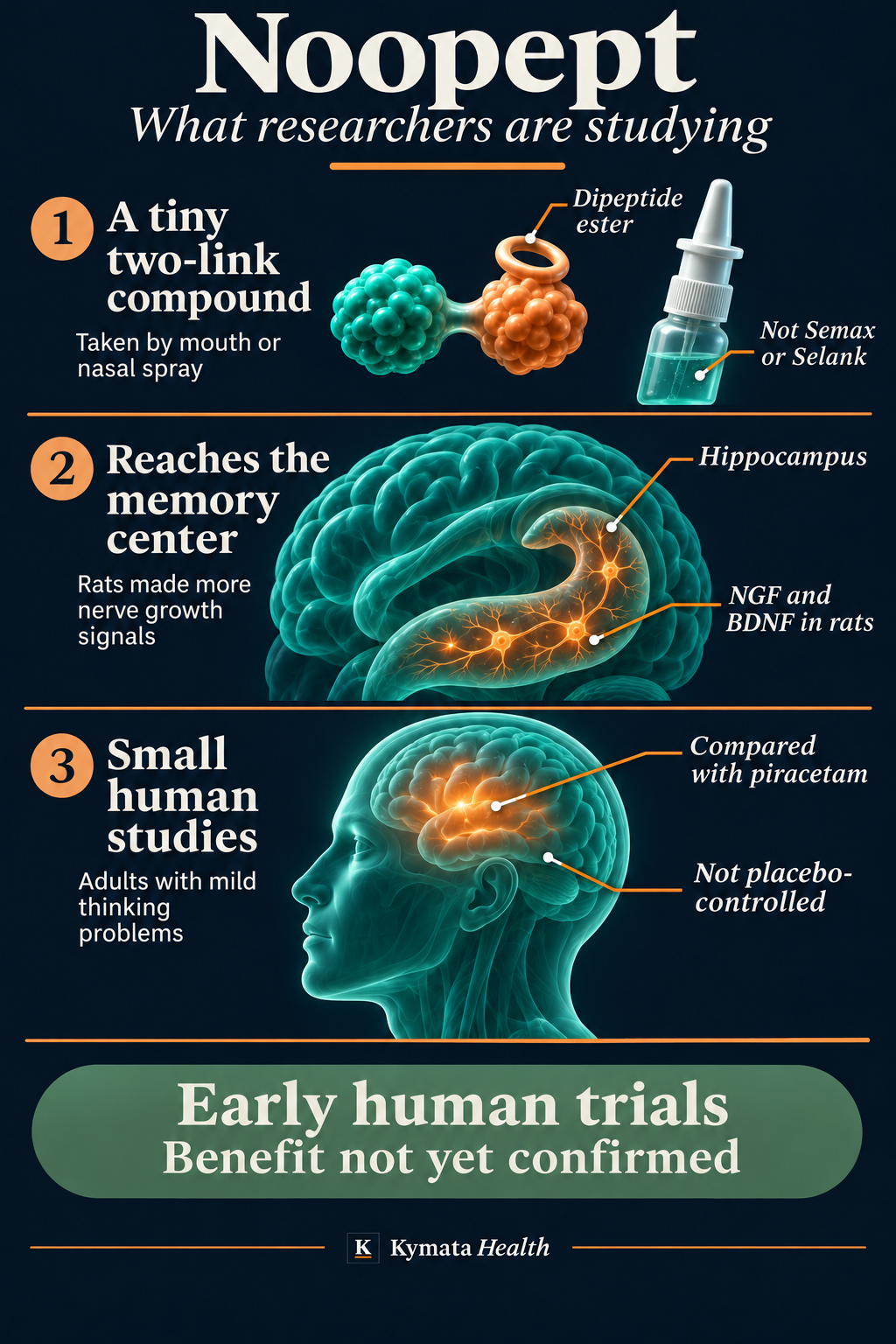
A Russian-developed dipeptide ester nootropic (omberacetam, GVS-111), usually taken by mouth or as a nasal spray; not Semax or Selank. In rats it raised hippocampal NGF and BDNF signals, and in cultured cells it switched on HIF-1; small Russian outpatient studies in mild cognitive disorders compared it with piracetam, without a placebo group. Small Russian human studies. Not FDA-approved. The drawing is a schematic, not a measured molecular structure, a product photograph or a treatment result. Illustration review: 19 November 2026, against this page’s own mechanism, evidence and regulatory records.
A sequence model is not provided for this record. Read the identity and evidence notes; an illustration does not verify a molecular structure.
Illustration notes and source record
Read the source record on this page. Laboratory, topical and injected studies are separate evidence; this illustration does not establish an indication or a treatment outcome.

How it works
SourcedNoopept is the trade name for N-phenylacetyl-L-prolylglycine ethyl ester (omberacetam; research code GVS-111). It was designed at the Zakusov Institute of Pharmacology as a proline–glycine dipeptide ester inspired by piracetam’s pharmacologic profile, not as a lyophilized recovery peptide and not as Semax or Selank.
Ostrovskaya, Gudasheva, and colleagues (Bulletin of Experimental Biology and Medicine, 2008) reported that acute and 28-day Noopept raised hippocampal NGF and BDNF mRNA in rats, with the hippocampal neurotrophin signal strengthening under chronic dosing rather than washing out. Separate rat work from the same lineage (PubMed abstract for the 2010 stress-kinase / neurotrophin paper) frames reduced hippocampal SAPK/JNK and ERK activity plus BDNF expression after chronic intraperitoneal exposure. Those are rodent molecular readouts, not a human dementia protocol.
Vakhitova, Ostrovskaya, Seredenin and co-authors (Acta Naturae, 2016; PMC4837574) tested transcription-factor reporters in HEK293 cells. At 10 μM, Noopept selectively increased HIF-1 DNA-binding activity and did not move CREB, NFAT, NF-κB, p53, STAT1, GAS, VDR, or HSF1 in that screen. Piracetam at 1 mM did not reproduce the HIF-1 signal. Docking in that paper proposes binding at prolyl hydroxylase 2 as a candidate route to HIF-1α stabilization. That is a proposed primary mechanism from an opened cell study, not proof that every oral capsule “activates HIF-1” in people.
Older awake-rat EEG work (PubMed abstract, 2003) implicated non-NMDA / AMPA-class glutamate receptors in the EEG fingerprint of repeated GVS-111 dosing. Treat that as a glutamate-pathway hypothesis supported by that abstract, not as a labeled AMPA agonist claim.
Practical identity: oral or intranasal product forms dominate commerce. Short parent exposure is why people do not treat it like a weekly GH peptide. It is not a SubQ reconstitution job by default.
Source: Russian clinical and preclinical nootropic literature (opened Ostrovskaya/Vakhitova/Neznamov files); Western regulatory status is research/supplement-adjacent, not an NDA
05 / Evidence and limits
Evidence and limits
Limited · Russian clinical tradition (not a US cognition NDA)
Human evidence
Limited · Russian clinical tradition (not a US cognition NDA)- Neznamov & Teleshova (Neuroscience and Behavioral Physiology, 2009; English translation of the 2008 Zhurnal Nevrologii i Psikhiatrii report): randomized comparative outpatient study, 53 adults with mild cognitive disorders of vascular or post-traumatic origin; Noopept 20 mg/day in two doses vs piracetam 1,200 mg/day for 56 days (PMID 19234797). Cognitive scale changes were described as comparable; overall CGI-style efficacy and tolerability favored Noopept in that analysis. Not placebo-controlled against inactive pill.
- Bochkarev et al. (PubMed abstract, 2008): clinical pharmaco-EEG in mild cognitive impairment of posttraumatic or vascular origin: alpha/beta power up, delta down, framed as nonspecific activating / anxiolytic EEG pattern; vascular cases looked clearer than posttraumatic ones in that abstract. Not a Western multi-center RCT.
- Amelin, Iliukhina, Shmonin (PubMed abstract, 2011): open prospective stroke-related mild cognitive impairment work reporting Noopept 20 mg daily for two months with MMSE and association-test improvements vs controls in that report (PMID 22500312). Open design. Not an FDA stroke label.
- This site will not treat dementia, stroke, or anxiety from a Noopept page.
Limits of current evidence
5 limits- Not Semax. Not Selank. Not bromantane. Different molecules and evidence bodies.
- Opened human work is small, largely single-tradition, and not a Western Phase 3 program.
- NGF/BDNF and HIF-1 claims on this page are tied to published papers (Ostrovskaya 2008; Vakhitova 2016); no other targets are established.
- Community milligram folklore and bromantane stacks are not combination RCTs.
- This site will not treat dementia, stroke, or anxiety from a Noopept page.
What it is studied for
- Identity vs Semax, Selank, and piracetam folklore
- Russian mild-cognitive-disorder literature literacy
- Not a SubQ reconstitution peptide and not a dementia protocol
Goal context
2 goals- Russian nootropic identity, not a Western Phase 3
- GVS-111 was built as a dipeptide ester with a piracetam-like story at much lower milligram amounts in the originating pharmacology. Russian product registration and Russian-language clinical papers are real. They are not an FDA cognition, Alzheimer’s, or anxiety NDA.
- Stacking with other Russian-line compounds
- Community logs often put Noopept next to Semax or Selank because all three show up in the same nootropic aisle. Semax and Selank are heptapeptide / tuftsin-analog sprays with their own Russian files: different molecules, different routes, no co-administration RCT on this page. Bromantane (ladasten) is a small-molecule actoprotector discussed in the same forums (see the bromantane page, /peptides/bromantane). We found no published combination trial of Noopept plus bromantane, so that pair is anecdote, not synergy pharmacology.
Verdict
Noopept is a Zakusov-line dipeptide ester nootropic with a real Russian clinical and neurotrophin/HIF preclinical file. It is not Semax, not Selank, not bromantane, and not a lyophilized recovery peptide. Its human evidence is small Russian outpatient studies (PMID 19234797, 22500312), study context rather than a protocol to copy. Russian history is not an FDA label.
06 / Product forms and access
Product forms and access
Regulatory & legal status
- FDA status (US)
- Research Only
- WADA status (2026)
- Not ListedNot currently on the WADA 2026 Prohibited List. Policies may change. Verify before competition.
- US compounding
- Not eligible / not available
07 / Tools and practical checks
Tools and practical checks
No separate record is provided here. Read the linked evidence and limitations for this compound.
08 / Published study use
Published study use
What published studies gave, in whom, and the source. Not a dose for you.
What studies used
Russian open studies- 60 people after stroke with mild cognitive impairment, an open study: 20 mg a day for 2 months. Amelin 2011, PMID 22500312 (opens in new tab)
A record of what researchers gave, in whom; not a dose for you.
Administration
- Route / form
- Not established: the cited study record does not state a route.
Who it is for
2 uses| Category | Fit | What exists |
|---|---|---|
| Nootropic identity / research literacy | Moderate | Useful page for separating GVS-111 from Semax, Selank, and racetam folklore. |
| US prescription care for diagnosed disease | Low | Not a US NDA substitute. |
09 / Safety and interactions
Safety and interactions
What the record says
In the Neznamov/Teleshova comparative course, reported undesirable effects included sleep disturbance, irritability, and blood-pressure rise in some patients; overall adverse-event burden was described as lower than the piracetam arm in that analysis. Community logs add headache and overstimulation. Research powders have unknown purity. Not for pregnancy. Not a syringe peptide by default. Not FDA-approved for cognition.
Interactions & Contraindications
Stimulation, headache, irritability, and blood-pressure rise show up in opened Russian clinical notes and community logs. Not a benzo or stimulant label. Unknown purity on research powders. Not for pregnancy.
10 / Comparisons and goal guides
Comparisons and goal guides
Combinations: what has been tested
3 pairings- + Semax →Community Russian-line pair (dipeptide ester vs ACTH-fragment spray). Complementary aisle marketing is not a co-administration RCT.
- + Selank →Tuftsin analog vs dipeptide ester: two files. No study has tested them together.
- + Bromantane →Different molecules and different files. No study has tested Noopept with bromantane.
Appears in goal guides
1 guideGoal guides give the evidence and status for each compound, with no doses. A mention here is not a treatment plan.
11 / Common questions
Common questions
Common questions
8 answersWhat is Noopept?
N-phenylacetyl-L-prolylglycine ethyl ester (omberacetam / GVS-111), a Zakusov Institute dipeptide ester nootropic usually taken oral or intranasal. Russian product history exists. It is not an FDA cognition drug.
How does it differ from racetams like piracetam?
It was designed with a piracetam-like pharmacology story but as a proline–glycine ester active at much lower milligram amounts in the originating literature. Neznamov & Teleshova compared 20 mg/day Noopept with 1,200 mg/day piracetam in one outpatient study (PMID 19234797), with comparable cognitive-scale movement in that analysis and a different side-effect profile. Vakhitova 2016 also saw a HIF-1 reporter effect with Noopept that piracetam did not reproduce in that cell screen.
Is Noopept the same as Semax or Selank?
No. Semax is an ACTH-fragment heptapeptide. Selank is a tuftsin analog. Noopept is a small dipeptide ester. Shared “Russian nootropic aisle” marketing is not shared identity.
What is the evidence level?
Limited for Western standards: small Russian clinical files plus stronger published preclinical neurotrophin and HIF-1 work. Not a US Phase 3 cognition program and not a reason to self-treat dementia or stroke.
What doses appear in studies you opened?
Neznamov/Teleshova compared 20 mg/day with piracetam and described comparable cognitive-scale changes (PMID 19234797). The Amelin stroke-MCI abstract reports 20 mg daily with MMSE and association-test improvements vs controls (PMID 22500312). Those are study records, not protocols to follow.
Can you stack it with bromantane, Semax, or Selank?
Semax and Selank co-use is common folklore; we have pages for both. Bromantane co-use is also common in forums (see /peptides/bromantane). We found no published combination trial, so community stacks are anecdote.
Do I reconstitute it like BPC-157?
Not by default. Most products are oral tablets/powder or nasal solutions. No SubQ form is established, and GH-peptide injection habits do not apply to it.
Is Noopept FDA-approved?
No. Not FDA-approved, research chemical.
12 / Sources and references
Sources and references
5 papers cited on this page.
Sources
5 papers- 1“Noopept stimulates the expression of NGF and BDNF in rat hippocampus.”Ostrovskaya RU, Gudasheva TA, Zaplina AP, et al. Bulletin of Experimental Biology and Medicine (2008). PMID: 19240853
- 2“Molecular mechanism underlying the action of substituted Pro-Gly dipeptide Noopept.”Vakhitova YV, Sadovnikov SV, Borisevich SS, Ostrovskaya RU, Seredenin SB Acta Naturae (2016). PMID: 27099787
- 3“Comparative studies of Noopept and piracetam in the treatment of patients with mild cognitive disorders in organic brain diseases of vascular and traumatic origin.”Neznamov GG, Teleshova ES Neuroscience and Behavioral Physiology (2009). PMID: 19234797
- 4“Clinical and electroencephalographic characteristic of noopept in patients with mild cognitive impairment of posttraumatic and vascular origin.”Bochkarev V, Teleshova ES, Syunyakov SA, et al. Zhurnal Nevrologii i Psikhiatrii (PubMed abstract) (2008). PMID: 19008801
- 5“Noopept in the treatment of mild cognitive impairment in patients with stroke.”Amelin AV, Iliukhina AIu, Shmonin AA Zhurnal Nevrologii i Psikhiatrii (PubMed abstract) (2011). PMID: 22500312
14 / Prescription options
Prescription options
Prescription options: compare licensed telehealth providers
Some peptide therapies are available only by prescription after a consult with a licensed clinician.
Compare telehealth →15 / Peptide library
Peptide library
Keep reading: Peptide research library
Peptide research library: every pagePeptide libraryBrowse all topics
- TesofensinePrevious in this topic · Oral triple monoamine reuptake inhibitor (dopamine, norepinephrine, serotonin) studied for obesity.
- PE-22-28Next in this topic · PE-22-28 (mini-spadin) is a synthetic seven-amino-acid fragment of spadin (GVSWGLR) that changed behavior in mouse tests used to study depression.
- ThymopentinSynthetic pentapeptide (Arg-Lys-Asp-Val-Tyr) corresponding to thymopoietin residues 32–36 (TP-5).
- Ac-SDKPAc-SDKP is a four-amino-acid fragment of thymosin beta-4.
- BromantaneAdamantane-derived actoprotector (Ladasten in Russia).
Regulatory and sport classification
- Not FDA-approved, research chemical