
The peptide field guide
SLU-PP-332
A synthetic estrogen-related receptor (ERR) agonist studied as an exercise mimetic in mice; a small molecule, not a peptide, and not MOTS-c.
Mouse studies only. No human study. Not FDA-approved.
Explore this compoundConceptual editorial illustration; not a measured molecular structure, product photograph or treatment result.
02 / At a glance
At a glance
Key facts
- Also known as
- ERRγ Agonist, Exercise Mimetic Compound
- Type
- Mitochondrial
- Evidence level
- Cell and animal research: human benefit remains unproven.
- US regulatory status
- Not FDA-approved, research chemical
- Updated
Identity
A synthetic estrogen-related receptor (ERR) agonist studied as an exercise mimetic in mice; a small molecule, not a peptide, and not MOTS-c.
Research context
ERRs are nuclear receptors that control genes for mitochondrial energy use; in diet-induced obese and ob/ob mice it raised energy expenditure and reduced fat gain (Billon 2024).
Evidence limits
Mouse studies only. No human study. Not FDA-approved.
Read the technical profile and study-use reference
Quick answer
Evidence: LowSLU-PP-332 is a synthetic estrogen-related receptor (ERR) agonist studied as an "exercise mimetic" in mice; there are no published human trials.
- In published studies
- No human study published
Research summary, not medical advice.
At a glance
Kymata peptide profile · Oct 29, 2026- Half-life
- Short (small molecule)
- Molecular weight
- ~350 Da
- In published studies
- No human study published
- Common vials
- Research compound studied in mice; no human product form
- CAS
- N/A (research compound)
03 / Identity and origin
Identity and origin
Also called ERRγ Agonist, Exercise Mimetic Compound. ERR pan-agonist small molecule (exercise-mimetic research; not a peptide).
Read the sequence and compound record
Compound card
- Class
- ERR pan-agonist small molecule (exercise-mimetic research; not a peptide)
- Formula
- Small molecule (not a peptide)
- Molecular weight
- ~350 Da
- CAS
- N/A (research compound)
- PubChem CID
- N/A
- Described by
- Thomas Burris, University of Florida, 2023
- Bioavailability
- Oral or injection (research compound)
04 / How it may work
How it may work
ERR pan-agonist small molecule (exercise-mimetic research; not a peptide)
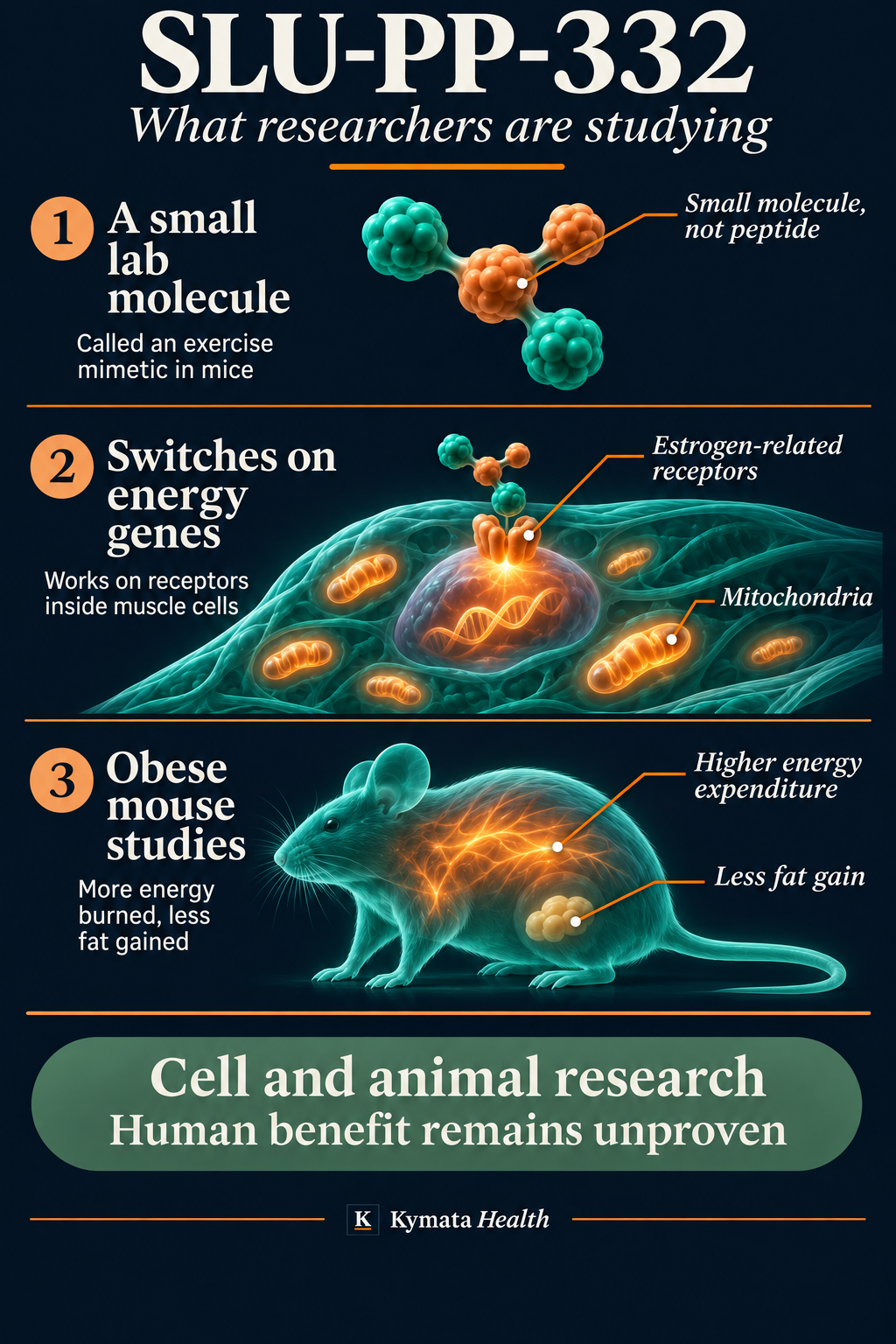
A synthetic estrogen-related receptor (ERR) agonist studied as an exercise mimetic in mice; a small molecule, not a peptide, and not MOTS-c. ERRs are nuclear receptors that control genes for mitochondrial energy use; in diet-induced obese and ob/ob mice it raised energy expenditure and reduced fat gain (Billon 2024). Mouse studies only. No human study. Not FDA-approved. The drawing is a schematic, not a measured molecular structure, a product photograph or a treatment result. Illustration review: 19 November 2026, against this page’s own mechanism, evidence and regulatory records.
A sequence model is not provided for this record. Read the identity and evidence notes; an illustration does not verify a molecular structure.
Illustration notes and source record
Read the source record on this page. Laboratory, topical and injected studies are separate evidence; this illustration does not establish an indication or a treatment outcome.

How it works
SLU-PP-332 is a synthetic small molecule agonist of ERR (estrogen-related receptor) alpha and gamma nuclear receptors. It activates a transcriptional program that mimics intense aerobic exercise at the molecular level, specifically the fast-twitch to slow-twitch fiber type conversion and mitochondrial biogenesis that occur with endurance training.
ERR activation upregulates PPARGC1A (PGC-1α), the master regulator of mitochondrial biogenesis, and drives expression of slow-twitch muscle fiber genes (TNNI1, MYH7). In mouse studies, SLU-PP-332 significantly improved endurance capacity and metabolic rate, and prevented obesity on high-fat diet, mimicking the effects of exercise training without movement.
Background & History
SLU-PP-332 was developed at Saint Louis University (hence "SLU") by Thomas Burris and colleagues. Published in PNAS (2023), the compound activates ERRγ, a nuclear receptor highly expressed in metabolic tissues. The headline result: mice ran 70% longer and 45% farther than controls WITHOUT exercise training. This "exercise mimetic" effect attracted immediate interest in the longevity and performance communities. Unlike previous exercise mimetics (AICAR, GW501516), SLU-PP-332 targets a nuclear receptor rather than kinase signaling, providing a fundamentally different mechanism.
05 / Evidence and limits
Evidence and limits
Limits of current evidence
2 limits- No human dose.
- This site will not treat mitochondrial disease from this page.
What it is studied for
- Identity: ERRγ small molecule vs a peptide SKU (it is not a peptide)
- Mouse running data is not an endurance NDA
- Not an exercise replacement or sarcopenia protocol on this site
Verdict
SLU-PP-332 is an estrogen-related-receptor agonist tested only in animals. Exercise-mimetic headlines are mouse work. Not MOTS-c. Not a peptide.
06 / Product forms and access
Product forms and access
Regulatory & legal status
- FDA status (US)
- Research Only
- WADA status (2026)
- Not ListedNot currently on the WADA 2026 Prohibited List. Policies may change. Verify before competition.
- US compounding
- Not eligible / not available
07 / Tools and practical checks
Tools and practical checks
No separate record is provided here. Read the linked evidence and limitations for this compound.
08 / Published study use
Published study use
What published studies gave, in whom, and the source. Not a dose for you.
What studies used
Mouse studies only- We found no published human study of SLU-PP-332.
- Diet-induced obese and ob/ob mice: it raised energy expenditure and reduced fat gain. Billon 2024, PMID 37739806 (opens in new tab)
A record of what researchers gave, in whom; not a dose for you.
Administration
- Route / form
- Not established: no human study.
Who it is for
1 use| Category | Fit | What exists |
|---|---|---|
| Exercise Mimetic / Endurance | Low | Strong preclinical data mimicking endurance exercise effects. Human data does not exist. |
09 / Safety and interactions
Safety and interactions
What the record says
ANIMAL DATA ONLY as of 2024. No human safety data exists. Extremely early-stage research compound. Not for human use outside of supervised research settings.
Interactions & Contraindications
Pre-clinical compound: no established human interactions. Small molecule, not a peptide (oral bioavailability). Theoretical ERR family involvement in hormone-sensitive cancers, so it is contraindicated in ER+ or hormone-sensitive malignancies. Monitor liver enzymes.
10 / Comparisons and goal guides
Comparisons and goal guides
Combinations: what has been tested
1 pairing- + Epitalon →ERR agonist mouse running data plus pineal-tetrapeptide folklore. Not a longevity stack and not an exercise replacement.
11 / Common questions
Common questions
Common questions
2 answersIs SLU-PP-332 safe for humans?
No human safety data exists as of 2024. SLU-PP-332 has only been studied in mouse models. While the preclinical data is exciting, human use is premature and potentially unsafe without proper clinical trial data.
Is SLU-PP-332 FDA-approved?
No. Not FDA-approved, research chemical.
12 / Sources and references
Sources and references
No separate record is provided here. Read the linked evidence and limitations for this compound.
14 / Prescription options
Prescription options
Prescription options: compare licensed telehealth providers
Some peptide therapies are available only by prescription after a consult with a licensed clinician.
Compare telehealth →15 / Peptide library
Peptide library
Keep reading: Peptide research library
Peptide research library: every pagePeptide libraryBrowse all topics
- P21Previous in this topic · CNTF C-terminal fragment, not FGL, not Semax.
- ARA 290Next in this topic · ARA 290 (cibinetide) is an 11-amino-acid peptide derived from erythropoietin that does not stimulate red-cell production; it has been studied in small Phase 2 trials for…
- CortexinCortexin is a polypeptide extract of animal brain cortex registered as a medicine in Russia, given by injection; Russian clinical studies examined it after stroke and brain injury.
- DesmopressinDesmopressin (DDAVP) is a synthetic vasopressin analog selective for the V2 receptor, FDA-approved for central diabetes insipidus, primary nocturnal enuresis, and some bleeding…
- LeuprorelinLeuprorelin (leuprolide) is a synthetic GnRH agonist that, given continuously, suppresses testosterone and estrogen.
Regulatory and sport classification
- Not FDA-approved, research chemical