
The peptide field guide
ARA 290
An EPO-derived peptide studied for nerve repair signals without raising red blood cells.
Small early human trials. Benefit has not been confirmed.
Explore this compoundConceptual editorial illustration; not a measured molecular structure, product photograph or treatment result.
02 / At a glance
At a glance
Key facts
- Also known as
- Cibinetide, EPO-derived peptide, Innate Repair Receptor Agonist
- Type
- Neuroprotective
- Evidence level
- Early human trials: benefit not yet confirmed.
- US regulatory status
- Investigational (cibinetide); not FDA-approved
- Updated
Identity
An EPO-derived peptide studied for nerve repair signals without raising red blood cells.
Research context
Researchers study ARA-290 for the innate repair receptor and small-fiber neuropathy; human data come from small Phase II trials.
Evidence limits
Small early human trials. Benefit has not been confirmed.
Read the technical profile and study-use reference
Quick answer
Evidence: ModerateARA 290 (cibinetide) is an 11-amino-acid peptide derived from erythropoietin that does not stimulate red-cell production; it has been studied in small Phase 2 trials for small-fiber neuropathy in people with sarcoidosis or type 2 diabetes.
- In published studies
- Trial amounts are recorded under What studies used (PMID 28475703)
Research summary, not medical advice.
At a glance
Kymata peptide profile · Oct 29, 2026- Half-life
- ~2 minutes (plasma)
- Common vials
- 4 mg / 8 mg
- Molecular weight
- ~990 Da
- In published studies
- Trial amounts are recorded under What studies used (PMID 28475703)
- CAS
- N/A (research compound)
03 / Identity and origin
Identity and origin
Also called Cibinetide, EPO-derived peptide, Innate Repair Receptor Agonist. Helix-B surface peptide / cibinetide (EPO-derived, non-erythropoietic).
Read the sequence and compound record
Compound card
- Class
- Helix-B surface peptide / cibinetide (EPO-derived, non-erythropoietic)
- Formula
- Cyclic EPO-derived spiral peptide
- Molecular weight
- ~990 Da
- CAS
- N/A (research compound)
- PubChem CID
- N/A
- Described by
- Araim Pharmaceuticals (Warren Maiden, Michael Brines), 2010s
- Bioavailability
- Subcutaneous injection
04 / How it may work
How it may work
Helix-B surface peptide / cibinetide (EPO-derived, non-erythropoietic)
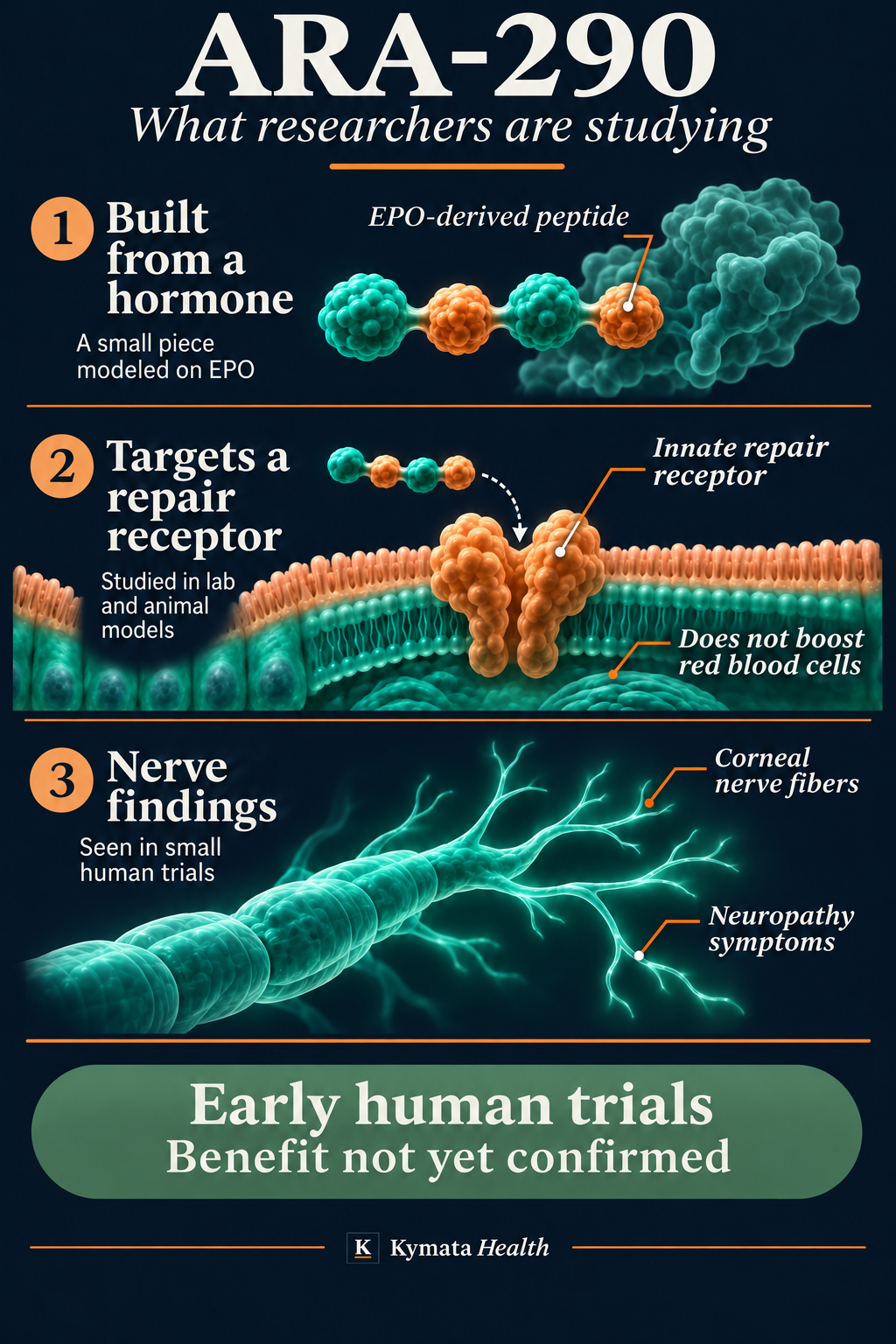
An EPO-derived peptide studied for nerve repair signals without raising red blood cells. Researchers study ARA-290 for the innate repair receptor and small-fiber neuropathy; human data come from small Phase II trials. Small early human trials. Benefit has not been confirmed. The drawing is a schematic, not a measured molecular structure, a product photograph or a treatment result. Illustration review: 19 November 2026, against this page’s own mechanism, evidence and regulatory records.
A sequence model is not provided for this record. Read the identity and evidence notes; an illustration does not verify a molecular structure.
Illustration notes and source record
Read the source record on this page. Laboratory, topical and injected studies are separate evidence; this illustration does not establish an indication or a treatment outcome.

How it works
ARA 290 (Cibinetide) is a non-hematopoietic synthetic peptide mimic of erythropoietin (EPO), engineered to selectively activate the innate repair receptor (IRR) (a heterodimer of the EPO receptor and CD131), without stimulating erythropoiesis or EPO's hematopoietic effects.
IRR activation suppresses pro-inflammatory cytokine production, promotes axonal regeneration, and has demonstrated efficacy in small-fiber neuropathy and painful diabetic peripheral neuropathy. ARA 290 has completed Phase II trials showing improvements in corneal nerve regeneration, neuropathic pain scores, and inflammatory markers in diabetic neuropathy patients.
Background & History
ARA 290 (Cibinetide) was developed by Araim Pharmaceuticals based on research by Anthony Cerami and Michael Brines. The key insight: erythropoietin (EPO) has tissue-protective effects mediated through a different receptor than the one driving erythropoiesis. ARA 290 was designed to specifically target this "innate repair receptor" (EPOR/βcR heterodimer) without stimulating red blood cell production. This allows EPO's neuroprotective, anti-inflammatory, and tissue-regenerative effects at pharmacological doses without the dangerous polycythemia that limits therapeutic EPO use.
05 / Evidence and limits
Evidence and limits
Use-case scores
0–100–10 against the evidence we have, not a gym ranking. Hidden domains do not apply here.
- Injury & tissue4/10Small human neuropathy / sarcoidosis-pain programs. Not an EPO doping drug. Small-human: 4.
Limits of current evidence
2 limits- Not a US approval.
- This site will not treat small-fiber neuropathy as if this were a labeled drug.
What it is studied for
- Neuropathy treatment (sarcoidosis, diabetic peripheral)
- Tissue protection and repair after ischemic events
- Anti-inflammatory therapy without immunosuppression
- Neuroprotection in chronic inflammatory conditions
Verdict
ARA-290 (cibinetide) is an EPO-helix-B peptide designed to keep tissue signaling without raising hematocrit. It is not EPO. It is not a recovery stack mascot.
06 / Product forms and access
Product forms and access
Regulatory & legal status
- FDA status (US)
- InvestigationalInvestigational (cibinetide); not FDA-approved
- WADA status (2026)
- Not ListedNot currently on the WADA 2026 Prohibited List. Policies may change. Verify before competition.
- US compounding
- Not eligible / not available
07 / Tools and practical checks
Tools and practical checks
Dose it
4 mg + 2 mL BAC water → 2 mg/mL · 1 unit (U-100) = 20 mcg.
Reconstitution math
U-100 syringe| Vial | Water | Concentration |
|---|---|---|
| 4 mg lyophilized | 2 mL BAC | 2 mg/mL |
08 / Published study use
Published study use
What published studies gave, in whom, and the source. Not a dose for you.
What studies used
Phase 2 trials- 64 people with sarcoidosis-related small nerve fiber loss and neuropathic pain: cibinetide 1, 4 or 8 mg a day, or placebo, for 28 days. Culver 2017, PMID 28475703 (opens in new tab)
A record of what researchers gave, in whom; not a dose for you.
Administration
- Route / form
- Not established: the cited trial record does not state a route.
Who it is for
2 uses| Category | Fit | What exists |
|---|---|---|
| Neuropathy / Peripheral Nerve Repair | Low | Phase II data for small-fiber neuropathy and DPN. Promotes axonal regeneration via IRR activation. |
| Inflammatory Conditions | Low | Anti-inflammatory via IRR-mediated cytokine suppression. Not EPO-related blood thickening concerns. |
09 / Safety and interactions
Safety and interactions
What the record says
Phase II clinical compound. Does not stimulate erythropoiesis (no red blood cell increase). Well-tolerated in trials. No significant adverse events reported.
Interactions & Contraindications
Very short half-life (~2 minutes), with effects mediated through signaling cascades that outlast peptide presence. No erythropoietic stimulation, so it can be used where EPO is contraindicated. Completed Phase II trials with favorable safety. No significant drug interactions documented.
10 / Comparisons and goal guides
Comparisons and goal guides
There is no separate comparison record on this page. Similar names do not establish that products or their evidence are interchangeable.
11 / Common questions
Common questions
Common questions
2 answersIs ARA 290 the same as EPO?
No. ARA 290 is an EPO-derived peptide that selectively activates the innate repair receptor (IRR) without stimulating red blood cell production. It has the tissue-protective and anti-inflammatory effects of EPO without hematopoietic side effects.
Is ARA 290 FDA-approved?
No. Investigational (cibinetide); not FDA-approved.
12 / Sources and references
Sources and references
No separate record is provided here. Read the linked evidence and limitations for this compound.
14 / Prescription options
Prescription options
Prescription options: compare licensed telehealth providers
Some peptide therapies are available only by prescription after a consult with a licensed clinician.
Compare telehealth →15 / Peptide library
Peptide library
Keep reading: Peptide research library
Peptide research library: every pagePeptide libraryBrowse all topics
- SLU-PP-332Previous in this topic · SLU-PP-332 is a synthetic estrogen-related receptor (ERR) agonist studied as an "exercise mimetic" in mice; there are no published human trials.
- CortexinNext in this topic · Cortexin is a polypeptide extract of animal brain cortex registered as a medicine in Russia, given by injection; Russian clinical studies examined it after stroke and brain injury.
- DesmopressinDesmopressin (DDAVP) is a synthetic vasopressin analog selective for the V2 receptor, FDA-approved for central diabetes insipidus, primary nocturnal enuresis, and some bleeding…
- LeuprorelinLeuprorelin (leuprolide) is a synthetic GnRH agonist that, given continuously, suppresses testosterone and estrogen.
- TetracosactideTetracosactide (cosyntropin) helps clinicians investigate whether the adrenal glands can make enough cortisol.
Regulatory and sport classification
- Investigational (cibinetide); not FDA-approved