
The peptide field guide
Petrelintide
Zealand Pharma’s investigational long-acting amylin receptor agonist.
Investigational drug. Not FDA-approved.
Explore this compoundConceptual editorial illustration; not a measured molecular structure, product photograph or treatment result.
02 / At a glance
At a glance
Key facts
- Also known as
- ZP8396, Zealand petrelintide
- Type
- Weight Management
- Evidence level
- Investigational drug: not FDA-approved.
- US regulatory status
- Investigational; not FDA-approved
- Updated
Identity
Zealand Pharma’s investigational long-acting amylin receptor agonist.
Research context
It belongs to the amylin satiety class with pramlintide and cagrilintide and is being tested in obesity trials.
Evidence limits
Investigational drug. Not FDA-approved.
Read the technical profile and study-use reference
Quick answer
Evidence: EmergingZealand Pharma investigational long-acting amylin receptor agonist (petrelintide / ZP8396). Not pramlintide. Not cagrilintide. Not a research vial that inherits Symlin labeling.
- In published studies
- Trial amounts are recorded under What studies used (PMID 42810355)
Research summary, not medical advice.
At a glance
Kymata peptide profile · Oct 29, 2026- In published studies
- Trial amounts are recorded under What studies used (PMID 42810355)
- Half-life
- Long-acting program (sponsor PK)
- Common vials
- Investigational injection; no reconstitution in this calculator
03 / Identity and origin
Identity and origin
Also called ZP8396, Zealand petrelintide. Investigational long-acting amylin receptor agonist (Zealand Pharma).
Read the sequence and compound record
Compound card
- Sequence
- Long-acting amylin agonist (ZP8396 / petrelintide)
- Class
- Investigational long-acting amylin receptor agonist (Zealand Pharma)
- Formula
- Amylin analog (proprietary)
- Described by
- Zealand Pharma, 2020s clinical program
04 / How it may work
How it may work
Investigational long-acting amylin receptor agonist (Zealand Pharma)
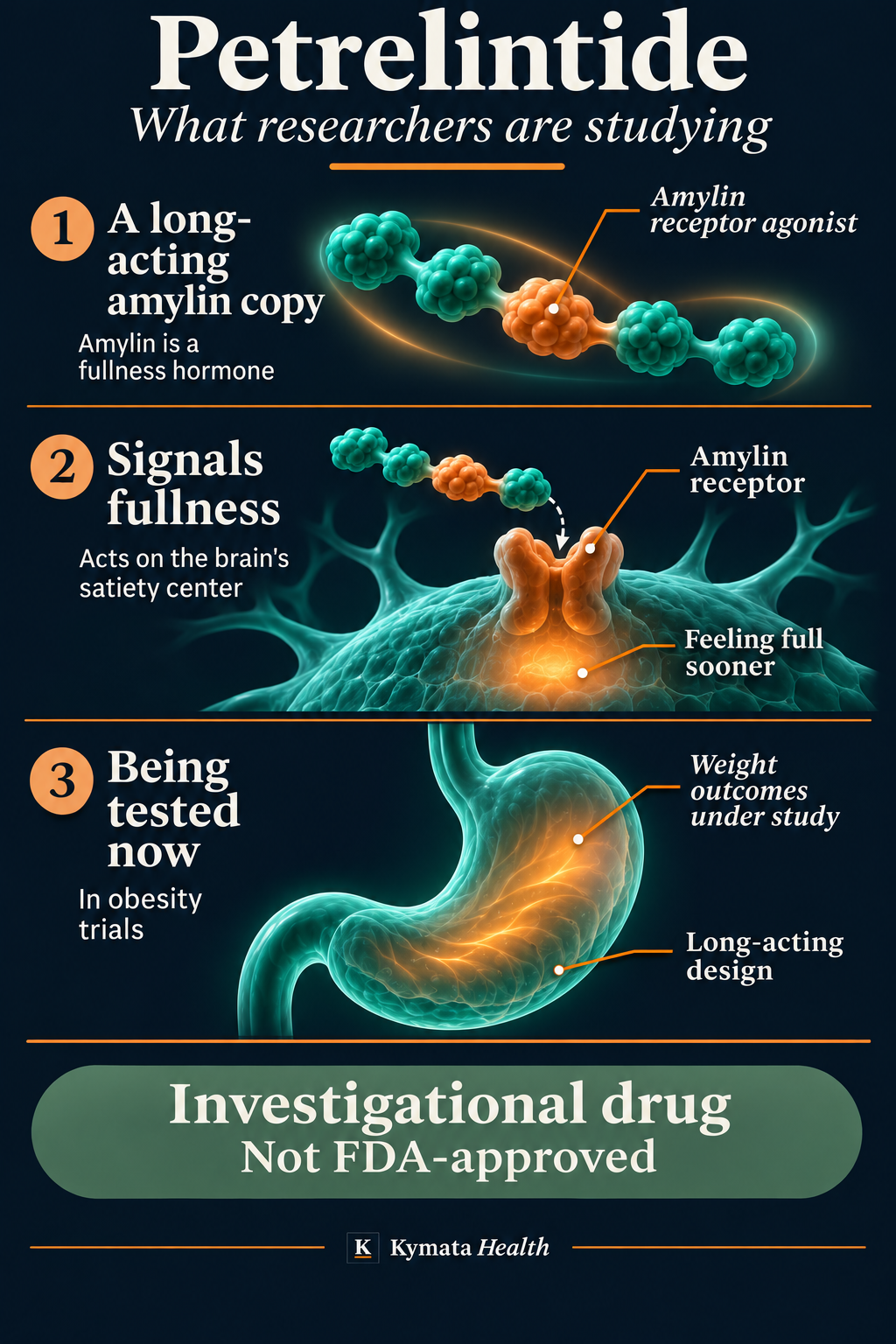
Zealand Pharma’s investigational long-acting amylin receptor agonist. It belongs to the amylin satiety class with pramlintide and cagrilintide and is being tested in obesity trials. Investigational drug. Not FDA-approved. The drawing is a schematic, not a measured molecular structure, a product photograph or a treatment result. Illustration review: 19 November 2026, against this page’s own mechanism, evidence and regulatory records.
A sequence model is not provided for this record. Read the identity and evidence notes; an illustration does not verify a molecular structure.
Illustration notes and source record
Read the source record on this page. Laboratory, topical and injected studies are separate evidence; this illustration does not establish an indication or a treatment outcome.

How it works
SourcedPetrelintide (ZP8396) is Zealand Pharma’s investigational long-acting amylin receptor agonist. It sits in the amylin satiety class with pramlintide and cagrilintide, but it is not Symlin and not cagrilintide.
Source: Zealand Pharma clinical program disclosures; not a finished US label
05 / Evidence and limits
Evidence and limits
Use-case scores
0–100–10 against the evidence we have, not a gym ranking. Hidden domains do not apply here.
- Metabolic / weight5.5/10Amylin-pathway obesity programs are real. Haircut: investigational, not pramlintide label, not a DIY powder.
Limits of current evidence
3 limits- Not interchangeable with pramlintide (Symlin) or cagrilintide.
- Sponsor milligrams are not a research-chem table.
- This site will not treat obesity or diabetes from this page.
Trial FinderRecruiting now: 6 open registrations for petrelintide
What it is studied for
- Amylin pipeline literacy: Moderate
- DIY reconstitution: Low
Verdict
Petrelintide is Zealand’s long-acting amylin agonist. Not pramlintide. Not cagrilintide. Not a research powder with a Symlin insert.
06 / Product forms and access
Product forms and access
Regulatory & legal status
- FDA status (US)
- InvestigationalInvestigational; not FDA-approved
- WADA status (2026)
- Not ListedNot currently on the WADA 2026 Prohibited List. Policies may change. Verify before competition.
- US compounding
- Not eligible / not available
07 / Tools and practical checks
Tools and practical checks
No separate record is provided here. Read the linked evidence and limitations for this compound.
08 / Published study use
Published study use
What published studies gave, in whom, and the source. Not a dose for you.
What studies used
Phase 2 trial- ZUPREME 1: once-weekly maintenance doses of 1.0 to 9.0 mg under the skin, or placebo, for 42 weeks including dose escalation, in 493 adults with obesity without type 2 diabetes. Garvey 2026, PMID 42810355 (opens in new tab)
- These are trial doses given under trial monitoring, not a schedule for anyone outside a trial.
A record of what researchers gave, in whom; not a dose for you.
Administration
- Route / form
- Route used in studies: injection under the skin (trials).
Who it is for
2 uses| Category | Fit | What exists |
|---|---|---|
| Amylin pipeline literacy | Moderate | Keep it distinct from GLP-1-only drugs. |
| DIY reconstitution | Low | Wrong tool. |
09 / Safety and interactions
Safety and interactions
What the record says
Investigational. Amylin-class nausea risk. Hypoglycemia risk rises when stacked carelessly with insulin. That is clinical pharmacology, not a gray-vial excuse. Unverified identity risk on research SKUs.
10 / Comparisons and goal guides
Comparisons and goal guides
There is no separate comparison record on this page. Similar names do not establish that products or their evidence are interchangeable.
11 / Common questions
Common questions
Common questions
3 answersIs petrelintide the same as cagrilintide?
No. Both are amylin-pathway agonists. Different sponsors and constructs.
Is it Symlin?
No. Symlin is pramlintide. Different molecule and label.
Is Petrelintide FDA-approved?
No. Investigational; not FDA-approved.
12 / Sources and references
Sources and references
No separate record is provided here. Read the linked evidence and limitations for this compound.
14 / Prescription options
Prescription options
Prescription options: compare licensed telehealth providers
Some peptide therapies are available only by prescription after a consult with a licensed clinician.
Compare telehealth →15 / Peptide library
Peptide library
Keep reading: Peptide research library
Peptide research library: every pagePeptide libraryBrowse all topics
- VK2735Previous in this topic · Viking Therapeutics investigational dual GLP-1/GIP receptor agonist (VK2735), studied in subcutaneous and oral obesity programs.
- EloralintideNext in this topic · Eli Lilly investigational long-acting amylin receptor agonist (eloralintide / LY3841136).
- TesofensineOral triple monoamine reuptake inhibitor (dopamine, norepinephrine, serotonin) studied for obesity.
- NoopeptRussian-developed dipeptide ester nootropic (omberacetam / GVS-111), usually taken oral or intranasal.
- PE-22-28PE-22-28 (mini-spadin) is a synthetic seven-amino-acid fragment of spadin (GVSWGLR) that changed behavior in mouse tests used to study depression.
Regulatory and sport classification
- Investigational; not FDA-approved