
The peptide field guide
N-Acetyl Semax Amidate
N-acetyl Semax amidate (NASA) is Semax with an N-acetyl cap and a C-terminal amide; it is not N-acetyl Selank amidate.
Research peptide. No published human study of this form. Not FDA-approved.
Explore this compoundConceptual editorial illustration; not a measured molecular structure, product photograph or treatment result.
02 / At a glance
At a glance
Key facts
- Also known as
- NASA, NA-Semax Amidate, Ac-Semax-NH2, N-acetyl Semax amide
- Sequence
- Ac–Met–Glu–His–Phe–Pro–Gly–Pro–NH₂
- Evidence level
- Research peptide: little published research.
- US regulatory status
- Not FDA-approved, research chemical
- Updated
Identity
N-acetyl Semax amidate (NASA) is Semax with an N-acetyl cap and a C-terminal amide; it is not N-acetyl Selank amidate.
Research context
Parent Semax is an ACTH 4–10 analog that Russian clinical literature links to BDNF and NGF and to monoamine signaling, with stroke studies using the unmodified peptide; longer action for the capped form is inferred from chemistry, not measured.
Evidence limits
Research peptide. No published human study of this form. Not FDA-approved.
Read the technical profile and study-use reference
Quick answer
Evidence: LowN-terminal acetylated, C-terminal amidated Semax (Ac-MEHFPGP-NH2). A laboratory distinguished it from acetyl-only Semax as a reference standard. No human pharmacokinetic, safety or efficacy study of this form has been published.
- In published studies
- No human study of this form published
Research summary, not medical advice.
At a glance
Kymata peptide profile · Nov 22, 2026- Molecular weight
- 855.0 g/mol (PubChem)
- In published studies
- No human study of this form published
- Half-life
- Human elimination half-life unknown
- Common vials
- Nasal spray or research vial; no sourced vial preset in this calculator
- CAS
- 2920938-90-3 (PubChem depositor synonym; not confirmed in CAS)
03 / Identity and origin
Identity and origin
Also called NASA, NA-Semax Amidate, Ac-Semax-NH2, N-acetyl Semax amide. Semax derivative with an N-terminal acetyl group and a C-terminal amide (no human PK).
Read the sequence and compound record
Compound card
- Sequence
- Ac–Met–Glu–His–Phe–Pro–Gly–Pro–NH₂
- Class
- Semax derivative with an N-terminal acetyl group and a C-terminal amide (no human PK)
- Formula
- C39H54N10O10S
- Molecular weight
- 855.0 g/mol (PubChem)
- CAS
- 2920938-90-3 (PubChem depositor synonym; not confirmed in CAS)
- PubChem CID
- 172638603
- Bioavailability
- The sources reviewed here do not establish how much reaches human blood or brain
04 / How it may work
How it may work
Semax derivative with an N-terminal acetyl group and a C-terminal amide (no human PK)
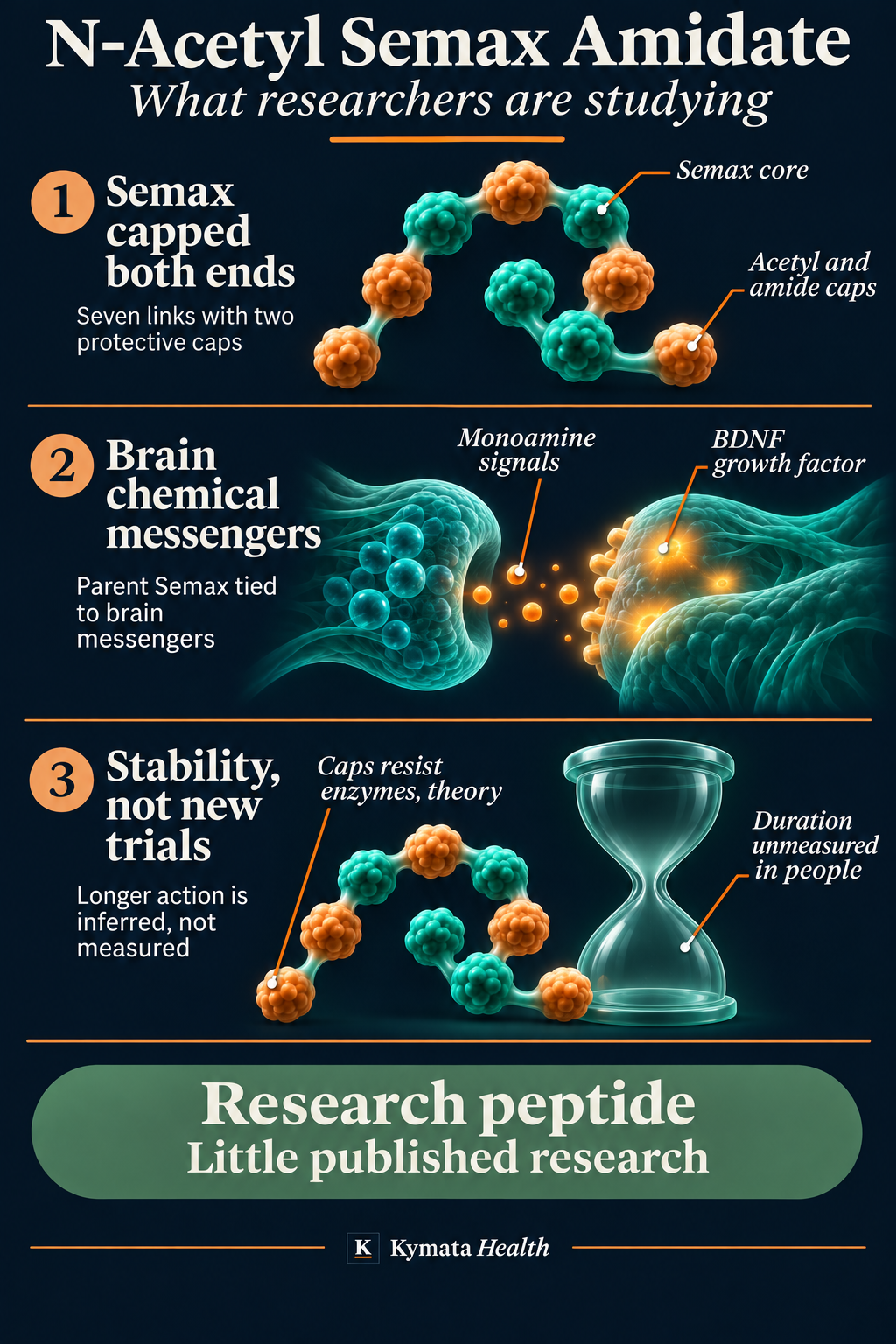
N-acetyl Semax amidate (NASA) is Semax with an N-acetyl cap and a C-terminal amide; it is not N-acetyl Selank amidate. Parent Semax is an ACTH 4–10 analog that Russian clinical literature links to BDNF and NGF and to monoamine signaling, with stroke studies using the unmodified peptide; longer action for the capped form is inferred from chemistry, not measured. Research peptide. No published human study of this form. Not FDA-approved. The drawing is a schematic, not a measured molecular structure, a product photograph or a treatment result. Illustration review: 19 November 2026, against this page’s own mechanism, evidence and regulatory records.
A sequence model is not provided for this record. Read the identity and evidence notes; an illustration does not verify a molecular structure.
Illustration notes and source record
Read the source record on this page. Laboratory, topical and injected studies are separate evidence; this illustration does not establish an indication or a treatment outcome.

How it works
SourcedA peptide chain is written from its amino end to its carboxyl end. Ordinary Semax is H–MEHFPGP–OH. An acetyl group at the front gives Ac–MEHFPGP–OH (N-acetyl Semax). The molecule on this page also has an amide at the back, Ac–MEHFPGP–NH₂. It is not N-acetyl Selank amidate.
Vanhee and colleagues (2020, PMID 31667971) built an LC-MS/MS screen for 10 research peptides sold online after identifying Semax and Selank in seized preparations from 2017 and 2018, and in their reference panel the N-acetyl Semax amidate standard (Ac-MEHFPGP-NH2, C39H54N10O10S) eluted at 10.26 minutes versus 10.89 minutes for acetyl-only N-acetyl Semax, with different fragment ions; no person was dosed.
A name search can hide the distinction. PubChem CID 172638603, titled N-acetyl semax amidate, has formula C39H54N10O10S (855.0 g/mol) with an acetylated methionine and an amidated C-terminal proline, and its depositor synonyms include both 2920938-90-3 and the misleading "N-acetyl semax". No breakdown measurement of the amidate has been published.
Source: Vanhee et al., 2020 (PMID 31667971), analytical reference standards
05 / Evidence and limits
Evidence and limits
Laboratory identification of reference standards · no human study
Human evidence
Laboratory identification of reference standards · no human study- Vanhee and colleagues (2020, PMID 31667971) built an LC-MS/MS screen for 10 research peptides sold online after identifying Semax and Selank in seized preparations from 2017 and 2018, and in their reference panel the N-acetyl Semax amidate standard (Ac-MEHFPGP-NH2, C39H54N10O10S) eluted at 10.26 minutes versus 10.89 minutes for acetyl-only N-acetyl Semax, with different fragment ions; no person was dosed.
- A ClinicalTrials.gov search for N-acetyl Semax amidate, Ac-MEHFPGP-NH2 and CAS 2920938-90-3 returned no registered studies (checked November 22, 2026).
Limits of current evidence
2 limits- The analytical comparison measured chemical identity. It did not measure breakdown in blood, delivery to the brain, memory or attention.
- Magrì and colleagues (2016, PMID 27586814) tested acetyl-only Semax, not the amidate, and found in cultured SH-SY5Y neuroblastoma cells that it did not protect against copper toxicity as parent Semax did. That finding does not transfer to the amidate.
What it is studied for
- Reference page for N-Acetyl Semax Amidate. Concentration arithmetic is not a treatment protocol.
Verdict
N-acetyl Semax amidate carries both an N-terminal acetyl group and a C-terminal amide (Ac-MEHFPGP-NH2), so a paper or product record must show both end groups to refer to this form. No human pharmacokinetic or safety data exist for it; the published work is a laboratory identification of a reference standard.
06 / Product forms and access
Product forms and access
Regulatory & legal status
- FDA status (US)
- Research OnlyDrugs@FDA lists no approved product containing Semax or N-acetyl Semax amidate. HHS’s October 2026 interim compounding policy covers Semax free base for intranasal use only and treats N-acetyl Semax and other analogs as outside it; the policy is not FDA approval
- WADA status (2026)
- Not ListedN-acetyl Semax amidate is not named on WADA’s 2026 Prohibited List, but class S0 prohibits any pharmacological substance not covered elsewhere that has no current governmental approval for human therapeutic use. Verify before competition.
- US compounding
- Not eligible / not available
07 / Tools and practical checks
Tools and practical checks
No separate record is provided here. Read the linked evidence and limitations for this compound.
08 / Published study use
Published study use
What published studies gave, in whom, and the source. Not a dose for you.
What studies used
No human study of this form- We found no published human study of N-acetyl Semax amidate. The Semax trials used the unmodified peptide in stroke patients.
- The amidate and acetyl-only Semax were compared as synthetic reference standards; they had separate retention times and fragment ions. No person was dosed. Vanhee 2020, PMID 31667971 (opens in new tab)
- A ClinicalTrials.gov search for N-acetyl Semax amidate, Ac-MEHFPGP-NH2 and CAS 2920938-90-3 returned no registered studies (checked November 22, 2026).
- The doses quoted online come from animal work and vendor or forum sources.
A record of what researchers gave, in whom; not a dose for you.
09 / Safety and interactions
Safety and interactions
What the record says
The reviewed evidence supplies no human dose, route, side-effect rate or interaction profile for the doubly modified peptide. The Russian Semax 0.1% nasal-drop instructions name only unmodified Semax (methionyl-glutamyl-histidyl-phenylalanyl-prolyl-glycyl-proline) and do not mention the acetylated or amidated forms. A laboratory reference standard cannot verify the contents of a particular bottle. Not N-acetyl Selank amidate (different peptide).
10 / Comparisons and goal guides
Comparisons and goal guides
N-Acetyl Semax Amidate vs. Semax
4 attributesCanonical comparison: N-Acetyl Semax Amidate vs Semax · Semax evidence profile
| Attribute | N-Acetyl Semax Amidate | Semax |
|---|---|---|
| Chain from start to finish | Ac–MEHFPGP–NH₂ | H–MEHFPGP–OH |
| What Vanhee and colleagues identified (PMID 31667971) | A synthetic reference standard in the laboratory panel | Recovered from seized samples |
| Russian nasal-drop leaflet | Not covered; the leaflet names unmodified Semax | Names this unmodified seven-amino-acid peptide |
| Human PK | Not published for this analog | Not established by the sources on this page |
11 / Common questions
Common questions
Common questions
5 answersIs N-acetyl Semax amidate the same as N-acetyl Semax?
No. The acetyl-only form ends in a free acid (Ac-MEHFPGP-OH); the amidate ends in an amide (Ac-MEHFPGP-NH2). In Vanhee 2020 the two standards had different retention times and fragment ions (PMID 31667971). PubChem lists "N-acetyl semax" as a depositor synonym on the amidate record, so the name alone can mislead.
What does the 10.26-minute result mean?
It was the time the amidate standard took to pass through the chromatography column in one laboratory method; the acetyl-only standard took 10.89 minutes. Neither number is a half-life or a duration of action in a person.
Do the Russian Semax nasal-drop instructions apply to this form?
No. The instructions name only unmodified Semax and do not mention the acetylated or amidated forms.
Is NASA the Selank analog?
No. NASA is N-Acetyl Semax Amidate. N-Acetyl Selank Amidate is the Selank twin. We keep them as separate library IDs.
Is N-Acetyl Semax Amidate FDA-approved?
No. Drugs@FDA lists no approved product containing Semax or N-acetyl Semax amidate. HHS’s October 2026 interim compounding policy covers Semax free base for intranasal use only and treats N-acetyl Semax and other analogs as outside it; the policy is not FDA approval.
12 / Sources and references
Sources and references
2 papers cited on this page.
Sources
2 papers- 1“The occurrence of putative cognitive enhancing research peptides in seized pharmaceutical preparations: An incentive for controlling agencies to prepare for future encounters of the kind.”Vanhee C, Francotte A, Janvier S, Deconinck E Drug Testing and Analysis (2020). PMID: 31667971 DOI: 10.1002/dta.2717
- 2“Influence of the N-terminus acetylation of Semax, a synthetic analog of ACTH(4-10), on copper(II) and zinc(II) coordination and biological properties.”Magrì A, Tabbì G, Giuffrida A, et al. Journal of Inorganic Biochemistry (2016). PMID: 27586814 DOI: 10.1016/j.jinorgbio.2016.08.013
14 / Prescription options
Prescription options
Prescription options: compare licensed telehealth providers
Some peptide therapies are available only by prescription after a consult with a licensed clinician.
Compare telehealth →15 / Peptide library
Peptide library
Keep reading: Peptide research library
Peptide research library: every pagePeptide libraryBrowse all topics
- SomatropinPrevious in this topic · 191-amino-acid recombinant human growth hormone, the hormone itself rather than a secretagogue.
- N-Acetyl SemaxNext in this topic · N-acetylated Semax without the C-terminal amide (Ac-MEHFPGP-OH).
- CJC-1295 + IpamorelinCJC-1295 and ipamorelin have been studied separately for their effects on growth hormone.
- Tesamorelin + IpamorelinClinic-style blend pairing FDA-approved tesamorelin (Egrifta, GHRH analog for HIV-associated lipodystrophy) with ipamorelin.
- Pentadeca arginateArginine salt of BPC-157 (the same 15-aa gastric peptide), sold as a distinct SKU from BPC-157 acetate.
Regulatory and sport classification
- Not FDA-approved, research chemical