
The peptide field guide
FOXO4-DRI
FOXO4-DRI is an experimental D-retro-inverso senolytic research peptide.
The reviewed cell and mouse work does not establish human antiaging benefit, safety, efficacy or dosing.
Explore this compoundIllustrative cellular context only; not a study image, diagnostic marker or depiction of cells being cleared.
02 / At a glance
At a glance
Key facts
- Also known as
- FOXO4-D-Retro-Inverso, Proxofim
- Type
- Longevity
- Evidence level
- Cell and animal research: human benefit remains unproven.
- US regulatory status
- Not FDA-approved, research chemical
- Updated
Identity
FOXO4-DRI is an experimental D-retro-inverso senolytic research peptide.
Research context
Baar’s 2017 preclinical work in cells and fast-ageing or naturally aged mice.
Evidence limits
The reviewed cell and mouse work does not establish human antiaging benefit, safety, efficacy or dosing.
Read the technical profile and study-use reference
Quick answer
Evidence: LowD-retro-inverso FOXO4/p53 interfering peptide from Baar 2017 mouse senolytic work. Not a frailty drug. Mouse doses do not translate into a human dose. Gray-market D-peptide authenticity is part of the risk.
- In published studies
- No human study published (mouse study, PMID 28340339)
Research summary, not medical advice.
At a glance
Kymata peptide profile · Oct 29, 2026- Common vials
- 10 mg / 50 mg
- Molecular weight
- ~3.1 kDa
- In published studies
- No human study published (mouse study, PMID 28340339)
- Half-life
- Extended (DRI design resists proteases)
- CAS
- N/A (custom research peptide)
03 / Identity and origin
Identity and origin
Also called FOXO4-D-Retro-Inverso, Proxofim. D-retro-inverso FOXO4/p53 interfering peptide (senolytic research).
Read the sequence and compound record
Compound card
- Class
- D-retro-inverso FOXO4/p53 interfering peptide (senolytic research)
- Formula
- D-retro-inverso peptide (custom synthesis)
- Molecular weight
- ~3.1 kDa
- CAS
- N/A (custom research peptide)
- PubChem CID
- N/A
- Described by
- Peter de Keizer, Utrecht University, 2017
- Bioavailability
- Intraperitoneal or subcutaneous injection
04 / How it may work
How it may work
D-retro-inverso FOXO4/p53 interfering peptide (senolytic research)
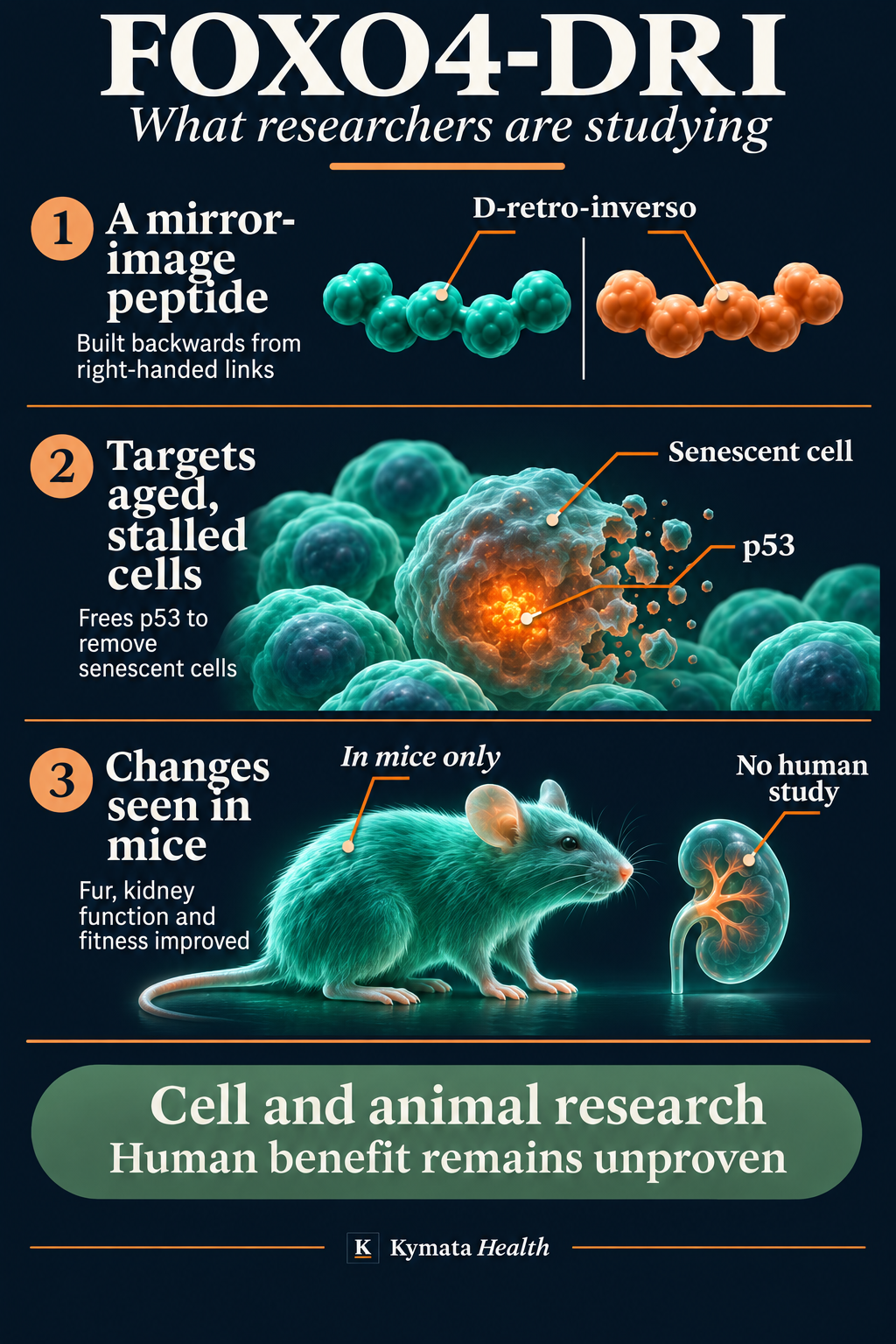
The guide shows FOXO4-DRI as a D-retro-inverso peptide, built from right-handed amino acids in reverse order, that interferes with FOXO4 binding p53 so senescent cells undergo programmed cell death. In mice, the 2017 study reported restored fur, kidney function and fitness (Baar 2017, PMID 28340339). No human study has been published. The drawing is a schematic, not a measured molecular structure, a product photograph or a treatment result. Illustration review: 22 November 2026, against this page’s own mechanism, evidence and regulatory records.
This record identifies a D-retro-inverso design. A standard one-letter residue model would not preserve that stereochemical scope, so no simplified sequence is inferred.
Illustration notes and source record
Read the source record on this page. Laboratory, topical and injected studies are separate evidence; this illustration does not establish an indication or a treatment outcome.

How it works
SourcedFOXO4-DRI is a D-retro-inverso (DRI) peptide that selectively induces apoptosis (programmed cell death) in senescent cells while leaving healthy cells unharmed. It is the first rationally designed peptide-based senolytic.
In senescent cells, the FOXO4 transcription factor binds and sequesters p53 in the cytoplasm, preventing p53 from entering the nucleus and triggering apoptosis. Senescent cells are otherwise resistant to normal cell death despite accumulating DNA damage. FOXO4-DRI competes with endogenous FOXO4 for p53 binding, freeing p53 to translocate to the nucleus and activate apoptotic gene programs. The D-retro-inverso (mirror amino acid) design makes it resistant to protease degradation, enabling systemic activity.
In mouse studies, FOXO4-DRI reversed aging phenotypes including fur loss/discoloration, renal dysfunction, and physical frailty. Liver senescent cell burden was reduced significantly after just 3 doses. This is a landmark proof-of-concept for senolytic peptide therapy.
Source: PMID: 28340339
Background & History
FOXO4-DRI is a D-amino acid retro-inverso peptide designed to disrupt the interaction between FOXO4 and p53 inside senescent cells. Developed by Peter de Keizer at the Princess Máxima Center (Netherlands), it was published in Cell (2017) showing it selectively induced apoptosis in senescent cells, the first demonstration that targeted senolysis with a peptide was achievable. This landmark paper established FOXO4-DRI as a potentially transformative longevity compound. It specifically kills senescent cells (which drive aging via SASP) while leaving normal cells unaffected.
05 / Evidence and limits
Evidence and limits
Limits of current evidence
2 limits- Mouse doses do not translate into a human dose; no human study has been published.
- This site will not treat aging or cancer from a FOXO4 page.
What it is studied for
- Identity: Baar 2017 mouse senolytic vs a gray-market D-peptide
- Do not scale mouse mg/kg onto a human
- Not a frailty or cancer protocol on this site
Verdict
FOXO4-DRI is an experimental senolytic peptide from mouse work. It is not a frailty drug. Killing senescent cells in mice is not a human anti-aging NDA. Cost and authenticity of gray-market D-peptides are part of the risk.
06 / Product forms and access
Product forms and access
Regulatory & legal status
- FDA status (US)
- Research Only
- WADA status (2026)
- Not ListedNot currently on the WADA 2026 Prohibited List. Policies may change. Verify before competition.
- US compounding
- Not eligible / not available
07 / Tools and practical checks
Tools and practical checks
Dose it
10 mg + 2 mL BAC water → 5 mg/mL · 1 unit (U-100) = 50 mcg.
Reconstitution math
U-100 syringe| Vial | Water | Concentration |
|---|---|---|
| 10 mg lyophilized | 2 mL BAC | 5 mg/mL |
08 / Published study use
Published study use
What published studies gave, in whom, and the source. Not a dose for you.
What studies used
No human study- We found no published human study.
- It was designed and tested in cells and in mice, including fast-ageing and naturally aged mice. Baar 2017, PMID 28340339 (opens in new tab)
A record of what researchers gave, in whom; not a dose for you.
Administration
- Route / form
- Not established: no human study.
Who it is for
2 uses| Category | Fit | What exists |
|---|---|---|
| Senolytic / Cellular Rejuvenation | Low | Most targeted senolytic peptide known. Proof-of-concept in mice is compelling, but human data is very limited. |
| Longevity Research | Low | Represents a new class of aging intervention. Suitable only for experimental longevity research. |
09 / Safety and interactions
Safety and interactions
What the record says
Research peptide with very limited human data. Initial mouse studies are promising but not equivalent to human safety data. May cause transient inflammation as senescent cells are cleared. Not recommended for cancer patients. Very expensive custom synthesis. Completely experimental. Use only under physician supervision.
Interactions & Contraindications
Experimental compound. Very limited human data. Induces apoptosis specifically in p21-positive senescent cells. Theoretical concern: some senescent cells serve protective roles (wound healing senescence, placental cells). Unknown impact with repeated dosing. No human study has tested any schedule: the quarterly-cycle wording in circulation traces to the mouse work that introduced the peptide (Baar 2017, PMID 28340339), not to a clinical protocol.
10 / Comparisons and goal guides
Comparisons and goal guides
Appears in goal guides
1 guideGoal guides give the evidence and status for each compound, with no doses. A mention here is not a treatment plan.
11 / Common questions
Common questions
Common questions
3 answersHow does FOXO4-DRI kill senescent cells?
Senescent cells survive because FOXO4 traps p53, preventing it from triggering cell death. FOXO4-DRI competes with FOXO4 for p53 binding, freeing p53 to enter the nucleus and activate apoptosis. Healthy cells are unaffected: they don't rely on this FOXO4-p53 survival mechanism.
What dose did studies use for FOXO4-DRI?
We found no published human study. It was designed and tested in cells and in mice, including fast-ageing and naturally aged mice (PMID 28340339). We do not give a dose.
Is FOXO4-DRI FDA-approved?
No. Not FDA-approved, research chemical.
12 / Sources and references
Sources and references
1 paper cited on this page.
Sources
1 paper- 1“"Targeted Apoptosis of Senescent Cells Restores Tissue Homeostasis".”Baar MP, Brandt RMC, Putavet DA, Klein JDD, de Keizer PLJ et al. Cell (2017). PMID: 28340339
14 / Prescription options
Prescription options
Prescription options: compare licensed telehealth providers
Some peptide therapies are available only by prescription after a consult with a licensed clinician.
Compare telehealth →15 / Peptide library
Peptide library
Keep reading: Peptide research library
Peptide research library: every pagePeptide libraryBrowse all topics
- TriptorelinPrevious in this topic · Triptorelin is a D-Trp6 GnRH agonist.
- Follistatin 344Next in this topic · Follistatin-344 is the precursor from which cells make the circulating protein FS315.
- KisspeptinKisspeptin is the hypothalamic peptide that stimulates GnRH release through the KISS1R receptor; infusions have been studied in small human physiology trials in healthy…
- Sermorelin + Ipamorelin ComboTwo peptides in one syringe or compounded vial: GHRH(1-29) plus ipamorelin.
- PinealonPinealon is Glu-Asp-Arg (EDR), a synthetic tripeptide.
Regulatory and sport classification
- Not FDA-approved, research chemical