
The peptide field guide
N-Acetyl Semax
N-acetyl Semax is Semax, the ACTH 4–10 heptapeptide analog, with an N-terminal acetyl cap and no C-terminal amide; it sits between Semax and N-acetyl Semax amidate (NASA).
Research peptide. No published human study of this form. Not FDA-approved.
Explore this compoundConceptual editorial illustration; not a measured molecular structure, product photograph or treatment result.
02 / At a glance
At a glance
Key facts
- Also known as
- Ac-Semax, NAS, acetylated Semax
- Sequence
- Ac–MEHFPGP–OH
- Evidence level
- Research peptide: little published research.
- US regulatory status
- Not FDA-approved, research chemical
- Updated
Identity
N-acetyl Semax is Semax, the ACTH 4–10 heptapeptide analog, with an N-terminal acetyl cap and no C-terminal amide; it sits between Semax and N-acetyl Semax amidate (NASA).
Research context
Russian clinical literature links parent Semax to BDNF and NGF in the brain, and its stroke studies used the unmodified peptide; the acetyl cap is meant to reduce aminopeptidase breakdown, which no human study has measured.
Evidence limits
Research peptide. No published human study of this form. Not FDA-approved.
Read the technical profile and study-use reference
Quick answer
Evidence: LowN-acetylated Semax without the C-terminal amide (Ac-MEHFPGP-OH). Researchers have tested its resistance to enzymatic breakdown and its copper and zinc binding in the laboratory; no human pharmacokinetic or clinical study of this form was found.
- In published studies
- No human study of this form published
Research summary, not medical advice.
At a glance
Kymata peptide profile · Nov 22, 2026- CAS
- N/A
- In published studies
- No human study of this form published
- Half-life
- Human half-life not established for Ac-Semax
- Common vials
- Nasal spray or research vial; no sourced vial preset in this calculator
- Molecular weight
- Monoisotopic mass 855.3585 Da (Vanhee 2020)
03 / Identity and origin
Identity and origin
Also called Ac-Semax, NAS, acetylated Semax. Semax heptapeptide with an N-terminal acetyl group and a free C-terminal acid.
Read the sequence and compound record
Compound card
- Sequence
- Ac–MEHFPGP–OH
- Class
- Semax heptapeptide with an N-terminal acetyl group and a free C-terminal acid
- Formula
- C39H53N9O11S (Ac-MEHFPGP-OH)
- Molecular weight
- Monoisotopic mass 855.3585 Da (Vanhee 2020)
- CAS
- N/A
- Described by
- Semax lineage
- Bioavailability
- Human absorption and brain exposure are unestablished for this preparation
04 / How it may work
How it may work
Semax heptapeptide with an N-terminal acetyl group and a free C-terminal acid
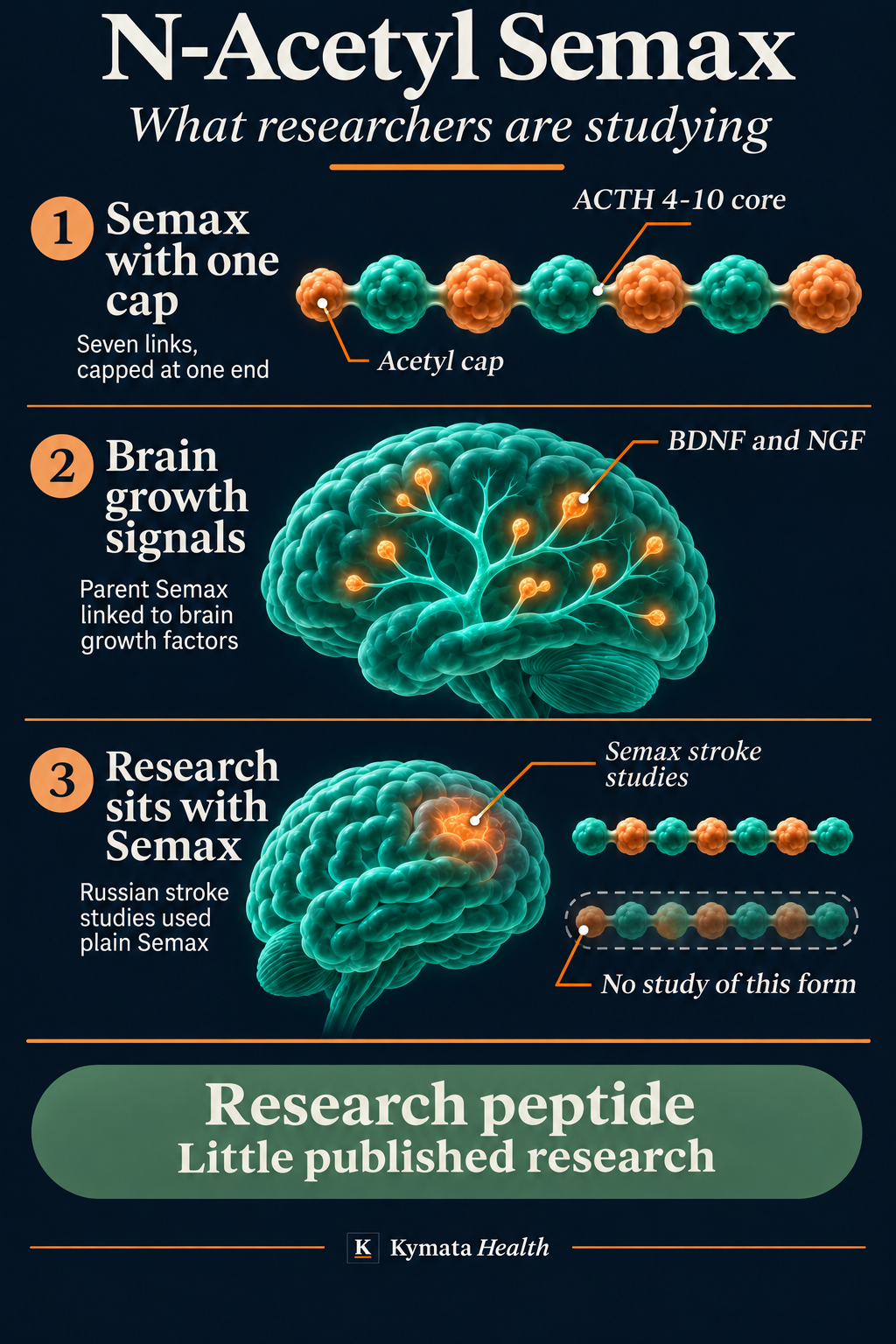
N-acetyl Semax is Semax, the ACTH 4–10 heptapeptide analog, with an N-terminal acetyl cap and no C-terminal amide; it sits between Semax and N-acetyl Semax amidate (NASA). Russian clinical literature links parent Semax to BDNF and NGF in the brain, and its stroke studies used the unmodified peptide; the acetyl cap is meant to reduce aminopeptidase breakdown, which no human study has measured. Research peptide. No published human study of this form. Not FDA-approved. The drawing is a schematic, not a measured molecular structure, a product photograph or a treatment result. Illustration review: 19 November 2026, against this page’s own mechanism, evidence and regulatory records.
A sequence model is not provided for this record. Read the identity and evidence notes; an illustration does not verify a molecular structure.
Illustration notes and source record
Read the source record on this page. Laboratory, topical and injected studies are separate evidence; this illustration does not establish an indication or a treatment outcome.

How it works
SourcedN-acetyl Semax is the Semax heptapeptide Met-Glu-His-Phe-Pro-Gly-Pro with an acetyl group on its N-terminus and a free C-terminal acid (Ac-MEHFPGP-OH, C39H53N9O11S in Vanhee and colleagues' 2020 reference table), which differs from the amidate (Ac-MEHFPGP-NH2). Semax acetate names a salt of the parent peptide; its acetate counterion is separate from the peptide chain.
Shevchenko and colleagues (2013, PMID 23652441) measured how acetylated Semax resisted enzymatic breakdown in biological media in vitro, a laboratory design that gives no human half-life, exposure or dose. In chemical assays and cultured human SH-SY5Y neuroblastoma cells, Magrì and colleagues (2016, PMID 27586814) found that N-terminal acetylation changed how Semax binds copper, left zinc binding of comparable strength, and removed the protection against copper toxicity seen with parent Semax; no person received either peptide.
Source: Shevchenko et al., 2013 (PMID 23652441) and Magrì et al., 2016 (PMID 27586814)
05 / Evidence and limits
Evidence and limits
Limits of current evidence
3 limits- No human pharmacokinetic or clinical study of N-acetyl Semax was found; the published work on this form is laboratory chemistry and cell experiments.
- The copper experiment used cultured human SH-SY5Y neuroblastoma cells. No person received Ac-Semax.
- N-acetyl Semax amidate (acetyl plus C-terminal amide) is a different molecule. An Ac-Semax finding does not establish how the amidate behaves.
What it is studied for
- Enzyme breakdown
- Copper and zinc binding
- A test in cultured cells
Goal context
3 goals- Enzyme breakdown
- Shevchenko and colleagues (2013, PMID 23652441) measured how acetylated Semax resisted enzymatic breakdown in biological media in vitro. That design gives no human half-life, exposure or dose.
- Copper and zinc binding
- Magrì and colleagues (2016, PMID 27586814) found that N-terminal acetylation changed how Semax binds copper and left zinc binding of comparable strength.
- A test in cultured cells
- In cultured human SH-SY5Y neuroblastoma cells, Ac-Semax lacked the protection against copper toxicity seen with parent Semax (PMID 27586814). No person received either peptide.
Verdict
N-acetyl Semax (Ac-Semax) has been studied only in laboratory chemistry and cell experiments. No human pharmacokinetic or clinical study of this form was found, so its effects on memory, attention or exposure in people are unknown.
06 / Product forms and access
Product forms and access
Regulatory & legal status
- FDA status (US)
- Research OnlyNo FDA-approved indication. HHS’s October 2026 interim compounding policy names parent Semax free base for intranasal use and lists N-acetyl Semax among the analogs outside it; the policy is not FDA approval
- WADA status (2026)
- Not ListedN-acetyl Semax is not named on WADA’s 2026 Prohibited List, but class S0 prohibits any pharmacological substance not covered by other sections that has no current governmental approval for human therapeutic use. Verify before competition.
- US compounding
- Not eligible / not available
07 / Tools and practical checks
Tools and practical checks
No separate record is provided here. Read the linked evidence and limitations for this compound.
08 / Published study use
Published study use
What published studies gave, in whom, and the source. Not a dose for you.
What studies used
No human study of this form- We found no published human study of N-acetyl Semax. The Semax trials used the unmodified peptide in stroke patients.
- Resistance of acetylated Semax to enzymatic breakdown was measured in biological media in vitro; this gives no human half-life, exposure or dose. Shevchenko 2013, PMID 23652441 (opens in new tab)
- Copper and zinc binding were measured in chemical assays and cultured SH-SY5Y cells; no person received the peptide. Magrì 2016, PMID 27586814 (opens in new tab)
- The doses quoted online come from animal work and vendor or forum sources.
A record of what researchers gave, in whom; not a dose for you.
Administration
- Route / form
- Not established: no human study.
Who it is for
1 use| Category | Fit | What exists |
|---|---|---|
| Cognitive research | Low | Laboratory chemistry and cell studies only. The human Semax studies used the unmodified peptide. |
09 / Safety and interactions
Safety and interactions
What the record says
Research analog. The two cited laboratory studies do not establish a safe human dose, route, interaction profile or long-term safety. The Russian instructions for Semax 0.1% nasal drops give the active substance as unmodified methionyl-glutamyl-histidyl-phenylalanyl-prolyl-glycyl-proline, with no acetyl or amide modification.
10 / Comparisons and goal guides
Comparisons and goal guides
There is no separate comparison record on this page. Similar names do not establish that products or their evidence are interchangeable.
11 / Common questions
Common questions
Common questions
6 answersWhich Semax derivative was actually studied?
The proteolysis paper (PMID 23652441) and the copper-and-zinc paper (PMID 27586814) examined Ac-Semax: an acetyl group at the front of the seven-amino-acid chain and a free acid at the back. The amidate also changes that back end. The Russian nasal-drop instructions name unmodified Semax.
Does N-acetyl Semax last longer in people?
Unknown. The proteolysis experiment measured breakdown in biological media in vitro, which gives no human half-life, exposure or dose. No human pharmacokinetic study of this form was found.
What does the copper study tell us about cognition?
Nothing directly. The researchers measured copper and zinc chemistry and a response in cultured SH-SY5Y cells; acetylation removed the protection against copper toxicity seen with parent Semax. No person was tested.
Is N-acetyl Semax the form in the US compounding policy?
No. HHS’s October 2026 interim compounding policy names parent Semax free base for intranasal use and lists N-acetyl Semax among the analogs outside it; the policy is not FDA approval.
NASA vs N-acetyl Semax vs Semax?
Semax = parent. N-acetyl Semax = acetyl only. NASA = acetyl + amide. No published human pharmacokinetic study compares them.
Is N-Acetyl Semax FDA-approved?
No. No FDA-approved indication. HHS’s October 2026 interim compounding policy names parent Semax free base for intranasal use and lists N-acetyl Semax among the analogs outside it; the policy is not FDA approval.
12 / Sources and references
Sources and references
2 papers cited on this page.
Sources
2 papers- 1“Stability of Semax acetyl to proteolysis in various biological media.”Shevchenko KV, Nagaev IY, Andreeva LA, Shevchenko VP, Myasoedov NF Doklady Biological Sciences (2013). PMID: 23652441 DOI: 10.1134/S0012496613020166
- 2“Influence of the N-terminus acetylation of Semax, a synthetic analog of ACTH(4-10), on copper(II) and zinc(II) coordination and biological properties.”Magrì A, Tabbì G, Giuffrida A, et al. Journal of Inorganic Biochemistry (2016). PMID: 27586814 DOI: 10.1016/j.jinorgbio.2016.08.013
14 / Prescription options
Prescription options
Prescription options: compare licensed telehealth providers
Some peptide therapies are available only by prescription after a consult with a licensed clinician.
Compare telehealth →15 / Peptide library
Peptide library
Keep reading: Peptide research library
Peptide research library: every pagePeptide libraryBrowse all topics
- N-Acetyl Semax AmidatePrevious in this topic · N-terminal acetylated, C-terminal amidated Semax (Ac-MEHFPGP-NH2).
- CJC-1295 + IpamorelinNext in this topic · CJC-1295 and ipamorelin have been studied separately for their effects on growth hormone.
- Tesamorelin + IpamorelinClinic-style blend pairing FDA-approved tesamorelin (Egrifta, GHRH analog for HIV-associated lipodystrophy) with ipamorelin.
- Pentadeca arginateArginine salt of BPC-157 (the same 15-aa gastric peptide), sold as a distinct SKU from BPC-157 acetate.
- AHK-CuCopper-complexed tripeptide Ala-His-Lys, the GHK-Cu sibling used in hair and cosmetic SKUs.
Regulatory and sport classification
- Not FDA-approved, research chemical