Evidence explainer · Digestion & Nutrient Absorption
How Digestion Works: The Food Route and the Organs That Help
Follow the contents of a meal from the stomach to the intestines, while keeping the liver, gallbladder and pancreas in their correct supporting roles.
- Question
- Does food pass through every organ involved in digestion?
- Sources
- 3 cited
- Quick answers
- 3 questions
- Clinician review
- None; sources cited inline
In short
Key takeaways
- Food travels through a connected tract; it does not travel through the liver, gallbladder or pancreas.1
- The stomach mixes food, while the small intestine carries out much of nutrient digestion and absorption.1
- Understanding these roles helps separate a biological function from a claim about an enzyme supplement.3
Chapter
One route, several different jobs
Digestion starts before food reaches the stomach. Chewing and saliva begin the process, and coordinated muscular movement called peristalsis moves swallowed food through the esophagus and onward. In the stomach, muscle, acid and digestive enzymes mix the contents. The stomach then releases material into the small intestine.1
Think of this as a sequence of jobs, not a single container that finishes the whole meal. Mixing, chemical breakdown, absorption and movement overlap. Start Follow a meal to see where the selected organs fit. The model is a general reference and does not reproduce a person’s transit time or symptoms.
Chapter
The supporting organs send fluids, not food
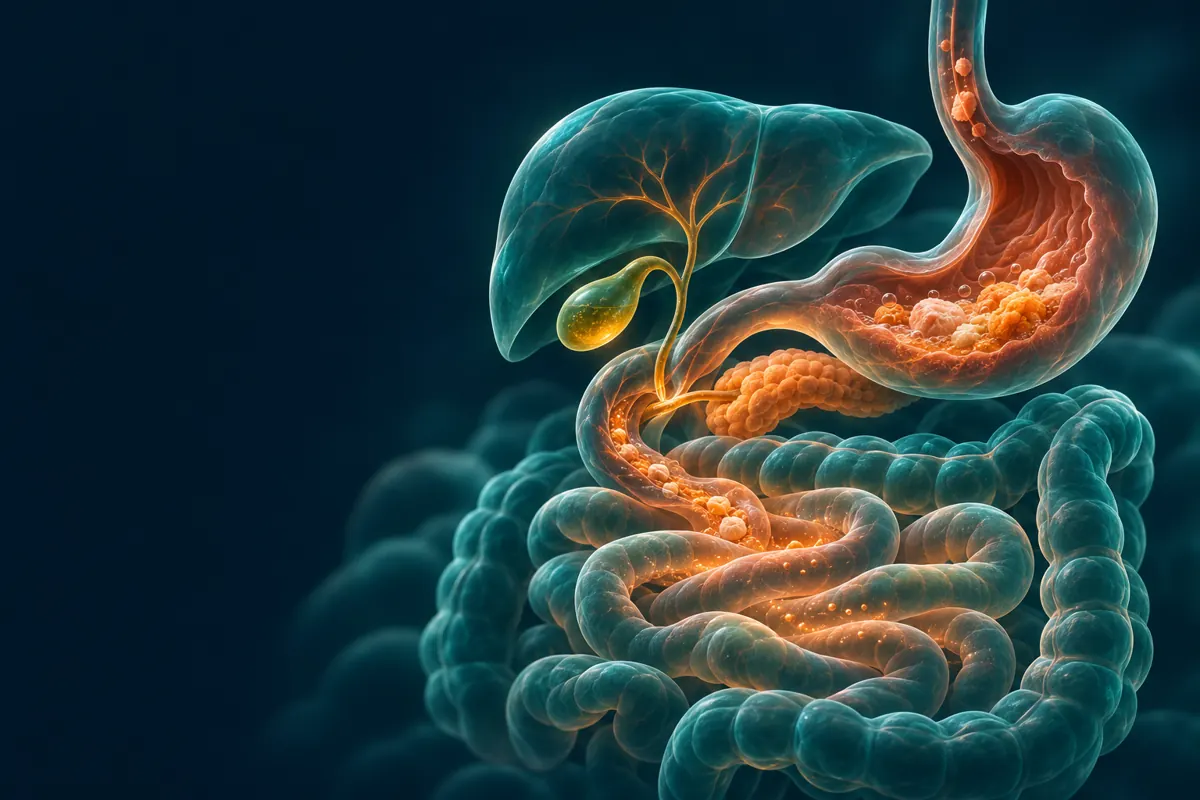
The liver makes bile. The gallbladder stores bile between meals and releases it through ducts toward the small intestine. Bile helps the body handle fats. The pancreas supplies digestive juice containing enzymes that help break down carbohydrates, fats and proteins.1
Food contents meet these fluids in the intestine. They do not take a detour through the liver or pancreas. This distinction matters when a diagram shows several digestive organs together: nearby structures can contribute to the same process without being part of the food’s route.
Chapter
The intestine is where breakdown becomes absorption
The small intestine receives bile and pancreatic juice and adds its own digestive contributions. Nutrients then cross the intestinal lining. Different nutrients have different handling steps; some enter blood directly, while many fats first enter the lymphatic circulation.1
Vitamin B12 is a useful example of coordination. Food-bound B12 must be released, bind to proteins and eventually reach an absorption site in the last part of the small intestine. Read where nutrients are absorbed for that sequence and the limits of the explorer’s reference mesh.2
Chapter
What this means for digestive-product claims
Knowing that an organ makes an enzyme does not establish that everyone needs to take that enzyme. When someone has exocrine pancreatic insufficiency, clinicians can prescribe pancreatic enzyme replacement therapy and monitor nutrition. That is a specific clinical situation, not a general conclusion from a diagram.3
Before comparing products, separate fiber, probiotics and enzymes. Then use the digestive enzyme guide to examine formulation and evidence. Neither a body illustration nor a product label can explain the cause of persistent symptoms.
Questions
Quick answers
Does food go through the liver?
No. Food stays within the digestive tract. The liver makes bile and processes absorbed nutrients, but it is not a chamber that food passes through.1
Are the small intestine and colon doing the same job?
No. The small intestine performs much of nutrient digestion and absorption. The colon is part of the large intestine, which absorbs water and helps form and move stool. Their functions overlap in some ways but are not interchangeable.1
Does understanding the pancreas mean I need digestive enzymes?
No. Prescription enzyme replacement is used for specific diagnosed problems such as pancreatic insufficiency. A normal physiological role does not establish a need for a supplement.3
Keep reading
More in Digestion & Nutrient Absorption
Researched and written by Kymata Health Editorial; sources cited inline. Drawn from the studies and documents cited below. Educational only, not medical advice.
Sources
References
Every study and document cited in this guide, numbered as in the text.
- 1Your Digestive System & How It Works (accessed 2026). NIDDK, 2026.
- 2Vitamin B12: Health Professional Fact Sheet (accessed 2026). NIH Office of Dietary Supplements, 2026.
- 3Treatment for Exocrine Pancreatic Insufficiency (accessed 2026). NIDDK, 2026.
Dietary supplements are not intended to diagnose, treat, cure or prevent any disease, and these statements have not been evaluated by the FDA. Prescription options need a licensed clinician. Talk to your clinician or pharmacist before starting anything new, especially if you take prescription medicines, are pregnant or breastfeeding.