Mind Lab Pro review: what is in it and what the trials measured
Mind Lab Pro is the caffeine-free nootropic from Performance Lab Group Ltd. We checked each of its 11 disclosed ingredients against human trials and read the three trials of the finished formula, two of them funded by the maker. Our grade is C: every dose is on the label, but the trials are small.
By Kymata Health Editorial · Labels and prices checked on mindlabpro.com · Sources cited inline
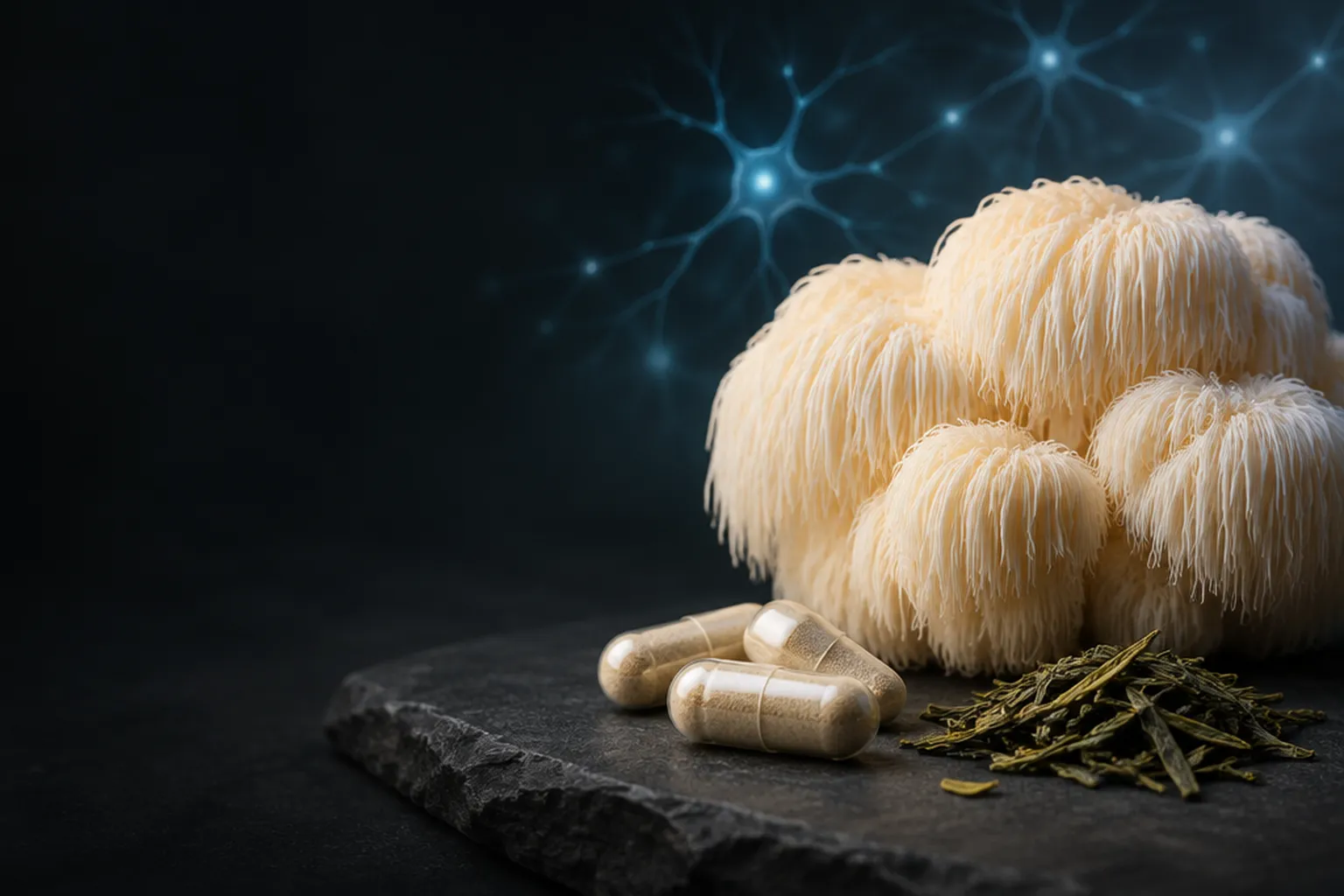
A caffeine-free nootropic capsule with 11 disclosed actives: citicoline, lion’s mane, phosphatidylserine, bacopa, N-acetyl L-tyrosine, L-theanine, rhodiola, maritime pine bark and three B vitamins. Non-GMO, gluten and soy free (label), with a vegan mark on the brand’s page. 60 capsules a bottle.
The finished formula has three published trials. A 2023 pseudo-randomized trial funded by the maker gave it or a placebo to 49 healthy adults for 30 days and found better immediate and delayed recall than placebo on the Wechsler Memory Scale, with uneven groups of 36 on the product and 13 on placebo (PMID 37194920). A 2025 trial, also funded by the maker, found no change in decision accuracy or reaction time after 60 days, only changes in EEG measures of brain activity (PMID 40149748). A third trial, in the Biomedical Journal of Scientific and Technical Research, measured reaction time and is not indexed in PubMed. Some single ingredients sit below their own trial amounts. Bacopa trials in older adults used 300 mg a day for 12 weeks (PMID 18611150), and the L-theanine attention meta-analysis used a 200 mg single dose (PMID 42410082).
CGrade C
Two small trials of the finished product, both funded by its maker: one found better recall than placebo, the other found EEG changes but no better decision accuracy or speed. Uneven groups, small samples and maker funding keep it at C. Every amount is on the label, which lets each ingredient be checked against its own research.
Fits Adults who want a caffeine-free focus formula with every dose on the label, and who accept limited evidence funded by the maker. It contains lion’s mane as one of 11 actives, so it is not a single-ingredient lion’s mane product.
Caution: Contains N-acetyl L-tyrosine, bacopa and rhodiola: check with a pharmacist first if you take an MAO inhibitor, thyroid medicine or other prescription medicines.
Buying links coming soon
Checked Nov 25, 2026
Our verdict
Best for:adults who want a caffeine-free focus formula with every dose on the label.
Standout:one of the few nootropics tested as a finished product, with three published trials, two of them funded by the maker.
Watch out for:several ingredients sit below the amounts their own trials used, and the formula trials are small.
Mind Lab Pro lineup at a glance
Mind Lab Pro lineup: category, label dose, evidence grade, one-time price per serving and certification
Evidence grade: A strong · B moderate · C limited · D preliminary. One-time price per serving, checked Nov 25, 2026.
Who Mind Lab Pro is
Mind Lab Pro is made by Performance Lab Group Ltd., which its terms page lists in Royal Leamington Spa, England, with a US arm, Performance Lab USA Corp. The same company sells the Performance Lab range, and the Performance Lab store lists Mind Lab Pro at the same price.
The capsule holds 11 actives at disclosed amounts: citicoline, lion’s mane, phosphatidylserine, bacopa, N-acetyl L-tyrosine, L-theanine, rhodiola, maritime pine bark and vitamins B6, B9 and B12. It contains no caffeine. The brand says it is made in New Jersey and that finished batches are third-party tested.
What the brand statesFrom mindlabpro.com
Company
Performance Lab Group Ltd., Royal Leamington Spa, England, with Performance Lab USA Corp in the US source
Made in
New Jersey, USA (brand statement) source
Caffeine
None (label) source
Batch certificates
Certificate of analysis lookup by batch number source
Testing and certifications
The brand says it quarantines and tests every incoming ingredient, re-tests finished batches for potency and purity, and has them third-party tested. Its site offers a certificate of analysis lookup by batch number and shows marks from Clean Label Project, ConsumerLab, Labdoor and Illuminate Labs, plus GMP and vegan marks. These are what the brand reports. We have not checked each certifier’s own listing.
What we confirmedChecked Nov 25, 2026
Ingredient testingIncoming ingredients are quarantined and tested before manufacturing (brand statement). source
Finished batchesFinished batches are re-tested for potency, purity and activity, and third-party tested for purity and potency (brand statement). source
Certificates of analysisA batch-number lookup returns the third-party certificate of analysis. source
Marks shownClean Label Project, ConsumerLab, Labdoor, Illuminate Labs, GMP and vegan marks (brand-reported). source
Pros and cons
What we like
Every amount is on the label, with no proprietary blend.
Caffeine free, vegan and free of gluten and soy (label).
Tested as a finished formula in published trials, and the brand offers batch certificates of analysis.
What to weigh
Two of the three formula trials were funded by the maker, and the groups were small.
Bacopa, L-theanine and lion’s mane sit below the amounts their own trials used.
At $2.30 a serving it costs more than buying a single well-studied ingredient such as L-theanine or citicoline.
Safety notes
Contains N-acetyl L-tyrosine: avoid with MAO inhibitors, and check with your pharmacist if you take thyroid medicine.
Contains bacopa and rhodiola, which have reported interactions with some prescription medicines: check with your pharmacist first.
Not studied in pregnancy or breastfeeding.
Supplements can interact with prescription medicines. Check with your doctor or pharmacist before starting.
Not medical advice. Ask your clinician before starting anything new.
Three trials have tested the finished Mind Lab Pro formula. A 2023 trial funded by the maker found better immediate and delayed recall than placebo in 49 healthy adults over 30 days. A 2025 trial, also funded by the maker, found EEG changes after 60 days but no better decision accuracy or reaction time. A third trial measured reaction time. We grade it C: promising but limited.
How do the citicoline and lion’s mane amounts compare with the research?
In Mind Lab Pro, citicoline (250 mg) is at a trialed amount: a 28-day trial in adolescent males gave 250 or 500 mg a day and found better attention and motor speed than placebo (PMID 26179181), and a 12-week trial in healthy older adults gave 500 mg a day and found better overall memory (PMID 33978188). Lion’s mane (500 mg) is below its trials, which gave healthy young adults 1.8 g (PMID 38004235). We grade lion’s mane D for cognition: small trials, mixed results.
How do the bacopa and phosphatidylserine amounts compare?
In Mind Lab Pro, bacopa (150 mg, 24% bacosides) is half the 300 mg a day used in a 12-week trial in adults 65 and over that found better delayed word recall (PMID 18611150). A 2025 trial at 300 mg a day in adults 40 to 70 found no difference from placebo (PMID 41091332). Phosphatidylserine (100 mg) matches the lower arm of a 6-month trial of 100 or 300 mg a day in adults 50 to 69 with memory complaints, where memory improved mainly in people who started with low scores (PMID 21103034). That trial used soy phosphatidylserine, and this label uses sunflower.
What do the L-theanine, N-acetyl L-tyrosine and rhodiola add?
In Mind Lab Pro, L-theanine (100 mg) is half the 200 mg single dose that improved choice reaction time in a meta-analysis of 31 trials (PMID 42410082). N-acetyl L-tyrosine (175 mg) is a different form from the L-tyrosine in the trials, where a 2,000 mg single dose before a stressful drill gave fewer missed Stroop responses (PMID 38975711). Rhodiola (50 mg) is well below the 576 mg a day of a 28-day trial in adults with stress-related fatigue (PMID 19016404).
What about the maritime pine bark and the B vitamins?
The Mind Lab Pro label lists 75 mg of maritime pine bark extract (95% proanthocyanidins) without naming a branded extract. Our pine bark page covers Pycnogenol, whose trials are mostly about blood pressure, not thinking. The B6, B9 and B12 are near or above their daily values. In a Cochrane review of 14 trials, B vitamins had little or no effect on overall thinking in people without cognitive problems (PMID 30556597).
Who is Mind Lab Pro not for?
People taking an MAO inhibitor (it contains N-acetyl L-tyrosine), people on thyroid medicine or other prescription medicines unless their pharmacist agrees, and anyone pregnant or breastfeeding, since it has not been studied there. If you want one well-studied ingredient, a single citicoline or L-theanine product costs less per serving.
Does Mind Lab Pro contain caffeine?
No. The Mind Lab Pro label lists no caffeine or other stimulant.
Is Mind Lab Pro a lion’s mane supplement?
Mind Lab Pro contains 500 mg of organic lion’s mane per serving as one of 11 actives, so it is a combination formula, not a single-ingredient lion’s mane product.
How much does Mind Lab Pro cost?
One bottle of 60 capsules (30 servings) was $69 on mindlabpro.com on Nov 25, 2026, the same list price as in the Performance Lab store. We did not verify any multi-bottle or subscription price.
Ask about Mind Lab Pro
Answers come from this page and our evidence pages, with links. Ask Kymata never ranks a partner or suggests a dose.
Sources
Label doses, prices and certifications come from Mind Lab Pro's own product pages, read Nov 25, 2026. Studies were checked on PubMed the same day.