Search
Conceptual cover for “Why Isn’t My GLP-1 Working? Plateaus, Slow Responders and What the Trials Show”.

Why Isn’t My GLP-1 Working? Plateaus, Slow Responders and What the Trials Show

In the Wegovy and Zepbound trials, most people lost 5% or more, at different speeds. Here is what labels and guidelines tell clinicians to check when it stalls.

By Kymata Health EditorialPublished 10 min read15 sourcesNo paid links in this articleEducation, not medical advice

Quick answer

A GLP-1 that seems not to work is usually early, slower than average, or at a plateau, not failing. In the label trials, 83.5% of adults on Wegovy injection and 90.9% on Zepbound’s highest dose lost at least 5% of their weight, but about 1 in 6 on Wegovy did not. Weight loss is fastest in the first six months and levels off by about 18 months. Both labels start low and raise the dose gradually, so the full effect is not expected in the first months. Guidelines tell clinicians to look at time on treatment, missed doses, storage, other medicines that promote weight gain, sleep, alcohol and hormonal conditions. Whether to change the dose or the drug is the prescriber’s decision. When cost or coverage is the real barrier, that is a separate problem with its own tools.

Researched and written by Kymata Health EditorialSources cited inlineHow we checkReport an error

In short

Most people on Wegovy or Zepbound lose a meaningful amount of weight, but not at the same speed, and not everyone reaches the trial averages. In the labels’ main trials, about 1 in 6 people on Wegovy injection and about 1 in 11 on Zepbound’s highest dose lost less than 5% of their body weight over 68 to 72 weeks.

  • Early: both labels start low and raise the dose gradually, so the full effect is not expected in the first months.
  • Slower responder: normal in every trial. Women, and people with lower HbA1c, tended to lose more (PMID 40673264).
  • Plateau: expected. Loss is fastest in the first six months and levels off by about 18 months (PMID 40673264).
  • Something in the way: guidelines tell clinicians to check missed doses, storage, other medicines, sleep, alcohol and hormonal conditions (PMID 41502845).
At a glance

Compounds

What “working” looks like in the Wegovy and Zepbound trials

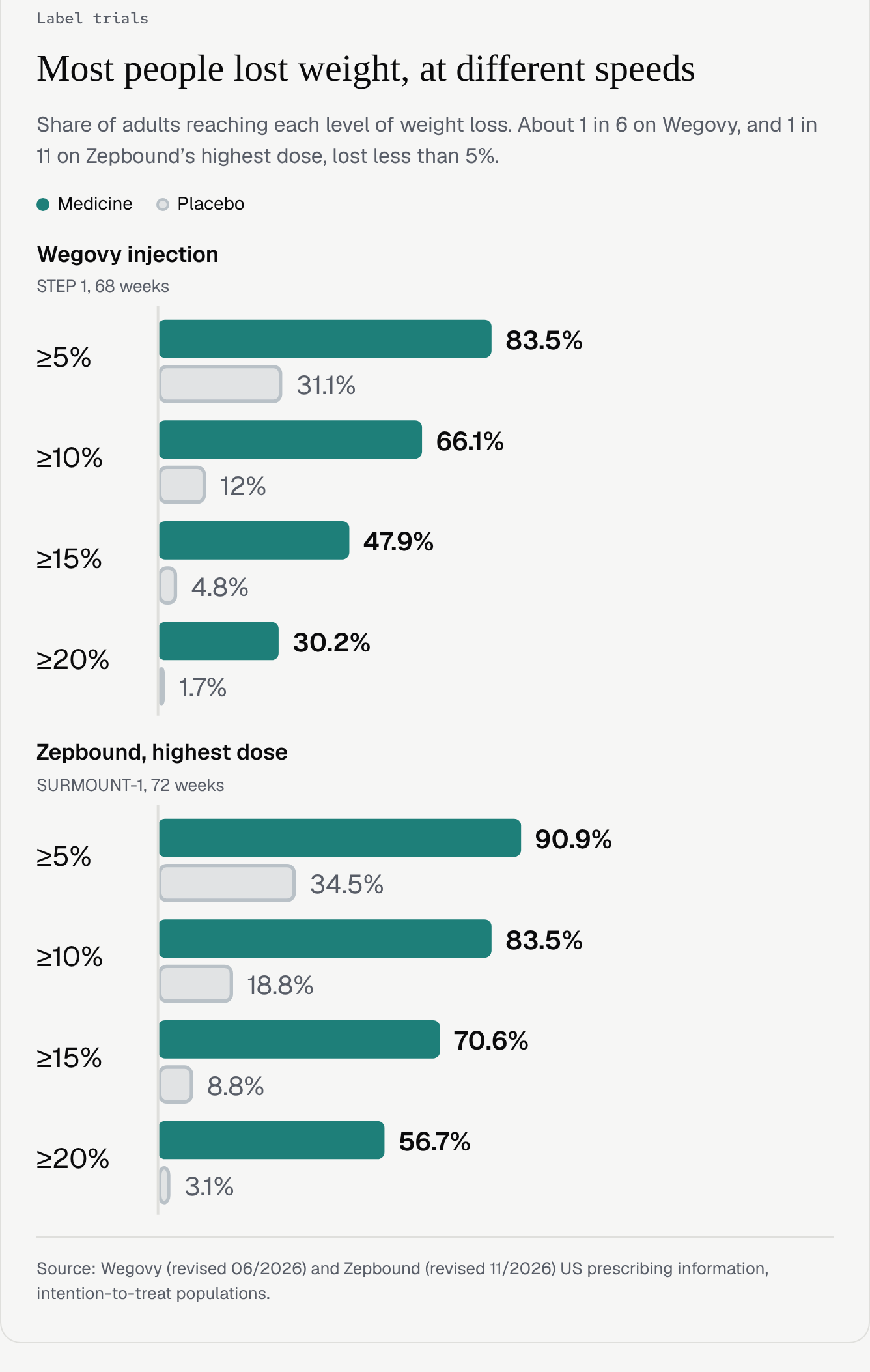
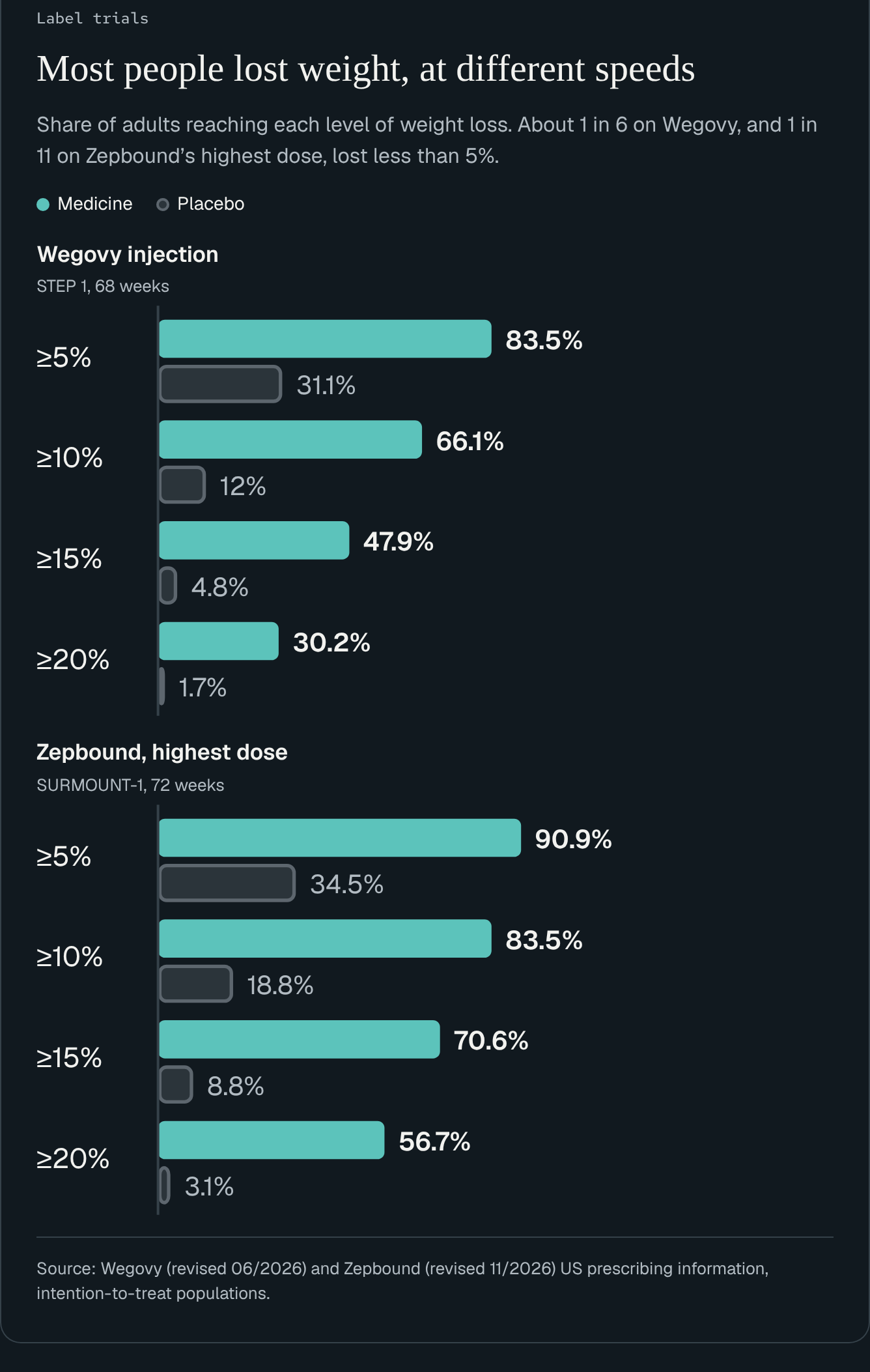
The labels report how many people reached each level of weight loss, not just the average. In Wegovy’s main weight trial (STEP 1, 68 weeks), 83.5% of adults on the injection lost at least 5% (31.1% on placebo), 66.1% at least 10% (12.0%), 47.9% at least 15% (4.8%) and 30.2% at least 20% (1.7%) (Wegovy prescribing information).

In Zepbound’s main weight trial (SURMOUNT-1, 72 weeks), on the highest dose 90.9% lost at least 5% (34.5% on placebo), 83.5% at least 10% (18.8%), 70.6% at least 15% (8.8%) and 56.7% at least 20% (3.1%) (Zepbound prescribing information).

Label trials
Most people lost weight, at different speeds
Share of adults reaching each level of weight loss. About 1 in 6 on Wegovy, and 1 in 11 on Zepbound’s highest dose, lost less than 5%.
MedicinePlacebo
Wegovy injectionSTEP 1, 68 weeks≥5%Wegovy injection: 83.5% lost 5% or more83.5%Placebo: 31.1% lost 5% or more31.1%≥10%Wegovy injection: 66.1% lost 10% or more66.1%Placebo: 12% lost 10% or more12%≥15%Wegovy injection: 47.9% lost 15% or more47.9%Placebo: 4.8% lost 15% or more4.8%≥20%Wegovy injection: 30.2% lost 20% or more30.2%Placebo: 1.7% lost 20% or more1.7%
Zepbound, highest doseSURMOUNT-1, 72 weeks≥5%Zepbound, highest dose: 90.9% lost 5% or more90.9%Placebo: 34.5% lost 5% or more34.5%≥10%Zepbound, highest dose: 83.5% lost 10% or more83.5%Placebo: 18.8% lost 10% or more18.8%≥15%Zepbound, highest dose: 70.6% lost 15% or more70.6%Placebo: 8.8% lost 15% or more8.8%≥20%Zepbound, highest dose: 56.7% lost 20% or more56.7%Placebo: 3.1% lost 20% or more3.1%
Source: Wegovy (revised 06/2026) and Zepbound (revised 11/2026) US prescribing information, intention-to-treat populations.
Most people lost at least 5%, and far fewer on placebo reached any level.
Share of adults reaching each level of weight loss in the label trials. Wegovy injection (STEP 1, 68 weeks): at least 5%, 83.5% versus 31.1% on placebo; at least 10%, 66.1% versus 12.0%; at least 15%, 47.9% versus 4.8%; at least 20%, 30.2% versus 1.7%. Zepbound highest dose (SURMOUNT-1, 72 weeks): 90.9% versus 34.5%; 83.5% versus 18.8%; 70.6% versus 8.8%; 56.7% versus 3.1%.The full-size image, for saving or sharingShare of adults reaching each level of weight loss in the label trials. Wegovy injection (STEP 1, 68 weeks): at least 5%, 83.5% versus 31.1% on placebo; at least 10%, 66.1% versus 12.0%; at least 15%, 47.9% versus 4.8%; at least 20%, 30.2% versus 1.7%. Zepbound highest dose (SURMOUNT-1, 72 weeks): 90.9% versus 34.5%; 83.5% versus 18.8%; 70.6% versus 8.8%; 56.7% versus 3.1%.The full-size image, for saving or sharing

Average weight change in the label trials

What the label trials averaged, as a yardstick (not a target):

Average weight change in the label trials
Trial (label)WhoLengthAverage weight change on the drugOn placeboLost at least 5%
Wegovy injection, Study 2 (STEP 1)Adults with obesity or overweight68 weeks−14.9%−2.4%83.5%
Wegovy injection, Study 3 (STEP 2)Adults with type 2 diabetes68 weeks−9.6%−3.4%67.4%
Zepbound, Study 1 (SURMOUNT-1), highest doseAdults with obesity or overweight72 weeks−20.9%−3.1%90.9%
Zepbound, Study 2 (SURMOUNT-2), highest doseAdults with type 2 diabetes72 weeks−14.7%−3.2%82.8%

Read the other way: a real share of people in both trials lost less than the average, and some lost less than 5%. The joint advisory notes that “individual responses can vary widely” and that real-world results run modestly below the trials (PMID 40673264). A slower result than a friend’s is not, on its own, evidence that the drug is not working.

Time: the dose rises gradually

Neither drug starts at its working dose. Both labels start low and raise the dose gradually, so the full effect is not expected in the first months (Wegovy prescribing information, Zepbound prescribing information). The Zepbound label says its first dose “is for treatment initiation and is not approved as a maintenance dosage”. SURMOUNT-1 also raised the dose gradually before its maintenance phase (PMID 35658024).

So the first months are largely spent getting to the dose the trials measured. Our how long does Ozempic take to work page covers the timeline week by week, and tirzepatide plateaus covers what the trials show when loss stalls.

Plateaus are part of the curve

Every weight-loss treatment levels off. The joint advisory describes GLP-1 weight reduction as “more rapid during the first 6 months” and slowing thereafter, “with relative plateauing at 18 months” (PMID 40673264). A flat month after months of loss is the expected shape, not a sign the drug stopped working.

What changes at a plateau is the question. Guidelines shift the focus to keeping muscle and keeping the weight off: protein, strength training and long-term use. See strength training on a GLP-1 and what happens when people stop.

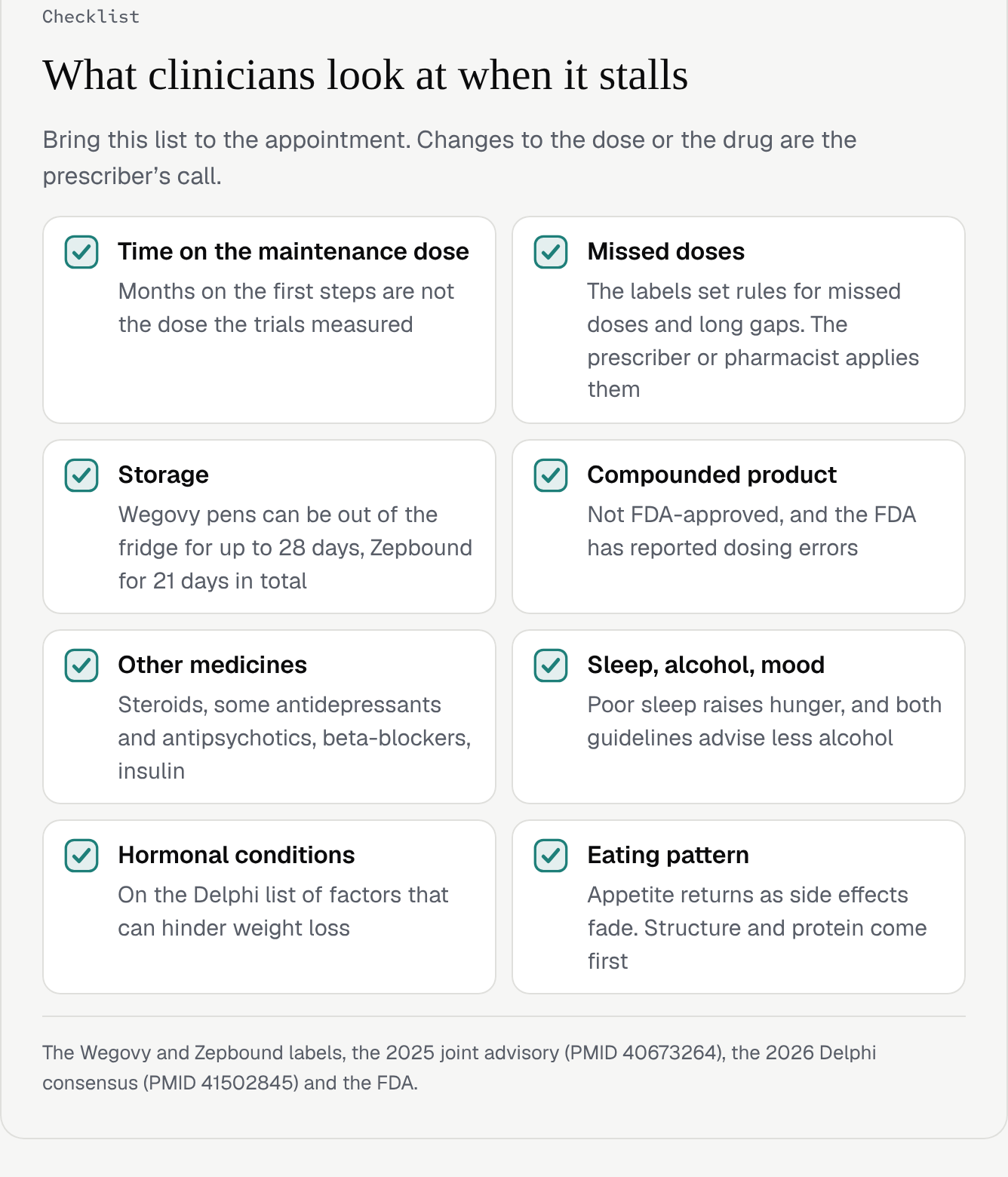
The checklist: what clinicians look at when it stalls

  • Time on the maintenance dose. Months on the starting steps are not the same as months on the dose the trials measured.
  • Missed doses. The labels set rules for missed doses and for long gaps. The prescriber or pharmacist applies them (Wegovy, Zepbound).
  • Storage. Wegovy pens belong in the refrigerator and can be kept at up to 30°C (86°F) for up to 28 days before the cap comes off. Zepbound pens and vials can be kept unrefrigerated, at up to 30°C (86°F), for a total of 21 days (Wegovy, Zepbound). A pen left somewhere hot, or past those limits, is a question for the pharmacist.
  • Compounded products. Compounded semaglutide and tirzepatide are not FDA-approved, and the FDA has reported dosing errors and quality concerns with them (FDA). If a compounded product is not doing what the brand trials did, the product itself is part of the question. See compounded GLP-1s: what the FDA says.
  • Other medicines. The 2026 Delphi consensus tells clinicians to identify factors that “may contribute to weight gain or hinder weight loss”, naming corticosteroids, antidepressants, antipsychotics, beta-blockers, insulin and hormonal abnormalities (PMID 41502845).
  • Sleep, alcohol and mood. Poor sleep is associated with insulin resistance, more hunger and weight gain (PMID 40673264). Both guideline documents advise minimizing alcohol (PMID 40673264, PMID 41502845), and depression is on the Delphi list.
  • Food that slips back. As side effects fade, appetite can return. The guidelines’ answer is structure: regular small meals, protein first, fewer ultra-processed foods (PMID 40673264). Our supplements on a GLP-1 guide covers the nutrition side.
Checklist
What clinicians look at when it stalls
Bring this list to the appointment. Changes to the dose or the drug are the prescriber’s call.
Time on the maintenance dose
Months on the first steps are not the dose the trials measured
Missed doses
The labels set rules for missed doses and long gaps. The prescriber or pharmacist applies them
Storage
Wegovy pens can be out of the fridge for up to 28 days, Zepbound for 21 days in total
Compounded product
Not FDA-approved, and the FDA has reported dosing errors
Other medicines
Steroids, some antidepressants and antipsychotics, beta-blockers, insulin
Sleep, alcohol, mood
Poor sleep raises hunger, and both guidelines advise less alcohol
Hormonal conditions
On the Delphi list of factors that can hinder weight loss
Eating pattern
Appetite returns as side effects fade. Structure and protein come first
The Wegovy and Zepbound labels, the 2025 joint advisory (PMID 40673264), the 2026 Delphi consensus (PMID 41502845) and the FDA.
What is worth checking before anyone decides the drug has stopped working.
Checklist of what clinicians look at when GLP-1 weight loss stalls: time on the maintenance dose, missed doses, storage, compounded product, other medicines, sleep, alcohol and mood, and eating patterns.The full-size image, for saving or sharingChecklist of what clinicians look at when GLP-1 weight loss stalls: time on the maintenance dose, missed doses, storage, compounded product, other medicines, sleep, alcohol and mood, and eating patterns.The full-size image, for saving or sharing

When to talk to the prescriber, and what they decide

The labels put the dose decision with the prescriber: Zepbound’s says to “consider treatment response and tolerability when selecting the maintenance dosage”, and Wegovy’s allows a lower maintenance dose when the usual one is not tolerated (Zepbound, Wegovy). Changing a dose, stretching doses or switching drugs on your own is not something the labels or the trials support.

Reasons worth an appointment include several months on the maintenance dose with little change, side effects that keep you from eating enough, a long gap in doses, a new medicine, or a question about whether a different drug would fit better. For that conversation, our switching guide covers what the labels and the SURMOUNT-5 head-to-head trial say.

When the real problem is access, not the drug

Sometimes the drug is working and the problem is keeping it: a prior authorization that lapsed, a coverage change, or a price that forced gaps between pens. Each has its own page:

Worked, then stopped: plateau or tolerance?

The trials do not show the drugs wearing off. They show weight leveling off while treatment continues, and coming back when it stops. In SURMOUNT-4, adults who had lost an average of 20.9% over a 36-week lead-in on tirzepatide were randomized to keep going or switch to placebo: over the next 52 weeks, those who stayed on it lost a further 5.5%, while those switched to placebo regained 14.0% (Aronne et al., JAMA 2024, PMID 38078870). Semaglutide showed the same pattern: in STEP 4, people who continued after a 20-week run-in lost a further 7.9% by week 68, while those switched to placebo regained 6.9% (PMID 33755728). In the STEP 1 extension, one year after stopping, participants had regained 11.6 of the 17.3 percentage points they had lost (PMID 35441470).

So a flat stretch after a year is usually the plateau the joint advisory describes (PMID 40673264), not resistance. The question for the prescriber at that point is about the goal: keeping the weight off, protecting muscle (lean mass is 25 to 35% of weight lost on these drugs, PMID 41877354), and whether the current dose is the right maintenance dose. See stopping a GLP-1 and weight regain.

Notes by drug: Ozempic, Wegovy, Mounjaro and Zepbound

People with type 2 diabetes lose less on average, on every brand. In the Wegovy label’s trials, adults with type 2 diabetes lost 9.6% on average, against 14.9% in the trial of adults without diabetes. In Zepbound’s, the figures on the highest dose were 14.7% and 20.9% (Wegovy, Zepbound; STEP 2, PMID 33667417; SURMOUNT-2, PMID 37385275). Ozempic and Mounjaro are the diabetes brands of the same molecules, approved for blood-sugar control rather than weight, so their trials report smaller weight changes (Ozempic, Mounjaro). A slower result on Ozempic or Mounjaro is partly the population, not the drug.

Ozempic and Wegovy (semaglutide). The Wegovy label has its own rule for a long gap between doses. The prescriber or pharmacist applies it before restarting.

Mounjaro and Zepbound (tirzepatide). SURMOUNT-1 raised the dose gradually at the start (PMID 35658024), so the early months understate what the maintenance dose does.

Questions

Why is Ozempic or Wegovy not working for me?

The usual reasons are time (the dose is raised gradually), a slower-than-average response, or a plateau. In Wegovy’s main trial, 83.5% of adults lost at least 5% of their weight over 68 weeks, but about 1 in 6 did not. Guidelines tell clinicians to also check missed doses, storage, other medicines that promote weight gain, sleep, alcohol and hormonal conditions.

Why is Zepbound or Mounjaro not working?

In Zepbound’s main trial (SURMOUNT-1), 90.9% of adults on the highest dose lost at least 5% over 72 weeks, and the dose was raised gradually at the start, so the first months show less than the full effect. The same checks apply as for semaglutide: time on the maintenance dose, missed doses, storage, other medicines and sleep.

How long before a GLP-1 starts working?

Appetite often changes within the first weeks, but both labels start low and raise the dose gradually, and the trials measured results at 68 to 72 weeks. The joint advisory describes loss as fastest in the first 6 months, then slowing.

Is a weight-loss plateau on a GLP-1 normal?

Yes. The 2025 joint advisory describes weight reduction on GLP-1s as more rapid in the first 6 months, slowing after, with relative plateauing at about 18 months (PMID 40673264).

Can storage make a GLP-1 pen stop working?

The labels set storage limits. Wegovy pens are kept refrigerated, or at up to 30°C (86°F) for up to 28 days before the cap is removed. Zepbound pens and vials are kept refrigerated, or unrefrigerated at up to 30°C (86°F) for a total of 21 days. A pen outside those limits is a question for the pharmacist.

What medicines can make GLP-1 weight loss harder?

The 2026 Delphi consensus lists corticosteroids, antidepressants, antipsychotics, beta-blockers and insulin, along with depression and hormonal abnormalities, as factors that may hinder weight loss (PMID 41502845). Any change to those medicines is for the prescriber.

Does Ozempic lose effectiveness over time?

The trials do not show the drug wearing off. They show weight leveling off while treatment continues. In SURMOUNT-4, people who kept taking tirzepatide after 36 weeks lost a further 5.5% over the next year, while those switched to placebo regained 14.0% (PMID 38078870). A plateau after a year matches the shape the 2025 joint advisory describes.

How long do plateaus last on tirzepatide?

There is no trial measure of plateau length. In the trials, weight fell fastest in the first six months and leveled off by about 18 months on treatment, then held while treatment continued (PMID 40673264, PMID 38078870).

Do some people not respond to Mounjaro or Zepbound?

Some respond less. In Zepbound’s main trial, about 1 in 11 people on the highest dose lost less than 5% over 72 weeks, and people with type 2 diabetes lost less on average (14.7% versus 20.9% without diabetes). Mounjaro is the diabetes brand of the same drug.

Why am I losing less on Ozempic than people on Wegovy?

Partly the population: in the Wegovy label, adults with type 2 diabetes lost 9.6% on average versus 14.9% without it. Ozempic is approved for type 2 diabetes, and its dosing differs from Wegovy’s. The prescriber can explain which applies.

Should I increase my dose if my GLP-1 stops working?

That is the prescriber’s decision. The Zepbound label tells prescribers to consider response and tolerability when choosing the maintenance dose. Neither label supports changing the dose on your own.

Medical disclaimer: This page summarizes drug labels, trials and guidelines for general education. It does not tell anyone to start, stop, change or switch a medicine. Talk to the clinician who prescribes your GLP-1 before changing anything.

Share this article

References

  1. 1WEGOVY (semaglutide) injection and tablets, US prescribing information, revised 06/2026Novo Nordisk, DailyMed 2026 · Source
  2. 2ZEPBOUND (tirzepatide) injection, US prescribing information, revised 11/2026Eli Lilly and Company, DailyMed 2026 · Source
  3. 3Once-Weekly Semaglutide in Adults with Overweight or Obesity (STEP 1)Wilding JPH, Batterham RL, Calanna S et al., New England Journal of Medicine 2021 · PMID: 33567185 · DOI: 10.1056/NEJMoa2032183
  4. 4Tirzepatide Once Weekly for the Treatment of Obesity (SURMOUNT-1)Jastreboff AM, Aronne LJ, Ahmad NN et al., New England Journal of Medicine 2022 · PMID: 35658024 · DOI: 10.1056/NEJMoa2206038
  5. 5Nutritional priorities to support GLP-1 therapy for obesity: A joint advisory from the American College of Lifestyle Medicine, the American Society for Nutrition, the Obesity Medicine Association, and the Obesity SocietyMozaffarian D, Agarwal M, Aggarwal M et al., Obesity Pillars 2025 · PMID: 40673264 · DOI: 10.1016/j.obpill.2025.100181
  6. 6Nutritional and lifestyle supportive care recommendations for management of obesity with GLP-1 based therapies: An expert consensus statement using a modified Delphi approachSievenpiper JL, Ard J, Blüher M et al., Obesity Pillars 2025 · PMID: 41502845 · DOI: 10.1016/j.obpill.2025.100228
  7. 7Continued Treatment With Tirzepatide for Maintenance of Weight Reduction in Adults With Obesity: The SURMOUNT-4 Randomized Clinical TrialAronne LJ, Sattar N, Horn DB et al., JAMA 2024 · PMID: 38078870
  8. 8Effect of Continued Weekly Subcutaneous Semaglutide vs Placebo on Weight Loss Maintenance in Adults With Overweight or Obesity (STEP 4)Rubino D, Abrahamsson N et al., JAMA 2021 · PMID: 33755728
  9. 9Weight regain and cardiometabolic effects after withdrawal of semaglutide: The STEP 1 trial extensionWilding JPH, Batterham RL et al., Diabetes, Obesity and Metabolism 2022 · PMID: 35441470
  10. 10Semaglutide 2.4 mg once a week in adults with overweight or obesity, and type 2 diabetes (STEP 2)Davies M, Færch L et al., The Lancet 2021 · PMID: 33667417
  11. 11Tirzepatide once weekly for the treatment of obesity in people with type 2 diabetes (SURMOUNT-2)Garvey WT, Frias JP et al., The Lancet 2023 · PMID: 37385275
  12. 12Lean Mass Changes With Incretin Therapy Versus Lifestyle Intervention: A Systematic Review and Meta-AnalysisEisa N, Barood O et al., Diabetes, Obesity and Metabolism 2026 · PMID: 41877354
  13. 13OZEMPIC (semaglutide) injection, US prescribing informationNovo Nordisk, DailyMed 2025 · Source
  14. 14MOUNJARO (tirzepatide) injection, US prescribing informationEli Lilly and Company, DailyMed 2026 · Source
  15. 15FDA’s Concerns with Unapproved GLP-1 Drugs Used for Weight LossUS Food and Drug Administration, FDA 2026 · Source

Educational only. Not medical advice.

We earn a commission on some links. That never changes a rank. How we make money: kymatahealth.com/affiliate-disclosure.