Search
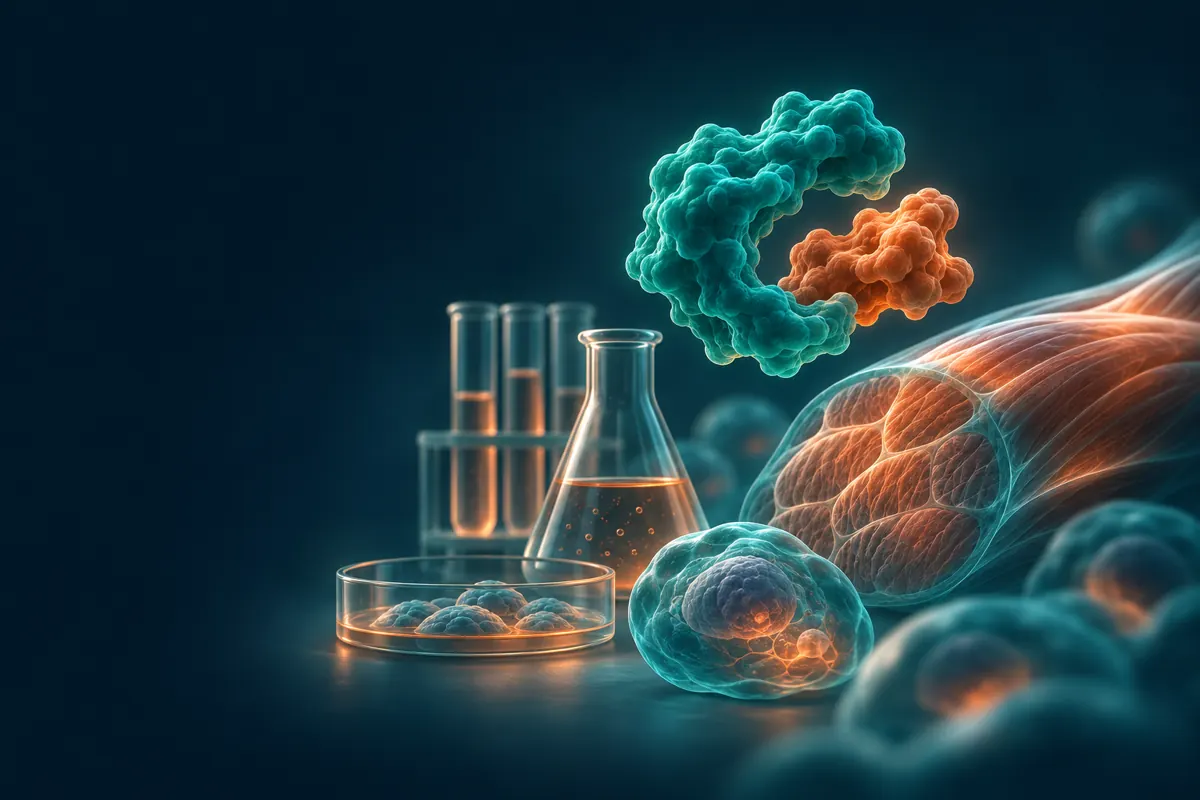
Conceptual cover for “Follistatin-344: What Myostatin Research Shows, and What It Has Not Shown in People”.

Follistatin-344: What Myostatin Research Shows, and What It Has Not Shown in People

By Kymata Health EditorialUpdated Published 11 min readNo paid links in this articleEducation, not medical advice

In brief

Follistatin blocks myostatin in animal studies. No human study of follistatin injections exists; the one human trial used gene therapy in six people (PMID 28279643). What is known, the fertility concern, and why we give no protocol.

Researched and written by Kymata Health EditorialHow we checkReport an error

Myostatin: Nature's Muscle Limiter

Myostatin (Growth Differentiation Factor 8, GDF-8) is a member of the TGF-β superfamily secreted primarily by skeletal muscle. It acts as a powerful negative regulator of muscle mass by suppressing satellite cell activation, myoblast differentiation, and muscle protein synthesis via Smad2/3 signaling at the ActRIIB receptor.

The biological purpose of myostatin is energy conservation: unlimited muscle growth would impose unsustainable metabolic demands. That is why myostatin blockade is studied for muscle-wasting diseases and age-related muscle loss; no myostatin blocker is FDA-approved.

Follistatin 344: Mechanism of Myostatin Neutralization

Follistatin is an endogenous glycoprotein that functions as a broad-spectrum TGF-β superfamily antagonist. It binds myostatin, activin A, and other TGF-β ligands in the extracellular space, preventing them from engaging their receptors. Follistatin 344 is the full-length, most bioactive isoform.

The binding is essentially irreversible under physiological conditions: follistatin sequesters myostatin in a high-affinity complex (Kd ~50 pM), neutralizing its signaling capacity. The follistatin-myostatin complex is then cleared via normal hepatic proteolytic pathways.

Beyond myostatin: follistatin also neutralizes activin A, a TGF-β family member that independently suppresses muscle growth and promotes inflammation.

Myostatin acts at the ActRIIB receptor through Smad2/3 to limit muscle; follistatin binds it in a high-affinity complex (Kd about 50 pM) and also neutralizes activin A. No human study of follistatin as a peptide injection exists; the one human trial used gene therapy in six people. Follistatin suppresses FSH, and no human study has measured fertility after injections
No human study of follistatin injections; the one human trial used gene therapy.

What Studies Used, and a Fertility Warning

No human study of follistatin given as a peptide injection has been published; the one human trial used a gene therapy (AAV1 FS344) in six people with inclusion body myositis (PMID 28279643).

Fertility: follistatin was first identified by its ability to suppress FSH release from pituitary cells (PMID 3120723), and an infusion lowered FSH in rats (PMID 9202226). FSH drives egg-follicle maturation and sperm production. No human study has measured fertility after follistatin injections.

Follistatin-344 binding myostatin and blocking Smad2/3 signaling at the ActRIIB receptor
Follistatin binds circulating myostatin and blocks Smad2/3 signaling. In animals this raised muscle mass; no human study of follistatin injections exists.

Follistatin vs. ACE-031 and Other Approaches

ACE-031 (a soluble ActRIIB-Fc fusion protein) was the pharmaceutical industry's approach to myostatin inhibition, but clinical trials were halted due to unexpected side effects including nosebleeds and gum bleeding from unintended anti-angiogenic effects of ActRIIB blockade.

Follistatin offers a more targeted approach: it neutralizes only free-floating TGF-β ligands without blocking the receptor itself.

Questions

Is Follistatin-344 a steroid?

No. Follistatin-344 is an autocrine glycoprotein, not an anabolic-androgenic steroid (AAS). It does not bind to androgen receptors. In animal studies it raised muscle mass by binding myostatin, a protein that limits muscle growth; no human study of follistatin injections has been published.

Is there a known safe length of use for Follistatin-344?

No study has established a safe course length, because no human study of follistatin peptide injections has been published. The one human trial was a gene therapy (PMID 28279643).

Will Follistatin weaken my tendons?

There is theoretical concern that strong myostatin inhibition lets muscle strength outpace tendon adaptation. No human study of follistatin injections has measured it.

Medical disclaimer: This article is for educational and informational purposes only. It does not constitute medical advice. Consult a qualified healthcare provider before using any peptide.

Share this article

Educational only. Not medical advice.

We earn a commission on some links. That never changes a rank. How we make money: kymatahealth.com/affiliate-disclosure.